
Hiring

Effective Strategies for Building a Diverse Talent Pool
You’ve seen the same resumes cross your desk. So have your clients. The roles keep changing, but the talent pipeline? Not so much.
You’re moving fast, trying to keep clients happy, fill urgent positions, and hit those KPIs. But deep down, there’s a nagging thought: are we really bringing the best to the table?
Because box-checking isn’t the same as building teams that last. Real growth comes from teams that think differently, challenge norms, and reflect the world around us.
And clients are catching on. In 2025, 83% of employers report active DEI measures in hiring, a big jump from just 67% in 2023.
A truly diverse talent pool doesn’t just fill roles. It elevates your agency's reputation. It opens new doors, wins new business, and keeps great clients coming back.
But finding that kind of talent takes more than scrolling job boards or tweaking keywords. It takes a real shift in how you source, assess, and support every candidate.
This isn’t just about meeting expectations, it’s about redefining them.
Let’s understand and explore the strategies that help you build a diverse talent pool that delivers real results.
TL;DR
- Stop recycling resumes: Same sourcing tactics yield the same candidates. It’s time to expand and diversify your pipeline.
- Build smarter, not just faster: Diversity fuels innovation, strengthens trust, and elevates long-term client relationships.
- Make inclusion visible: Your brand, job posts, and policies should reflect real DEI commitment, not just words.
- Trusted Partner: Consultadd gives you instant access to diverse, pre-screened talent with full compliance and post-placement support.
The Importance of Building a Diverse Talent Pool
Same job boards. Same candidates. Same results.
It’s not just frustrating, it’s limiting your growth.
When your talent pool is diverse, your candidate shortlist speaks for itself. It’s sharper, smarter, and built for today’s business challenges.
Diversity fuels innovation. But more importantly, it builds trust. And that trust is what keeps clients coming back.
What a Diverse Talent Pool Delivers
- Broader perspectives that spark innovation
- Stronger representation that builds trust
- Smarter hiring that sets you apart
This isn’t about checking quotas. It’s about reshaping how staffing firms define value and how clients recognize it.
Tips to Build a Diverse Talent Pool
If you’re pulling from the same pipelines, you’re going to get the same outcomes.
Building a diverse talent pool isn't a trend, it’s a strategic advantage. Here’s how you can make it happen:
1. Establish a Clear Diversity Recruitment Strategy
You can’t improve what you don’t define. A strong diversity recruitment strategy starts with clarity, not guesswork.
Here’s how to build a strategy that actually works:
Set DEI-Driven Recruitment Goals
- Tie hiring goals to your clients' broader DEI commitments.
- Focus on impact, not just quotas.
- Prioritize equity in sourcing, interviewing, and hiring.
Assign Clear Ownership
- Define who’s responsible: HR, recruiters, team leads, or leadership.
- Create accountability checkpoints for every step.
- Encourage collaboration, not confusion.
Track What Matters
- Use data to measure applicant diversity, hiring ratios, and drop-off points.
- Set quarterly benchmarks for improvement.
- Review progress with clients and adjust as needed.
2. Diversify Your Employer Brand
Sundar Pichai, CEO of Alphabet Inc., built one of the world’s most innovative companies by amplifying inclusion from the top down.
In his words:
“A diverse mix of voices leads to better discussions, decisions, and outcomes for everyone.”
This wasn’t just corporate speak. Early in his career, Pichai noticed that teams with global perspectives made faster, more accurate decisions. Different viewpoints challenged groupthink, and the result was better products and better workplaces.
His strategy? Make sure every team member sees themselves as valuable and visible in the company’s mission.
Today’s candidates want to see companies that truly embrace diversity, not just say it.
That means showcasing an authentic, inclusive identity that speaks to people from all walks of life.
Start by making your DEI values visible:
- Publicly share your commitment through your website and social channels.
- Make it clear that diversity is a core part of your culture and mission.
Bring your team’s stories to life:
Real voices resonate more than generic messages. Highlight employees from varied backgrounds through testimonials, videos, or blog features.
Review every touchpoint:
Your job ads, social media, and website should all reflect inclusivity, both in language and imagery. Simple changes like replacing jargon and using diverse visuals make a big difference.
By diversifying your employer brand, you not only attract a wider talent pool but build trust that lasts beyond the hire.
3. Expand Recruitment Channels
Relying on the same old sourcing methods limits your reach and results.
To build a truly diverse talent pool, casting a wider net is essential.
Mix mainstream and niche job boards:
- Use popular sites alongside diversity-focused platforms and affinity groups.
- This combination broadens access to untapped candidate pools.
Harness social media creatively:
Platforms like LinkedIn, Twitter, and Instagram allow you to connect with passive and active candidates.
By expanding recruitment channels thoughtfully, you increase your chances of presenting clients with fresh, qualified candidates.
Partnering with a trusted provider like Consultadd gives you instant access to a pre-screened, diverse candidate pool cutting down sourcing time and boosting placement speed.
4. Use Inclusive Language in Job Postings
The words you choose shape who feels welcome to apply. Inclusive language isn’t just about fairness, it’s a strategic move to unlock a wider, richer talent pool.
Small changes in wording can make a huge difference in who raises their hand for your roles.

Inclusive job postings aren’t a checkbox, they’re a powerful way to invite the best candidates and show clients you mean business.
5. Broaden Job Requirements and Qualifications
Hiring success starts with how you define the role. Tight requirements often limit your talent pool.
Reimagine “Must-Haves” vs. “Nice-to-Haves”
- Separate essential skills from desirable ones.
- Avoid discouraging great candidates who don’t tick every box.
- Focus on core competencies that truly impact job performance.
Value Transferable Skills and Potential
- Look beyond exact experience, skills can transfer across industries.
- Prioritize adaptability, learning mindset, and problem-solving abilities.
- Recognize that diverse backgrounds often bring fresh solutions.
6. Offer Remote and Flexible Working Opportunities
Work today isn’t tied to a desk and neither should your hiring be.
Why Flexibility Matters
Candidates expect options. Remote and flexible jobs widen your talent pool and show you understand modern work-life balance.
What Clients Gain
Offering flexible roles means happier, more loyal hires. It reduces churn and speeds up placements.
How to Make It Work
Make flexibility clear in job ads. Equip clients to manage remote teams confidently. Use tech for smooth remote interviews and onboarding.
Embracing remote work opens doors to untapped talent and unreachable talent.
We at Consultadd can help you tap into remote-ready, pre-screened talent fast, complete with compliance, relocation, and onboarding support to streamline flexible hiring.
7. Use Structured and Bias-Free Selection Tools
Gut feeling might help you pick lunch, but it shouldn't pick your next hire.
When hiring decisions are inconsistent or biased, even unintentionally, great candidates slip through the cracks. And that’s not just unfair, it’s expensive.
Here’s how you can avoid it:

And don’t forget the power of smart reference checks. The right questions can reveal a candidate’s potential, work ethic, and cultural fit beyond what a resume or interview can show.
Read: Smart Reference Questions to Make Better Hiring Decisions to upgrade how you validate talent before placement.
8. Establish and Promote Diversity & Inclusion Policies
Diversity doesn’t start with hiring, it starts with what you stand for.
When your agency lives its values out loud, candidates and clients notice. A clearly communicated D&I policy isn’t a checkbox, it’s a trust signal. It tells talent, “You belong here.”
Not Just a Statement—A Standard
Policies set the tone, but actions define the brand. Here’s how to build real credibility:
- Put it in writing. Create a concise, values-driven D&I policy accessible on your website and job posts.
- Make it visible. Promote the policy across platforms: clients, candidates, and internal teams should all see it.
- Review regularly. Update the language, commitments, and benchmarks every 6-12 months.
What to Include in Your D&I Policy
Use this quick-reference table to guide your framework:

More importantly, inclusive workplaces attract talent faster and retain them longer. Therefore, a well-established policy isn’t just about fairness, it’s a hiring advantage.
9. Develop Partnerships with Diverse Organizations
Diversity hiring shouldn’t feel like fishing in the same pond, it’s time to widen the waters.
To build a richer, more inclusive talent pipeline, partnerships are your secret superpower. They don’t just give you access, they give you trust, credibility, and reach into communities you may not yet understand deeply.
Why It Matters
Let’s get real:
Most traditional sourcing channels come with baked-in bias, unintended, but limiting all the same.
To find exceptional talent, you need to go where they already feel seen.
Targeted Partnerships That Deliver
Here are a few high-impact sources to consider:
- HBCUs & Minority-Serving Institutions
Tap into future-ready talent from historically underrepresented groups. - Veterans’ Groups
Access skilled, disciplined candidates with leadership experience. - Disability-Focused Nonprofits
Source highly capable professionals who bring problem-solving and resilience to the table. - Women-in-Tech Forums
Add strong, diverse voices in industries where representation is still catching up.

10. Establish Mentorship and Support Programs
A strong support system can be the difference between talent that stays and talent that thrives. Because placing talent is just the beginning, nurturing them is how you win loyalty. These simple, high-impact programs build trust, belonging, and long-term loyalty:
- Onboarding buddy
Helps new hires feel seen, supported, and less overwhelmed on day one. - Peer mentoring
Creates a safe space for open dialogue, questions, and real human connection. - Career guidance
Offers a clear path forward, because no one sticks around in a role without growth. - Mental health check-ins
Shows that people come first, because emotional safety fuels long-term performance.
Pro Tip: Match mentors and mentees based on goals, background, or lived experience, not just department.
11. Track Progress and Adjust Strategies
Success in staffing isn’t static, it’s a constant evolution. Tracking progress ensures you stay ahead and adapt fast.

If your hiring process feels like it’s hitting a plateau, it might be time to revisit foundational strategies. Read our blog: How to Hire the Best: The Recruiting Best Practices You Need for a fresh look at high-impact recruiting methods that work across industries.
Conclusion: Building and Sustaining Diversity in the Talent Pipeline
If you're feeling the pressure to deliver diverse talent fast and at scale, you’re not alone. Diversity isn’t just a “nice to have” anymore. It’s a business-critical expectation from clients, candidates, and even your own internal teams.
You now have a roadmap, from inclusive job descriptions to mentorship programs to tracking what truly works. These aren’t box-checking efforts. They’re long-term shifts that create trust, equity, and belonging in every placement.
That’s where Consultadd comes in as your strategic tech talent partner.
We’ve spent the last 14+ years helping staffing firms go beyond the brief and build talent pipelines that reflect today’s workforce and tomorrow’s promise.
Here’s how we do it:
- 5K+ staffing engagements delivered successfully across industries and job functions
- ~65 staffing partners served just in the last year
- Top 100 candidates vetted and submitted from thousands screened annually
- Strong MSAs signed with firms like Robert Half, Teksystems, and more
- Talent sourced in under 24 hours, because timing matters
- Ready-to-deploy candidates, trained, compliant, and motivated
- University partnerships to bring in fresh, diverse, and committed talent
- 1:1 account managers to ensure personalized, consistent, and proactive support
And we don’t stop at placements:
- Every candidate is thoroughly vetted for background, skills, and compliance
- Lower turnover risks thanks to our focus on long-term fit and career alignment
- Full compliance coverage, including documentation, visas, and onboarding paperwork
- Post-placement support that ensures your hires grow and stay
With Consultadd, you’re not gambling on talent, you’re building with confidence.
You’re not just meeting client expectations. You’re exceeding them.
Ready to build a talent pipeline that actually performs?
Let’s talk. We’re here to help you source smarter, faster, and more equitably.

Speed Up Hiring for Hard-to-Fill Tech Roles
You're chasing deadlines. Your client’s growing impatient. And the tech role that’s been open for three weeks? Still vacant.
Welcome to the daily pressure of trying to fill tech roles quickly, especially the hard ones like full-stack developers, AI engineers, or DevOps specialists.
Candidates vanish. Others don’t respond at all. And when someone finally looks promising, they’re off the market before your client has even opened the resume.
The longer the hiring clock ticks, the greater the risk to your client's delivery timelines, your team’s momentum, and ultimately your reputation.
Over 28% of recruiters say they struggle to spot potential in candidates who don’t check every skills box. That means great talent slips by simply because it doesn’t fit the mold.
In a hyper-competitive tech market, the cost of delay isn’t just time, it’s trust.
In this article, let’s look at why some roles are so tough to fill and how to speed up the hiring process without cutting corners.
TL;DR
- Act fast or lose talent: In-demand candidates vanish quickly. Speed is your competitive edge.
- Think beyond borders: Remote and global talent pools offer quality, contract-ready professionals faster.
- Use tools that do the heavy lifting: AI, ATS, and coding assessments streamline hiring and reduce delays.
- Partner smart: Consultadd delivers pre-vetted, compliant, ready-to-go candidates in under 24 hours.
Why Some Tech Roles Are Harder to Fill

Chasing top talent for certain tech roles can feel like running in circles, despite job orders and eager clients, some positions remain unfilled.
It's not just about compensation or timing; it's a deeper challenge that recruiters everywhere face.
1. Niche Skills, Limited Supply
There aren’t enough qualified professionals for fast-growing tech specializations.
2. The Talent Pool is Shrinking
Fewer candidates meet the exact mix of skills, availability, and contract flexibility.
3. The Competition is Ruthless
Top talent gets multiple offers and often disappears before you can act.
4. Overly Rigid Requirements
Strict job criteria eliminate strong candidates who could grow into the role.
Targeted Strategies to Speed Up Hiring for Hard-to-Fill Tech Roles

When your top candidate has three offers, every hour counts. Bill Gates once said,
“Companies that give extra flexibility to their employees will have the edge.”
This wasn’t just a prediction; it became reality.
At Microsoft, Gates saw how delays in decision-making caused teams to miss out on top talent.
When roles stay open, you don’t need more resumes; you need the right people, ready to go, right now.
Here’s how to shift from reactive recruiting to a streamlined, strategic approach that delivers fast results:
1. Tap into Global & Remote Talent Pools
Still relying on local databases to fill highly specialized tech roles? That’s like fishing in a puddle during a drought.
Remote and global hiring isn’t a backup plan; it’s your fast track to skilled, contract-ready talent.
For more on how to reduce hiring time without sacrificing quality, check out our blog on Efficient Hiring: Strategies to Reduce Time Without Sacrificing Quality. By using targeted sourcing and automation, you can streamline your hiring process while maintaining the highest standards.

Speed Advantages:
- Skip relocation, most are already remote-ready
- A larger talent pool leads to shorter hiring cycles.
- Global coverage ensures productivity around the clock.
Going global means filling tech roles quickly with talent you’d otherwise miss.
2. Focused Sourcing for Niche Skill Sets
Generic sourcing won’t fill niche roles, and deep down, everyone knows it.
When the job order says “Kubernetes on AWS with Python,” mass outreach becomes a waste of time. These roles demand precision, not volume.
Therefore, go where the talent actually is:
- GitHub
Spot contributors to real-world codebases. - Stack Overflow
Engage with developers in solving complex problems. - Niche Slack Groups
Access curated, invite-only communities. - LinkedIn Boolean Search
Pinpoint profiles with exact tech stacks. - Referral Loops
Ask great candidates to recommend peers.
Stay Ahead with Proactive Pipelines
- Build shortlists before the job order drops.
- Engage consistently, not just when hiring.
- Offer insights, not just opportunities, build trust first.
At Consultadd, we provide a steady pipeline of pre-vetted talent in Full-Stack, Cloud, and DevOps. Need something more specific? We can source any custom candidate in the field of tech, from AI to cybersecurity to emerging niche roles enabling fast placements without delays
3. Strengthen Employer Branding to Attract Top Talent
Even the most qualified candidates hesitate if a brand doesn’t feel right.
In a competitive market, a compelling employer brand becomes your silent recruiter; it speaks before you do.
Remember,
- Top tech professionals don’t just want a job—they want purpose.
- A strong employer image builds instant trust and attracts selective candidates.
- Branding helps you stand out in a sea of near-identical offers.

Pro Tip: Showcase values in job posts, highlight client successes, and share behind-the-scenes content to boost engagement.
4. Leverage Recruitment Agencies Specializing in Tech
When roles are urgent and hyper-specific, generalist sourcing just doesn’t cut it.
Specialized tech partners aren’t just helpful, they’re your shortcut to high-quality, ready-to-place candidates. Why?
- They speak tech fluently, no need to translate your job orders.
- Their networks are deep, not wide, more relevant talent, less noise.
- They've already screened for tech skills, availability, and contract preferences.
What You Gain by Partnering
- Pre-vetted talent pool
Skip initial screenings, get straight to interviews. - Faster submissions
Days, not weeks, to fill roles. - Expertise in niche technologies
No ramp-up time to understand requirements. - Less back-and-forth with clients
Better matches lead to fewer rejections.
Teaming up with tech-first partners doesn’t slow you down; it clears the path ahead.
Partnering with Consultadd speeds up hiring by providing ready-to-hire, vetted candidates. Thorough vetting ensures quality, reducing sourcing time and drop-offs, while strengthening client relationships with faster, more reliable hires.
5. Use AI and Automation to Streamline the Process
Every minute spent screening resumes or chasing down interview slots is a minute lost on actual hiring.
AI helps cut through the busywork, so you can fill roles faster, without burning out your team.

6. Recruitment Platforms & ATS Systems
Manual tracking slows everything, follow-ups get missed, resumes vanish, and good candidates slip away.
Modern platforms fix that. They turn chaos into clarity and delays into done deals.
Here’s how you can stay ahead:
- Candidate Tracking
Centralized dashboard with real-time status updates - Resume Management
Tag, filter, and search across all candidate profiles - Interview Scheduling
Automated scheduling with calendar integrations - Communication Logs
Every message in one place, fully searchable - Analytics & Reporting
Data-backed metrics: time-to-fill, source quality, etc.
7. Use Skill-Specific Coding Assessments
You’ve seen it before: resumes stacked with buzzwords.
But can they actually code?
The fastest way to find out?
Skip the guesswork. Use assessments that mirror the job, not just test theory.

Situation 1: The Resume Looks Perfect... Until the Technical Round
You shortlist a candidate after weeks of outreach, they pass the screening, but fail the real-world task test.
Solution: Use coding assessments early to catch red flags before the client does.
Situation 2: The Client Wants Proof, Not Promises
You’ve got a solid DevOps candidate, but the client wants proof: “Can they build pipelines under pressure?”
Solution: Send a task-based assessment link tailored to the role, now you’re sending proof, not just candidates.
Remember, you reduce interview stages and give your client decision-making clarity.
Situation 3: The Candidate Is Strong, But Not From a Big Brand
You believe in the candidate, but the client is skeptical, they didn’t work at FAANG, and their resume doesn’t shine.
Solution: Let their code speak for them. Skill-specific tasks cut through pedigree bias.
To ensure your interview process is both thorough and efficient, read our blog on How to Master the Tech Interview Screening Process. This blog dives into the best practices for conducting interviews that reveal true technical proficiency, so you can make the right hire faster.
8. Pre-Offer Agreement with Top Candidates
You’ve found “the one.”
But before you can say offer letter, your candidate is entertaining two more interviews, and your client is stuck in feedback limbo.
A simple pre-offer agreement can hold attention and avoid last-minute fallouts.

What to Include in the Agreement
- Role Overview
Confirms job scope, responsibilities, and title
- Compensation
Aligns on salary, contract rate, and benefits
- Tentative Start Date
Helps both parties plan next steps
- Candidate Consent
Indicates genuine interest and willingness to proceed
Remember, this lightweight agreement isn't legal; it’s strategic.
It’s the difference between losing talent and securing commitment while the final offer is in motion.
Consultadd simplifies visa and compliance complexities, handling work authorization and documentation to avoid delays. We also manage administrative tasks like 401(k) benefits and relocation, letting your team focus on closing deals. This support reduces drop-offs and keeps candidates engaged throughout.
Conclusion: Accelerating Success in Filling Hard-to-Fill Tech Roles
Speed is the key to winning top tech talent. In today’s market, even a 24-hour delay can cost you your best candidate.
By optimizing job descriptions, using AI tools, and leveraging remote-ready talent, you can reduce hiring friction and improve candidate quality.
But the right recruitment partner makes all the difference.
Here’s how Consultadd helps you fill roles faster with fewer risks:
- Trusted, day-one-ready candidates: All thoroughly vetted for skills, experience, and compliance.
- Reduced dropouts and ghosting: With better fitment, you get long-term commitment, not short-term fillers.
- Speed on demand: We can source and present talent in less than 24 hours.
- Real relationships, not ticket numbers: 1:1 account managers that know your business inside out.
- Post-hire support: We stay in the picture even after onboarding, so your hires actually stick.
- Compliance made easy: Visa, documentation, or regulatory stress? We handle it all.
- Backed by results: 5K+ staffing engagements, ~65 satisfied staffing firms last year alone.
- Strong networks: We’ve placed top 100 candidates, built ties with universities, and hold MSAs with firms like Teksystems and Robert Half.
- 14+ years of experience: We’ve grown with the industry and helped others grow, too.
Hiring doesn’t have to feel like chasing shadows. With the right partner, you can stop reacting and start hiring proactively.
Need tech talent fast without the chaos?
Let’s talk. Book a call with our team and get qualified candidates in as little as 24 hours.
FAQs
1. How to source for hard-to-fill roles?
Explore platforms like GitHub, Stack Overflow, and expert Slack channels. Use Boolean search and tailored outreach to engage skilled, hard-to-reach candidates. Referrals from trusted professionals also help surface hidden talent.
2. What sourcing strategies work best for specialized tech roles?
Focus on skill-first searches using coding communities, curated talent pools, and shortlists prepared before the role goes live. Target engagement over volume.
3. Why are some roles harder to fill than others?
These roles often demand rare skills, specific experience, or contract flexibility. Most qualified professionals aren’t actively job-hunting, making it harder to connect quickly.
4. How to reduce sourcing time for hard-to-find talent?
Build warm pipelines, use AI for resume filtering, and screen with skill assessments early. This speeds up decisions and improves fit.

Making the Right Hire: The Importance of Reference Checks
You’ve been chasing top talent for weeks. The interviews are done. The client’s eager.
But before you hit “send” on that offer letter, there’s one step that could save you from a painful misstep: the reference check.
Skipping this step can cost you trust, credibility, and future business.
A poor placement doesn’t just reflect on the candidate; it reflects on you. Your judgment, your process, your promise to deliver only the best.
Think of it this way: reference checks aren’t legally required, but according to SHRM, skipping them could leave you exposed to unnecessary risk. A candidate might seem perfect, but a quick call to a former supervisor can uncover red flags or, better yet, confirm you’ve got a star on your hands.
Done right, it’s not just about verification. It’s about validation of skills, work ethic, and reliability. It’s how you make every placement count.
What Are Reference Checks?
Reference checks are an essential part of the hiring process that help you ensure a candidate is as strong as they seem. By contacting past professional connections, you get a clearer picture of their performance beyond the resume.
This step helps you make a confident decision, ensuring the candidate’s skills, work style, and character align with what they’ve shared. It’s about choosing someone who will thrive with your team.
Common Practices and Mistakes
It’s easy to rush through the final steps when a placement is almost complete. But skipping or delaying a reference check isn’t just a shortcut. It's a risk that could undo all your hard work.
Here's how and where it often go wrong:

Effective Reference Check Strategies

Fast-moving hiring cycles leave little room for second chances. That’s why every step in your process must do more than just move fast; it must also protect the quality of your placements.
Here’s how you make this step work smarter, not slower.
1. Start Sooner Than You Think
- Don’t wait until the final round: Check references earlier in the process before you're emotionally invested in one candidate.
- Screen more than one: Run checks on your top two or three candidates. It gives you options and insight.
2. Think Beyond the List
- Ask for more than who’s on the resume: Encourage candidates to include peers or past collaborators, not just handpicked managers.
- Find senior-level context: Where possible, reach out to someone with higher visibility into the candidate’s impact.
- Respect boundaries: Avoid contacting a current employer too early, it can create unnecessary friction for the candidate.
Just as important as who you speak to is whether the candidate aligns with the values and culture of your client. Reference checks can be a window into that. Explore how identifying cultural alignment can enhance hiring in 'How Cultural Fit Transforms Hiring Outcomes'.
3. Be Smart With Your Conversations
- Avoid one-size-fits-all questions: Tailor questions to the role and responsibilities the candidate is stepping into.
- Focus on performance, not personality: Ask how they handled real challenges, deadlines, or team conflicts.
- Dig for growth indicators: Check if they took initiative, improved processes, or earned trust in past roles.
Mastering the reference check can dramatically reduce client pushback and candidate misfires. This builds trust with every submission.
Reference Check Laws
Compliance isn’t just red tape, it’s your safety net.
In an industry where one bad hire can cost a client relationship, staying compliant keeps your reputation intact and your business protected.
Let’s break down what you really need to know:
Federal Compliance: Fair Credit Reporting Act (FCRA)
If you’re using a third-party agency to run reference or background checks:
- You must get written permission from the candidate before starting.
- If you reject a candidate based on the results, follow the adverse action process (pre-adverse notice, a copy of the report, and final adverse notice).
Skipping this step can lead to legal trouble even if the intent was honest.
State Laws Reference Check Provisions
Rules vary by state. Some are stricter about what you can ask and share.
Here are a few standout examples:

Always check both where you are and where your candidate will work.
Who to Contact for References
A reference is only as strong as the person giving it.
Let’s break down who deserves a spot on your reference radar.
Prioritize Direct Work Relationships
1. Former supervisors
They offer performance insights, leadership feedback, and how the candidate handled pressure.
2. Peers and teammates
Colleagues reveal collaboration style, communication, and how well the candidate worked cross-functionally.
3. Subordinates (if applicable)
For leadership roles, team feedback reflects how the candidate supports and manages others.
Pro Tip: Ask for Context
When a reference is offered, always ask:
- How did you work with the candidate?
- What was your reporting relationship?
- How long did you work together?
This adds clarity and filters out irrelevant or shallow feedback.
Therefore, reaching out to the right voices ensures your decisions are backed by proof, not assumptions.
Identifying the right references can be challenging, especially when candidates provide limited or biased contacts. That’s why Consultadd steps in with deep networks and verified candidate histories, helping you reach authentic, relevant references from supervisors to peers who provide the clear insights you need to make confident hires.
Asking the Right Questions

A reference check isn’t a checkbox task, it’s a goldmine for real insights.
But only if you ask the right questions.
Here, it’s time to get curious, intentional, and a little strategic.
1. Ditch the Yes/No Format
Close-ended questions limit you. They make it easy for references to say, “Yep, great worker,” and move on. Instead, go open-ended to invite real stories and measurable insights.
Pro Tip: Look for specifics, not generalities. Always measurable results or impact.
2. Dig Deeper with Follow-Ups
A single question rarely tells the full story. Layer your follow-ups to uncover patterns:
- Start with: “How did they respond to pressure?”
- Then ask: “Can you share a specific situation that stands out?”
- Then go deeper: “What was the outcome, and how did others perceive their actions?”
Pro Tip: Look for responses that show genuine pauses, this usually means they’re reflecting honestly.
This helps you filter generic praise from meaningful insights.
Want to know if you’re asking the right question? Check out our blog: Smart Reference Questions to Make Better Hiring Decisions, it’s full of tips to help you ask insightful questions when hiring.
Handling Challenging Situations

Every reference check won’t be smooth sailing. But that’s no reason to skip it.
Tough calls often lead to the best hiring decisions if handled with care and precision.
1. When the Current Employer Is Off-Limits
Reaching out to a candidate’s current manager too early? Risky. It can cost them their job.
What to do instead:
- Request HR to hold off until a final offer is ready.
- Ask the candidate to provide alternate references from previous roles.
Pro Tip: Let trust build first. Then, revisit the manager reference post-offer if needed.
2. When a Reference Sounds Negative
You ask for insights. What do you get? A red flag. Now what?
Steps to follow:
- Don’t panic, one bad reference isn’t a final verdict.
- Cross-check by interviewing a second or third reference.
- Revisit interview notes. Look for consistency in behavior or skills.
- Consider an additional skill test or situational interview.
Pro Tip: Use red flags as signals, not stop signs. Investigate before deciding.
3. When References Are Vague or Uncooperative
Sometimes, references offer little more than “They were fine.”
Fix it fast:
- Use specific, open-ended questions.
- Politely push for real examples: “Can you recall a time they...?”
- If needed, move to an alternate contact from the same company.
Pro Tip: A good question often unlocks better insights than a familiar name.
A tricky reference situation isn’t a dealbreaker. It’s just another step to getting it right.
When facing complex hiring hurdles like managing compliance, visa issues, or high candidate drop-offs, Consultadd takes the burden off your shoulders. Our expert handling of work authorization, paperwork, and ongoing candidate engagement ensures your process stays smooth, so you can focus on making the best hire.
Conclusion: Thoughtful Reference Checks Make All the Difference
You know the impact of a bad hire: lost time, broken trust, and stalled momentum. Therefore, thoughtful reference checks provide a crucial layer of confidence, helping secure candidates who truly fit and perform.
By asking the right questions and reaching out to the right contacts, you gain insights that lead to faster, smarter hiring decisions and stronger client relationships.
We at Consultadd, transforms your hiring process by delivering:
- Safe, reliable hires: Every candidate thoroughly vetted for experience and compliance, ready to deliver from day one.
- Lower turnover risks: Professionals committed to long-term success, reducing last-minute drop-offs.
- Seamless compliance: Handling visas, documentation, and regulations so you don’t have to.
- Continuous support: Ensuring hires thrive long after placement
Backed by 14+ years in business and 5,000+ successful staffing engagements, We stand alongside 65+ satisfied staffing companies. Our partnerships include industry leaders like Robert Half and Teksystems.
With 1:1 account managers, access to the top 100 candidates in the past year, and the ability to source talent in under 24 hours, We equip you to deliver exceptional results every time.
Ready to elevate your hiring process? Connect with us today and discover how seamless talent acquisition can be.

Creating a Strategic Talent Management Framework for 2025
As hiring managers, you are tired of playing catch-up.
Timelines shrink. Client pressure builds. And you're left scrambling to find someone again.
The demands aren’t slowing down.
Clients want specialized talent, faster. Candidates seek flexibility, growth opportunities, and a sense of purpose.
And amid all this, your team is expected to deliver without burning out or dropping the ball.
This is why 2025 can’t be approached with the same old playbook.
You need a smarter, sharper approach to train and develop talent that aligns with business goals.
One that helps you attract the right people, retain them longer, and consistently meet client expectations.
It starts with a strategy built for how work really happens today.
In this article, we’ll define what strategic talent management means in 2025 and explain how to create an effective framework for it.
Defining Strategic Talent Management in 2025
When hiring feels like a sprint but success depends on long-term wins, strategy matters more than speed.
Strategic talent management is a business necessity.
What Does It Really Mean?
Strategic talent management isn’t just filling roles.
It’s about creating a system where talent drives the business forward.
- Every hire serves a purpose.
- Every development plan has a goal.
- Every process is tied to business impact.
It's a shift from reacting to planning, from transactional to intentional hiring.
Benefits of a Talent Management Strategy
A well-crafted strategy doesn’t just fill seats, it builds unstoppable teams.
- Improved Retention
Career development and recognition help retain high-value talent. - Higher Productivity
Aligned roles and clear goals boost focus and performance. - Greater Agility
Skilled teams adapt quickly to market and client demands. - Stronger Company Performance
Engaged employees drive measurable business outcomes. - Minimized Disruption
Planning ahead ensures critical roles are always covered.
Traditional Talent Management vs. Strategic Talent Management

The Core Objectives for 2025
- Attract Top Talent
Target skilled professionals who align with evolving client needs. - Train and Develop Continuously
Upskill and reskill talent to stay ahead of market shifts. - Retain with Purpose
Offer clear career paths and growth opportunities to keep top talent engaged. - Drive Innovation Through People
Encourage fresh ideas by building a culture of learning and progress. - Use Data to Guide Every Move
Make decisions based on real insights, not assumptions.
Strategic talent management is about doing more with intention, not just doing more.
10 Ways to Create a Strategic Talent Management Framework for 2025
A strong talent management framework doesn’t just fix broken processes; it builds a system that scales.
Here are ten simple, smart ways to do just that in 2025:
1. Aligning Talent Management with Business Strategy
The biggest hiring mistakes happen when talent decisions run on autopilot.

Jack Welch, the legendary former CEO of General Electric, understood this well.
He said,
“Talent management is the lifeblood of any organization.”
At General Electric, Welch ensured that every role was closely tied to strategic business outcomes.
Therefore, alignment matters more than ever since:
- Business goals shift fast, new markets, tech adoption, budget cuts.
- Talent plans that stay static quickly fall out of sync.
- When hiring lags behind strategy, growth stalls or worse, reverses.

Start with business goals, not job reqs.
Instead of asking “Who do you need?”, the better question is “What are you trying to achieve this quarter?”
That shift leads to smarter intake calls, better candidate profiles, and hires that deliver real impact.
Turn insights into hiring actions.
- If speed to market is critical, build a bench of deployable contractors.
- If innovation is the focus, find talent with startup energy and problem-solving muscle.
- If customer retention is the goal, prioritize client-facing roles with empathy and adaptability.
Remember, great hiring doesn’t just react, it predicts.
2. Leveraging Technology to Optimize Talent Management
2025 isn’t waiting.
Clients want talent faster. Candidates want better experiences. And hiring managers? They're tired of burnout.
The pressure to deliver is real, so tech needs to actually help, not overwhelm.
It’s not about the latest tool. It’s about choosing the right ones that cut noise, not add to it.
Here’s how to use it strategically:

And when the right tools are paired with the right partner, the impact multiplies. That’s where Consultadd comes in.
We bring relief where it matters most, with access to pre-vetted, ready-to-hire talent and full support for compliance, documentation, and payroll. Our team takes on the heavy administrative lift, so yours can focus on what they do best: building exceptional teams.
3. Fostering a Personalized Employee Experience
In a market flooded with job offers, personalization is your edge.
Today’s talent is drawn to roles that feel tailor-made for them.
And that starts the moment they say yes.
Start with a personalized welcome.
People remember how they were treated on Day One.
Instead of a generic onboarding doc, try:
- Intro emails from the team
- A role-specific roadmap based on their goals
- A mentor match that fits their style, not just their skillset
Build growth into the job, not just the title.
Employees want to evolve. When you ignore that, they quietly start browsing LinkedIn.
Create space for personalized growth by:
- Asking how each person defines “career success”
- Offering learning paths that match their pace
- Giving feedback in a way that fits their preferences
Let them work how they work best.
Some love morning stand-ups. Others thrive with quiet, deep work.
It’s not about being flexible. It’s about being intentional.
- Let them choose between remote, hybrid, or in-office (if possible)
- Learn their collaboration style: meetings, async updates, or both
- Adjust KPIs to reflect how they get results, not just what they deliver
Recognize them in a way that lands.
Public shoutouts don’t work for everyone. For some, they feel awkward.
Instead:
- Ask: “How would you like to be recognized?”
- Use tools that let peers give private kudos
- Celebrate milestones they actually care about
The takeaway? Personalization isn’t a perk. It’s a retention strategy.
4. Skills-Based Hiring and Development
In 2025, roles will evolve quickly. Titles mean less. Skills mean everything.
Hiring managers who shift focus from resumes to real capabilities win faster and build lasting impact.
Why Skills Over Titles?
Degrees can mislead. Titles can inflate. But skills tell the real story.
You are tired of poor fits. Clients crave hires who can do, not just say.
Candidates with verified skills ramp faster, adapt quicker, and outperform legacy hires.
What Skills-Based Hiring Looks Like?
Use these checkpoints to design a skills-first process:

Want to know which specific skills are in highest demand right now? Check out our blog on the Most Wanted Skills You Should Know in Skills-Based Hiring to ensure you're building a workforce that’s ready for 2025 and beyond.
Development Doesn’t Stop at Placement
A placement isn’t the finish line; it’s the launchpad.
- Offer upskilling paths tailored to each candidate's goals
- Track progress in client-facing dashboards
- Suggest stretch projects to build experience and loyalty
This ensures clients feel reassured seeing proof of skill, not buzzwords.
Candidates feel seen when developed for their unique strengths.
And you stand out as not just faster but smarter and stronger.
5. The Hybrid Work Revolution and Talent Management
Hybrid work isn’t a phase, it’s the future.
And it’s rewriting every rule of talent engagement.
- Assess for remote-readiness
Don’t just screen for skills. Screen for focus, self-drive, and digital communication. - Align with client flexibility levels
Make sure expectations are crystal clear, from start dates to working hours. - Standardize virtual onboarding
Support placements with templates, guides, and check-ins so no one feels lost on Day - Measure outcomes, not presence
Help clients shift from time-tracked models to output-based success metrics.
6. Aligning Talent Acquisition with Talent Management
When recruiting and development operate in silos, candidates slip through the cracks.
Bringing these functions together turns hires into long-term contributors.
Set Shared Objectives
Agree on business goals before sourcing begins.
Use that vision to shape job specs and development plans.
- Define success metrics together (e.g., time-to-impact, retention rates)
- Align candidate profiles with both immediate needs and future growth
Create Continuous Feedback Loops
Feedback shouldn’t end at offer acceptance.
Keep insights flowing between hiring managers and L&D teams.
- Share early performance data after 30 days
- Discuss skill gaps spotted in the first projects
- Adjust sourcing and training based on real outcomes
A well-optimized recruiting funnel is essential to ensure these insights actually translate into better hires. For a step-by-step breakdown, check out our blog on How to Master Your Recruiting Funnel Strategy, it’s your playbook for turning talent insights into hiring wins.
Co-Design Candidate Journeys
Hiring managers and coaches should build the onboarding path together.
That ensures each hire hits the ground running.
- Map key touchpoints: interview, offer, Day 1, Week 4
- Embed mentoring check-ins into the plan
- Include client-side and agency-side support steps
Bridging acquisition and management creates a seamless talent flow and strong, loyal teams.
7. Agile Performance Management
Annual reviews don’t work when projects move at the speed of client demands.
You need systems that keep pace with shifting expectations, talent dynamics, and business goals.
Agile performance management offers:
- Continuous Feedback Loops
Frequent check-ins keep talent aligned and clients informed. - Real-Time Goal Adjustment
Talent can pivot goals as business needs evolve. - OKRs Over KPIs
OKRs link individual performance to broader strategic outcomes—not just activity tracking. - Coaching vs. Critiquing
Agile focuses on guiding talent, not grading them after the fact.
Agile performance keeps your talent aligned, your clients happy, and your placements competitive.
8. Building a Future-Ready Leadership Pipeline
The leaders of tomorrow won’t come pre-packaged; they need to be discovered, developed, and trusted.

Strong pipelines protect against risk and fuel growth, especially in unpredictable markets.
Strategic frameworks only succeed when they drive real result,s and that's where Consultadd makes a measurable difference. Whether it’s managing visas, handling end-to-end onboarding, or keeping candidates engaged with clear career support, we turn hiring metrics into performance wins.
9. Metrics for Measuring the Effectiveness of Your Talent Strategy
Gut feeling doesn’t scale. Metrics do.
Tracking the right talent data gives you power, clarity, and control in a competitive market.
a. Time-to-Fill
Speed reflects efficiency. Long cycles hint at gaps in sourcing or decision-making.
- Track average days from job order to placement
- Compare performance by role, client, and hiring manager
- Shorten time without sacrificing quality
b. Quality of Hire
Fast hires are meaningless if they don’t perform.
- Measure 90-day retention and client satisfaction
- Include performance reviews from clients
- Ask: Would they rehire this candidate?
c. Submittal-to-Interview Ratio
Are your submissions actually what the client wants?
- Low ratios signal strong vetting and alignment
- High ratios may indicate poor matching or unclear requirements
- Ideal target: 2–3 submittals per interview
d. Offer Acceptance Rate
You found them. Did they say yes?

e. Talent Retention (Post-Placement)
Turnover hurts trust. Retention builds long-term relationships.
- Monitor how many hires stay beyond 6 months
- Ask clients why someone left
- Offer re-engagement support for churned candidates
f. Client Satisfaction
Retention isn’t just about candidates. Clients need to feel supported too.
- Run post-placement scorecards
- Track Net Promoter Scores (NPS) over time
- Collect qualitative insights from account managers
With every metric, you’re not just reporting, you’re refining.
10. The Critical Role of Soft Skills in Talent Management
Hard skills may win the offer. But soft skills win trust, loyalty, and long-term success.

Soft skills are no longer optional; they’re essential.
Talent Management vs. Talent Development
- Talent Management
A strategic process focused on attracting, hiring, and retaining top talent.
It includes everything from recruitment and onboarding to performance reviews and succession planning. - Talent Development
Focused on nurturing and growing your existing workforce.
It emphasizes upskilling, continuous learning, leadership training, and career pathing.
In short, talent management brings great people in and keeps them. Talent development helps them grow into future leaders.
Conclusion: Designing a Strategic Talent Management Framework for 2025
2025 is not forgiving to those who guess. Staffing success now demands precision, speed, and intent. Hiring managers can no longer rely on gut feel; strategy is everything.
We’ve explored how to align hiring with long-term value, adapt to hybrid demands, and measure what matters. From building leadership pipelines to prioritizing soft skills, every piece forms a stronger, smarter hiring strategy.
The future belongs to agencies that think beyond the placement. That builds systems, not shortcuts. They choose partners who make talent work harder for longer.
That’s where Consultadd delivers real change.
With 14+ years of experience and 5,000+ successful staffing engagements, we help staffing leaders build resilient, future-ready teams.
- Top 100 vetted candidates delivered in the last year
- ~65 satisfied staffing firms we’ve partnered with recently
- MSAs signed with powerhouses like Robert Half and Teksystems
- Talent sourced in <24 hours, often ready to deploy immediately
- Strong university ties to access fresh, skilled professionals
- 1:1 account managers who understand your unique hiring needs
We don’t just fill roles. We transform your hiring process:
- Safe, compliant hires with zero guesswork
- Lower turnover, thanks to long-term candidate commitment
- Seamless visa and regulatory support
- Ongoing post-placement assistance to ensure success
Consultadd is your strategic advantage.
Let’s build a talent strategy that doesn’t just meet 2025, but owns it.
Reach out today and see how we can power your next placement.

High Volume Hiring Strategies and Best Practices
It starts with one urgent email. Then another.
Soon, you’re racing to fill dozens of roles, each one high priority, all due yesterday.
High-volume recruitment isn’t just about hiring at scale. It’s about doing it without shortcuts.
No room for weak resumes, inconsistent vetting, or late-stage dropouts.
But when candidates ghost after the first call, or disappear, you’re left chasing shadows while clients grow impatient.
Your team feels the strain. Screening, scheduling, paperwork, it all adds up.
And in the rush to deliver, quality can slip through the cracks.
Still, expectations stay the same: find top-tier talent. Fast. Without error.
So, how do the best staffing leaders meet that demand and still sleep at night?
In this article, let’s explore the strategies that make high-volume recruitment not just manageable, but masterful.
Understanding the High-Volume Hiring Challenge

When demand surges, hiring becomes a race against time and burnout.
From sorting stacks of resumes to chasing no-show candidates, high-volume recruitment tests every system in place.
The challenge? Fill roles quickly without compromising quality, compliance, or candidate experience.
1. Speed vs. Accuracy
Filling roles fast often means compromising on quality or consistency.
2. Candidate Drop-Off is Real
Many candidates drop out or disappear mid-process.
3. Administrative Overload
Hours are lost to scheduling, compliance, and documentation that slow down hiring.
4. No Ready Pipeline
Without pre-vetted talent on standby, every new req starts from scratch.
Struggling with sourcing at scale? That’s where partners like Consultadd make the difference. With pre-screened, ready-to-deploy talent, we help you cut sourcing time, reduce unqualified applicants, and keep up with hiring surges without compromising on quality.
5. Constant Pressure to Deliver
Clients expect speed, precision, and zero excuses every single time.
High-volume hiring doesn’t have to be chaotic; the right systems turn it into a strength.
Mastering High-Volume Hiring: Top Strategies & Best Practices
In high-volume hiring, structure, tools and the right strategies help scale recruitment without sacrificing quality.
1. Leverage Technology and Automation
Manual hiring processes? They're holding you back. The right tech gives you speed, scale, and sanity.
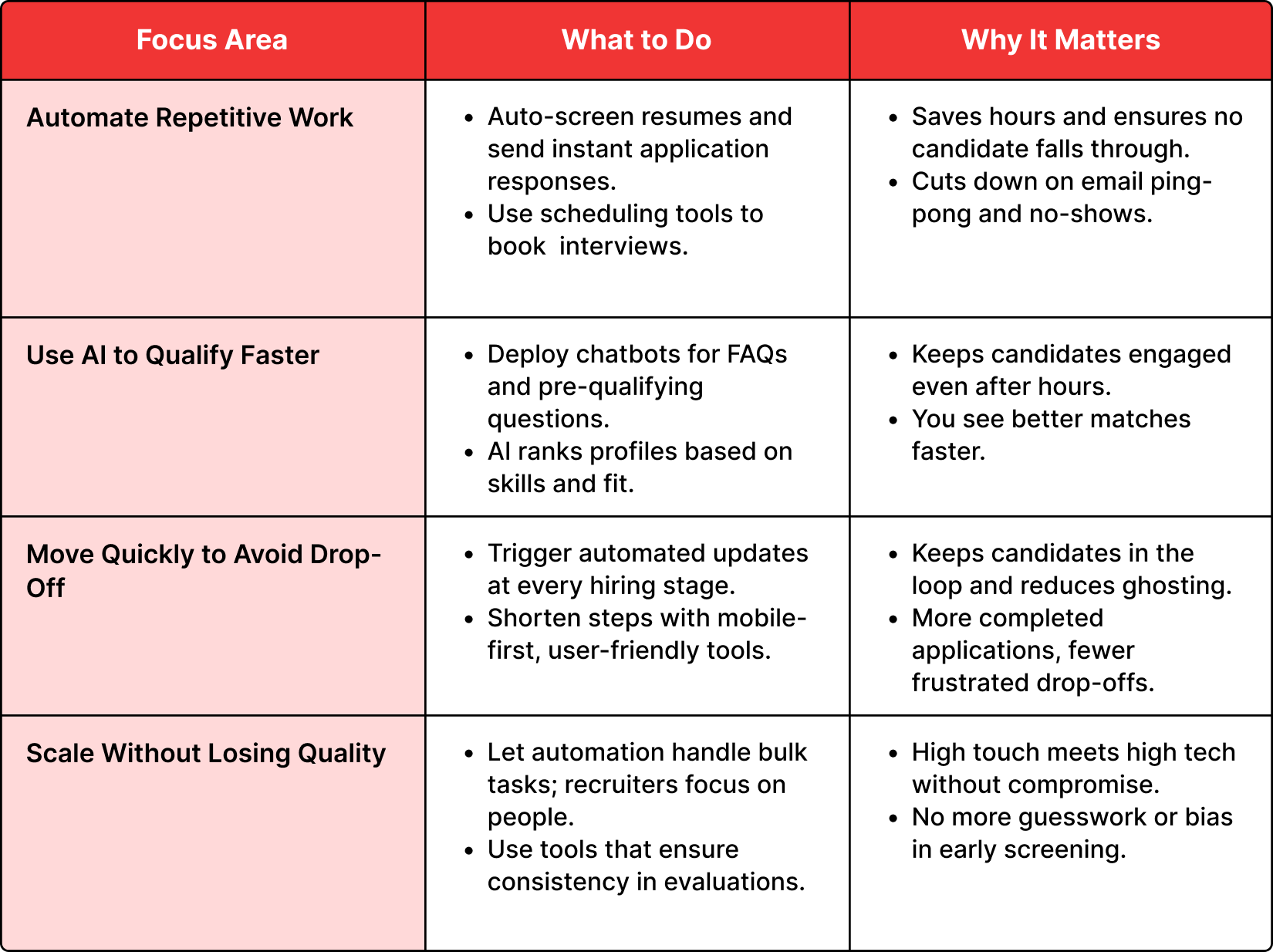
Manual hiring processes? They're holding you back. The right tech gives you speed, scale, and sanity.
Want to go deeper on speeding up hiring without cutting corners? Check out our blog on Efficient Hiring: Strategies to Reduce Time Without Sacrificing Quality.
2. Tap Into Existing Talent Databases
Your best candidates might already know you therefore reactivating your database is faster, cheaper, and more effective than starting fresh.
Reconnect With Dormant Talent
They interviewed before. Maybe even reached the final rounds. But the role didn’t work out.
- Send tailored check-ins based on their past stage or client.
- Highlight new, relevant roles, don’t just ask for updated resumes.
Why it works: Familiar candidates close faster and are less likely to ghost.
Organize and Maximize Your CRM
Most databases are messy. Fix that.
- Use tags like “Java | East Coast | Green Card” or “No-shows Q1.”
- Add notes after every touchpoint: interview feedback, rate changes and sync with your ATS.
Why it works: The clearer your system, the quicker your shortlist.
Build Your Own Talent Community
Don’t just store candidates, keep them engaged.
- Create WhatsApp groups, email newsletters, or invite-only Slack channels.
- Share exclusive openings, client success stories, or visa updates.
Why it works: Warm pipelines are easier to activate than cold ones.
3. Streamline and Standardize Hiring Processes
Consistency drives performance. Following a proven playbook boosts results, keeps candidates engaged, and builds client trust.
Here’s how you can do so:
- Create a Repeatable Intake Workflow
Use a standard form to collect role requirements, timelines, and expectations every time. - Build Role-Based Email and Message Templates
Automate responses for outreach, follow-ups, and feedback requests to reduce turnaround time. - Use Scorecards for Every Interview
Replace vague opinions with measurable feedback aligned across all interviewers. - Establish a Checklist and Candidate Milestones
Ensure every resume meets standards and track candidate progress with clear status markers: submitted, shortlisted, interviewed, offered. - Automate Candidate and Client Notifications
Keep both sides informed using triggers tied to key process events without manual check-ins. - Monitor SLA Compliance with Dashboards
Track recruiter response times, submittal quality, and client feedback speed in real-time.
When hiring runs smoothly, your team spends less time fixing issues and more time closing roles.
4. Optimize Job Marketing and Sourcing Channels
Your job postings are only as good as where and how they're seen. This strategy is about making every listing count by being intentional with platforms, messaging, and data.

Remember, visibility without strategy leads to volume without value.
Make every channel work harder for your hiring goals.
5. Make Applications Accessible and Mobile-Friendly
A candidate’s first touchpoint with a role shouldn’t feel like a chore.
If the application is slow, confusing, or clunky, especially on mobile, talent walks away.
Cut the Clutter
- Long forms are deal-breakers. Ask only what’s essential upfront.
- Add follow-up stages later for deeper insights.
Design for Mobile-First
- Over half of job seekers apply via phone. Your process must reflect that.
- Mobile-friendly means smart, smooth, and swipe-ready.
Enable One-Click Apply
- Let candidates apply using LinkedIn, resumes-on-file, or job board profiles.
- Remove unnecessary login walls and extra steps.
Let Progress Be Saved
- Allow candidates to pause and return to incomplete applications.
- A saved draft is better than a lost applicant.
When applications feel effortless, conversion rates spike and the best talent sticks around.
6. Prioritize Candidate Experience

Sir Richard Branson said,
“Train people well enough so they can leave, treat them well enough so they don't want to.”
This mindset helped him build and retain talent across 400+ companies.
In high-volume hiring, the difference between an accepted offer and a ghosted one often comes down to this:
Candidates remember how you made them feel, not just the outcome.

Candidate experience doesn’t end with an offer and neither does Consultadd’s support. We help keep candidates engaged throughout the process and beyond, offering guidance that reduces ghosting and boost retention.
7. Employ Data-Driven Decision Making
Decisions come fast. But are they smart or just reactive?
Let data be your edge. When used well, it doesn’t just track performance, it transforms it.
Where are you losing time?
Speed matters. Every day a role stays open, someone’s losing patience or revenue.
- Track time-to-fill by job and client to spot bottlenecks.
- Prioritize process tweaks, not guesswork.
Which sourcing channels actually work?
Posting everywhere is exhausting. ROI matters.
- Analyze sources for top performers and cut what doesn’t work.
- Double down on high-converting sources.
Why are candidates dropping off?
Good candidates don’t ghost without reason.
- Measure abandonment and no-shows. Too many steps? Delayed feedback?
- Remove friction before it costs a placement.
Are your hires sticking around?
No one wins if a placement quits in 60 days.
- Track short-term retention by recruiter, job function, and client.
- Use this to set clearer expectations or rethink fit during screening.
How many interviews to land one hire?
Too high a ratio? That’s a red flag.
- Aim for tighter screening and better candidate briefs.
- Fewer interviews, better matches, happier clients.
Pro Tip: Data reveals quiet excellence: track revenue, submittals, and fall-offs to shape winning strategies. Let data be your compass.
8. Foster Diversity and Inclusion
Inclusive hiring isn’t a checkbox. It’s a competitive edge.
Diverse teams drive better results and top candidates know it.

Expand Your Sourcing Network
- Partner with organizations that support underrepresented talent.
- Tap into alumni groups, DEI job boards, and niche communities.
Use Structured Interviews
- Same questions, same criteria, every time.
- Reduces bias and levels the field.
Track Diversity Metrics
- Know who’s applying, who’s interviewing, and who’s getting offers.
- Adjust strategies where gaps show up.
9. Communicate Your Company Culture and Employer Brand
Top candidates don’t just chase paychecks, they seek purpose, people, and a promise of belonging.
That’s where culture and branding becomes your superpower.
Why Should Culture Be Front and Center?
- Because people remember how a company feels more than what it does.
- Because authenticity builds trust, and trust attracts top-tier candidates.
Ways to Bring Your Employer Brand to Life
Share Real Voices
- Feature team testimonials, not templated slogans.
- Candidates connect with real stories, not buzzwords.
Post With Purpose
- Use LinkedIn, Instagram, and YouTube to share day-in-the-life content.
- Behind-the-scenes posts perform 3x better than generic job alerts.
Align Job Descriptions with Values
- Go beyond tasks. Show how the role contributes to bigger goals.
- Highlight impact, not just requirements.
Make the Brand Visible Across Touchpoints
- Career sites, email signatures, social profiles, ensure consistent brand messaging.
- Even your ATS confirmation emails matter.
10. Continuously Gather Feedback and Optimize
The best recruitment strategies don’t just run, they evolve.
Here’s how top staffing teams listen, learn, and grow.

The best recruitment strategies don’t just run, they evolve. See what changes make the biggest impact in our blog ‘Make Every Hire Count: Key Recruitment Improvements’.
Conclusion: Building an Efficient High-Volume Hiring Strategy
High-volume hiring doesn’t have to feel like a constant scramble.
With the right strategy, staffing agencies can achieve speed and consistency without cutting corners.
Streamlined systems, smarter sourcing, and data-driven decisions make high-volume hiring a competitive edge.
That’s where Consultadd comes in.
We don’t just help you fill roles, we help you fill them with confidence.
- Safe, reliable hires vetted for skill, compliance, and day-one performance
- Lower attrition rates with professionals committed to long-term success
- Seamless visa and documentation support to eliminate compliance stress
- Post-hire care that ensures each placement grows with your client needs
And it’s not just words, it’s backed by performance:
- 1:1 account managers supporting you throughout the hiring cycle
- 5,000+ successful staffing engagements and counting
- Talent sourced and ready to deploy in under 24 hours
- Top 100 candidates provided in the last year alone
- 65+ staffing companies supported last year
- MSAs signed with leaders like Robert Half and Teksystems
- 14+ years of expertise in recruitment
- Deep connections with universities for early access to top talent
Consultadd empowers staffing agencies to win faster, smarter, and with fewer compromises.
When the stakes are high, the process shouldn't be. Let’s raise the standard for high-volume hiring.
Ready to turn hiring chaos into consistency? Talk to an expert today!

What Time to Hire Industry Trends Look Like in 2025
In staffing, every minute counts. You’ve felt it firsthand, candidates ghosting as soon as they hear it’s a contract role, leaving you racing against the clock. Time to hire isn’t just a number; it directly impacts how well you deliver for your clients.
Across industries, hiring timelines vary and understanding these differences is key to staying ahead. Over the past four years, the average time to hire has steadily increased, making speed and strategy more critical than ever.
Knowing where each industry stands helps you sharpen your approach and reduce delays.
Let’s dive into the latest trends on average time to fill by industry and what they mean for your recruitment game.
Overview of Average Time to Hire by Industry
The clock is always ticking in recruitment. Knowing how long it takes to fill roles across industries is vital to winning the race.
- It impacts client satisfaction and business growth.
- Helps plan resources and improve recruitment speed.
- Shapes expectations for candidates and hiring managers.
Based on the April 2025 Job Openings and Labor Turnover Survey (JOLTS) report from the U.S. Bureau of Labor Statistics, only an estimate of the average time to hire by industry can be calculated.
This is the approximate breakdown using seasonally adjusted data:

Factors Affecting Time to Hire
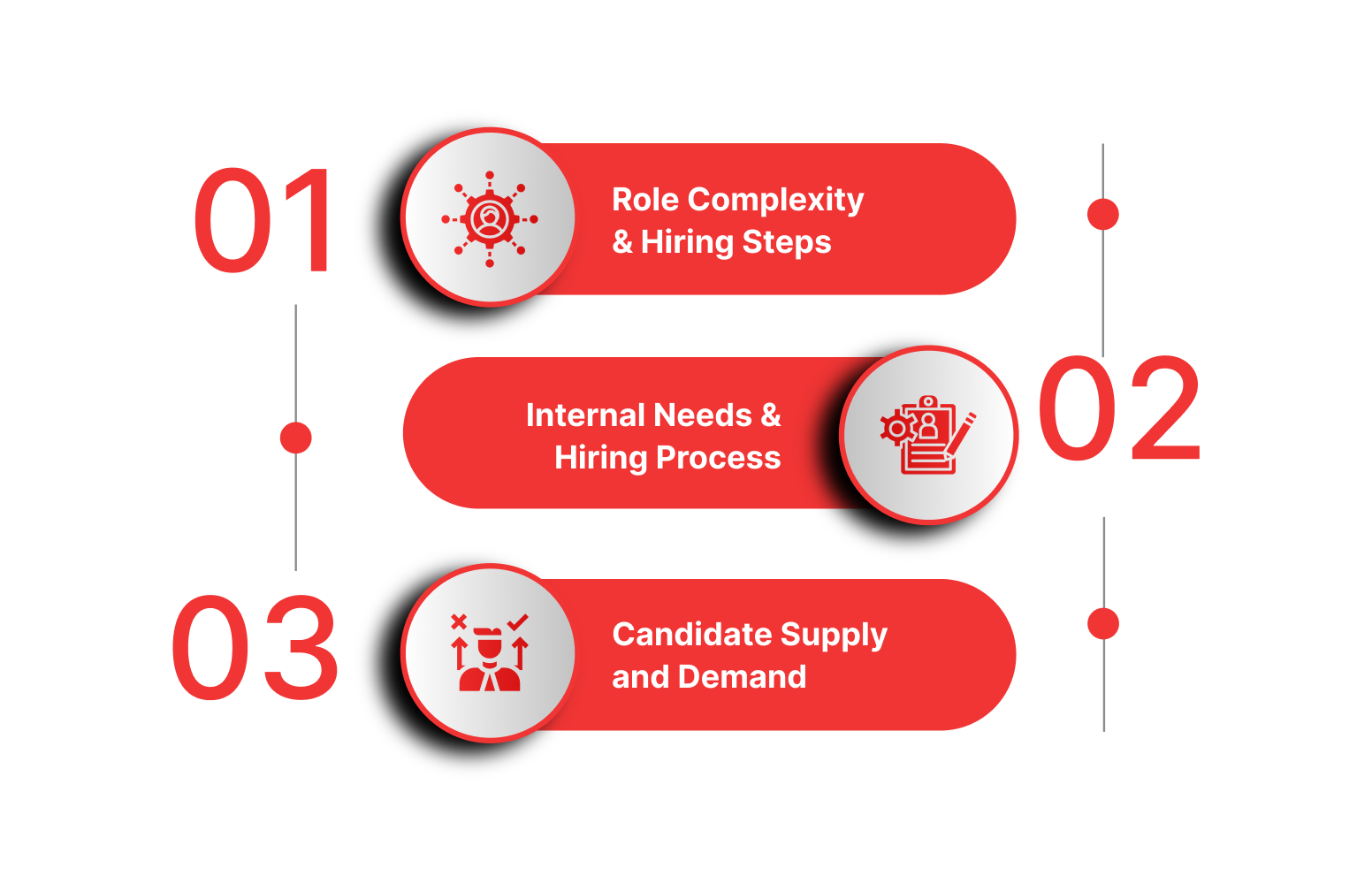
Hiring delays don’t just frustrate clients, they cost business. And often, the slowdown isn’t where you think it is.
Let’s break down the key factors that quietly shape every hiring timeline.
1. Role Complexity and Hiring Steps
Some positions are straightforward. Others? They come with layered interviews, approvals, and assessments.
- Specialized roles usually require more touchpoints.
- The more people involved, the longer it takes to make decisions.
Each added step increases the risk of delay.
2. Internal Requirements and Recruitment Process Design
Your process either moves things forward or holds everything up.
- Long application forms or slow interview scheduling can lose great candidates.
- Unclear role definitions delay screening and shortlisting.
Tight processes lead to faster fills. Loopholes invite lag.
3. Candidate Supply and Demand
Sometimes, the perfect candidate just isn’t actively looking.
- Highly skilled professionals have more options and take longer to commit.
- If you’re hiring in a crowded or competitive space, expect longer decision cycles.
The harder it is to find, the longer it takes to hire.
When you know what’s slowing you down, you can plan smarter and fill faster.
Struggling with slow hiring, unqualified candidates, or drop-offs? Consultadd tackles these challenges by delivering pre-screened, ready-to-hire talent and boosting retention through ongoing support. With us, you don’t just spot gaps, you close them fast.
Global Trends and Comparisons
Hiring timelines are stretching, and the pressure to secure top talent is intensifying.
In 2025, the global average time to hire has risen to 44 days. This increase reflects the growing complexity of hiring processes, with more detailed screenings and multiple interview stages becoming the norm.
Hiring speeds vary significantly across regions:
- United States: Average time to hire is approximately 36 days. Additionally, U.S. teams are 8% faster than the global median.
- Australia: Companies are hiring 16% faster than the global median, indicating more efficient processes.
- Germany: The median hiring time extends to 55 days, influenced by structured interviews and compliance requirements.
Remember, top candidates are available for only 10 days before getting hired, emphasizing the need for swift action.
As roles evolve and traditional qualifications become less predictive of success, skills-based hiring is transforming the recruitment landscape.
Learn how this approach is reshaping workforce planning in our blog: Redefining the Future Workforce with Skills-Based Hiring.
Strategies for Optimizing Hiring Times

Steve Jobs, co-founder of Apple Inc., once said,
“I consider the most important job of someone like myself is recruiting.”
For Jobs, finding the right people was not just a task, it was the foundation of innovation and success.
This focus on recruitment highlights a vital truth: speed is more than just a metric; it’s a promise to clients and candidates alike. Optimizing hiring times means staying ahead, building trust, and winning in a competitive market.
Here’s how you transform your hiring pace while keeping quality intact.

1. Map Out the Hiring Process
Clear steps make hiring faster and stronger. Here’s how to get started.
- Define Every Step: Clearly outline each stage from job planning to final offer. This keeps everyone aligned and expectations clear.
- Cut Delays: Identify and remove steps that slow down hiring. Streamlining accelerates decisions and keeps candidates engaged.
- Use Visual Tools: Create simple flowcharts or dashboards to monitor progress. Visual tracking helps catch bottlenecks early and stay organized.
2. Implement Efficient Candidate Screening
Screening is the first gate to hiring excellence. Getting it right speeds success.

Check out our blog on How to Hire the Best: The Recruiting Best Practices You Need to explore battle-tested recruiting strategies, from role definition to onboarding success. It’s the perfect companion to speed-focused tactics, helping you build a high-performance hiring engine.
3. Enhance Candidate Communication
Strong communication builds trust and keeps candidates engaged throughout the hiring journey.
Keep Candidates Informed
Send timely updates and honest feedback at every stage.
Candidates appreciate transparency, it shows respect and professionalism.
Use Automated Outreach
Leverage tools for consistent, personalized follow-ups without extra effort.
Automation helps maintain connection, even with large candidate pools.
Reduce Drop-Offs
Clear, frequent communication cuts confusion and frustration.
This speeds decisions and keeps your pipeline active.
Pro Tip: Schedule regular check-ins using automation to keep candidates feeling valued.
4. Foster Cross-Department Collaboration
When teams come together with clarity and purpose, hiring transforms from a challenge into a shared victory. The key lies in seamless collaboration across departments.
- Start with Alignment: Set clear roles and expectations at the outset. This prevents delays and misunderstandings.
- Maintain Consistent Communication: Regular updates and open dialogues keep everyone informed. This transparency builds trust and speeds decisions.
- Celebrate Shared Wins: Acknowledging progress motivates teams and creates a positive hiring culture.
Quick Tips:
- Schedule weekly check-ins with all stakeholders.
- Use simple tools to centralize candidate feedback.
- Encourage openness; no question or concern is too small.
Collaboration creates momentum that carries every hire across the finish line.
5. Embrace Contextual Adaptation
Success in recruiting doesn’t come from rigid routines, it thrives on adapting to the moment. Understanding what works best in each unique scenario is key to winning talent and trust.

Consultadd provides continuous support like career benefits, handling visa and compliance complexities to keep talent committed throughout the hiring journey.
This reduces drop-offs and builds trust, helping you maintain a healthy, ready-to-hire pipeline.
The Impact of Time to Hire on Recruitment Outcomes
Ever lost a top candidate because your process was too slow?
You're not alone. In today’s hyper-competitive market, every extra day counts. Candidates juggle offers and move fast. If you don’t keep pace, your dream hire might vanish.
What’s really at stake?
- Talent vanishes: Fast movers get snapped up before you even call back.
- Clients lose trust: Empty roles slow business, and clients start doubting your efficiency.
- Costs pile up: Longer vacancies mean lost productivity and extra recruiting hours.
But speeding up isn’t just about rushing...
It’s about being smart. Streamlined screening, clear milestones, and prompt communication build trust and keep quality high.
Pro Tip: Set a clear deadline for each hiring stage. Make every minute count without sacrificing thoroughness.
The payoff?
- Happier clients are impressed by your agility.
- Candidates who feel valued and engaged.
- Your agency’s reputation skyrockets as the go-to for fast, quality hires.
So, don’t just speed up, be strategic. Find that balance, and you’ll close roles faster.
Conclusion: Reducing Time-to-Hire and Embracing Future Trends
Hiring fast isn’t just a goal, it’s survival in a fiercely competitive market. Every delay risks losing top talent and client confidence. The pressure is real, but so is the opportunity to lead with speed and precision.
At Consultadd, we transform your hiring with trusted, thoroughly vetted candidates who start strong and stay committed. We handle complex compliance issues, visas, documentation, and regulations so you don’t have to. Plus, our continuous support ensures your hires thrive long after placement.
Here’s how we empower your staffing success:
- 14+ years of industry experience with 5,000+ successful staffing engagements
- 1:1 dedicated account managers offering personalized service
- Provided over 100 top candidates to clients in the last year
- Supported around 65 satisfied staffing companies recently
- Signed MSAs with industry leaders like Robert Half and Teksystems
- Ability to source and deploy talent within 24 hours
- Strong connections with leading universities to access fresh, skilled talent
When every second counts, Consultadd helps you reduce time-to-hire while maintaining uncompromising quality. Together, we’re shaping the future of talent acquisition fast, reliable, and ready for whatever’s next.
Ready to speed up your hiring and secure top talent? Connect with us today and transform your recruitment process.