
Introduction
If a U.S. company wants to hire someone who isn't a citizen or green card holder, it usually can't just add them to payroll. There's a legal step in between, and that step is visa sponsorship.
So what is a visa sponsorship, in plain terms? It's when a U.S. employer formally asks the government for permission to hire a foreign worker. The employer files the paperwork, pays most of the fees, and takes on legal responsibility for the role. The worker receives the visa. The employer does the sponsoring.
For recruiters and staffing teams, this matters more than people expect. Sponsorship shapes who you can place, how quickly, and at what cost. This guide walks through how it works, the main visa types, who pays for what, and where the process tends to slow down.
TL;DR
- Visa sponsorship is when a U.S. employer petitions the government to legally hire a foreign national, filing the paperwork and covering the required fees.
- It comes in two broad forms: temporary work visas (like the H-1B) and permanent green card sponsorship (through EB categories).
- The employer is the sponsor. Most sponsorship costs are the employer's legal responsibility and cannot be passed to the worker.
- The H-1B is the most common sponsored work visa, capped at 85,000 new visas a year and awarded through a lottery.
- Rules shifted in late 2025 and early 2026, including higher fees and a weighted lottery, so always confirm current requirements before filing.
What is a visa sponsorship?
A visa sponsorship is a commitment. When an employer sponsors someone, it tells U.S. immigration authorities that it has a real job, it will pay a fair wage, and it will follow the rules that protect American workers.
The government doesn't hand visas to individuals who apply on their own for most work categories. It requires a company to stand behind the hire. That company becomes the petitioner, and the worker becomes the beneficiary.
Here's the part that trips people up. A job ad that says "sponsorship available" is not the same as a company with a track record of approved cases. Some employers list it and rarely follow through. Others file dozens of petitions a year and know the process is cold.
The two parties in every sponsorship
Every sponsorship has a sponsor and a beneficiary.
The sponsor is the U.S. employer. It must have a valid tax ID, a genuine job offer, and the ability to pay the promised wage. According to U.S. Citizenship and Immigration Services, the employer files the petition on the worker's behalf.
The beneficiary is the foreign worker. They need to meet the job's requirements, usually a degree or equivalent experience tied directly to the role.
The main types of visa sponsorship
People often assume visa sponsorship means one thing. It doesn't. The two big buckets are temporary and permanent, and family sponsorship sits in a category of its own.
Temporary work visa sponsorship
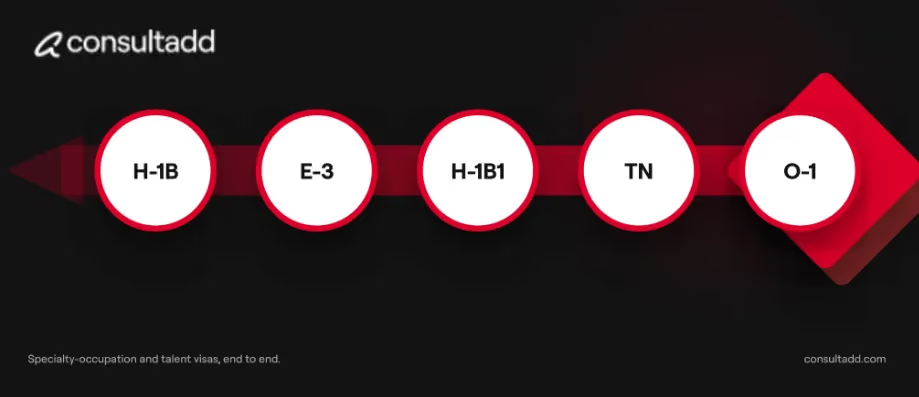
This covers nonimmigrant visas that let someone work in the U.S. for a set period. The H-1B is the best known, but E-3, H-1B1, TN, and O-1 all fall here. The worker can stay as long as they hold valid status and remain employed by the sponsor.
Permanent green card sponsorship
Here the employer sponsors the worker for lawful permanent residence. Most employment-based green cards run through the EB-2 and EB-3 categories, and both usually require a PERM labor certification first.
PERM stands for Program Electronic Review Management. Through it, the Department of Labor confirms there are no qualified, willing U.S. workers available for the job at the prevailing wage.
Once PERM is approved, the employer files Form I-140, and the worker moves toward a green card through adjustment of status or consular processing.
The EB-1 category and the EB-2 National Interest Waiver skip PERM entirely. Nurses and physical therapists fall under Schedule A, which also bypasses the labor market test.
Family-based sponsorship
A separate track lets U.S. citizens and permanent residents sponsor certain relatives. This isn't employer-driven and has nothing to do with a job offer, so it works differently from the work-based paths above.
Here's how temporary and permanent sponsorship compare.
Common U.S. work visas that require sponsorship
Not every work visa looks the same. Some are open to any nationality, and others are reserved for specific countries. The table below covers the main sponsored categories.
The H-1B dominates the conversation for a reason. It covers a wide range of fields, from software and engineering to finance and healthcare, and it allows dual intent, meaning a worker can pursue a green card while holding it.
How the H-1B sponsorship process works
The H-1B has more moving parts than most sponsored visas, so it's worth walking through. The U.S. Department of Labor and USCIS both play a role.
Most employers face an annual cap of 85,000 new H-1B visas: 65,000 under the regular cap and 20,000 reserved for workers with a U.S. master's degree or higher. Universities, nonprofits, and government research organizations are cap-exempt and can file year round.
Because demand runs far ahead of supply, USCIS uses a lottery. In one recent cap season, employers filed 483,927 registrations for about 127,600 spots, which put the odds of selection near 26 percent. Registration usually opens in March, and the earliest an approved worker can start is October 1.
The rough sequence looks like this:
- The employer registers the candidate during the March window.
- If selected, the employer files a Labor Condition Application with the Department of Labor, attesting to wages and working conditions.
- The employer files Form I-129 with USCIS, along with evidence the role is a specialty occupation and the worker qualifies.
- Once approved, the worker either starts on October 1 or applies for a visa stamp abroad.
Processing often takes a few months, though the full path through the Department of Labor and USCIS can stretch to six or seven months. Premium processing shortens the USCIS decision to about 15 days for an added fee.
Who pays for visa sponsorship?
This is where a lot of confusion, and sometimes a lot of trouble, comes from. The short version: the employer carries most of the cost, and certain fees legally cannot be shifted to the worker.
Under Department of Labor rules, the sponsoring employer must cover the costs tied to the Labor Condition Application. If a recruiter asks a candidate to reimburse required filing fees as a condition of sponsorship, that's a red flag worth pausing on.
Sponsorship isn't cheap. Registration fees, filing fees, legal support, and premium processing add up quickly, which is one reason smaller firms sometimes skip it while larger consulting and staffing companies file at scale.
What sponsorship means for staffing agencies
If you run placements, sponsorship isn't a side note. It decides how fast you can put a qualified person in front of a client and keep them there.
Staffing firms often work with candidates who already hold work authorization, such as H-1B holders looking to transfer or workers on OPT. That reduces friction, but it also means you need clean documentation and a clear employer-employee relationship on file. One missed amendment when a work location changes can put someone out of status.
There's also the question of the employment model. Many placements run through a Corp-to-Corp setup, where the candidate works through their own corporation rather than joining the client directly.
If you want the mechanics, ConsultAdd covers how corp-to-corp visa sponsorship works for H-1B roles in detail.
In practice, agencies that handle sponsorship well treat documentation as an ongoing habit, not a one-time task. That's the difference between a placement that sticks and one that unravels during an audit.
What changed in 2025 and 2026
The rules moved recently, and some of the changes are significant.
The H-1B registration fee jumped from $10 in FY 2025 to $215 in FY 2026, a big enough increase to change how some employers approach speculative filings.
A September 2025 presidential proclamation introduced a $100,000 fee for certain new H-1B petitions. The policy has faced legal challenges, and its status has shifted more than once. Because rules like this can change fast, confirm the current requirements on the USCIS site before you file.
A separate DHS rule that took effect in early 2026 reshaped the lottery itself. Instead of a flat random draw, USCIS moved to a weighted selection that favors higher-paid roles, starting with the FY 2027 cap season. For staffing firms, that puts wage level and role structure front and center well before registration opens.
Start Strong With Consultadd
With 15 years in business and 5,000+ successful staffing engagements, we don't just fill roles, we build reliability into your process. We've supported 65 staffing companies in the past year alone and maintain MSAs with industry leaders like Robert Half and TEKsystems.
Here's what working with Consultadd looks like:
- Talent sourced in under 24 hours
- Ready-to-deploy candidates, vetted for experience and compliance
- Lower turnover risk: we match long-term goals, not just short-term needs
- Seamless compliance: visa, documentation, onboarding? Handled.
- Dedicated 1:1 account managers for responsive, personalized support
- Top 100 candidate matches delivered in the past year
- Strong partnerships with universities to tap into fresh, committed talent
- Post-placement support so your investment grows beyond day one
For candidates, your next opportunity is more than just a job title, it's a chance to build skills, gain experience, and move your career forward. At Consultadd, we connect technology professionals with projects and employers that align with their goals, whether they're looking for contract, contract-to-hire, or long-term opportunities.
The tech job market moves fast, but the right guidance can make all the difference. Ready to take the next step in your career journey? Explore Opportunities >>
Key takeaways
- A visa sponsorship is a U.S. employer petitioning the government to legally hire a foreign worker, and the employer carries the filing and legal load.
- Sponsorship splits into temporary work visas and permanent green card paths, with PERM required for most EB-2 and EB-3 cases.
- The employer pays the required fees. If someone asks the worker to cover mandatory costs, treat that as a warning sign.
- The H-1B is the most common sponsored visa, capped at 85,000 new visas a year and decided by lottery.
- Fees and lottery rules changed in 2025 and 2026, so verify current requirements with USCIS before every filing.
FAQs
What does visa sponsorship mean for an employer?
It means the company files an immigration petition for a foreign worker and takes legal responsibility for the role. The employer must offer a real job, pay at least the prevailing wage, and follow labor rules meant to protect U.S. workers. It also covers the required government fees.
Does visa sponsorship cost the employee money?
The core filing costs are the employer's responsibility and cannot be passed to the worker under Department of Labor rules. Workers may choose to pay for optional extras like premium processing in some cases. If an employer asks you to reimburse mandatory fees, ask questions before agreeing.
How long does visa sponsorship take?
A temporary work visa like the H-1B can take a few months, though the full path through the Department of Labor and USCIS may run six to seven months. Green card sponsorship through PERM usually takes two to three years, and longer for applicants from countries with heavy backlogs.
Can a small company sponsor a visa?
Yes. Any U.S. employer with a valid tax ID and a genuine job offer can sponsor a worker, from a startup to a large firm. The company does need to show it can pay the offered wage and supervise the role. Smaller employers sometimes skip sponsorship because the fees add up.
Is visa sponsorship the same as a green card?
No. Visa sponsorship is the broader act of an employer petitioning for a worker. A green card is one possible outcome through permanent, employment-based sponsorship. Many people start on a temporary visa like the H-1B and later pursue a green card through their employer.
Do staffing agencies sponsor visas?
Many do, often placing workers who already hold valid authorization such as H-1B or OPT. Agencies commonly use W2 or Corp-to-Corp models, which affect who holds the sponsorship and manages compliance.
.png)


.webp)