
Hiring & Recruitment

How to Master the Tech Interview Screening Process
Introduction
Your inbox is full, but not with the right candidates.
Some don’t reply. Others disappear the moment they hear it’s a contract role. Meanwhile, the client is waiting, and the pressure is on.
With this kind of pressure, here’s the part many agencies overlook: a great technical screening and an important filter.
Done right, it helps you move faster, avoid mismatches, and build trust on all sides. Done poorly, and you could lose a great candidate before the real conversation begins. 83% of candidates say a bad interview experience can change how they feel about a role they previously liked.
Let’s explore what technical screening involves and how it sets the tone for everything that follows.
TL;DR
- Technical screening helps recruiters validate real-world skills before interviews, reducing hiring mistakes and improving placement quality.
- Role-specific assessments, structured evaluations, and practical coding exercises identify qualified candidates more efficiently.
- Combining automation with human evaluation creates a faster, fairer, and more engaging screening process.
- A positive candidate experience during technical screening improves completion rates and strengthens employer branding.
- Consultadd accelerates hiring by providing pre-screened, technically validated, and compliance-ready professionals.
Importance of Technical Screening
Bad hires drain time, strain relationships, and stall deals. And in tech roles, the cost multiplies. Technical screening is your strongest line of defense and your smartest strategy for staying ahead.
1. Sharper Hiring Decisions
- Go beyond resumes. Assess actual skills, not just keyword-matching.
- Screen for what matters: role-specific abilities, logic, and execution.
2. Less Time Wasted on Unqualified Candidates
- No more endless interviews with candidates who can’t code.
- Running quick tests early helps prevent bottlenecks later.
3. Bias-Free Shortlisting
- Structured assessments reduce unconscious bias.
- Talent rises purely on merit, not background or branding.
Remember, this builds client trust and improves diversity placements.
4. Better Brand Reputation
- A clean, efficient screening process speaks volumes about your professionalism.
- It builds loyalty with clients and candidates.
When you get screening right, you don’t just fill roles, you elevate the entire hiring game.
Let’s learn about how to prepare for a successful technical screening.
Best Practices for Preparing a Successful Technical Screening
When speed meets scrutiny, preparation can’t be left to chance.
One wrong hire dents client trust. One great one wins long-term business.
That’s why successful staffing agencies build technical screening processes that are predictable, scalable, and tailored to each role.
Here’s how to prepare for success without wasting a minute.
1. Define Role-Specific Criteria Early
No two tech roles are the same.
An Android dev needs Kotlin fluency. A data engineer? SQL, Python, and cloud platform know-how.
Do this:
- Build skill matrices for each tech stack.
- Align client expectations to hard skills and coding depth.
- Include soft skills, especially problem-solving and communication.
Why it matters: Clear benchmarks reduce back-and-forth with clients and cut unqualified profiles early.
2. Use Structured, Validated Assessments
Guesswork doesn’t scale. Standardized tests do.
Assessments must measure the right skills and be fair, fast, and repeatable.
Best practices:

Pro tip: Use platforms like CodeSignal or CoderPad. But don’t rely on them alone; layer in human review.
3. Customize by Role and Seniority
A junior frontend dev doesn’t need a systems design round.
A lead architect can skip FizzBuzz.
Make it smart:
- Match complexity to experience level.
- Add pair programming or architecture rounds for senior roles.
- Skip boilerplate tests if a portfolio speaks volumes.
Outcome: Better candidate engagement. Higher completion rates. Stronger shortlists.
4. Automate, But With a Human Touch
Time is your most expensive resource.
Automation speeds up screening. But humans bring context, clarity, and care.
Use tech to:
- Schedule assessments and reminders.
- Score code challenges automatically.
- Track performance across multiple candidates.
But always:
- Personalize instructions.
- Follow up with feedback.
- Humanize the process, especially in final rounds.
When you prepare for screening the right way, everything gets easier: fewer rejections, happier clients, and stronger submittals.
By partnering with Consultadd, you gain access to a pipeline of qualified candidates who are already pre-screened for skills, experience, and compliance, reducing the risk of mismatches and speeding up the hiring process.
Conducting Effective Technical Screens

There’s a difference between filling a role and making a client’s business better. The secret? It starts long before onboarding. It begins with how well you screen your tech talent. This step isn’t just a box to tick; it’s a turning point in your hiring success story.
Before we dive into the how-tos, let’s take a cue from an unexpected guide:

John Ruskin, the polymath who wore many hats: writer, art critic, historian, philanthropist.
Ruskin wasn’t screening Java developers, of course. But he understood what many hiring teams tend to miss:
“Quality is never an accident; it is always the result of high intention, sincere effort, intelligent direction and skillful execution.”
Those words hit home, especially when you're building technical screens that separate passable from powerful. The same principles Ruskin lived by intention, effort, direction, and execution are what shape great screening. Let’s turn those principles into actions that will raise the quality of your candidate pool every single time.
1. Start with Pre-Interview Tests
Quick tests help identify candidates with the right baseline.
These tests should measure core competencies that is code fluency, logic, and applied thinking.
Examples of tools:
- CodeSignal: Custom challenges with real-world relevance
- Codility: Hands-on tasks, timed assessments
- HackerRank: Ideal for large volumes
Why this works:

2. Use Structured Assessments
No more freestyle interviews that vary by interviewer.
Structure brings clarity and confidence to both sides of the table.
Best practices:
- Build a question bank for common roles
- Use rubrics for scoring
- Involve multiple evaluators for balance
3. Run Live Interviews That Reflect Real Work
Live screens shouldn’t feel like exams; they should mirror the job.
What to include:
- Pair programming sessions
- Debugging tasks in shared environments
- Real product challenges
Pro Tip: Give context. Let candidates ask questions. Observe how they think, not just what they code.
4. Mix Problem-Solving With Communication
A strong developer doesn’t just solve problems; they also explain them.
Great technical screens test both.
Try this:
- Ask candidates to walk through their code
- Prompt them to explain trade-offs
- Discuss how they’d refactor or scale
Why it matters: Clients want candidates who can collaborate, not just code in isolation.
The goal isn’t to trip up candidates; it’s to spot the ones who will thrive in the job.
Key Questions for Technical Screening
Finding the right candidate starts with asking the right questions.
You need insights that cut through the noise and spotlight true potential.
Here’s a streamlined approach to craft your technical screens with confidence.

This table gives you everything you need to conduct purposeful, high-impact technical screens that build confidence and trust.
Once your technical screening identifies top candidates, the final piece of confidence often comes from references. But not all reference checks are created equal. Read: Smart Reference Questions to Make Better Hiring Decisions and validate a candidate’s fit beyond the resume.
Challenges and Solutions in Technical Screening
Technical screening can feel like walking a tightrope, balancing speed, accuracy, and the candidate experience.
Common Challenges
- Quality vs. Speed
Pressure to fill roles quickly can compromise thorough screening, potentially leading to poor hires. - Assessing Soft Skills
Technical tests rarely reveal communication, teamwork, or culture fit, leaving gaps. - Candidate Drop-Offs
Complex or lengthy tests frustrate candidates, reducing engagement and shrinking talent pools. - Bias and Subjectivity
Unstructured screens allow unconscious biases to influence decisions, impacting diversity. - Technology Limitations
Not all screening tools offer flexibility or relevance to specific roles, causing mismatches.
Practical Solutions
- Structured, Role-Specific Assessments
Design tests that mirror actual job tasks and skills for precise evaluation. - Blend Technical with Behavioral
Pair coding or technical tests with conversations to reveal soft skills and mindset. - Keep It Candidate-Friendly
Limit test length and complexity; clearly explain relevance to respect candidates’ time. - Standardize Scoring and Criteria
Utilize clear rubrics and multiple evaluators to minimize bias and promote fairness. - Use Advanced Screening Platforms
Choose platforms that offer customizable, scalable, and up-to-date testing options.
Effective technical screening transforms your hiring from guesswork to a confident, consistent science.
Balancing speed and quality in tech hiring is tough, and it’s exactly why many companies can consider partnering with behind-the-scenes tech talent partners to fill these high-stakes roles. If you're still weighing whether that’s the right move, check out our blog “Should You Use a Staffing Agency for Tech Roles? A Candid Breakdown” to help you decide better.
Improving Candidate Experience During Screening

A great candidate experience is key to faster hiring and stronger relationships.
1. Clear Communication From the Start
- Share screening steps and timelines.
- Explain how skills will be assessed.
- Provide quick, friendly updates.
2. Make Screening Relevant and Fair
- Use job-related questions only.
- Keep tests short and focused.
- Apply consistent evaluation criteria.
3. Respect Candidates’ Time and Effort
- Limit assessments to 30–45 minutes.
- Offer flexible scheduling options.
- Give feedback, even if rejected.
4. Add a Personal Touch to Hiring
- Train interviewers to be empathetic.
- Balance tech tests with personal chats.
- Use video calls to build rapport.
5. Leverage Technology Thoughtfully
- Use simple, user-friendly platforms.
- Offer clear instructions and support.
- Automate routine messages with a personal touch.
This is where we at Consultadd can help and further enhance the candidate experience. Our candidates are not only qualified but also supported throughout the hiring process, ensuring better engagement and smoother transitions into roles.
Therefore, ensuring a smooth and respectful screening experience is crucial to keeping talent engaged.
Start Strong With Consultadd
With 15 years in business and 5,000+ successful staffing engagements, we don't just fill roles, we build reliability into your process. We've supported 65 staffing companies in the past year alone and maintain MSAs with industry leaders like Robert Half and TEKsystems.
Here's what working with Consultadd looks like:
- Talent sourced in under 24 hours
- Ready-to-deploy candidates, vetted for experience and compliance
- Lower turnover risk: we match long-term goals, not just short-term needs
- Seamless compliance: visa, documentation, onboarding? Handled.
- Dedicated 1:1 account managers for responsive, personalized support
- Top 100 candidate matches delivered in the past year
- Strong partnerships with universities to tap into fresh, committed talent
- Post-placement support so your investment grows beyond day one
For candidates, your next opportunity is more than just a job title, it's a chance to build skills, gain experience, and move your career forward. At Consultadd, we connect technology professionals with projects and employers that align with their goals, whether they're looking for contract, contract-to-hire, or long-term opportunities.
The tech job market moves fast, but the right guidance can make all the difference. Ready to take the next step in your career journey? Explore Opportunities >>
Key Takeaways
- Screen for real skills, not resumes: Technical assessments reveal coding ability, problem-solving, and practical expertise beyond job titles and certifications.
- Standardize the screening process: Structured assessments, consistent scoring rubrics, and role-specific evaluations improve hiring accuracy while reducing bias.
- Balance technology with human judgment: Automation speeds up scheduling, testing, and scoring, but recruiters should still evaluate communication, collaboration, and contextual problem-solving.
- Prioritize the candidate experience: Short, relevant assessments, transparent communication, and timely feedback reduce candidate drop-offs and improve employer reputation.
- Partner with trusted specialists: Consultadd delivers pre-vetted tech professionals who have already been screened for technical skills, experience, and compliance, enabling faster and more reliable hiring.
FAQs
What is technical screening in recruitment?
Technical screening is the process of evaluating a candidate's technical knowledge, coding ability, problem-solving skills, and job-specific competencies before advancing them to later interview stages.
Why is technical screening important?
Technical screening helps recruiters identify qualified candidates early, reduce hiring mistakes, shorten interview cycles, improve hiring quality, and build greater confidence with clients.
What are the best practices for technical screening?
Best practices include defining role-specific skill requirements, using structured technical assessments, customizing evaluations by seniority, combining automated testing with human review, and using standardized scoring criteria.
How can recruiters improve the candidate experience during technical screening?
Recruiters can improve the experience by keeping assessments relevant and concise, communicating expectations clearly, offering flexible scheduling, providing timely updates, and sharing constructive feedback whenever possible.
How does Consultadd support technical hiring?
Consultadd provides staffing agencies with pre-screened, technically assessed, and compliance-ready professionals, reducing screening time, minimizing hiring risks, and helping clients secure qualified tech talent more quickly.

Efficient Hiring: Strategies to Reduce Time Without Sacrificing Quality
Introduction
Let’s be real, long hiring cycles aren’t just frustrating. They’re deal-breakers.
Your client is waiting. Your team is scrambling. Your candidates? Already gone.
In a world where speed defines success, every extra day between a job opening and hire means lost time and missed opportunities for a hiring manager.
You lose revenue, credibility, and momentum. And worse, your client starts looking elsewhere.
Time is your most precious resource. Reduce it, and you don’t just win more, you win faster. Imagine delivering top-tier tech talent in half the time, with zero compromises on quality.
This is what time reducing is all about, cutting the lag, keeping the edge. And when you get it right, it’s not just efficient. It’s transformative.
TL;DR
- Long hiring cycles lead to lost candidates, reduced revenue, and lower client satisfaction. Reducing time-to-hire gives staffing firms a competitive edge.
- Empowering recruiters with decision-making authority, better collaboration, and continuous training helps eliminate hiring bottlenecks.
- Building a pre-screened talent pool, maintaining regular candidate communication, and using hiring data significantly improve recruitment speed.
- AI, automation, and ATS optimization reduce manual work, streamline sourcing, and improve candidate matching without compromising quality.
- Measuring KPIs like time-to-fill, time-to-submit, and candidate drop-off rates helps staffing firms continuously optimize and scale hiring efficiency.
Empowering the Workforce to Reduce Time in Hiring
The pressure to deliver fast without breaking under chaos is real. But time doesn't stretch; it’s how you use it that transforms outcomes.
When your internal teams are confident, skilled, and equipped, reducing hiring time becomes second nature. Here’s how to empower your people to move faster, smarter, and with far less friction:
1. Remove Bottlenecks with Decision-Making Freedom
Micromanagement kills momentum.
Give your team ownership of the recruitment process, from candidate selection to client delivery.
Empowered decision-makers work faster and more confidently under pressure.
To truly speed up hiring, having access to ready-to-go, fully screened candidates makes all the difference. This is exactly where Consultadd adds value by providing thoroughly screened talent that significantly cuts down sourcing time and reduces the risk of unqualified applicants slowing the process.
2. Keep Candidates Warm with Human Touch
Long silences lead to cold candidates. Encourage frequent, personalized check-ins: texts, calls, even quick video updates. It keeps interest high and drop-offs low.

3. Upskill for Speed and Efficiency
Equip your team with skills that reduce dependency.
- Teach advanced search techniques
- Train on matching tools
- Offer quick refreshers on compliance and visa rules
Each skill mastered cuts unnecessary back-and-forth.
4. Turn Collaboration into a Competitive Edge
Forget scattered spreadsheets.
Use real-time tools like Slack, Notion, or Trello to centralize hiring communication.
Give everyone visibility so no one repeats tasks or wastes time chasing updates.
5. Solve Problems with Data, Not Guesswork
Teach teams to look at what's slowing them down.
Empower them to use metrics like:
- Time-to-submit
- Candidate response rate
- Interview-to-offer ratio
Data builds clarity. Clarity fuels speed.
When your people feel capable and supported, they move with purpose, not panic.
Utilizing Maintenance Strategies

Speed without consistency creates burnout. You might meet a deadline once, but without the right habits in place, it’s not repeatable.
Sustainable time reduction in hiring doesn’t come from last-minute scrambles. It’s built quietly through steady routines, smart planning, and small daily improvements.
1. Daily Syncs to Stay Aligned
When recruitment tasks get buried under client emails or rescheduled interviews, time slips away.
Short, focused team check-ins each morning help you stay on track.
- Revisit top priorities
- Flag potential bottlenecks early
- Adjust quickly without losing momentum
What takes 10 minutes today can save hours over the weekend.
2. Keep Skills Sharp, Not Just Checked Off
Hiring is evolving, so should your team.
Set aside time for continuous learning:
- New sourcing methods
- Visa policy updates
- Changes in client expectations
When teams stay current, they spend less time catching up and more time delivering results.
3. Build and Maintain a Ready-to-Go Talent Pool
Reactive sourcing adds days.
A strong candidate database puts you ahead of the curve.
- Tag candidates by skill set, availability, and visa status
- Re-engage regularly to keep interest warm
- Track changes in real-time
A well-maintained talent pool reduces time-to-fill without sacrificing quality.
4. Spot Issues Before They Become Delays
Don't wait for a crisis to fix a broken process.

Reviewing these patterns weekly allows you to refine processes before they impact performance.
While strong maintenance strategies lay the groundwork for long-term success, technology can take your hiring time reduction to the next level.
Leveraging Technology for Hiring Time Reduction

When the clock is your fiercest competitor, every second counts.
But it’s not just about moving fast, it’s about moving smart

In the words of management legend Peter Drucker,
“Time is the scarcest resource, and unless it is managed, nothing else can be managed.”
Drucker wasn’t just sharing a theory; he lived it.
As a consultant to major corporations and nonprofits, he noticed something striking: Leaders weren’t failing because of a lack of ideas. They were failing due to poor time management.
Therefore, recruitment delays aren't always about people; they’re often about process.
This is also where the question comes up: Should you handle everything in-house or work with a staffing agency? If you’re hiring for tech roles, it’s not always clear. Our blog, Should You Use a Staffing Agency for Tech Roles?, helps you understand when it makes sense to use one.
The right tools don’t just save time. They change how you recruit.
1. Smart Screening with AI
AI tools help shortlist the right talent in minutes, not days.
No more sorting through unqualified resumes.
Pro Tip: Use AI models trained on your past successful hires to boost accuracy.
2. Simplify Your ATS Workflow
An efficient ATS eliminates back-and-forth communication and tracks every candidate in real-time.
Less admin, more hiring.
Pro Tip: Set up automated nudges for interview follow-ups and submission status.
3. Track Drop-Off Patterns Early
Recruitment data reveals where candidates lose interest.
Spot bottlenecks before they hurt your pipeline.
Pro Tip: Monitor time-to-contact after submission. Delays kill engagement.
4. Let Tech Do the Heavy Lifting
Automation handles the routine.
You focus on closing.
Pro Tip: Use integrations (ATS + calendar + CRM) to avoid manual updates.
Optimizing Sourcing and Recruiting Methods
Long searches burn out teams, lose candidates, and disappoint clients.
But better methods don’t just reduce time, they raise the bar.

Implementing Automation and Process Optimization

Hiring managers don’t have time to chase paperwork, repeat tasks, or get lost in clunky workflows. When every second counts, automation becomes the teammate that never sleeps and never forgets.
1. Use automation tools for faster candidate matching
Let AI shortlist profiles that actually fit the brief.
No more scrolling through 100 mismatches to find 1 maybe.
Pro Tip: Train your tools using past successful hires for sharper results.
2. Streamline workflows inside your ATS
Set triggers for emails, reminders, and stage changes.
Let the system push things forward without manual follow-ups.
Pro Tip: Keep the workflows lean, complex automations can confuse, not help.
3. Automate outreach (without sounding robotic)
Send bulk messages that still sound personal.
Use placeholders for names, roles, and companies to stay human.
Pro Tip: Always test the message yourself before it hits inboxes.
4. Digitize client intake and job specs
Replace scattered calls and notes with structured intake forms.
You’ll save hours and avoid miscommunication.
This is exactly where Consultadd comes in to manage visa and compliance hurdles seamlessly, so your team can focus on closing roles faster without administrative burdens.
Pro Tip: Keep forms short, ask what matters, skip what doesn’t.
5. Optimize every touchpoint
Audit where time gets lost; handoffs, approvals, updates and fix it.
Every delay adds up.
Pro Tip: Map your hiring process monthly. Small tweaks save big time.
When scaling hiring speed, the type of contract you offer matters just as much as how you find the candidate. For many firms, C2C contract hiring solutions offer unmatched flexibility and speed, especially in the tech sector. We explain why they’re gaining traction and when to use them, in our blog: How Important Are C2C Contract Hiring Solutions in Recruitment?.
Therefore, with strategies in place, it's very important to track your progress. Here’s how you can monitor and quantify hiring time reduction.
Monitoring and Quantifying Hiring Time Reduction
Time saved is only valuable if you know where and how you’re saving it.
Here’s how high-performing staffing teams track and prove their efficiency gains.
1. Start With a Baseline
Record how long each recruiting task takes before changes are made. This gives you a clear “before” picture.
2. Measure Time-to-Fill and Time-to-Submit
These are your power metrics. Small improvements here have a big impact on client satisfaction.
Pro Tip: Break down time-to-fill into phases: sourcing, screening, and closing for sharper insights.
3. Use Dashboards That Actually Make Sense
Visual reports beat spreadsheets every time. Track average days per role, bottlenecks, and recruiter performance at a glance.
4. Monitor Drop-Off Points
Where are candidates ghosting? This is often where your time is silently slipping away.
5. Run Monthly Reviews
Set a recurring time to compare metrics month-over-month. Use the data to course-correct and celebrate wins.
6. Tie It Back to Revenue
Faster hiring leads to quicker placements, ultimately resulting in increased revenue. Make this clear to internal teams and clients.
7. Share Wins With Clients
Show clients how your speed benefits them. Use hard numbers to build trust and retention.
When time savings become trackable, they also become scalable.
Start Strong With Consultadd
With 15 years in business and 5,000+ successful staffing engagements, we don't just fill roles, we build reliability into your process. We've supported 65 staffing companies in the past year alone and maintain MSAs with industry leaders like Robert Half and TEKsystems.
Here's what working with Consultadd looks like:
- Talent sourced in under 24 hours
- Ready-to-deploy candidates, vetted for experience and compliance
- Lower turnover risk: we match long-term goals, not just short-term needs
- Seamless compliance: visa, documentation, onboarding? Handled.
- Dedicated 1:1 account managers for responsive, personalized support
- Top 100 candidate matches delivered in the past year
- Strong partnerships with universities to tap into fresh, committed talent
- Post-placement support so your investment grows beyond day one
For candidates, your next opportunity is more than just a job title, it's a chance to build skills, gain experience, and move your career forward. At Consultadd, we connect technology professionals with projects and employers that align with their goals, whether they're looking for contract, contract-to-hire, or long-term opportunities.
The tech job market moves fast, but the right guidance can make all the difference. Ready to take the next step in your career journey? Explore Opportunities >>
Key Takeaways
- Empower recruitment teams: Give recruiters ownership, remove approval delays, and provide access to qualified candidate pipelines.
- Keep candidates engaged: Regular communication reduces candidate drop-offs during lengthy hiring processes.
- Leverage technology: AI screening, ATS automation, and workflow integrations dramatically reduce administrative tasks.
- Maintain a proactive talent pool: Continuously update candidate databases to minimize sourcing time when new roles open.
- Track hiring performance: Monitor metrics such as time-to-fill, time-to-submit, recruiter productivity, and candidate conversion rates to identify improvement opportunities.
FAQs
What is hiring time reduction?
Hiring time reduction is the process of shortening the time between opening a job requisition and successfully hiring a qualified candidate by improving recruitment workflows, technology, and collaboration.
How can AI reduce hiring time?
AI speeds up hiring by automatically screening resumes, matching candidates to job requirements, ranking applicants, and automating repetitive recruitment tasks like scheduling and follow-ups.
Why is a talent pool important for faster hiring?
A well-maintained talent pool allows recruiters to quickly identify pre-qualified candidates instead of starting the sourcing process from scratch for every new position.
Which hiring metrics should staffing firms monitor?
Key metrics include time-to-fill, time-to-submit, candidate response rate, interview-to-offer ratio, candidate drop-off rate, and recruiter productivity.
How do staffing partners help reduce hiring time?
Staffing partners accelerate hiring by providing pre-vetted candidates, managing sourcing, handling compliance and visa processes, and reducing administrative workload, allowing businesses to fill roles more quickly.

Fix the Leak: Tactics to Cut Drop-Off Rates Fast
Introduction
You chase top-tier candidates, move fast, and still—poof—they vanish.
You’re not alone. Hiring managers frequently encounter this frustrating trend.
Candidate drop-off is more than an inconvenience. It’s a hit to your credibility and your time. It shakes client trust and steals momentum from even your best efforts.
One major reason? Candidates feel like they're walking into the unknown. In fact, the biggest hurdle job seekers face is not understanding what it’s actually like to work at a company.
But here’s the good news: it’s not out of your control.
By understanding what’s causing these drop-offs, you can fix them before they happen. You’ll reclaim time, deliver stronger talent pipelines, and wow your clients with consistency.
Let’s start with why candidates drop off in the first place.
TL;DR
- Candidate drop-offs are often caused by poor communication, lengthy hiring processes, unclear job expectations, and competing offers.
- Faster communication, transparent hiring timelines, and a candidate-first experience significantly improve candidate engagement.
- AI, automation, and ATS tools help reduce delays by streamlining communication, scheduling, and interview coordination.
- Monitoring hiring data helps identify bottlenecks and continuously improve the recruitment process.
- Partnering with specialized staffing firms enables faster placements through pre-vetted talent, compliance support, and efficient hiring workflows.
Understanding Why Candidates Ghost

It’s one of the most frustrating mysteries in hiring when great candidates suddenly vanish. To fix the problem, we need to understand what’s behind it. Here's what’s really going on.
1. Long and Complicated Hiring Forms
Friction kills momentum. Candidates don’t want to jump through hoops to apply.
- Most candidates abandon applications that take too long or ask repetitive questions.
- Asking them to re-enter their resume details feels like busywork.
2. Poor Communication or Lack of Updates
Silence signals disinterest. Candidates want to know where they stand at every step.
- Regular updates build trust and keep them engaged.
- Unanswered messages or unclear timelines create doubt.
3. Long Hiring Processes and Delays
Time kills interest. Candidates lose momentum when hiring drags on. A week’s delay can cost you a great hire.
- Professionals lose interest if they don’t hear back within two weeks.
- Top tech talent is often off the market in less than a few days.
4. Misaligned Job Expectations
Surprises scare people off. If what’s promised doesn't match reality, candidates begin to question everything.
- Vague descriptions or last-minute changes raise red flags
- The biggest challenge for candidates is not knowing what the job will really be like
5. Better Offers from Competitors
Top candidates move fast. They compare timelines, communication quality, and how valued they feel.
- Faster responses often win over higher offers
- Strong engagement can tip the scales in your favor
This is where tech talent partners like Consultadd make a difference. We provide ready-to-hire, pre-screened candidates to help your team move fast and reduce time-to-fill without sacrificing quality.
Consequences of Drop-Offs
When candidates ghost, it’s expensive, disruptive, and reputation-damaging.
Every no-show interview or unanswered follow-up drains your time, your team, and your trust with clients.
Here’s how the impact shows up in real terms:

Strategies to Reduce Drop-Off Rates

Reducing candidate drop-offs isn’t just about fixing problems; it’s about shaping a hiring experience that inspires loyalty and excitement.
Charles Darwin, the great naturalist who shaped our understanding of evolution, once said,
“It is not the strongest of the species that survives, nor the most intelligent that survives. It is the one that is most adaptable to change.”

This insight offers powerful lessons in battling candidate drop-off.
Darwin’s journey teaches us that resilience and flexibility matter more than brute force or pure smarts.
Therefore, with the right approach, you can become a trusted partner that candidates want to work with every time.
Here’s how to turn drop-offs into hires:
1. Clear and Consistent Communication
Keep candidates in the loop.
Regular updates demonstrate your respect for their time and effort.
- Send timely status updates after each hiring step.
- Personalize messages to build genuine connections.
- Use candidates’ preferred contact methods: email, phone, or text.
Clear communication builds trust and keeps candidates engaged.
2. Set Clear Expectations Early
Honesty is empowering.
Sharing timelines, job details, and pay upfront avoids surprises.
- Outline the hiring process and expected duration.
- Be transparent about responsibilities, salary, and culture.
- Encourage questions to ensure alignment from day one.
Clear expectations reduce uncertainty and keep candidates committed.
3. Use Technology to Enhance Engagement
Innovative tools speed things up.
Automate routine tasks to focus on personal candidate care.
- Use Applicant Tracking Systems (ATS) to send automatic updates.
- Utilize AI chatbots for quick candidate responses.
- Automate interview scheduling and reminders.
Technology keeps the process seamless and candidates informed.
Tech hiring moves fast, and so should you. Our blog, Should You Use a Staffing Agency for Tech Roles? breaks down how specialized partners help you stay ahead.
4. Streamline the Interview Process
Speed and simplicity win.
Fewer interview rounds and flexible formats keep the momentum.
- Limit interviews to essential rounds only.
- Use video interviews to save time.
- Adopt structured interviews for fairness and efficiency.
Faster decisions reduce drop-off opportunities.
5. Analyze Data to Improve Continuously
Numbers don’t lie.
Track where candidates drop off and fix those pain points.
- Monitor candidate progress at each hiring stage.
- Identify and remove bottlenecks slowing the process.
- Adjust workflows regularly based on data insights.
Data-driven improvements ensure your hiring process remains smooth and candidate-friendly.
By embracing these strategies, staffing agencies gain a competitive edge, turning drop-offs into committed hires.
Foster a Candidate-Centric Experience
Creating a hiring process that truly centers on candidates changes everything.
When candidates feel respected and valued, they become partners, not just applicants.
Here’s how you can craft an experience candidates remember for the right reasons:
1. Show Empathy and Respect
Candidates want to be seen as people, not just resumes.
Respond with kindness and understanding, even during tough decisions.
- Acknowledge their time and effort throughout the process.
- Share honest feedback promptly and thoughtfully.
Empathy builds trust that keeps candidates engaged and loyal.
2. Communicate Transparently
Clear, honest communication removes uncertainty and builds confidence.
Keep candidates informed about every step, good or bad.
- Set realistic expectations early about timelines and outcomes.
- Answer questions openly to reduce anxiety and confusion.
Transparency empowers candidates to make informed decisions.
Want to offer even more flexibility? Our blog Why C2C Contract Hiring Solutions Are Ideal for Modern Businesses explores how contract models streamline hiring while meeting modern talent expectations.
3. Respond Quickly and Consistently
Candidates notice slow responses and often move on.
Speed matters as much as quality in today’s job market.
- Answer inquiries within 24 hours.
- Provide regular updates to maintain momentum.
Promptness shows you value candidates and their time. By prioritizing these actions, agencies create experiences that attract and retain top talent.
Improve the Interview Process
When interviews drag or confuse, top talent slips away, frustration sets in, and drop-offs rise.
Here’s how to transform interviews into a powerful hiring advantage:

Utilizing Data and Analytics to Identify Bottlenecks
Every hiring process faces hidden delays that quietly cost time and talent.
How can you spot these issues quickly?
1. Where are candidates dropping off?
When do candidates lose interest or stop responding? Data shows key moments like long waits or unclear feedback cause drop-offs.
2. Which steps slow down the process?
Are interviews taking too long? Is communication slow? Identifying these bottlenecks helps keep candidates engaged and hiring on track.
Administrative delays like visa paperwork and onboarding compliance often stall hiring timelines. With Consultadd handling all compliance and relocation tasks, you stay focused on hiring while candidates move forward seamlessly.
3. How can hiring improve continuously?
Are you reviewing data regularly and adjusting your approach? Staying proactive ensures your process meets candidate expectations.
Asking these questions helps agencies see where candidates fall off and how to create a faster, smoother hiring journey.
Building a "No-Drop Off" Hiring Culture
Drop-offs don't just slow down hiring, they chip away at trust and momentum. Creating a culture that values clear communication transforms this challenge into a powerful advantage.

Start Strong With Consultadd
With 15 years in business and 5,000+ successful staffing engagements, we don't just fill roles, we build reliability into your process. We've supported 65 staffing companies in the past year alone and maintain MSAs with industry leaders like Robert Half and TEKsystems.
Here's what working with Consultadd looks like:
- Talent sourced in under 24 hours
- Ready-to-deploy candidates, vetted for experience and compliance
- Lower turnover risk: we match long-term goals, not just short-term needs
- Seamless compliance: visa, documentation, onboarding? Handled.
- Dedicated 1:1 account managers for responsive, personalized support
- Top 100 candidate matches delivered in the past year
- Strong partnerships with universities to tap into fresh, committed talent
- Post-placement support so your investment grows beyond day one
For candidates, your next opportunity is more than just a job title, it's a chance to build skills, gain experience, and move your career forward. At Consultadd, we connect technology professionals with projects and employers that align with their goals, whether they're looking for contract, contract-to-hire, or long-term opportunities.
The tech job market moves fast, but the right guidance can make all the difference. Ready to take the next step in your career journey? Explore Opportunities >>
Key Takeaways
- Improve communication: Frequent updates and clear timelines keep candidates engaged and reduce ghosting.
- Simplify the hiring process: Fewer interview rounds, shorter applications, and faster decisions prevent candidate drop-offs.
- Set expectations early: Be transparent about job responsibilities, compensation, hiring stages, and company culture from the start.
- Leverage technology: Use ATS platforms, AI, and automation to improve candidate engagement and eliminate manual delays.
- Track recruitment metrics: Analyze drop-off points, response times, and hiring stages to identify and remove process bottlenecks.
FAQs
What is candidate drop-off in recruitment?
Candidate drop-off occurs when applicants leave the hiring process before accepting an offer, often by withdrawing, becoming unresponsive, or accepting another opportunity.
Why do candidates drop out of the hiring process?
The most common reasons include slow hiring timelines, poor communication, lengthy application processes, unclear job expectations, and receiving better or faster offers from competitors.
How can recruiters reduce candidate drop-off rates?
Recruiters can reduce drop-offs by communicating regularly, shortening hiring timelines, setting clear expectations, simplifying interviews, and using automation to keep candidates informed.
How does technology help prevent candidate ghosting?
Applicant Tracking Systems (ATS), AI-powered screening tools, automated interview scheduling, and personalized communication workflows help maintain engagement and reduce delays that lead to candidate drop-offs.
Why is reducing candidate drop-off important for staffing agencies?
Lower drop-off rates improve time-to-fill, strengthen client relationships, increase placement success, reduce recruitment costs, and enhance the agency's reputation for delivering reliable talent quickly.

Efficient Tech Hiring Strategies for Fast Talent Acquisition
Introduction
Every hour you spend searching for the right tech candidate, your client gets more impatient, and your competition gets closer to closing the role. Also, delays don’t just cost time, they cost trust, revenue, and weak business.
For hiring managers, especially those supporting tech clients, the pressure to deliver fast has never been higher. Clients expect highly skilled engineers who can hit the ground running. They don’t want excuses, they want results.
McKinsey reports that 87% of companies will face major skills gaps in the near future. The demand for cloud experts, full-stack developers, and DevOps specialists is outpacing supply, and the race to find them is getting tougher by the day.
Therefore, fast hiring isn’t a nice-to-have anymore; it’s the difference between winning and losing accounts.
So, how can you respond with speed and precision? It starts by rethinking where and how you hire. Let’s explore strategies that can accelerate your hiring process and drive faster growth.
TL;DR
- Faster tech hiring starts with clear job descriptions, smarter sourcing, and streamlined recruitment processes.
- AI, automation, curated talent platforms, and data-driven hiring help reduce time-to-hire while improving candidate quality.
- Building long-term talent pipelines, embracing remote hiring, and strengthening employee referrals create sustainable hiring success.
- A strong Employee Value Proposition (EVP) and exceptional candidate experience attract and retain top tech talent.
- Tracking hiring metrics and partnering with specialized staffing firms enables faster, more reliable placements in a competitive market.
1. Clarify Roles to Attract the Right Talent
When a job description feels vague, the wrong candidates come pouring in.
You waste hours screening resumes that miss the mark. Meanwhile, quality talent slips away fast.
The most efficient hiring starts before a job ever hits the market. It starts with crystal-clear role clarity.
- Pitch the Role, Not Just the Skills
Show what the job actually involves tools, tasks, team impact, and growth. Make it clear why the role matters. - Focus on What Matters
Align on must-have skills vs. what can be taught. Keep the culture real and specific. - Write to Save Time
Clear, honest descriptions attract better-fit candidates, reduce dropouts, and improve interview-to-hire ratios.
With defined roles, you stop guessing and start delivering.
2. Tap Into Curated Talent Platforms
You post. You wait. You screen dozens of resumes and still come up short.
Curated talent platforms flip the script. They bring you tech candidates who are already screened, available, and aligned with your job specs.
How This Works:

- You send your job requirements.
Simple, clean specs, what you need, when you need it. - The platform does the heavy lifting.
Candidate profiles are pre-screened for skills, visa status, and availability. - You get a shortlist fast.
No resume dumping. Just ready-to-interview professionals matched to your role. - You choose, we coordinate.
Interview scheduling, compliance paperwork, and onboarding? All handled for you.
When speed matters, curated platforms don’t just save time they transform the entire hiring flow.
This is where Consultadd takes it a step further by providing ready-to-hire candidates within 24 hours, drastically reducing sourcing time and helping you fill roles faster.
3. Expand Your Reach with Global Hiring
When local sourcing hits a dead end, looking outward isn’t a fallback, it’s a strategy for growth. The smartest hiring managers know that the future of fast tech hiring lies in casting a wider, smarter net.
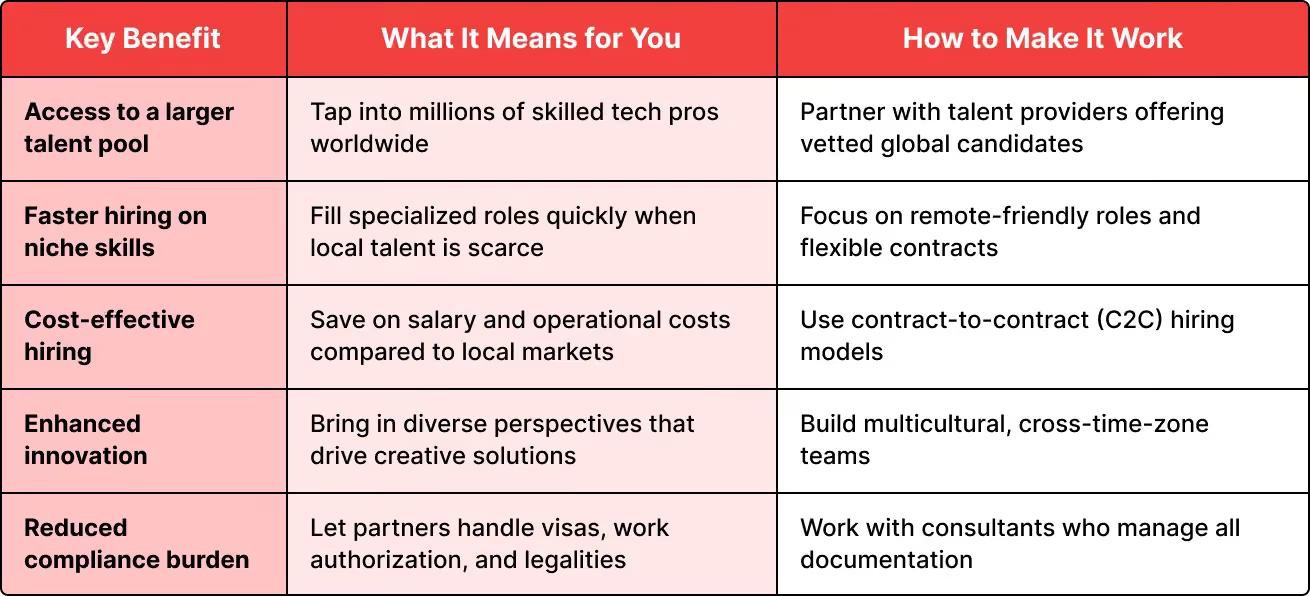
Global hiring doesn't just increase volume. It increases velocity, quality, and reach without compromising control.
4. Validate Skills Through Practical Testing
Marc Benioff, co-CEO of Salesforce, once said:
“Acquiring the right talent is the most important key to growth. Hiring was and still is the most important thing we do.”
Benioff didn’t build Salesforce into a global powerhouse by guessing who might deliver. He championed the idea that skill validation is the backbone of smart hiring. Great teams aren’t assembled by chance, they’re built through data, testing, and proof.
Therefore, relying solely on resumes often leads to surprises after hiring. When talent is tested through practical exercises, agencies gain clarity and confidence in their choices.
Why It Works
Real-world tests reveal true capabilities beyond what's on paper. They help avoid costly mismatches and ensure faster placements.
Smart Ways to Test
- Role-specific coding tasks that mirror daily challenges
- Case studies grounded in real project scenarios
- Simulations replicating on-the-job responsibilities
Standardized evaluations bring fairness and transparency. They minimize bias and spotlight candidates who excel in action, not just words.
This is where Consultadd takes it a step further by providing ongoing candidate monitoring and training, ensuring each hire continues to perform at a high level and adapts quickly to evolving business needs.
5. Nurture High-Potential Junior Developers
Finding fresh talent with promise feels like striking gold. But raw potential needs careful nurturing to shine.
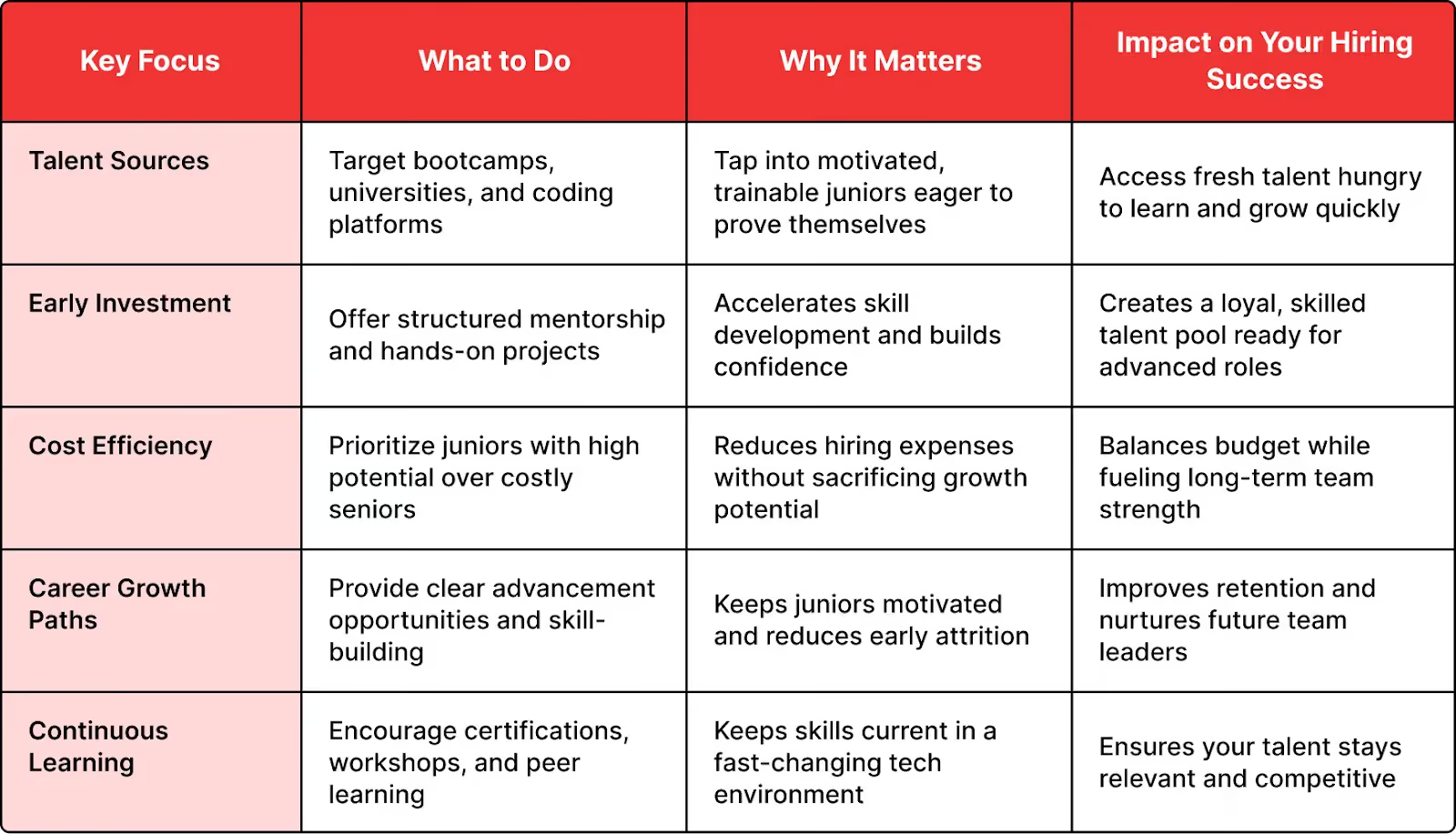
Guiding juniors through this journey builds a loyal talent pipeline. It transforms hiring into long-term success.
6. Use AI to Streamline Hiring
The pressure to fill roles faster and smarter can feel overwhelming. AI offers a game-changing edge.
How does AI speed up resume screening?
By scanning resumes for key skills and experience, AI slashes hours of manual review.
This means faster shortlists and more time to focus on top talent.
How AI improves candidate engagement?
Yes! Chatbots handle candidate questions instantly and schedule interviews anytime.
Immediate responses keep candidates interested and reduce drop-offs.
What role does AI play in predictive analytics in hiring?
AI studies past hiring success to predict which candidates will thrive.
This boosts your confidence in making long-term hires.
How AI sharpens your hiring strategy?
By analyzing data continuously, AI guides smarter sourcing and interview decisions.
This keeps your agency agile and competitive.
While AI optimizes processes like screening and engagement, the most critical insights often come from outside the interview room. Smart reference checks can reveal how candidates perform in real-world situations, further strengthening your hiring decisions. Read our blog ‘Smart Reference Questions to Make Better Hiring Decisions’, to understand how to leverage references.
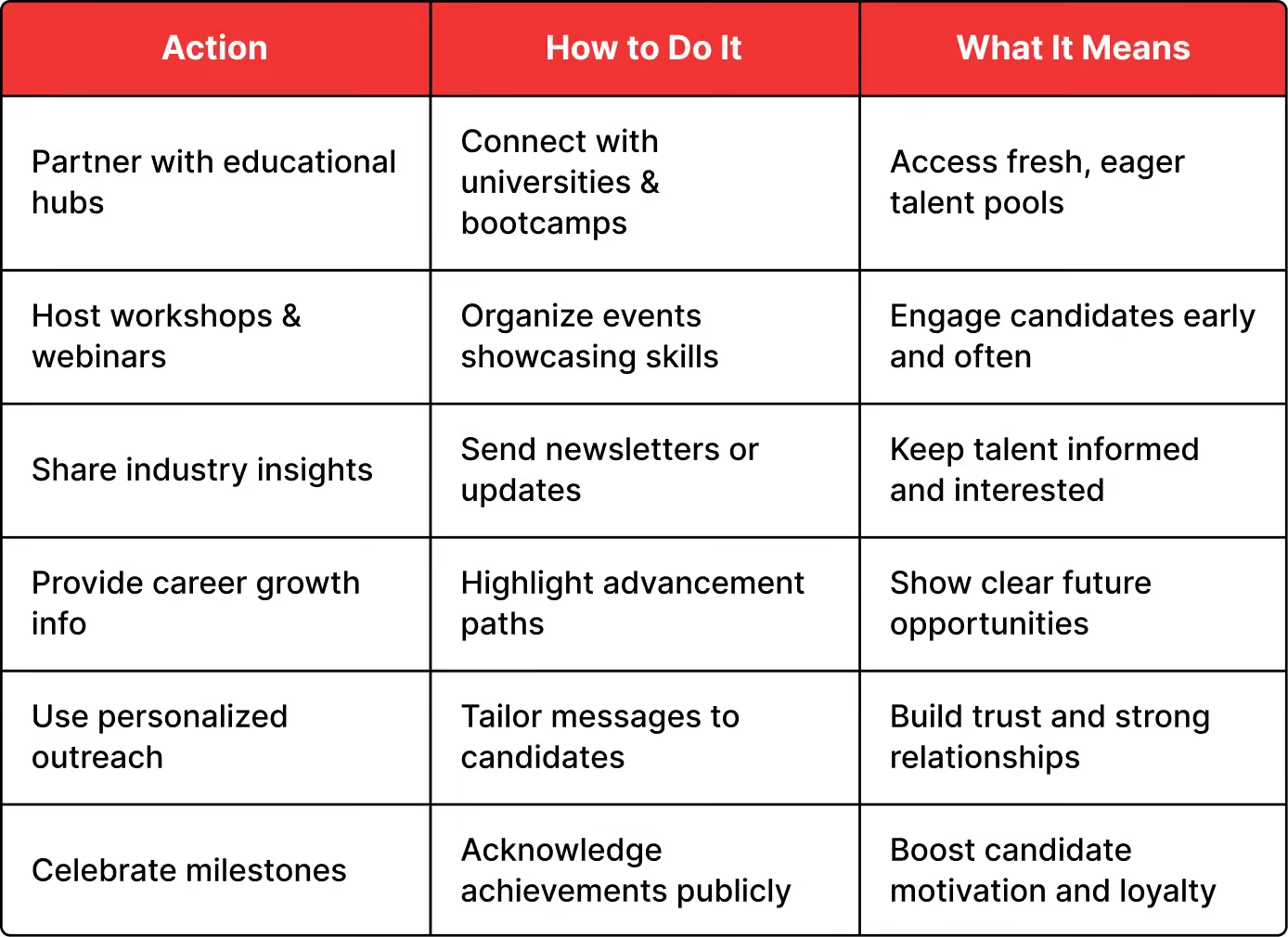
7. Develop Future Talent Pipelines
Building tomorrow’s talent today is the secret to staying ahead in staffing. Creating strong talent pipelines ensures you never scramble when demand spikes.
8. Build a Remote-First Team Culture
Remote work is no longer a trend, it’s a necessity for top talent.
Creating a remote-first culture means embracing flexibility without losing connection or quality.
Why Embrace Remote-First?
- Access a wider, diverse talent pool beyond local limits
- Boost employee satisfaction through work-life balance
- Reduce overhead costs while scaling quickly
How to Build It?
- Establish clear communication rhythms: daily check-ins, async tools, and video calls
- Prioritize trust and autonomy; results matter more than hours logged
- Invest in virtual team bonding to keep culture vibrant and inclusive
What Challenges Should You Prepare For?
- Overcome feelings of isolation with regular social activities
- Ensure consistent training and onboarding, even from afar
- Use technology that supports seamless collaboration and transparency
Adopting a remote-first culture turns distance into advantage. It positions staffing agencies to win in today’s fast-changing tech market.
Moreover, for this model to thrive, cultural fit is crucial. Our blog “How Cultural Fit Transforms Hiring Outcomes” explores why aligning candidates with your company culture is essential for building successful, long-term teams in the tech industry.
9. Modernize Your Tech Hiring Infrastructure
To win today’s competitive tech talent race, your hiring system needs an upgrade. Old processes drain time and miss quality candidates.
Embrace Intelligent Automation
Streamline repetitive tasks like resume screening and interview scheduling. Automation frees you to focus on human connections.
Pro Tip: Use AI tools that adapt to your agency’s unique needs for smarter results.
Integrate Real-Time Collaboration Tools
Enable seamless teamwork between recruiters, account managers, and clients. Shared platforms speed decisions and reduce errors.
Pro Tip: Choose tools with instant feedback features to keep everyone aligned and responsive.
Centralize Candidate Data
A unified talent database helps track interactions and candidate progress efficiently. No more scattered info or missed opportunities.
Pro Tip: Implement cloud-based systems for secure access anytime, anywhere.
Upgrade Assessment Methods
Replace outdated tests with practical, scenario-based evaluations. This reveals true candidate skills and fit faster.
Pro Tip: Incorporate tech assessments that mimic real job challenges to boost hiring confidence.
Leverage Analytics for Smarter Hiring
Track metrics like time-to-hire, candidate sources, and success rates. Data-driven insights refine your strategy continuously.
Pro Tip: Regularly review reports to spot bottlenecks and improve hiring velocity.
Modernizing tech hiring means transforming challenges into streamlined, winning processes. This foundation sets the stage for exceptional talent sourcing.
10. Develop an Employee Value Proposition (EVP)
Top talent today isn’t just looking for a job, they’re choosing an experience.
They want to know: What’s in it for me beyond the paycheck?
A strong EVP makes your opportunities irresistible. It’s how agencies compete on more than compensation.
Here’s the essential EVP elements and what they signal to candidates:
- Career Growth – “We invest in your future, not just your output.”
- Company Culture – “You’ll belong here, and your voice will matter.”
- Purpose & Impact – “Your work contributes to something bigger.”
- Flexibility – “We respect your time and life outside of work.”
- Recognition – “We see your wins and celebrate them often.”
- Well-being Support – “Your health and happiness aren’t afterthoughts.”
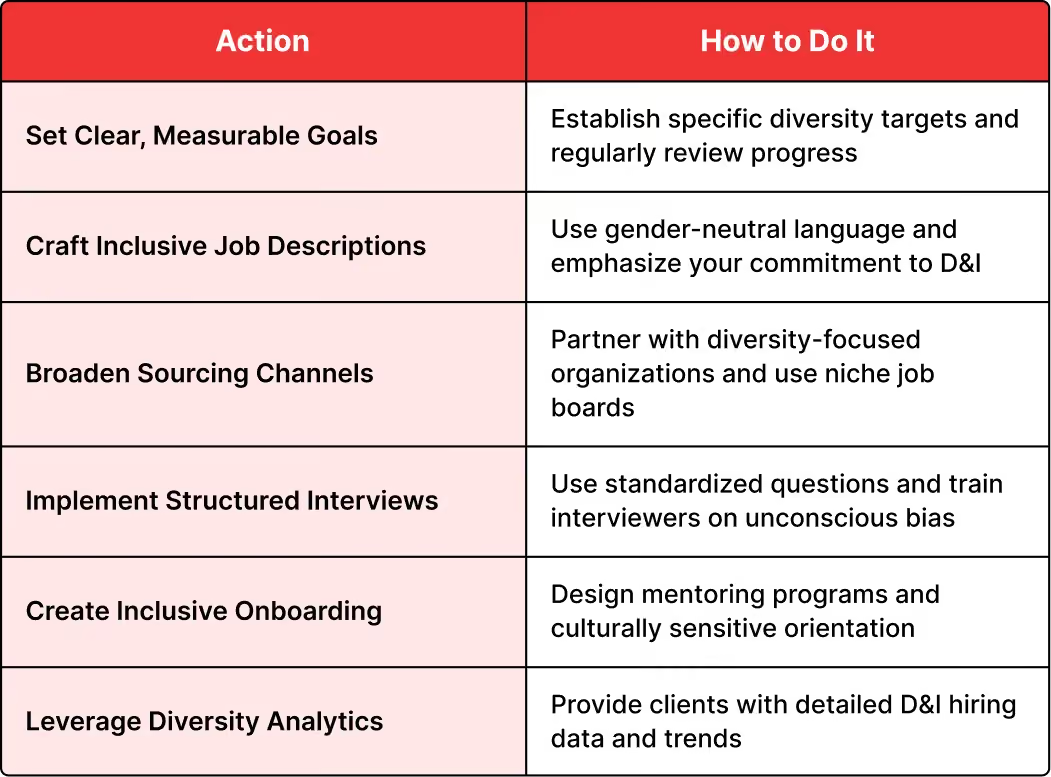
11. Embed Diversity and Inclusion at Every Stage
Building a truly diverse and inclusive workforce isn’t just a trend, it’s a competitive advantage. Embracing it from the start fuels stronger teams and greater innovation.
12. Activate Employee Referral Networks
When agencies tap into employee referrals, they unlock faster hires and better cultural fits. Yet, many miss out on this goldmine.
- Communicate Clear Incentives
Make rewards motivating and transparent. Bonuses, recognition, or career perks work wonders. - Simplify the Referral Process
Use easy-to-access platforms or mobile apps. No one wants complex forms. - Promote Regularly
Share success stories and referral milestones in newsletters or meetings. - Engage Employees as Brand Ambassadors
Equip them with info and social media content to share openings widely. - Measure and Share Impact
Track referral hires, retention, and performance. Celebrate wins openly.
Pro Tip: Create a friendly competition between teams to boost referrals, it sparks excitement and results.
Activating referral networks is a game-changer for quality, speed, and trust in hiring.
13. Deliver an Exceptional Candidate Experience
A great candidate experience is more than a checkbox, it’s a competitive advantage. When candidates feel valued, they stay engaged and spread the word.
Simple Ways to Wow Candidates
- Keep them in the loop with honest, timely updates, no silence allowed.
- Streamline applications and interviews so candidates don’t feel stuck or frustrated.
- Personal touches matter, remember their skills, goals, and preferences.
- Give meaningful feedback to show respect and help them grow.
- Set the tone early by training hiring teams to engage warmly.
Exceptional experiences turn candidates into loyal advocates and amplify your brand.
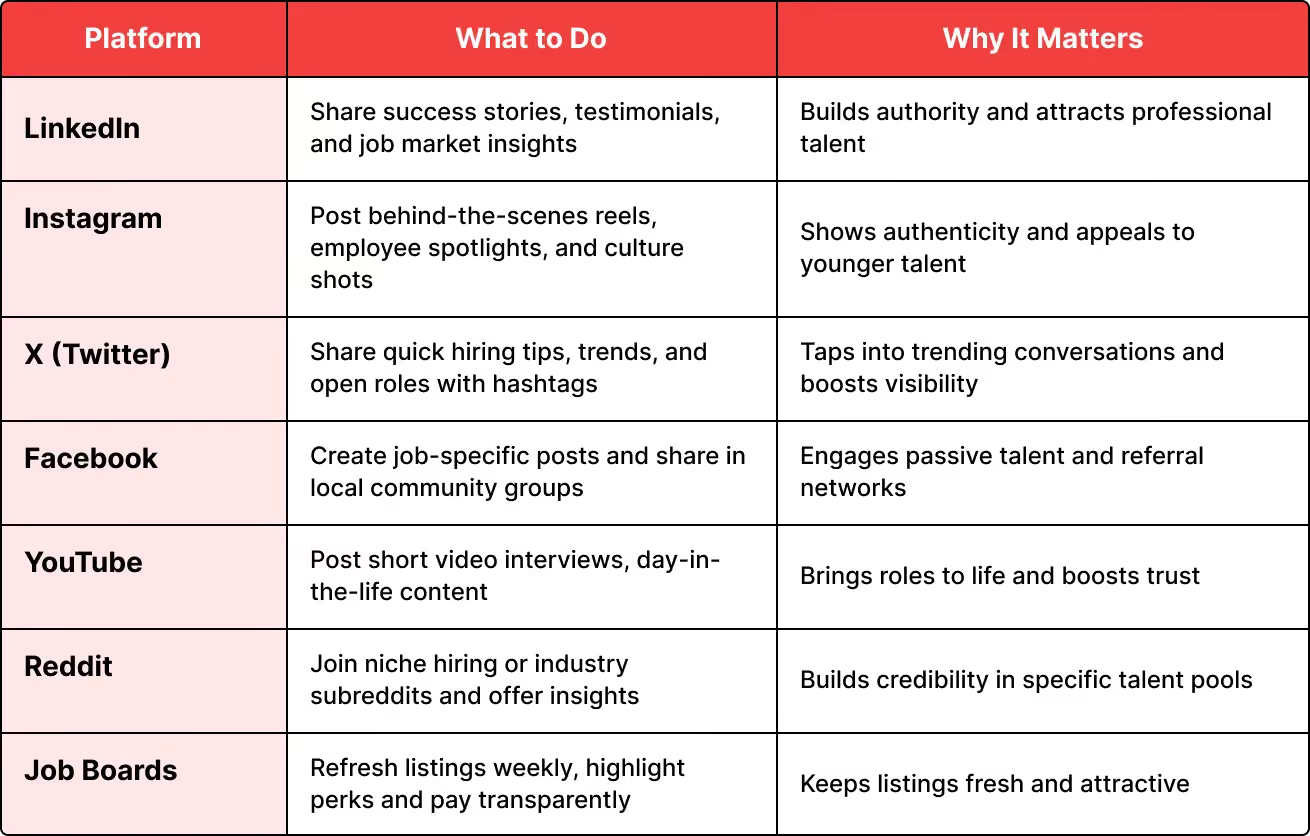
14. Leverage Social Media and Online Platforms
Your future hires are online. Are your strategies keeping up?
15. Make Data-Driven Hiring Decisions
In today’s fast-paced market, guessing won’t cut it. Data is your secret weapon. Data removes bias and guesswork, boosting hiring accuracy. It uncovers hidden patterns often missed.
- Track Key Metrics: Focus on time-to-fill, candidate source effectiveness, and interview-to-offer ratios. These numbers reveal what works.
- Use Data to Predict Success: Analyze past hires to spot traits linked to performance. This sharpens candidate screening and match quality.
- Empower Your Team with Real-Time Insights: Share dashboards with recruiters and managers for faster, aligned decisions. Transparency fuels confidence and trust.
- Avoid Data Overload: Focus on actionable insights, not every number. Too much data can slow decisions and cause confusion.
Harnessing data transforms your hiring from reactive to strategic. This shift elevates your agency’s impact and reputation.
Start Strong With Consultadd
With 15 years in business and 5,000+ successful staffing engagements, we don't just fill roles, we build reliability into your process. We've supported 65 staffing companies in the past year alone and maintain MSAs with industry leaders like Robert Half and TEKsystems.
Here's what working with Consultadd looks like:
- Talent sourced in under 24 hours
- Ready-to-deploy candidates, vetted for experience and compliance
- Lower turnover risk: we match long-term goals, not just short-term needs
- Seamless compliance: visa, documentation, onboarding? Handled.
- Dedicated 1:1 account managers for responsive, personalized support
- Top 100 candidate matches delivered in the past year
- Strong partnerships with universities to tap into fresh, committed talent
- Post-placement support so your investment grows beyond day one
For candidates, your next opportunity is more than just a job title, it's a chance to build skills, gain experience, and move your career forward. At Consultadd, we connect technology professionals with projects and employers that align with their goals, whether they're looking for contract, contract-to-hire, or long-term opportunities.
The tech job market moves fast, but the right guidance can make all the difference. Ready to take the next step in your career journey? Explore Opportunities >>
Key Takeaways
- Define roles clearly: Detailed job descriptions attract better-fit candidates and reduce unnecessary screening time.
- Leverage modern hiring technology: AI, ATS platforms, automation, and analytics improve sourcing, screening, and decision-making.
- Build proactive talent pipelines: Develop relationships with candidates, universities, and referral networks before hiring needs arise.
- Enhance candidate experience: Fast communication, simplified interviews, and a compelling EVP improve acceptance rates and reduce drop-offs.
- Use data to optimize hiring: Monitor hiring KPIs such as time-to-fill, source effectiveness, and interview-to-offer ratios to continuously improve recruitment performance.
FAQs
How can companies hire tech talent faster?
Companies can accelerate hiring by creating clear job descriptions, using AI-powered recruiting tools, building talent pipelines, leveraging referrals, and partnering with specialized tech staffing firms.
Why is AI important in tech recruitment?
AI automates resume screening, candidate matching, interview scheduling, and predictive hiring analysis, reducing manual effort while improving hiring speed and quality.
What is an Employee Value Proposition (EVP)?
An EVP is the overall value a company offers employees beyond salary, including career growth, workplace culture, flexibility, recognition, and well-being, helping attract and retain top talent.
How do employee referrals improve hiring?
Employee referrals often produce higher-quality candidates, reduce hiring costs, shorten recruitment timelines, and improve employee retention due to stronger cultural alignment.
Which hiring metrics should recruiters track?
Key recruitment metrics include time-to-fill, time-to-hire, candidate source effectiveness, interview-to-offer ratio, offer acceptance rate, quality of hire, and candidate satisfaction.

Measure What Matters: Recruitment KPIs That Drive Real Results
Introduction
You’re chasing hiring targets, juggling multiple roles, and managing expectations that change by the hour. But somewhere between reviewing resumes and coordinating interviews, you’re left wondering, is all this effort actually working?
For recruiters, hiring success can feel like a moving target. One month, you're over-delivering, and the next, you're dealing with delayed feedback, vanishing candidates, or roles that suddenly go on hold.
That’s why recruitment KPIs are a way to stay in control, improve outcomes, and show the real value of your work.
Let’s explore the recruitment KPIs that help you measure hiring success through a process that delivers the best results.
TL;DR
- Recruitment KPIs help hiring teams measure efficiency, improve decision-making, and demonstrate the business impact of recruitment.
- Core metrics like time-to-hire, cost per hire, quality of hire, offer acceptance rate, and candidate experience directly influence hiring success.
- Tracking sourcing channel performance enables recruiters to invest in the channels that consistently deliver high-quality hires.
- Candidate experience and diversity metrics strengthen employer brand, improve offer acceptance, and support long-term retention.
- Using recruitment KPIs consistently helps organizations optimize hiring strategies, reduce costs, and build scalable talent acquisition processes.

1. Time to Hire
When time is running out and stakeholders are expecting results, speed often feels like the most important factor. Every extra day between job requisition and offer letter isn’t just a delay; it’s a risk. Moreover, the best candidates don’t wait around.
What is Time to Hire?
Time to hire measures how quickly you move a candidate from application to signed offer.

Note: This isn’t about rushing, it’s about readiness.
Why Time to Hire is a Deal-breaker?
Long hiring cycles send the message, "We’re not ready," while fast hires say, "We’ve got our act together."
Here’s how a slow process affects your business:
- Top candidates drop off: They accept offers elsewhere before your team decides.
- Loss of trust: Delays signal disorganization, even when it’s not your fault.
- Margins shrink: The longer a seat stays open, the more expensive it becomes.
Tracking your time to hire is a strategy for consistency, trust, and business growth.
Understanding the right support from a staffing partner is crucial to optimizing this process and speeding up your hiring. Read: What to Expect When Working with a Staffing Agency.
And while time is critical, so is cost.
2. Cost per Hire
There’s nothing worse than pouring time, energy, and budget into hiring, only to question where it all went. When costs creep up and ROI stays unclear, pressure builds fast. Moreover, in staffing, every dollar spent has to prove its worth.
What is Cost per Hire?
Cost per hire shows how much you spend to make one successful hire. It’s the most straightforward way to track recruitment spending and justify hiring decisions.
Here's how it works:

These numbers help spot what’s working and what’s draining your budget.
What’s Included in Cost per Hire?
It’s not just job ads. Here’s what usually makes up the total cost:
- Sourcing tools: Job boards, LinkedIn licenses, recruiter platforms.
- Recruitment team salaries: Time spent per role filled.
- Background checks: Verifications, screenings, compliance fees.
- Interview logistics: Time, software, scheduling tools.
- Onboarding: Tech setup, paperwork, initial training.
Remember that every step has a cost and adds up quickly if the process drags or restarts.
Compare Costs Across Sources
Knowing the average cost per hire is good, but comparing by channel is great.

With visibility into performance and cost, you can direct spending toward results, not noise.
If you’re still weighing whether a staffing agency is cost-effective, compare it to low-cost options like internal databases and referrals. Then, explore how to choose the right IT staffing agency and discover what sets exceptional partners apart.
Therefore, when you understand cost per hire, you stop guessing and start hiring smarter. Next, let’s discuss the quality of the hire, because low-cost means nothing if the hire doesn’t perform.
3. Quality of Hire
Filling a role doesn’t always mean winning the hire.
You can tick all the boxes; skills, timeline, budget and still end up with a mismatch. When that happens, it’s not just disappointing; it’s expensive for everyone.
That’s why quality of hire is the KPI that separates placements from partnerships.
What Does Quality of Hire Really Mean?
It’s the outcome that follows the offer.
High-quality hires:
- Stick around long enough to make a difference.
- Earn the trust of clients and team leads.
- Deliver value faster, with fewer hand-holds.
- Fit the culture without forcing it.
Here, it's less about resumes and more about results.
How to Measure It (Without Overcomplicating Things)
Here’s a simple framework:

Pro Tip: Always aim for a score of 4+ consistently. Below that? Time to review sourcing or screening.
Why Recruiters Should Care Deeply About This Metric?
- It reduces churn and rehire panic.
- It creates measurable business value.
- It positions you as a strategic recruiter
Always remember that every successful hire boosts your track record, while every bad one lasts longer than you’d like. Now, you’ve made a great hire, but the hiring process isn’t over until they say yes.
Next, let's focus on candidate experience, which most influences that 'yes'.
4. Interview-to-Offer Ratio
Your hiring process speaks volumes before an offer is even made.
If too many interviews lead nowhere, it signals inefficiencies in candidate screening or unclear role requirements. This KPI measures the percentage of interviewed candidates who receive a job offer.
Here’s how you can calculate it:
Interview-to-Offer Ratio = (Number of offers extended / Number of candidates interviewed) × 100
A healthy ratio means your team is interviewing the right candidates and making informed decisions quickly.
5. Offer Acceptance Rate
Say you’ve found the perfect match. The interview went well, and everyone’s excited. You extend the offer. And then silence. Or worse, a polite “Thanks, but I’m going in another direction.”
It stings, not just because of the lost placement but also because of the time, trust, and margin that disappear with it. That’s why the offer acceptance rate (OAR) matters. It’s your deal-closure metric and it speaks volumes.
What Is the Offer Acceptance Rate?
OAR tracks how many candidates say “yes” to a job offer.
As a recruiter, you should calculate this:
Offer Acceptance Rate = (Accepted Offers / Total Offers Extended) × 100
Let’s simplify it:
If you roll out 20 offers and 15 are accepted, (15 ÷ 20) × 100 = 75% OAR
Why This KPI Deserves Your Attention
- It reflects candidate trust in your process.
- It helps diagnose gaps between the offer and expectation.
- It gives clients confidence in your delivery reliability.
Note: A high OAR? It means alignment. A low one? It’s a red flag waiting to spread.
Top Reasons Offers Get Declined and How to Fix Them
- The role isn’t the right fit?
Fix: Tighten your screening to match the right people with the right roles. - They got a better offer elsewhere?
Fix: Move faster. Speed can be a deciding factor. - Expectations weren’t clear?
Fix: Set them early for both you and the candidate. - Salary didn’t match?
Fix: Align on total comp early: base, bonuses, equity, and growth. Pay bands are public, but expectations still vary. Close the gap before the offer stage. - The experience felt off?
Fix: Communicate clearly and consistently at every stage.
Pro Tip: Ask for feedback from candidates who decline an offer to improve your process and make adjustments for the future.
When candidates say yes, it's not luck, it’s precision.
5. Hires to Goal
Hiring plans mean nothing without follow-through. This KPI tracks how close you are to meeting your recruitment targets within a set timeframe.
Hires to Goal = (New hires / Hiring goal) × 100
A strong ratio shows your team is on track and aligned with business needs. Falling short? It’s a signal to reassess your strategy and resources.
5. Candidate Experience
Your reputation begins long before a candidate signs the offer. Delayed responses, vague job descriptions, and robotic interview processes aren’t just red flags; they’re reasons top talent walks away.
In today’s talent-short market, you don’t get second chances. Therefore, a strong candidate experience doesn’t just impress, it converts, driving business-critical results.
Why Candidate Experience Is Business-Critical
- Candidates are customers. And they share their experiences online, good or bad.
- Most job seekers say the hiring experience directly impacts their decision to accept.
- A poor experience reflects poorly not just on your business, but on the brand as well.
In short, experience shapes perception, and perception shapes results.
The Candidate Experience Checklist
Use this guide to ensure a seamless and positive experience for every candidate.

Each touchpoint is a brand moment. Treat it like one.
Evaluate with Candidate Experience Metrics
Candidate experience is no longer a soft metric. It’s a growth lever.
1. Candidate NPS (cNPS)
This is your reality check. Candidate Net Promoter Score measures a candidate's overall experience and likelihood of recommending the company to others based on their recruitment experience.
Therefore ask:
“How likely are you to recommend your experience with us to a friend or peer?”
And then score on a scale of 0-10 to calculate as follows:
cNPS = (% of Promoters: 9–10) – (% of Detractors: 0–6)
- +50 or above: You're doing great.
- 0 to +50: There's room to grow.
- Below 0: It's a red flag.
Pro Tip: Follow-up surveys can also uncover gaps in communication, clarity, or empathy.
Why Does It Pay Off?
- Higher offer acceptance rates
- Stronger Glassdoor reviews
- Shorter hiring cycles through positive referrals
- Better long-term retention
2. Diversity and Inclusion Metrics
Diversity isn’t just good ethics, it’s innovative business.
But diversity must go hand-in-hand with inclusion. Without it, retention drops, and engagement falters.
Key metrics to track:
- % of underrepresented groups in the candidate pool.
- Diversity across interview panels.
- Retention of diverse hires over 6–12 months.
How to elevate inclusion:
- Use blind resume screening to remove bias.
- Partner with affinity networks to broaden sourcing.
- Train hiring teams to recognize and reduce bias.
3. Adverse Impact Detection
Unintentional discrimination can happen even with the best intentions.
Adverse impact metrics help ensure your hiring process is fair to everyone, without disadvantaging any group.

To stay compliant and fair:
- Use structured interviews for consistency.
- Run periodic audits of conversion rates by demographic.
- Document decisions to show objectivity and fairness.
The experience you deliver determines which way candidates lean.
To help meet these key recruitment KPIs, Consultadd simplifies the hiring process by reducing sourcing overhead and minimizing restarts. Our candidates are thoroughly screened, which shortens time-to-fill and minimizes post-hire issues, ultimately driving greater hiring success.
Next, let’s dive into what attracts them with source quality and channel effectiveness.
6. Source Quality and Channel Effectiveness
Source quality and channel effectiveness reveal where your best candidates are really coming from.
These ensure high-quality hires so you can focus your efforts, save time, and boost hiring success.
Source Quality Matters More Than Ever
Staffing today is about precision sourcing, finding talent that isn’t just qualified but high-impact.
Here’s what quality really looks like:
- Retention-ready: Candidates who stay and grow, not ghost or churn.
- Cultural fit: People who click with clients, teams, and expectations.
- High-performance: Talent that delivers results faster with less handholding.
Low-quality sources don’t just miss the mark; they cost time, trust, and team morale.
As we know, Steve Jobs didn’t talk about sourcing channels or recruiting metrics, but lived and implemented them.
He said,
“Great things in business are never done by one person. They're done by a team of people.”

His model for business was The Beatles, where each brought different strengths, and by supporting and balancing one another, they achieved more as a group than they could have individually.
That belief shaped everything he built, including his approach to talent. Jobs saw talent not as a transaction but as the lifeblood of innovation. It wasn’t just about hiring skilled people; it was about building teams that clicked, challenged each other, and created something bigger than themselves.
And to do that, he needed more than resumes. He required quality people.
The Channel Effectiveness Equation
Not all sourcing channels are created equal. And more is not better, better is better.
Here’s a comparison to make that clear:

The most innovative staffing leaders aren’t on every channel. They’re on the right ones, consistently.
How to Measure Channel Effectiveness
You can’t improve what you don’t track. Here's what to measure and monitor:
Sourcing Channel Efficiency = (Total Number of Hire via the Channel / Total Number of Applications via Channel x 100) × 100
Moreover, monitoring the following KPIs closely can provide insight into how each channel is performing:
- Conversion Rate (Views to Hires)
- Source of Hire (% hires per channel)
- Cost per Hire (per channel)
- Retention Rate (by channel)
- Time to Fill (per source)
Use this data to double down on what’s working and drop what’s draining time and trust.
Inspired by Jobs, Measured by You
Steve Jobs knew talent drives innovation, not just product specs or roadmaps.
“The total was greater than the sum of the parts.”
That’s precisely what excellent sourcing should do: create teams that outperform, outlast, and outshine.
When you track source quality and channel effectiveness, you're not just filling roles. You're building something greater: a hiring process that scales trust and performance.
With access to deep university partnerships, specialized talent pools, and a proprietary database of ready-to-go candidates, Consultadd is a high-yield sourcing partner. We don’t just deliver resumes, we deliver results that stick.
Start Strong With Consultadd
With 15 years in business and 5,000+ successful staffing engagements, we don't just fill roles, we build reliability into your process. We've supported 65 staffing companies in the past year alone and maintain MSAs with industry leaders like Robert Half and TEKsystems.
Here's what working with Consultadd looks like:
- Talent sourced in under 24 hours
- Ready-to-deploy candidates, vetted for experience and compliance
- Lower turnover risk: we match long-term goals, not just short-term needs
- Seamless compliance: visa, documentation, onboarding? Handled.
- Dedicated 1:1 account managers for responsive, personalized support
- Top 100 candidate matches delivered in the past year
- Strong partnerships with universities to tap into fresh, committed talent
- Post-placement support so your investment grows beyond day one
For candidates, your next opportunity is more than just a job title, it's a chance to build skills, gain experience, and move your career forward. At Consultadd, we connect technology professionals with projects and employers that align with their goals, whether they're looking for contract, contract-to-hire, or long-term opportunities.
The tech job market moves fast, but the right guidance can make all the difference. Ready to take the next step in your career journey? Explore Opportunities >>
Key Takeaways
- Measure hiring efficiency: Track KPIs like time-to-hire, cost per hire, and interview-to-offer ratio to identify process bottlenecks.
- Focus on quality, not just speed: Monitor quality of hire and offer acceptance rates to ensure successful long-term placements.
- Prioritize candidate experience: Fast communication, transparency, and positive interactions improve employer reputation and hiring outcomes.
- Evaluate sourcing channels: Measure source quality, conversion rates, retention, and hiring costs to optimize recruitment investments.
- Use data to improve continuously: Regular KPI reviews enable smarter decisions, better forecasting, and stronger recruitment performance.
FAQs
What are recruitment KPIs?
Recruitment KPIs (Key Performance Indicators) are measurable metrics that evaluate the effectiveness, efficiency, quality, and overall success of an organization's hiring process.
Which recruitment KPIs are the most important?
The most commonly tracked KPIs include time-to-hire, cost per hire, quality of hire, offer acceptance rate, interview-to-offer ratio, candidate experience, and source quality.
Why is quality of hire an important KPI?
Quality of hire measures how well new employees perform, fit the organization, and remain with the company, making it one of the strongest indicators of long-term recruitment success.
How can recruiters improve recruitment KPIs?
Recruiters can improve KPIs by streamlining hiring workflows, strengthening candidate communication, using data-driven sourcing strategies, improving screening processes, and regularly analyzing recruitment performance.
Why should companies track source quality and channel effectiveness?
Tracking source quality helps identify which recruitment channels consistently produce high-performing, long-term hires, allowing organizations to reduce hiring costs, improve efficiency, and maximize recruitment ROI.

How to Hire the Best: The Best Recruiting Practices You Need
Introduction
You’re under pressure: tight deadlines, talent shortages, and clients who expect results.
While your clients demand top talent delivered quickly, as a hiring manager, you may be wondering how exactly you can attract this talent.
Imagine top talent candidates staying with you because your process feels transparent, supportive, and human. In turn, you show up to client calls already trusted because your reputation for delivering quality talent speaks for itself.
That’s the power of best recruiting practices. They draw in clients and candidates before the conversation even begins. It’s not just about looking polished; it’s about being known for the one thing that truly matters: delivering quality results with confidence.
Let’s explore how the best recruiting practices can strengthen your brand and position your agency as the top choice for talent and clients.
TL;DR
- Strong recruiting practices combine employer branding, candidate experience, data-driven decisions, and diverse sourcing to attract top talent faster.
- A positive candidate experience improves offer acceptance, referrals, and long-term retention while strengthening your employer brand.
- Recruitment metrics help optimize hiring processes, identify bottlenecks, and demonstrate ROI to clients and stakeholders.
- Expanding sourcing channels, employee referrals, virtual hiring events, and skills-based hiring increase access to high-quality candidates.
- Consistently refining recruitment strategies helps staffing firms build trust, fill roles faster, and create lasting client relationships.
Leverage Your Staffing Brand to Win More Clients and Candidates
There’s nothing more frustrating than losing a top candidate after doing everything. You’ve built relationships and pitched the role perfectly. But still, someone else got there first. Or worse, looked more credible.
This is where a strong staffing brand changes everything. It doesn’t just support your pitch, it supercharges it.
1. Build a Reputation for Speed and Trust
Logos don’t win business; your speed and reliability do.
Show real data that backs your value.
Proven consistency builds trust with both clients and candidates.
2. Tell a Compelling Story
Your brand isn’t just what you post; it’s what people remember.
It should reflect your values, standards, and candidate-first mindset.
- Share placement wins
- Highlight hiring success stories
- Show how your team supports growth
It makes you memorable and preferred.
3. Build a Contractor Value Proposition (CVP)
Why should top talent choose you and stay with you?
Your CVP should answer that in one sentence.
Offer:
- Visa support
- Upskilling opportunities
- Dedicated account managers
- Community and benefits
This builds loyalty and keeps your pipeline engaged long after placement. When your brand speaks for your performance, you're not chasing business. You’re attracted to it.
Next, let’s explore how experience shapes your ability to keep top talent engaged.
Enhance the Candidate Experience

Top talent doesn’t ghost interviews because they’re flaky; they ghost because the experience feels forgettable.
Tech professionals today want more than a paycheck. They want clarity, respect, and a process that values their time. If they don’t feel it? They move on.
Creating a standout candidate experience isn’t a nice-to-have. It’s the edge that sets great staffing teams apart.
1. Communicate With Clarity and Respect
Silence kills trust. Delayed feedback breeds doubt.
The best agencies act fast and keep it human.
- Send updates, even if there’s no news
- Be upfront about timelines and expectations
- Personalize messages, ditch the cold auto-replies
Clear, timely communication shows candidates they matter.
2. Streamline Interviews and Onboarding
Clunky scheduling. Repetitive rounds. Endless paperwork. These are candidate deal-breakers.
Your process should feel smooth, not stressful.

Less friction means more accepted offers.
3. Reduce Offer Rejections and Boost Retention
Candidates accept offers when they feel seen, heard, and supported.
They stay when promises are kept after the contract is signed.
- Send welcome kits
- Assign check-ins during the first 90 days
- Offer career planning conversations
Remember, It’s not about perks, it’s about partnership.
A memorable candidate experience builds trust, drives referrals, and shortens your hiring cycle.
Moreover, Consultadd can help enhance your post-placement experience with benefits, visa support, and career guidance that reinforce loyalty. Our holistic approach ensures that the candidate journey doesn’t end with an offer; it continues with commitment, minimizing drop-offs and driving referrals.
Let’s now look at how data can sharpen every decision you make.
Utilize Recruitment Metrics and Data
Guesswork slows you down. Data-driven decisions speed you up and build trust with clients and candidates.
1. Track Metrics That Matter
Focus on what moves the needle, not just what looks good.
- Time to fill: How fast are roles getting closed?
- Quality of hire: Are placements staying and succeeding?
- Drop-off rate: Where are candidates bailing out?
Pro tip: Use dashboards for a weekly pulse check.
2. Let Data Guide Every Decision
Numbers tell you what’s working and what’s costing you hires.
- Spot bottlenecks in your process
- Match candidate skills with project outcomes
- Show clients clear ROI with every placement
Pro tip: Always have one data point ready to back your pitch.
One often-overlooked but powerful way to validate a hire is through thoughtful reference checks. Instead of going through the motions, strategic recruiters ask smart reference questions that reveal performance patterns, red flags, and alignment with the role. Read our blog: Smart Reference Questions Top Agencies Use to Make Better Hiring Decisions with Confidence.
3. Keep Evaluating and Improving
Recruitment isn’t static; your metrics shouldn’t be either.
- Review numbers monthly
- Adjust goals based on trends
- Share insights with your team
Let’s dig into sourcing strategies that attract hard-to-reach, high-performing talent.
Diversify Sourcing Strategies

Relying on the same old sources shrinks your talent pool and slows your growth. Breaking out of routine opens doors to untapped talent, fresh ideas, and faster placements.
Here’s how to widen your reach and bring diverse candidates into the fold.
1. Engage Passive Candidates
Most top talent isn’t actively job hunting; they wait to be noticed.
- Build relationships through industry events and online communities.
- Share content that speaks to their interests and career goals.
2. Explore Beyond Job Boards
Job boards are crowded. It’s time to think differently.
- Tap into coding forums, niche Slack groups, and tech meetups.
- Partner with training programs or bootcamps for early access.
3. Focus on Diversity, Equity, and Inclusion (DEI)
DEI is more than a trend; it's a competitive advantage that reshapes teams.
- Source from underrepresented groups to create balanced, innovative teams.
- Use inclusive language in job postings to attract a broader audience.
- Train hiring managers to reduce unconscious bias during interviews.
Research shows companies with the highest levels of ethnic diversity are 39% more likely to outperform financially.
This isn’t just good ethics, it’s good business.

Expanding your sourcing strategy transforms your talent pool and strengthens your agency’s edge.
Host Virtual Recruitment Events
Virtual recruitment events are a game-changer in today’s hiring landscape, offering cost-effective ways to connect with top talent from anywhere.
- Interactive Sessions: Incorporate live Q&As, webinars, and panel discussions.
- Invest in Career Fair Software: Streamline the process with virtual career fair platforms that facilitate easy, interactive chats.
Offer Flexible Work Arrangements
Flexibility is now a top priority for job seekers. Embracing remote and hybrid work models attract and retain the best talent.

Leverage Social Media to Attract Talent and Build Trust
Social media is no longer optional; it’s a powerful tool to connect with top talent.
Using it well can transform your agency’s reputation and candidate pipeline.

Social media isn’t just about posting jobs, it’s about building relationships and trust. With the right approach, you turn passive candidates into eager applicants.
Next, let’s explore building a robust employee referral program to accelerate talent acquisition further.
Develop a Robust Employee Referral Program
Finding top talent isn’t just about casting a wide net, it’s about tapping into the networks of your strongest team members.
Dennis de Munck, Director of Recruitment Methods at L’Oreal, shares how their referral program transformed their hiring success.

He says, “The best employees refer the best candidates.”
This simple truth became a cornerstone for their talent strategy.
Referrals bring faster, better candidates.
1. Make the program clear and simple.
Explain how it works and what rewards people get. Avoid complicated steps.
2. Offer meaningful rewards.
Cash bonuses, extra time off, or public recognition motivate employees to refer.
3. Build diversity into the program.
Encourage referrals from different backgrounds to grow a more inclusive talent pool.
4. Keep employees updated.
Share progress on their referrals to keep excitement and trust alive.
5. Track and improve.
Use data to see what’s working and adjust rewards or communication accordingly.
A strong referral program turns your team into powerful talent ambassadors.
This is where Consultadd can make a difference. With thoroughly screened, ready-to-hire candidates, your agency gets a head start in every search. By cutting down sourcing time and reducing early-stage screening hurdles, Consultadd empowers recruiters to deliver the best talent faster and precisely.
Implement Skills-Based Recruitment
Making skills the heart of your hiring process takes intentional steps. Here’s how to do it right:
1. Redefine Job Descriptions
- List specific skills and competencies needed for the role.
- Remove rigid degree or certification requirements unless essential.
2. Source Candidates Differently
- Use platforms and job boards focused on skills (e.g., GitHub for developers, Behance for designers).
- Look beyond resumes: check portfolios, project samples, or open-source contributions.
3. Implement Skills Testing Early
- Use short, relevant assessments to evaluate candidates’ abilities.
- Tools like HackerRank, Codility, or customized practical tasks work well.
- Share tests upfront to set expectations and respect the candidate's time.
4. Align Interview Questions to Skills
- Develop interview questions that probe real-world problem-solving.
- Use scenario-based questions and role-play exercises.
Following these steps simplifies hiring and expands your access to top talent only.
To stay ahead of evolving skill demands, smart agencies use talent mapping to proactively identify gaps, anticipate client needs, and build future-ready pipelines. Learn more in From Skills Gap to Strategic Growth: Talent Mapping That Delivers.
Bridge the Gap Between Sourcing and Client Expectations
Misaligned expectations waste time. Clear communication earns trust and repeat business. Therefore, it is crucial to keep talent engaged throughout the process and even after.

Start Strong With Consultadd
With 15 years in business and 5,000+ successful staffing engagements, we don't just fill roles, we build reliability into your process. We've supported 65 staffing companies in the past year alone and maintain MSAs with industry leaders like Robert Half and TEKsystems.
Here's what working with Consultadd looks like:
- Talent sourced in under 24 hours
- Ready-to-deploy candidates, vetted for experience and compliance
- Lower turnover risk: we match long-term goals, not just short-term needs
- Seamless compliance: visa, documentation, onboarding? Handled.
- Dedicated 1:1 account managers for responsive, personalized support
- Top 100 candidate matches delivered in the past year
- Strong partnerships with universities to tap into fresh, committed talent
- Post-placement support so your investment grows beyond day one
For candidates, your next opportunity is more than just a job title, it's a chance to build skills, gain experience, and move your career forward. At Consultadd, we connect technology professionals with projects and employers that align with their goals, whether they're looking for contract, contract-to-hire, or long-term opportunities.
The tech job market moves fast, but the right guidance can make all the difference. Ready to take the next step in your career journey? Explore Opportunities >>
Key Takeaways
- Build a trusted recruitment brand: Showcase consistent hiring success, tell compelling stories, and create a strong contractor value proposition to attract clients and candidates.
- Prioritize candidate experience: Clear communication, streamlined interviews, and strong post-placement support improve offer acceptance and retention.
- Use recruitment data strategically: Monitor KPIs like time-to-fill, quality of hire, and candidate drop-off rates to improve hiring outcomes.
- Diversify sourcing methods: Go beyond job boards by leveraging referrals, social media, niche communities, virtual events, and DEI-focused recruitment strategies.
- Adopt skills-based hiring: Evaluate candidates based on demonstrated abilities through practical assessments rather than relying primarily on degrees or traditional credentials.
FAQs
What are the best recruiting practices for attracting top talent?
The most effective recruiting practices include building a strong employer brand, providing an excellent candidate experience, using data-driven hiring, diversifying sourcing channels, implementing employee referral programs, and adopting skills-based hiring.
Why is candidate experience important in recruitment?
A positive candidate experience increases offer acceptance rates, improves employer reputation, generates referrals, and encourages high-quality candidates to stay engaged throughout the hiring process.
How can recruiters find better candidates beyond job boards?
Recruiters can expand their talent pool through employee referrals, social media, professional communities, industry events, coding platforms, virtual career fairs, university partnerships, and passive candidate outreach.
How do recruitment metrics improve hiring?
Recruitment metrics help identify hiring bottlenecks, measure recruiter performance, optimize sourcing strategies, improve hiring quality, reduce costs, and support better business decisions.
Why is skills-based recruitment becoming more popular?
Skills-based recruitment focuses on proven capabilities instead of degrees or job titles, helping employers access larger talent pools, reduce hiring bias, improve candidate quality, and hire people who can perform the job effectively.