

Introduction
It's the checkbox that stops thousands of job applications mid-scroll: "Are you legally authorized to work in the United States?"
If you're asking yourself "am I legally authorized to work in the US?", here's the short answer: you are if you're a US citizen or national, a green card holder, or a noncitizen with valid work authorization, which includes people on employment visas like the H-1B and students with approved CPT or OPT.
The confusion isn't really about the law. It's about the checkbox. Application forms compress a genuinely nuanced status into a yes/no answer, then follow it with a second question about future sponsorship that trips up even people who've lived in the US for years.
Answer either one wrong, in either direction, and you can lose an offer you'd already earned or get filtered out of a job you fully qualified for.
This guide explains what work authorization actually means, exactly how to answer both application questions based on your status, and what documents prove it all when hiring paperwork begins.
TL;DR
- You're legally authorized to work in the US if you're a citizen, national, permanent resident, or a noncitizen with valid authorization: an employment visa, an EAD card, or approved CPT/OPT.
- The application question "Are you legally authorized to work in the US?" gets a Yes from F-1 students eligible for CPT/OPT and from H-1B holders, not just citizens and green card holders.
- The second question, "Will you now or in the future require sponsorship?", is the one that actually screens for visa status: most students and work-visa holders answer Yes honestly.
- Answer both truthfully; misrepresenting authorization surfaces at the I-9 stage and can end an offer, or worse, employment already begun.
- Employers may ask about authorization and sponsorship needs, but questions about citizenship, national origin, or specific visa types cross legal lines in most hiring contexts.
What "legally authorized to work" actually means
Under US immigration law, every employer must verify that each person they hire is permitted to work in the United States. "Legally authorized" simply means you fall into one of the categories the law recognizes: authorization that comes automatically with your status (citizens, permanent residents), authorization tied to a specific employer (H-1B, L-1), or authorization granted through a document or program (an EAD card, CPT, OPT).
Notice what that framing includes. A software engineer on an H-1B is legally authorized to work in the US. An F-1 student with approved OPT is legally authorized to work in the US. The question is not "are you a citizen?" and treating it that way, in either direction, is the root of most wrong answers.
Notice also what it doesn't include: tourists on B-1/B-2 visas, students without an approved work benefit, and anyone whose authorization has lapsed. Eligibility to apply for a status isn't authorization either; the approval has to exist before work begins.
Who is authorized to work in the US
The categories sort into three buckets, and the bucket you're in shapes every answer downstream:
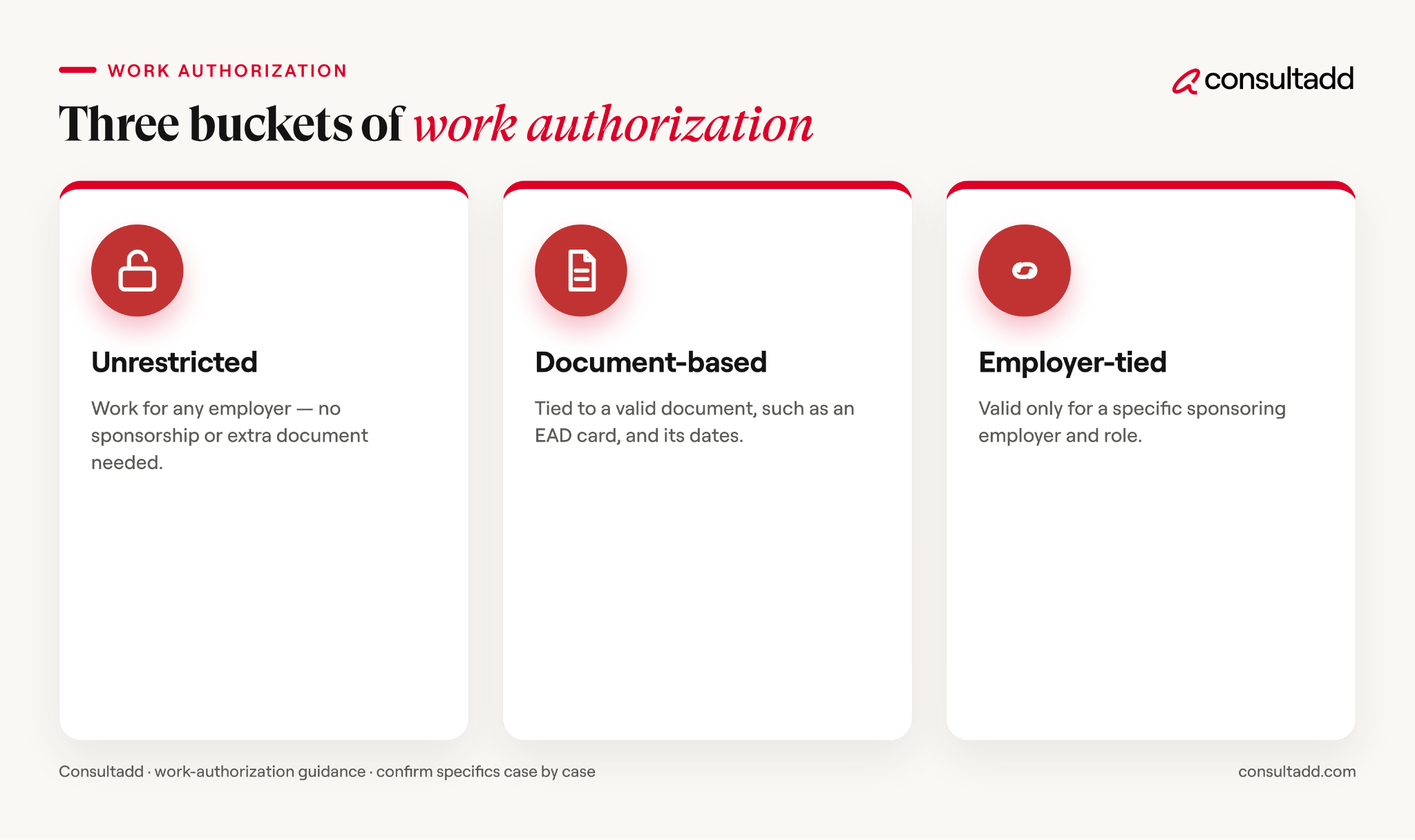
Two clarifications that resolve most real-world confusion.
First, F-1 students belong in the document-based bucket even before their CPT or OPT is approved in one specific sense: work authorization is a built-in benefit of F-1 status that they're eligible to activate.
University career offices consistently advise that students eligible for CPT/OPT answer "yes" to authorization questions, while making sure the approval is actually in hand before the first day of work.
Second, "employer-tied" still means authorized.
An H-1B professional filling out an application is legally authorized to work in the US; what they need is sponsorship, which is precisely what the second question exists to ask.
How to answer the two application questions
Applications almost always pair the authorization question with a sponsorship question. Here's the matrix, status by status:
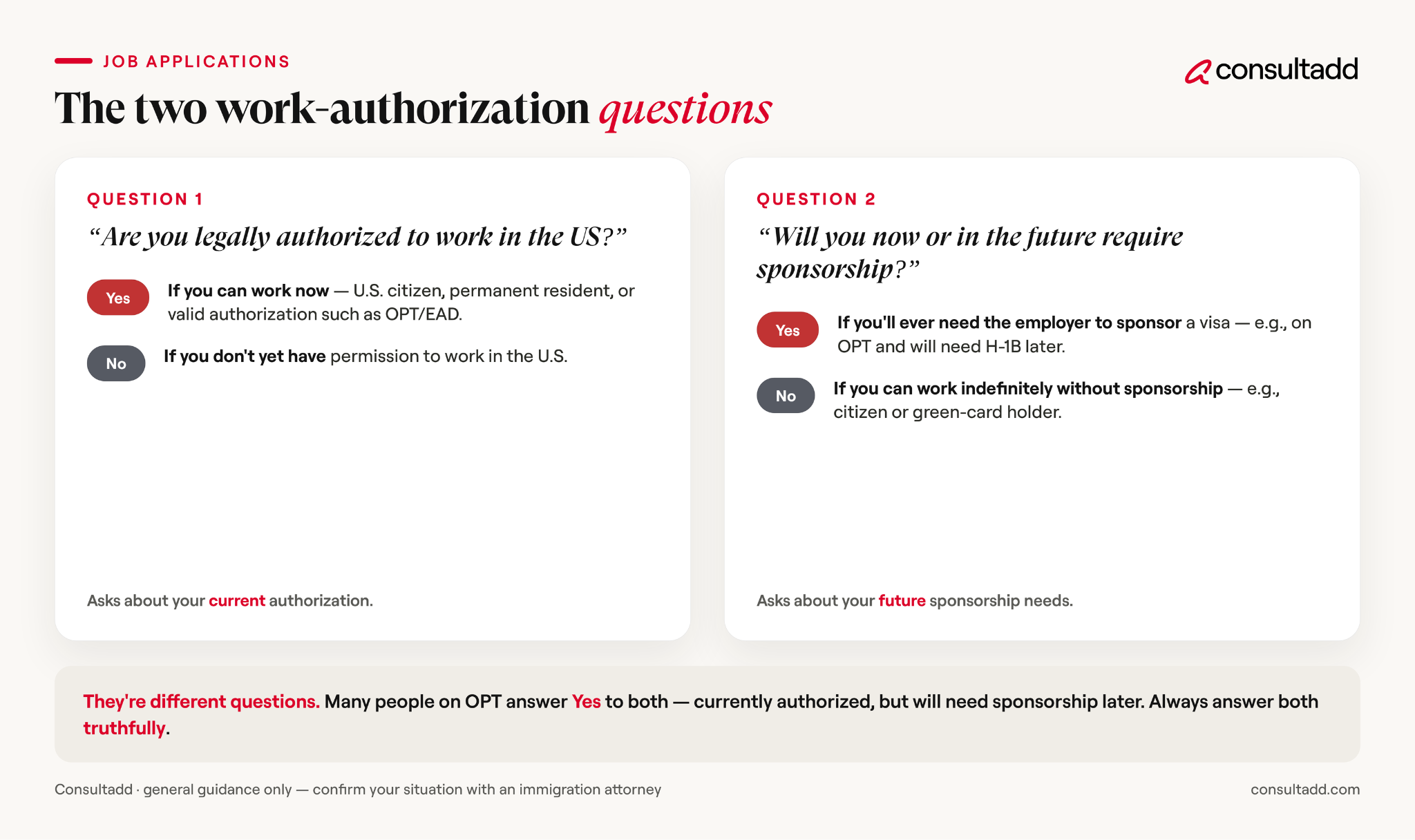
A few notes the table can't hold. The "in the future" phrasing is doing the heavy lifting: an OPT student doesn't need sponsorship today, but will when OPT runs out, so the honest answer is Yes unless they genuinely plan to leave the US afterward (a short internship before returning home is the classic legitimate No).
And wording varies: a question like "are you authorized to work without restriction?" reads differently, since employer-tied and time-limited authorization is a restriction; when a form offers a comments field, one clarifying sentence ("authorized via STEM OPT through May 2027; will require H-1B sponsorship thereafter") beats a bare checkbox every time.
The sponsorship question: honesty and strategy
Let's address the temptation directly, because everyone in this situation has felt it: answering "No" to the sponsorship question to get past the filter.
Don't. The misrepresentation doesn't disappear; it resurfaces at the offer stage or during onboarding paperwork, when your documents tell the real story. Offers get rescinded over exactly this, bridges get burned at companies you may want to approach again in three years, and in the worst cases employment already begun gets terminated.
The filter is frustrating, but it's screening for a real constraint: whether the company is set up to file petitions. Beating the filter doesn't change the constraint.
The productive strategy is targeting, not misdirection. Sponsorship-friendly employers exist in every industry, they're identifiable through H-1B disclosure data and platforms that flag sponsoring companies, and consulting and staffing firms that routinely employ visa-holding professionals are a well-trodden entry point into the US market.
Our guide to H-1B sponsorship for tech professionals covers how the employer side works, and once you're in front of the right companies, the differentiator becomes interview performance, where our coding interview playbook earns its keep.
Candidates with strong, specific skills get sponsored every year at companies that "don't sponsor," because policies bend for people teams genuinely want.
Proving it: Form I-9 and your documents
Whatever you checked on the application, verification happens for real after hire. Every US employer must complete Form I-9 with each new employee within three business days of the start date, examining documents that prove identity and work authorization. The official reference for all of it is USCIS I-9 Central.
Documents come in three lists:
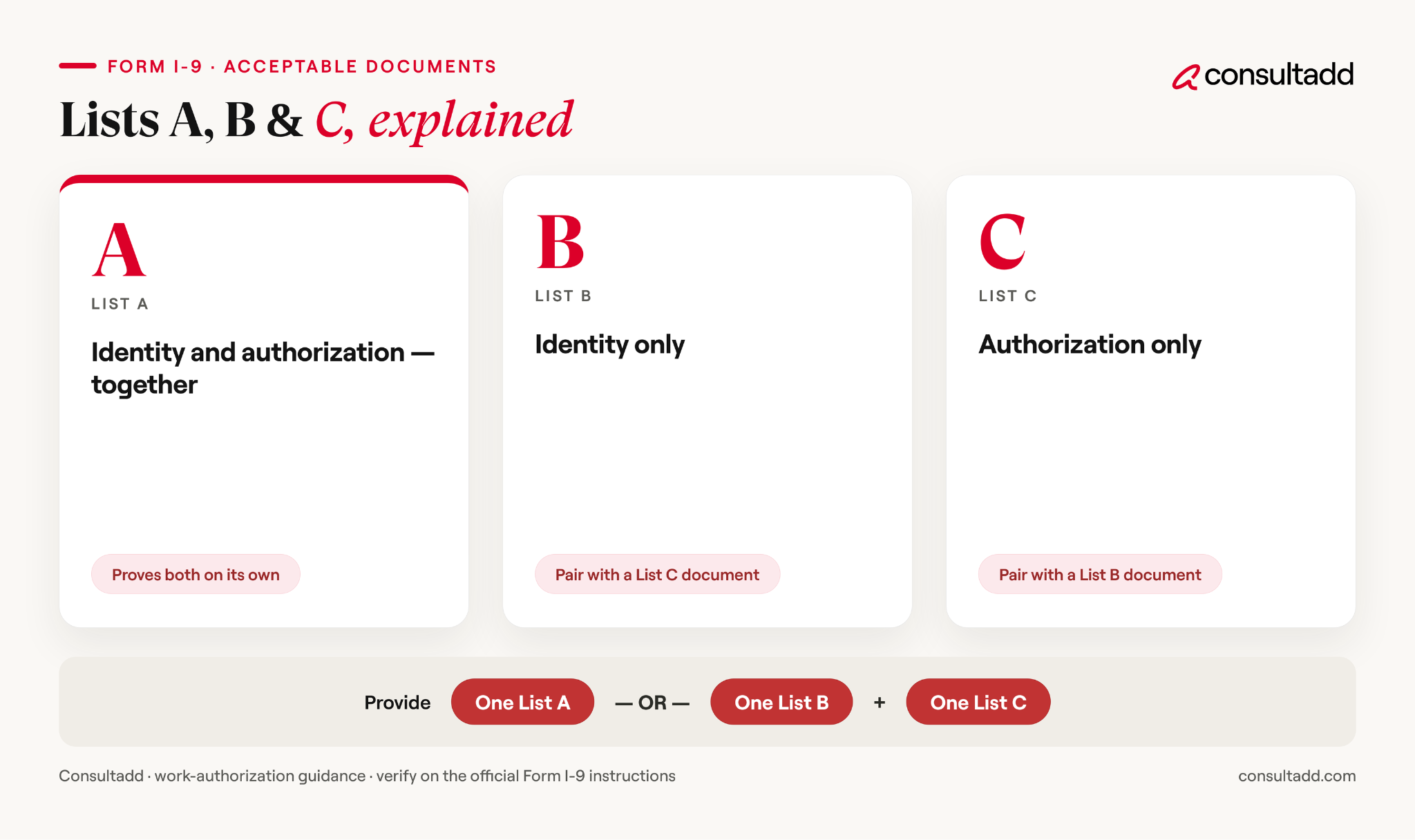
You present either one List A document or a B + C combination, and crucially, the choice of which valid documents to show is yours; employers cannot demand a specific document, a practice known as document abuse.
Many employers also run E-Verify, the government's electronic check, and STEM OPT employment requires an E-Verify enrolled employer by rule.
Practical housekeeping that prevents ugly surprises: track your document expiration dates (EADs in particular), start renewals as early as the rules allow, and keep copies of everything. Staffing and consulting employers who work with visa-holding professionals every day treat this compliance layer as routine.
Our overview of the best IT staffing firms touches on why operational maturity matters when choosing who to work through.
What employers can and can't ask
The boundaries here protect you, and knowing them changes how interviews feel.
Employers may ask the two screening questions this article is built around: whether you're authorized to work and whether you'll need sponsorship now or in the future. Those are lawful, standard, and asked of all candidates.
What crosses the line in most contexts: "Are you a US citizen?", "What country are you from?", "What visa are you on?", or demands for immigration paperwork before an offer.
Federal anti-discrimination law, enforced by the Justice Department's Immigrant and Employee Rights Section, prohibits hiring discrimination based on citizenship status and national origin against work-authorized individuals, with narrow exceptions (certain government contracts and roles with legal citizenship requirements).
University HR guidance across the country says the same thing to hiring managers: ask about sponsorship needs, never about visa types or origins.
If a recruiter pushes past the line, a composed, complete answer usually settles it: "I'm authorized to work for any US employer and won't require sponsorship," or "I'm authorized through 2027 and would need H-1B sponsorship afterward." You've answered the legitimate business question in full. Anything more is yours to share by choice, not obligation.
The bottom line on the whole topic: authorization is a matter of fact, the checkboxes are a matter of honest mapping, and the strategy is aiming your applications where your status is workable. Get those three straight and the scariest question on the application becomes the easiest one.
Start Strong With Consultadd
With 15 years in business and 5,000+ successful staffing engagements, we don't just fill roles, we build reliability into your process. We've supported 65 staffing companies in the past year alone and maintain MSAs with industry leaders like Robert Half and TEKsystems.
Here's what working with Consultadd looks like:
- Talent sourced in under 24 hours
- Ready-to-deploy candidates, vetted for experience and compliance
- Lower turnover risk: we match long-term goals, not just short-term needs
- Seamless compliance: visa, documentation, onboarding? Handled.
- Dedicated 1:1 account managers for responsive, personalized support
- Top 100 candidate matches delivered in the past year
- Strong partnerships with universities to tap into fresh, committed talent
- Post-placement support so your investment grows beyond day one
For candidates, your next opportunity is more than just a job title, it's a chance to build skills, gain experience, and move your career forward. At Consultadd, we connect technology professionals with projects and employers that align with their goals, whether they're looking for contract, contract-to-hire, or long-term opportunities.
The tech job market moves fast, but the right guidance can make all the difference. Ready to take the next step in your career journey? Explore Opportunities >>
Key takeaways
- You're legally authorized to work in the US as a citizen, national, green card holder, asylee/refugee, EAD holder, or employment-visa holder; authorization is broader than citizenship.
- F-1 students eligible for CPT/OPT and H-1B professionals both answer Yes to the authorization question; the sponsorship question is where their status honestly shows.
- Answer "Will you require sponsorship?" truthfully; a strategic-sounding No unravels at the I-9 stage and costs offers, reputations, and sometimes jobs already started.
- Verification is real: Form I-9 within three days of starting, with documents of your choosing from Lists A, B, and C, and E-Verify at many employers.
- Employers may ask about authorization and future sponsorship needs, but citizenship, national origin, and visa-type interrogations are off-limits in most hiring, and you can answer the legitimate question without volunteering the rest.
FAQs
What does "legally authorized to work in the US" mean?
It means US law permits you to be employed here: as a citizen or national, a permanent resident, an asylee or refugee, someone holding a valid EAD, or someone on an employment visa like the H-1B. It's a broader category than citizenship, and time-limited or employer-tied authorization still counts as authorization.
Am I legally authorized to work in the US on an F-1 visa?
Yes, for authorized employment. Work authorization through CPT and OPT is a benefit of F-1 status, so university advisors direct students to answer Yes on applications. The approval must actually be in place before your first day of work, and off-campus work without it violates your status.
How should H-1B holders answer "Are you legally authorized to work in the US?"
Yes. H-1B status is full legal work authorization, tied to the sponsoring employer. The second question is where the nuance lives: a new employer would need to file an H-1B transfer, so "Will you require sponsorship?" honestly gets a Yes.
Should I say No to the sponsorship question to get interviews?
No. The truth surfaces during I-9 verification and offer paperwork, and misrepresentation is grounds for rescinding offers or terminating employment. The better strategy is targeting employers with sponsorship track records, including consulting and staffing firms that employ visa-holding professionals routinely.
What documents prove work authorization for a new job?
Form I-9 accepts either one List A document proving both identity and authorization (US passport, green card, EAD, or foreign passport with qualifying I-94) or a combination of List B identity (driver's license) and List C authorization (unrestricted Social Security card). The choice among valid documents is legally yours, not the employer's.
Can an employer ask what visa I'm on?
Employers can ask whether you're authorized to work and whether you'll need sponsorship now or in the future. Asking about citizenship, national origin, or your specific visa type before an offer generally crosses into territory prohibited by federal anti-discrimination law, outside narrow exceptions like roles with legal citizenship requirements.