


Introduction
The US tech job market still runs on H1B sponsorship. For international technology professionals, sponsoring an H1B visa is the most direct path to working legally in the United States in a specialty role, whether that is software engineering, data science, cloud infrastructure, or IT consulting.
However, the landscape changed considerably in late 2025 and into 2026, and what worked for candidates three years ago no longer applies.
The H1B program has undergone what immigration attorneys are calling its most significant structural overhaul in decades. A weighted lottery replaced the old random draw. A new $100,000 fee now applies to certain petitions.
USCIS scrutiny on petition consistency has intensified. For candidates who do not have a staffing partner guiding them through this, the process can feel like trying to navigate a maze that keeps redesigning itself.
This guide explains how sponsoring an H1B visa actually works in 2026, what has changed and why it matters to you, and how partnering with a company like Consultadd gives you a genuine edge.
TL;DR
- H1B sponsorship is employer-driven. You cannot apply on your own, and success depends on finding an employer willing to sponsor your petition.
- The 2026 H1B process has changed significantly, with a wage-weighted lottery giving higher-paid, experienced candidates better selection odds.
- Preparation is critical, from securing a sponsor early to ensure your documentation and eligibility meet USCIS requirements.
- OPT, STEM OPT, and Cap-Gap provisions can help international graduates remain work-authorized while pursuing H1B status.
- Working with an experienced staffing partner like Consultadd can simplify the sponsorship process through immigration expertise, employer connections, and ongoing support.
What Sponsoring an H1B Visa Actually Means
The H1B is a temporary, nonimmigrant work visa that allows US employers to hire foreign nationals in specialty occupations. A specialty occupation is one that requires at minimum a bachelor's degree or its equivalent in a field directly related to the job duties.
Here is the part many candidates do not fully grasp: you cannot apply for an H1B yourself. The employer must initiate and file the petition on your behalf. There is no self-petition option.
The employer becomes the legal sponsor, owns the compliance obligations, and pays the filing fees. You cannot pay a company to sponsor you, that is illegal. The right employer relationship is the entire foundation of the process.
Once an employer agrees to sponsor you, here is roughly what happens:
The employer files a Labor Condition Application (LCA) with the Department of Labor, attesting to prevailing wage compliance and working conditions. If selected in the lottery (more on that in a moment), they then file an H1B petition with USCIS. Processing takes roughly two to three months after filing, or fifteen business days with premium processing. If approved and you are already in the US, your status changes. If you are abroad, you apply for the visa stamp at a US consulate.
The annual cap is 65,000 visas, plus an additional 20,000 for individuals who hold an advanced degree from a US institution. Demand consistently exceeds supply, which is why the lottery has historically been the defining moment in the process.
What Changed in 2026 And Why It Matters
The 2026 H1B cap season is the first year operating under a fundamentally different selection system. The Department of Homeland Security finalized a rule in December 2025, effective February 27, 2026, that replaced the random lottery with a wage-weighted selection process for the FY 2027 cap.
Under the old system, every registration had roughly the same chance of selection around 30% regardless of salary or experience level. Under the new system, your odds are tied directly to the Department of Labor's prevailing wage level for your occupation and location. There are four wage levels:
- Level I (entry-level): 1 lottery entry
- Level II (qualified): 2 lottery entries
- Level III (experienced): 3 lottery entries
- Level IV (fully competent): 4 lottery entries
USCIS modeling suggests Level IV positions may see selection rates approaching 60%, while Level I positions could fall below 15%. That is not a small shift, that is a complete restructuring of who gets through.
A separate Presidential Proclamation added a $100,000 fee for new H1B petitions where the beneficiary is abroad and requires consular processing.
This does not apply to change-of-status petitions for candidates already in the US, which is one reason international graduates currently on OPT or F1 have become significantly more attractive to employers this year.
For candidates, the practical implications are direct: the more experienced and specialized you are, the better your odds. And the right employer matters more than ever, because employers who cannot justify a higher wage level for your role are statistically putting you in a much weaker position in the lottery.
For more on how the weighted system works, the official guidance from USCIS is available.
Who Qualifies for H1B Sponsorship
To be eligible for sponsoring an H1B visa, candidates generally need to meet a few core criteria:
A qualifying degree. You need a US bachelor's degree or higher or a foreign equivalent in a field that is directly related to the job. Three years of relevant work experience is treated as equivalent to one year of university education for evaluation purposes, which helps professionals who did not attend a four-year institution but built deep technical knowledge on the job.
A specialty occupation role. The position itself must require that degree. Roles in software development, data engineering, cloud architecture, cybersecurity, IT consulting, and finance analytics typically qualify. Generalist roles that accept any degree field face heavier scrutiny from USCIS.
A genuine job offer. You need a formal offer from a US employer who is prepared to sponsor the petition, file the LCA, and meet prevailing wage requirements for your location and occupation.
Proper documentation. This includes educational credential evaluations (especially for foreign degrees), work history verification, and skill-specific supporting evidence. Candidates with three-year bachelor's degrees from certain countries may need supplementary coursework evaluations.
The H1B Sponsorship Process, Step by Step
Understanding the sequence helps candidates avoid the common mistake of treating visa sponsorship as an afterthought. Bring it up before you get deep into the interview process, not after you've already accepted an offer contingent on visa approval.
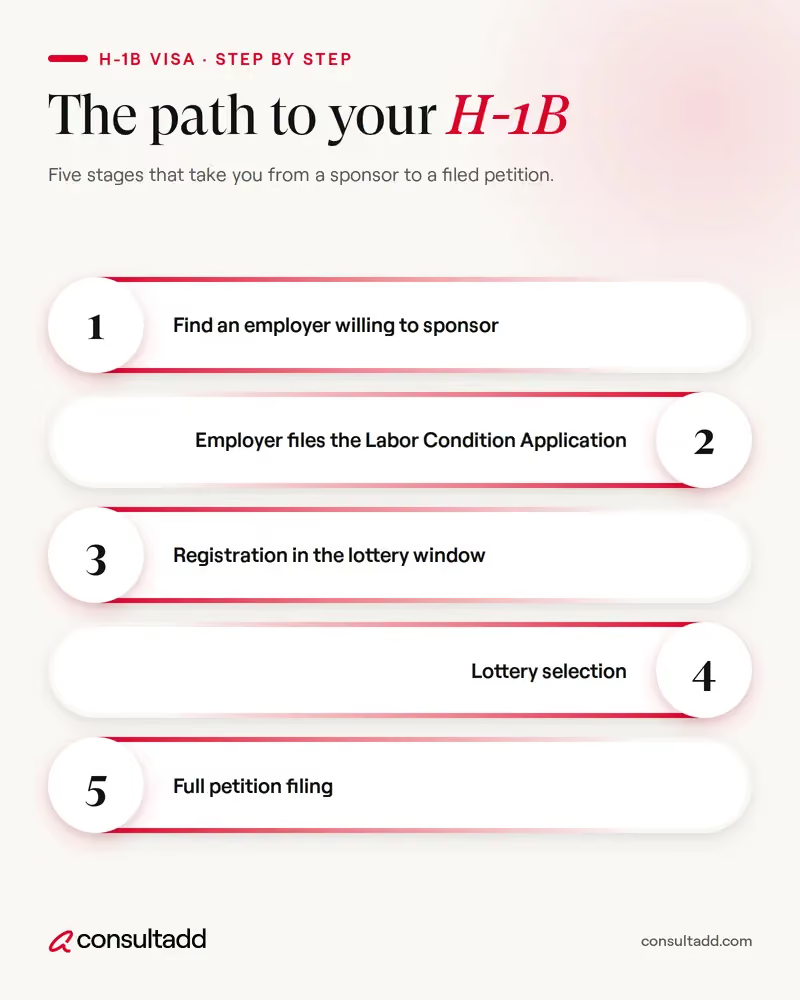
Step 1: Find an employer willing to sponsor. This is the hardest step for most candidates, and the one where staffing firms like Consultadd play the biggest role. Most large employers do sponsor, but their timelines, internal processes, and appetite for sponsoring entry-level versus senior candidates vary considerably.
Step 2: Employer files the Labor Condition Application. Before anything goes to USCIS, the employer submits an LCA to the Department of Labor certifying that they will pay the prevailing wage and that hiring you will not adversely affect working conditions for US workers.
Step 3: Registration in the lottery window. The registration window typically opens in early March. For FY 2027, it ran from March 4 to March 19, 2026. The employer submits a registration fee and enters the candidate's information, including the SOC code, location, and wage level into the USCIS online system.
Step 4: Lottery selection. USCIS runs the weighted selection and notifies employers of results. Selected registrations proceed to the full petition stage.
Step 5: Full petition filing. Approved registrations trigger a filing window (April 1 to June 30 for FY 2027). The employer submits the complete H1B petition with all supporting documentation. Premium processing expedites USCIS review to fifteen business days for an additional fee.
How Consultadd Helps Candidates Navigate H1B Sponsorship
Finding an employer who will sponsor you is the central challenge and that challenge has gotten harder, not easier, in 2026. Companies with no prior immigration infrastructure often say they are open to sponsorship in theory but freeze when they see the actual compliance requirements, the lottery timing, and the attorney fees involved.
Consultadd has been sponsoring H1B visas for IT professionals for years. We have an established immigration process and an in-house team that handles the mechanics from LCA filing and petition preparation to RFE responses and green card support.
Candidates who have worked with Consultadd consistently point to the immigration team's transparency as one of the most valuable parts of the relationship. You know what is happening at each stage, you understand your timeline, and you are not left waiting on email replies to understand your status.
Fast-track your hiring process without cutting corners. Consultadd handles technical assessments, background checks, visa support, and payroll management so you get fully trained, ready-to-deploy developers faster. Explore our immediately available core talent pool now.
This matters for H1B candidates for a specific reason: IT consulting firms that have cap-exempt institutional clients can sometimes place workers under cap-exempt arrangements, which means no lottery, no annual cap, and year-round filing eligibility.
That option is not available to every candidate, but it is worth exploring when you speak with the Consultadd team.
For candidates already on OPT or STEM OPT, Consultadd can help bridge the gap between your current authorization and your H1B, including managing Cap-Gap extensions if your OPT expires while your H1B petition is pending.
For a look at companies currently active in H1B sponsorship and their approval histories, the H1B Grader database is a useful public resource.
Practical Tips for Candidates Seeking H1B Sponsorship
Target companies with a proven sponsorship track record. Past behavior is the most reliable signal. Check public LCA databases. Consultancies, larger tech firms, and healthcare organizations tend to have established immigration pipelines.
Do not wait until March. The registration window is narrow. Employers need to have their LCA submitted and their petition documentation ready well before the window opens. If you are not in active conversations with a potential sponsor by December or January, you are likely missing the current cycle.
Know your wage level before conversations start. Your offered salary determines your lottery entry weight. Going into employer conversations without knowing where your compensation lands in the OEWS wage structure for your occupation and city means you cannot have an informed conversation about your odds.
OPT and STEM OPT are your bridging tools. If you are currently on F1 and working on OPT, you have a window. Use it to build experience, pursue senior-tier roles, and work with a staffing partner on your H1B strategy before your OPT window closes.
Understand the Cap-Gap. If your OPT expires between April 1 and September 30 and your H1B petition has been filed, you are covered by Cap-Gap protection and can continue working. Your employer needs to know this rule applies, not all HR teams do.
For candidates who want a comprehensive breakdown of the employer process and what documents are required, check out the Department of Labor's H1B program page.
Start Strong With Consultadd
With 15 years in business and 5,000+ successful staffing engagements, we don't just fill roles, we build reliability into your process. We've supported 65 staffing companies in the past year alone and maintain MSAs with industry leaders like Robert Half and TEKsystems.
Here's what working with Consultadd looks like:
- Talent sourced in under 24 hours
- Ready-to-deploy candidates, vetted for experience and compliance
- Lower turnover risk: we match long-term goals, not just short-term needs
- Seamless compliance: visa, documentation, onboarding? Handled.
- Dedicated 1:1 account managers for responsive, personalized support
- Top 100 candidate matches delivered in the past year
- Strong partnerships with universities to tap into fresh, committed talent
- Post-placement support so your investment grows beyond day one
For candidates, your next opportunity is more than just a job title, it's a chance to build skills, gain experience, and move your career forward. At Consultadd, we connect technology professionals with projects and employers that align with their goals, whether they're looking for contract, contract-to-hire, or long-term opportunities.
The tech job market moves fast, but the right guidance can make all the difference. Ready to take the next step in your career journey? Explore Opportunities >>
Key Takeaways
- The 2026 weighted lottery is a fundamental change. Higher wage levels (Level III and IV) now have dramatically better selection odds than Level I positions.
- A $100,000 fee applies to new petitions for candidates abroad requiring consular processing; candidates already in the US changing status are not subject to this fee.
- The annual cap is 85,000 visas. Candidates with US advanced degrees access a separate 20,000-visa pool.
- IT staffing firms like Consultadd offer established immigration infrastructure, in-house immigration support, and access to cap-exempt placement opportunities that most direct employers cannot offer.
- OPT and STEM OPT are strategic bridging tools. The sooner you align with a sponsoring employer, the better positioned you are for the March registration window.
FAQs
Can I sponsor my own H1B visa?
No. The H1B is an employer-sponsored visa. A US employer must file the petition on your behalf. You cannot initiate or file the petition yourself.
How long does the H1B visa last?
The initial H1B is granted for up to three years, with one extension available for a total of six years. Extensions beyond six years are possible in specific circumstances, typically tied to a pending green card application.
What is the H1B cap, and does it apply to everyone?
The standard annual cap is 65,000 visas, with an additional 20,000 for US advanced degree holders. However, employers such as universities, nonprofit research organizations, and government research institutions are cap-exempt, meaning they can file year-round without the lottery.
What happens if I am not selected in the lottery?
You can register in the following year's lottery. If you are in the US on OPT or STEM OPT, you may be able to continue working while you try again. Consulting firms like Consultadd can also explore cap-exempt placement arrangements depending on your role and the client environment.
Does H1B sponsorship affect my green card path?
Not negatively. The H1B is a dual-intent visa, which means you can apply for permanent residency while on H1B status. Many candidates use the H1B period to initiate their I-140 green card petition with employer support.
What is a Cap-Gap extension?
If your OPT status expires between April 1 and September 30 and a timely-filed H1B petition is pending or approved, Cap-Gap protection allows you to continue working until October 1, when H1B status begins.
.webp)



.webp)
