

Introduction
A recruiter calls with a contract role at "$65 an hour." A different company offers $120,000 a year. Which one pays more? You can't answer that until you know exactly what each number includes.
So what is rate of pay, and why do two offers that look similar end up so different on a paycheck?
Your rate of pay is the amount you earn for a set unit of work, usually an hour, a week or a year. This guide covers the common types of pay rates, how to calculate and convert them, how overtime uses your "regular rate," and how the same number means different things on W-2, 1099 and corp-to-corp (C2C) arrangements.
TL;DR
- Rate of pay is what you earn per unit of work, such as per hour, per week or per year, before taxes and deductions.
- Common types include hourly, salary, day rate, piece rate, commission and contract rates.
- A full-time year is usually counted as 2,080 hours, which is how most people convert between hourly and annual pay.
- For overtime, the law uses your "regular rate," which can include bonuses and other pay, not just your base hourly rate.
- A W-2 rate and a 1099 or C2C rate aren't directly comparable, because self-employed workers pay both halves of Social Security and Medicare tax and buy their own benefits.
What is rate of pay?
Rate of pay, often shortened to pay rate, is the amount an employer agrees to pay you for a specific unit of time or output. If you earn $30 an hour, your rate of pay is $30 per hour. If you earn $90,000 a year, your rate of pay is $90,000 annually.
It's a gross figure. Your rate of pay is what you earn before income tax, Social Security, Medicare, retirement contributions or insurance premiums come out. What lands in your bank account is your net pay, and it's always lower.
Rate of pay is also different from total compensation. Bonuses, commissions, benefits, stock and paid time off can add a lot of value on top of your base rate. When you compare offers, look at both.
Types of pay rates
Employers set pay in different ways depending on the job, the industry and how the work is measured.
Many jobs combine types. A sales role might pay a base salary plus commission. A contract developer might earn an hourly rate plus an overtime rate for hours beyond 40 in a week.
How to calculate your rate of pay
The math is simple once you know the standard assumption: a full-time year is usually counted as 40 hours a week for 52 weeks, or 2,080 hours.
Converting hourly to annual
Multiply your hourly rate by the number of hours you work in a year.
Hourly rate × 2,080 = annual pay (for full-time work)
At $40 an hour, that's $40 × 2,080 = $83,200 a year.
Converting annual to hourly
Divide your annual salary by 2,080.
Annual salary ÷ 2,080 = hourly equivalent
A $100,000 salary works out to about $48.08 an hour.
Converting for part-time or different schedules
If you don't work 40 hours a week, use your actual hours. Someone working 25 hours a week for 50 weeks works 1,250 hours a year. At $30 an hour, that's $37,500.
Monthly figures are annual pay divided by 12. They're approximate because months have different numbers of workdays.
Gross pay vs net pay
Every number above is gross pay. To estimate net pay, subtract federal and state income tax, Social Security and Medicare, and any deductions like health insurance or 401(k) contributions. The difference depends on where you live, your filing status and the benefits you choose, so a paycheck calculator for your state gives a better estimate than a single percentage.
Regular rate of pay and overtime
Here's where "rate of pay" gets a legal meaning. Under the Fair Labor Standards Act (FLSA), overtime isn't always calculated from your base hourly rate. It's calculated from your regular rate of pay.
According to the Department of Labor's FAQ on the regular rate, most nonexempt employees covered by the FLSA must receive overtime of at least one and one-half times their regular rate for hours worked beyond 40 in a workweek.
The regular rate can be higher than your base rate. DOL Fact Sheet #56A explains that it includes all pay for employment, with only a specific list of exclusions allowed by law. Nondiscretionary bonuses usually count.
The DOL's guidance on bonuses notes that all compensation for hours worked, services or performance belongs in the regular rate unless it falls under one of those exclusions.
A worked example
Say you earn $30 an hour, work 45 hours in a week, and earn a $90 nondiscretionary productivity bonus that week.
- Straight-time pay: $30 × 45 hours = $1,350
- Add the bonus: $1,350 + $90 = $1,440
- Regular rate: $1,440 ÷ 45 hours = $32 per hour
- Overtime premium: half of $32 is $16, times 5 overtime hours = $80
- Total pay for the week: $1,440 + $80 = $1,520
If the employer had used only the $30 base rate, the overtime premium would have been $75 instead of $80. Small gaps like that add up over a year.
Salaried employees who qualify as exempt under the FLSA generally aren't entitled to overtime. Exemption depends on salary level and job duties, not just job title, and some states set stricter rules than federal law.
Pay rate vs bill rate
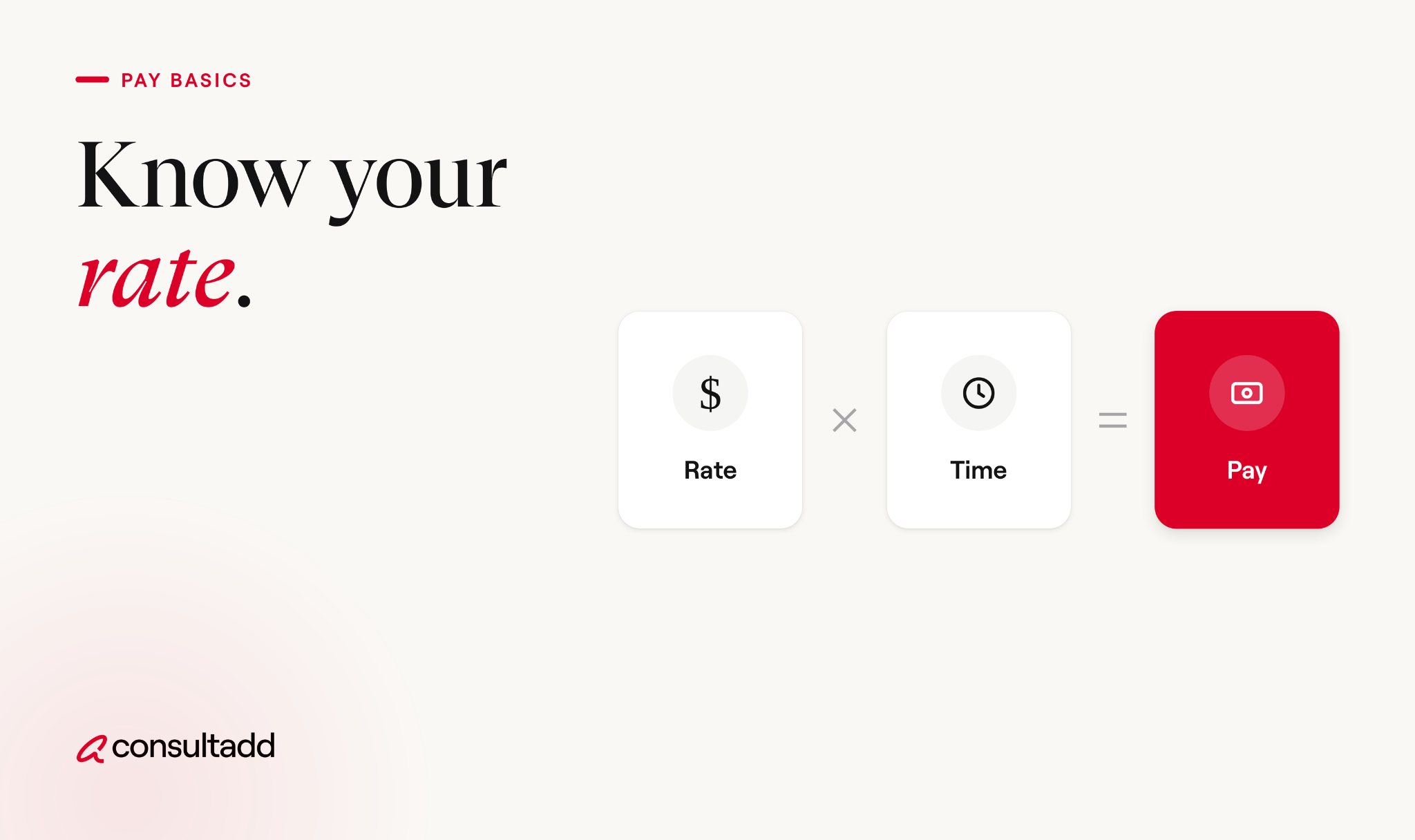
If you work through a staffing agency, you'll hear two numbers: your pay rate and the bill rate. Your pay rate is what you earn per hour. The bill rate is what the agency charges the client for your hour of work.
The gap between them isn't all profit. It covers employer payroll taxes, insurance, recruiting costs and the agency's margin.
Our guide to software development staffing breaks a bill rate into its layers with an example.
When a recruiter quotes a number, ask directly: "Is that my pay rate or the bill rate?" Only one of them determines your paycheck.
Rate of pay on W-2, 1099 and C2C
The same hourly number means very different take-home value depending on how you're employed. This trips up a lot of contractors, especially in IT.
On W-2, the employer withholds your taxes, pays its share of Social Security and Medicare, and may offer benefits. On 1099 or C2C, you're running your own business.
The IRS explains that the self-employment tax rate is 15.3%, made up of 12.4% for Social Security and 2.9% for Medicare. A W-2 employee pays half of that, 7.65%, and the employer covers the rest.
That's why a 1099 or C2C rate usually needs to be higher than a W-2 rate for the same role to leave you equally well off.
If you're weighing contract work, our post on staffing agencies for remote jobs explains how W-2 hourly, C2C and direct-hire roles usually work through an agency.
How to evaluate a rate of pay offer
When we talk with consultants about contract offers, the hourly number gets most of the attention. The questions around it often matter just as much. Before you accept, find out:
- Is this rate W-2, 1099 or C2C?
- Am I eligible for overtime, and at what rate?
- Are paid holidays and PTO included, or do I only get paid for hours worked?
- What benefits are offered, and what do they cost me?
- How many hours per week are expected or guaranteed?
- How often am I paid, weekly, biweekly or monthly?
- Are travel or equipment costs reimbursed?
- For contract roles, what's the expected assignment length?
A contract role at a higher hourly rate with no paid holidays and a three-month end date can earn less over a year than a slightly lower W-2 rate with benefits and a longer assignment.
How to negotiate your rate of pay
Start with real market data rather than a gut number. The Bureau of Labor Statistics publishes wage data by occupation, and our guide to hiring AWS developers shows how that data gets used to anchor rates for technical roles.
A few habits help:
- Convert every offer to the same basis, such as annual W-2 equivalent, before comparing.
- Name a range rather than a single number, with your target near the top.
- Tie your ask to specific skills or certifications the role requires.
- For contract roles, negotiate the overtime rate and holiday pay along with the hourly rate.
Employers think in total cost too.
Our breakdown of contract vs permanent staffing costs explains why a salaried hire costs the company well above base pay, which is useful context when you're negotiating.
Putting your rate of pay in context
So, what is rate of pay in practice? It's the starting number, not the whole picture. Once you know whether a rate is hourly or salaried, W-2 or self-employed, overtime-eligible or exempt, you can compare offers on equal terms and spot when a high number is hiding missing benefits or unpaid time.
This guide is general information, not tax or legal advice, so check state rules and talk to a tax professional for your situation.
Start Strong With Consultadd
With 15 years in business and 5,000+ successful staffing engagements, we don't just fill roles, we build reliability into your process. We've supported 65 staffing companies in the past year alone and maintain MSAs with industry leaders like Robert Half and TEKsystems.
Here's what working with Consultadd looks like:
- Talent sourced in under 24 hours
- Ready-to-deploy candidates, vetted for experience and compliance
- Lower turnover risk: we match long-term goals, not just short-term needs
- Seamless compliance: visa, documentation, onboarding? Handled.
- Dedicated 1:1 account managers for responsive, personalized support
- Top 100 candidate matches delivered in the past year
- Strong partnerships with universities to tap into fresh, committed talent
- Post-placement support so your investment grows beyond day one
For candidates, your next opportunity is more than just a job title, it's a chance to build skills, gain experience, and move your career forward. At Consultadd, we connect technology professionals with projects and employers that align with their goals, whether they're looking for contract, contract-to-hire, or long-term opportunities.
The tech job market moves fast, but the right guidance can make all the difference. Ready to take the next step in your career journey? Explore Opportunities >>
Key takeaways
- Rate of pay is your gross earnings per unit of work, before taxes, deductions and benefits.
- Hourly, salary, day rate, piece rate, commission and contract rates are the most common pay structures.
- Use 2,080 hours to convert between hourly and annual pay for full-time work.
- Overtime is based on your FLSA regular rate, which can include nondiscretionary bonuses, not just base pay.
- Compare W-2, 1099 and C2C offers on an equal basis, since self-employed workers pay the full 15.3% self-employment tax and fund their own benefits.
FAQs
What does rate of pay mean?
Rate of pay is the amount you earn for a set unit of work, such as per hour, per day or per year. It's a gross figure, meaning it's calculated before taxes and deductions. Your take-home pay will be lower.
Is rate of pay hourly or salary?
It can be either. Hourly workers have a rate of pay per hour, while salaried workers have an annual rate of pay divided into regular paychecks. Some jobs also use day rates, piece rates or commission.
What is the regular rate of pay?
Under the FLSA, the regular rate of pay is the hourly rate used to calculate overtime. It includes all pay for employment, such as nondiscretionary bonuses, except for specific exclusions listed in the law. It can be higher than your base hourly rate.
How do I calculate my hourly rate from my salary?
Divide your annual salary by 2,080, which is 40 hours a week for 52 weeks. For example, a $90,000 salary is about $43.27 an hour. If you work a different schedule, divide by your actual annual hours instead.
What is the difference between pay rate and bill rate?
Your pay rate is what you earn per hour. The bill rate is what a staffing agency or consultancy charges the client for your work. The difference covers employer taxes, insurance, overhead and the agency's margin.
Why are 1099 and C2C rates higher than W-2 rates?
Self-employed workers pay the full 15.3% Social Security and Medicare tax instead of splitting it with an employer. They also pay for their own health insurance, retirement savings and unpaid time off. A higher rate helps cover those costs.