


Introduction
Here is a framing problem that shows up constantly in conversations about IT contract staffing: companies treat it as what you do when the real plan falls through.
The real plan, in this framing, is hiring a full-time employee. Contract staffing is the consolation prize you use when that takes too long, when budget is uncertain, or when you need someone tomorrow and cannot afford to wait three months for an offer to clear.
That framing is not just wrong. It is expensive.
The companies winning in tech hiring right now are the ones that have stopped treating contract staffing as a fallback and started treating it as a design decision.
- They ask, before a role is even posted, whether this work calls for a permanent headcount addition or a contract engagement.
- They maintain relationships with contract talent pools the same way they maintain relationships with permanent candidates.
- They use the flexibility of contract staffing not because they have to, but because it gives them something permanent hiring cannot: the ability to get the right person into a role in days
This blog is about that mindset shift, and the practical questions that follow from it.
TL;DR:
- IT contract staffing is no longer a backup plan,it's a strategic workforce model that helps companies hire faster, scale efficiently, and reduce hiring risk.
- Choose contract staffing for project-based work, specialized skills, and rapid hiring needs
- The true cost comparison goes beyond salary, as full-time employees include benefits, taxes, onboarding and long-term expenses.
- Many organizations now use a hybrid workforce, combining permanent employees with contract professionals to balance flexibility and business continuity.
- Success depends on planning ahead, partnering with the right staffing firm, and treating contract talent as a long-term workforce asset.
The State of IT Contract Staffing in 2026
Contract and contingent hiring has been growing quietly for years. After three consecutive years of modest contraction in the broader staffing market, 2026 looks like a genuine inflection point.
The American Staffing Association's Staffing Index rose steadily through late 2025, with staffing employment running roughly 4.7% above the same period in 2024.
The Staffing Industry Analysts forecast for 2026 projects the first meaningful growth year since 2022, with the professional services and technology segments expected to outperform the overall market.
More telling than the growth numbers is the shift in how companies are using contract staffing. Analysis from KORE1 covering Q4 2025 through Q1 2026 found that contract-to-hire has become the new default for senior IT roles, with direct hire losing market share in that segment every quarter.
This is not driven by cost alone. It is driven by the reality that permanent hiring cycles are too slow and the penalty for a wrong hire in a senior technical role is too high.
IT staffing searches hit a five-year high in late 2025, consistent with a broader shift from passive to active hiring intent across technology companies. Organizations that had been cautious about headcount through 2024 started moving again, but differently than before. They are prioritizing contract and project-based arrangements over permanent roles, especially for work tied to specific transformation initiatives.
Why the "Backup Plan" Framing Hurts Companies
There is a concrete cost to treating IT contract staffing reactively rather than strategically, and it shows up in a few predictable places.
Slower time-to-fill
- When companies only turn to contract staffing after a permanent search has stalled, they have already lost weeks.
- Specialized IT contract talent, especially in areas like cloud security, AI implementation, and DevSecOps, is in short supply.
- Getting ahead of that curve means maintaining relationships with contract talent pools before you need them, not starting a search from scratch when a project deadline is three weeks out.
Worse candidate quality:
- The best contract IT professionals have options. They gravitate toward companies that treat contract engagements professionally, communicate clearly about scope and duration, and pay on time without friction.
- Companies that only engage contract staffing in crisis mode often end up with whoever is available that week rather than who they actually need.
Missed evaluation opportunity:
- One of the genuine advantages of contract staffing is that it lets companies evaluate someone's work before making a permanent offer.
- Contract-to-hire arrangements reduce hiring risk significantly. But this only works if the engagement is structured thoughtfully from the start, not cobbled together in a rush.
The Real Cost Math
The cost comparison between contract and permanent IT hiring is more nuanced than most people realize. Here is what the numbers actually show.
The visible cost of a contractor is higher on an hourly basis. Contract IT professionals typically bill at rates that can look 2 to 3 times higher than equivalent permanent salary if you only compare base compensation. That comparison is misleading.
Full-time employees carry significant costs beyond salary. Benefits packages, healthcare contributions, paid leave, payroll taxes, and onboarding expenses typically add 25 to 40 percent to the stated salary. That means a $100,000 salaried engineer actually costs $125,000 to $140,000 or more per year, before accounting for the time and internal resources spent recruiting them.
That said, contract staffing is not always the cheaper option. For roles that need to stay in place for two or more years, require deep institutional knowledge, or carry strategic leadership responsibility, the math often flips.
The cost of continuous contract renewal, combined with the loss of retention and cultural integration that comes with permanent employment, can make permanent hiring more economical at longer time horizons.
The right framework is not "which model is cheaper" in the abstract. It is "which model fits the actual nature and duration of this work."
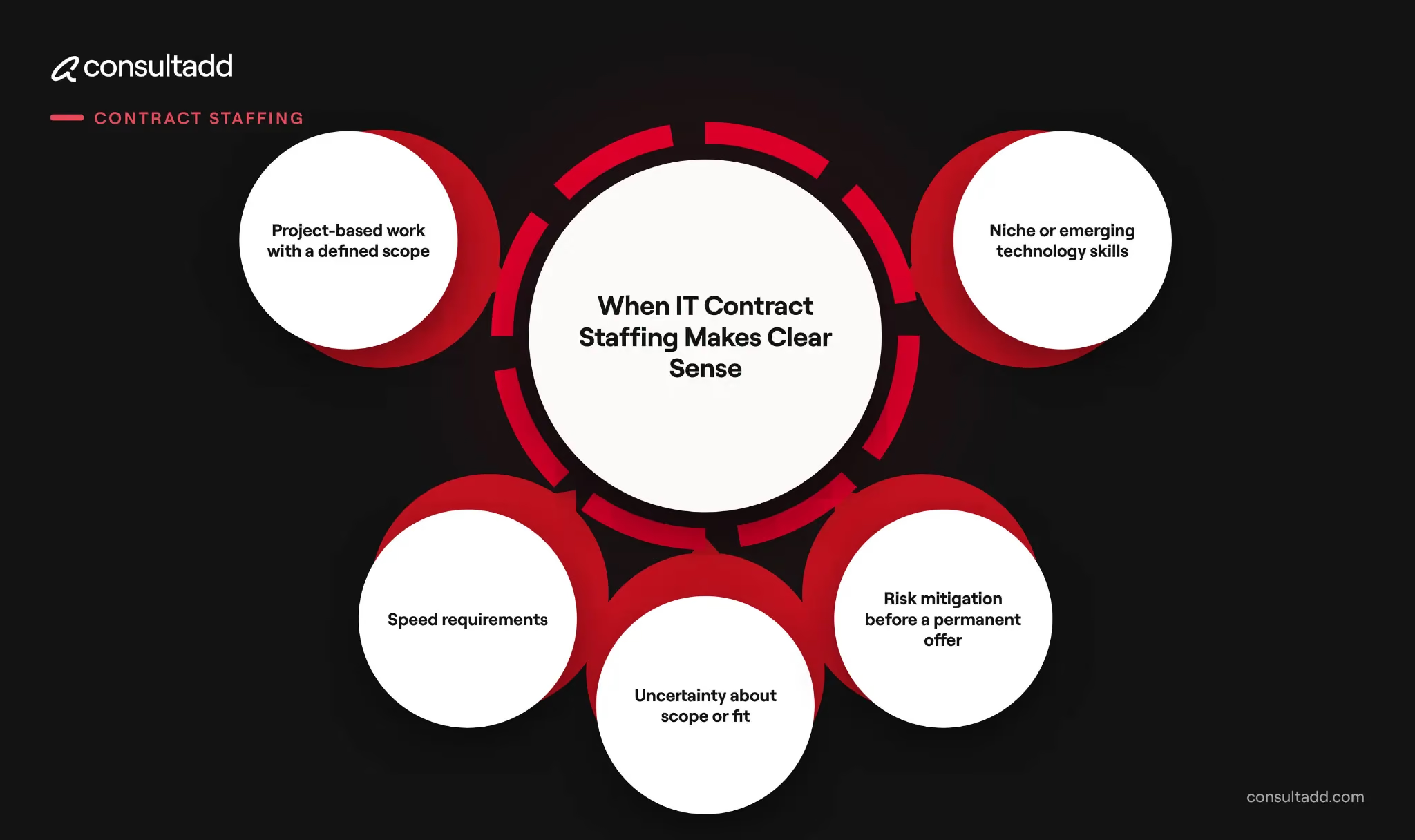
When IT Contract Staffing Makes Clear Sense
There are specific situations where contract staffing is not just a reasonable option but the obviously correct one. Here are the patterns that show up most often:
Project-based work with a defined scope:
- Cloud migrations, system overhauls, security audits, platform builds, and similar initiatives have start and end points.
- Hiring permanent employees for work that has a clear conclusion creates a retention and offboarding problem that does not need to exist. Contract staffing aligns the workforce with the work.
Niche or emerging technology skills:
- AI engineering, cloud security, and advanced data science roles require specialization that may not need to live permanently in your organization.
- A 12-month contract with a specialist who has done this exact thing at three other companies often produces better results than trying to upskill a generalist or hiring someone into a permanent role whose peak value is front-loaded.
Speed requirements:
- Specialized contract staffing firms maintain pre-vetted talent pools. Getting a qualified engineer onboard in days rather than months is genuinely possible with the right partner.
- For projects where time-to-productivity matters, this is a meaningful operational advantage.
Uncertainty about scope or fit:
- When a company is not sure yet whether a function needs to be permanent, or when the skills required are likely to shift as a project evolves, contract staffing provides room to learn before committing.
- This is especially valuable in organizations going through significant technology change.
Risk mitigation before a permanent offer:
- Contract-to-hire arrangements give both sides time to evaluate fit before making a long-term commitment.
- Research consistently shows that early-stage mis-hires are expensive, disruptive, and hard to reverse quickly.
- Starting with a contract period reduces that exposure.
When IT Contract Staffing Is the Wrong Tool
Being clear about when contract staffing does not fit is just as important.
Core long-term roles:
- Functions that require deep institutional knowledge, leadership continuity, or strong cultural alignment are generally better served by permanent hires.
- The cost of losing that institutional knowledge when a contract ends can outweigh the flexibility benefits.
Roles requiring long-term investment:
- Some positions justify years of onboarding, training, and development.
- If you are building a leadership pipeline or investing in someone whose value compounds over time, contract staffing is not the right vehicle.
When team cohesion is a priority:
- Research consistently finds that permanent employees show higher organizational citizenship behaviors: they mentor colleagues, suggest improvements, and contribute to team culture in ways that contract workers typically do not.
- If team cohesion is a strategic priority, over-relying on contract staffing can erode it.
When the math does not work at longer durations:
- As noted above, the cost advantage of contract staffing narrows and eventually reverses at longer time horizons.
- If a role is genuinely permanent and the skills are not especially scarce, building that headcount into a permanent hire often makes more financial sense.
Read more about IT staffing done right.
The Hybrid Workforce Model: Where Most Companies Are Landing
The companies doing this well are not choosing between contract and permanent. They are building workforce architectures that deliberately combine both.
A typical model looks like this: a permanent core team handles long-term operations, institutional knowledge, leadership, and culture. Contract professionals provide surge capacity for defined projects, fill specialized roles during peak demand, and plug gaps while permanent searches are underway.
This blended approach is increasingly embedded in workforce planning rather than treated as an exception. Organizations exploring flexible workforce models are assessing how contract IT staffing supports both immediate needs and long-term digital roadmaps, not just how it covers short-term gaps.
The shift that matters is from reactive to proactive. The organizations that get the most out of IT contract staffing maintain warm relationships with contract talent before they need them, track their vendor relationships actively, and plan contract engagements with the same rigor they apply to permanent hires.
Contract Hiring vs Permanent Hiring
What the IT Contract Talent Market Looks Like Right Now
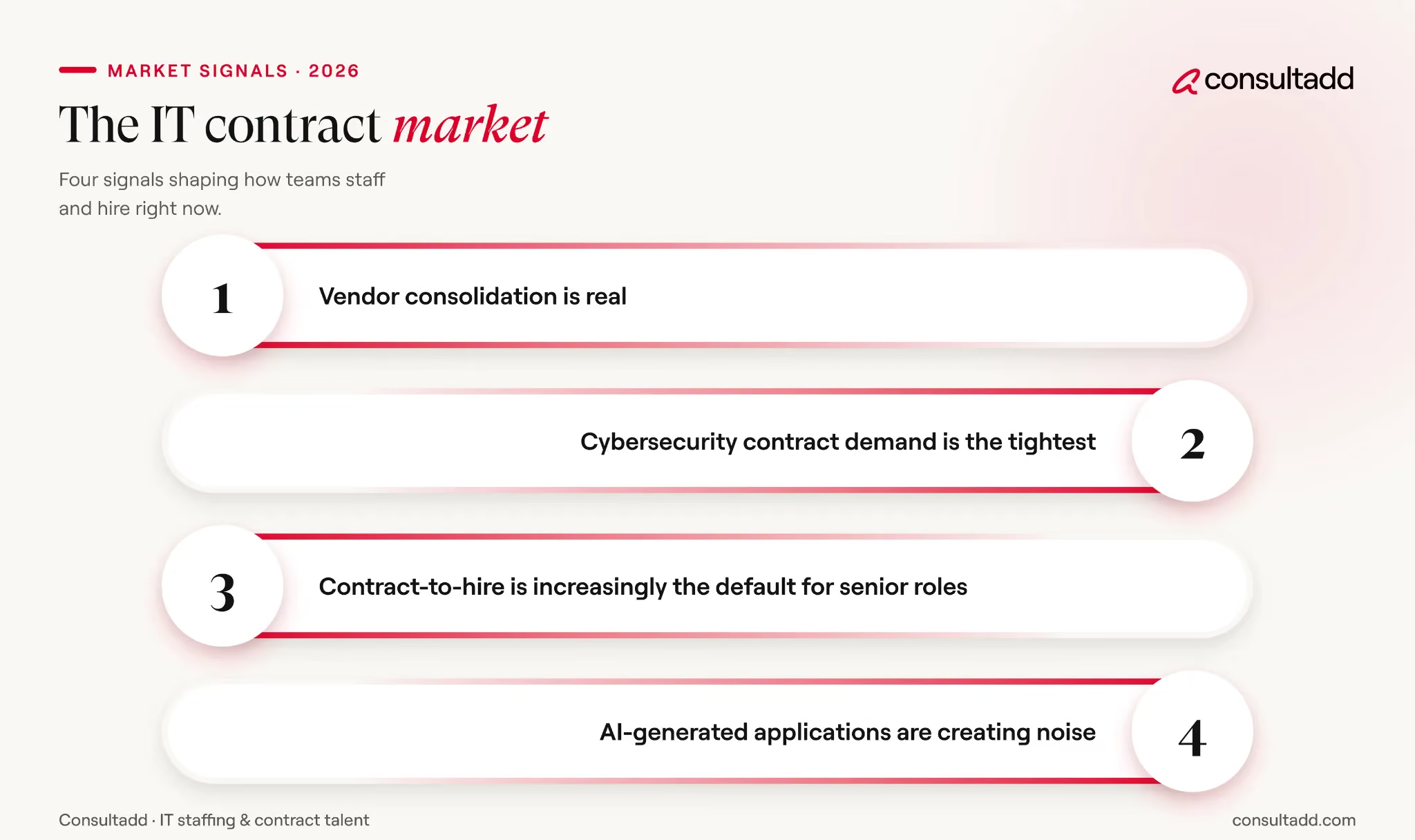
A few specific dynamics are shaping the contract talent market in 2026 that are worth understanding before you start a search.
Vendor consolidation is real:
- Enterprise buyers are cutting their staffing vendor rosters significantly. A financial services company tracked by KORE1 cut from eleven active IT vendors to four at the start of Q1 2026 and saved 22 percent on staffing costs while actually improving time-to-fill.
- The lesson: working with fewer, higher-performing partners often produces better results than spreading searches across a long vendor list.
Cybersecurity contract demand is the tightest:
- In the KORE1 data, a federal contractor searching for four cleared cloud security engineers across six weeks and four agencies surfaced exactly three qualified candidates.
- If cybersecurity contract roles are on your roadmap, start the search earlier than you think you need to.
Contract-to-hire is increasingly the default for senior roles:
- For senior IT positions, both companies and candidates have started to prefer contract engagements as an evaluation period before permanent employment.
- The mutual risk reduction is appealing on both sides.
AI-generated applications are creating noise:
- The volume problem in permanent hiring is spilling into contract staffing as well.
- Pre-vetted talent pools maintained by specialized staffing firms are worth more than they used to be, because they filter out the volume problem before it hits your desk.
How to Get More Out of IT Contract Staffing
A few practical points that consistently separate companies that use contract staffing well from those that do not:
Treat contract professionals like professionals:
- Onboarding processes, clear scope documentation, timely payments, and genuine communication about project status affect contractor experience and, by extension, contractor performance.
- Word travels in specialized talent communities.
Define scope before you search:
- The more specific you can be about what success looks like, the duration of the engagement, the technologies involved, and the deliverables expected, the better the match you will get from a staffing partner.
Invest in a real onboarding process:
- Contract professionals typically require minimal training on their technical specialty.
- But they do need context: how the team works, where the relevant documentation lives, who the stakeholders are, what the communication norms are.
Maintain relationships between engagements:
- If a contractor performed well, stay in contact.
- The IT contract talent market is small enough that re-engaging a known quantity is almost always faster and lower-risk than starting a fresh search.
Use data to evaluate your staffing vendors:
- Track which partners are submitting candidates that actually land. The KORE1 data on enterprise vendor consolidation found that most agencies on a typical roster were submitting resumes without landing hires.
- Measuring hit rates over 24 months of actuals produces a very different picture than the one agencies present in their sales conversations.
Start Strong With Consultadd
With 15 years in business and 5,000+ successful staffing engagements, we don't just fill roles, we build reliability into your process. We've supported 65 staffing companies in the past year alone and maintain MSAs with industry leaders like Robert Half and TEKsystems.
Here's what working with Consultadd looks like:
- Talent sourced in under 24 hours
- Ready-to-deploy candidates, vetted for experience and compliance
- Lower turnover risk: we match long-term goals, not just short-term needs
- Seamless compliance: visa, documentation, onboarding? Handled.
- Dedicated 1:1 account managers for responsive, personalized support
- Top 100 candidate matches delivered in the past year
- Strong partnerships with universities to tap into fresh, committed talent
- Post-placement support so your investment grows beyond day one
For candidates, your next opportunity is more than just a job title, it's a chance to build skills, gain experience, and move your career forward. At Consultadd, we connect technology professionals with projects and employers that align with their goals, whether they're looking for contract, contract-to-hire, or long-term opportunities.
The tech job market moves fast, but the right guidance can make all the difference. Ready to take the next step in your career journey? Explore Opportunities >>
Key Takeaways
- IT contract staffing works best when it is treated as a deliberate design decision rather than a fallback when permanent hiring stalls.
- The cost comparison between contract and permanent hiring requires including total employment costs. Benefits, payroll taxes, and onboarding expenses add 25 to 40 percent to salary, making contract arrangements more cost-competitive than headline hourly rates suggest.
- Contract-to-hire has become the default for senior IT roles, with both companies and candidates using it as a lower-risk evaluation period before permanent employment.
- Cybersecurity and cloud security contract talent is the tightest segment in the current market, requiring longer lead times than most other IT roles.
FAQs
What is IT contract staffing?
IT contract staffing involves hiring technology professionals for a defined period or specific project rather than as permanent employees. The staffing agency typically manages payroll, compliance, and benefits for the contract worker, while the client company directs the day-to-day work.
How is IT contract staffing different from staff augmentation?
They are closely related and the terms are often used interchangeably. Staff augmentation typically refers to extending an existing in-house team with external contract professionals who work as part of your team. In practice, the distinction matters less than the specifics of how the engagement is structured.
Is IT contract staffing more expensive than permanent hiring?
On an hourly basis, contract rates are typically higher than equivalent salary. But total employment costs for permanent employees, including benefits, payroll taxes, paid leave, and onboarding, typically add 25 to 40 percent to the stated salary. For project-based or short-duration work, contract staffing is often more cost-effective.
What IT roles are best suited for contract staffing?
Project-based roles with defined scopes and timelines are the clearest fit. Specialized areas where niche expertise is needed for a limited period, such as cloud migration, cybersecurity assessments, AI implementation, or platform builds, are also strong candidates.
What is a contract-to-hire arrangement?
Contract-to-hire means a professional starts in a contract role with an explicit or implicit understanding that the company may offer permanent employment after an evaluation period, typically three to six months. Both sides benefit from the arrangement.
How do we evaluate whether a staffing partner is performing?
Track hit rates over time, meaning what percentage of candidates a vendor submits actually results in a hire, not just what volume they are submitting. Also track time-to-fill, quality of first-round candidates, and retention of placed contractors past the 90-day mark.
What should we watch out for in IT contract staffing?
Worker misclassification is the most significant legal risk. If a contract arrangement effectively makes someone a de facto employee, including directing their work closely, providing equipment, and controlling their schedule, classification rules may require treating them as an employee.



.webp)
.png)
