

Introduction
If you're sponsoring a consultant for a green card, or you're the consultant waiting on one, the Department of Labor sets the pace for the first year or more.
Here's the short answer on DOL H-1B PERM processing right now. An H-1B labor condition application still clears in about a week. A PERM case is a different story. As of October 31, 2026, DOL reported analyst-review averages of 300 calendar days over 30 days, 315 over 90 days and 360 over 180 days, and that's before you count the prevailing wage and recruitment steps.
This guide breaks down each DOL stage, what the current numbers mean, and how to plan a sponsorship so the timeline doesn't catch anyone off guard.
TL;DR
- The DOL reviews H-1B labor condition applications within 7 working days, which makes it the fastest DOL step by far.
- PERM analyst review averaged 300 to 360 days in DOL's October 31, 2026 data, down from more than 500 days earlier in the year.
- Prevailing wage determinations for PERM take roughly three to four months right now, and they must finish before recruitment can safely start.
- Counting every stage, an unaudited PERM case usually takes 16 to 20 months. An audit can add nine months or more.
- There's no premium processing at DOL, so the only real lever is starting early and filing a clean case.
What the DOL actually processes for H-1B and PERM
People often say "DOL processing" as if it's one queue. It isn't. The DOL's Office of Foreign Labor Certification (OFLC) handles several separate filings, and each moves at its own speed.
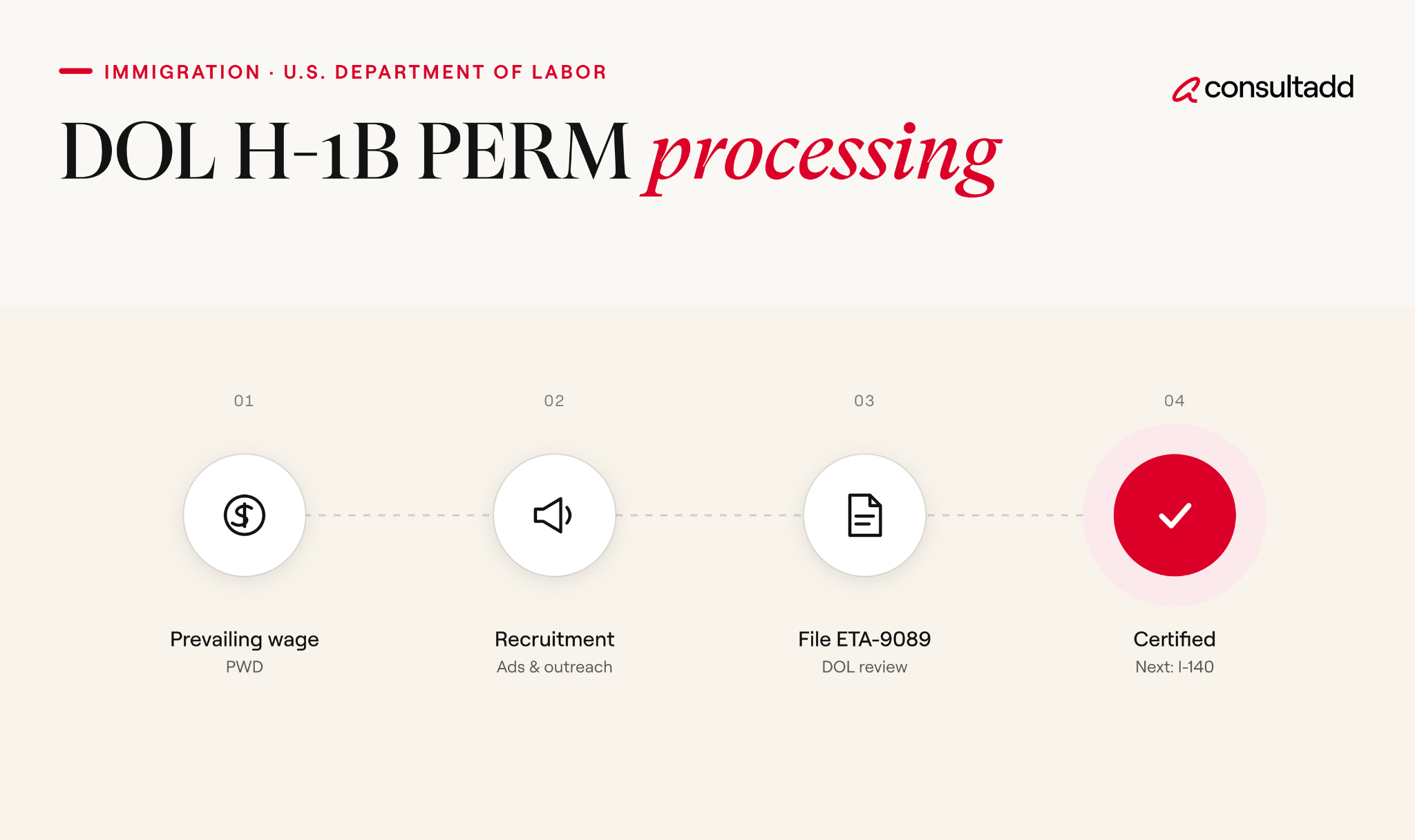
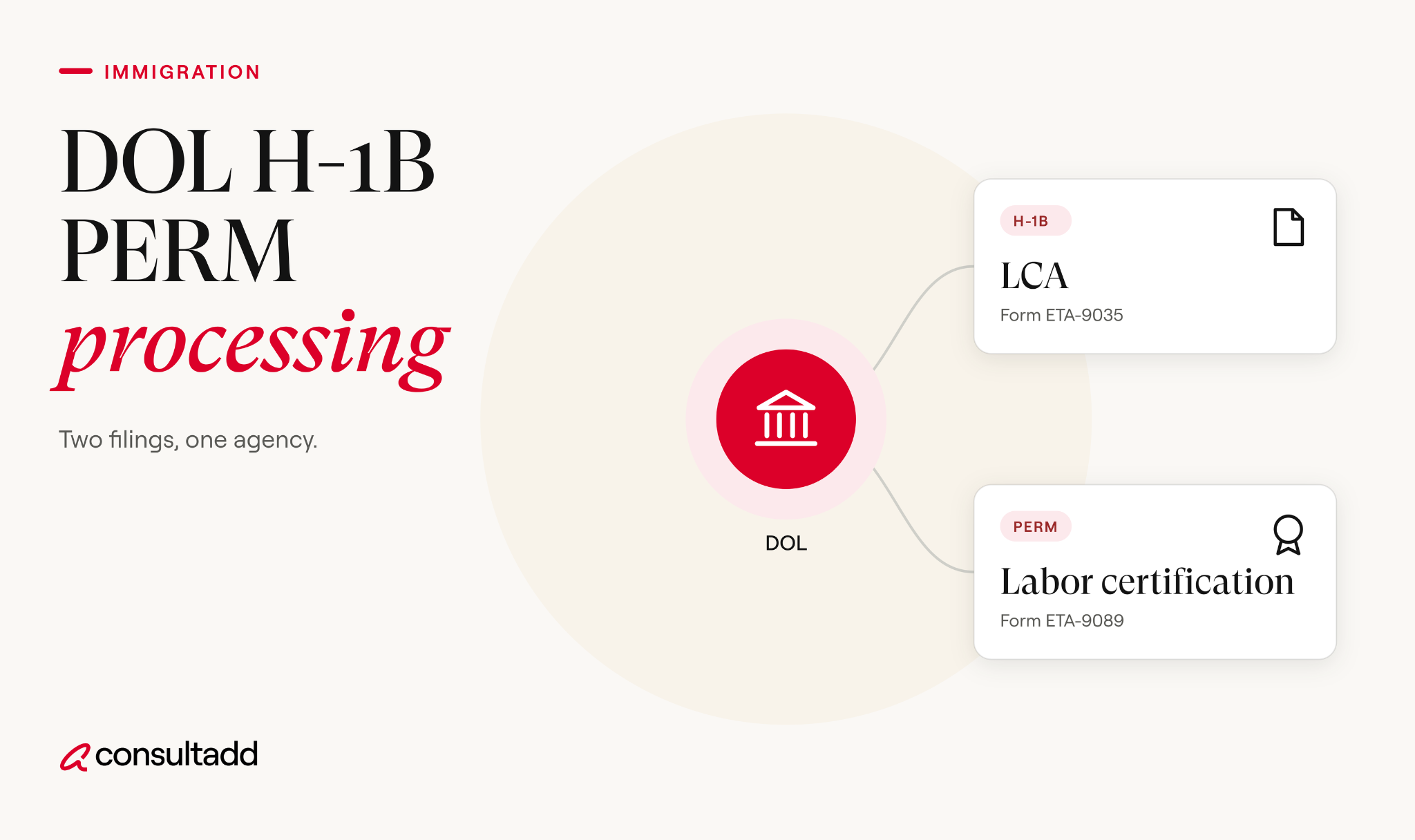
For a temporary H-1B, the employer files a labor condition application (LCA) on Form ETA-9035. For a green card through PERM, the employer first gets a prevailing wage determination on Form ETA-9141, runs recruitment, and then files the PERM application on Form ETA-9089.
All of these are filed through the DOL's Foreign Labor Application Gateway, known as FLAG. The DOL posts official wait times on its FLAG processing times page, and the OFLC permanent labor certification program page covers the rules behind PERM.
New to sponsorship in general? Consultadd's guide on what visa sponsorship means and how it works covers the basics before you get into timelines.
Where DOL H-1B PERM processing stands in November 2026
H-1B labor condition applications
The LCA is the one DOL step that stays predictable. Per the DOL's own guidance, LCAs are reviewed within seven working days for completeness and obvious errors or inaccuracies.
The main timing rule to remember is on the front end. An LCA can't be submitted more than 6 months before the employment start date. For extensions, most staffing firms file the LCA as soon as that window opens so it never holds up the I-129.
The DOL's H-1B program page lists the employer obligations that come with each certified LCA.
Prevailing wage determinations
This is where waits start to stretch. In DOL's September 30 data, both PERM and H-1B prevailing wage requests from June 2026 filings were being worked on.
The October 31 update moved faster on the PERM side. Prevailing wage determinations were being issued for August 2026 PERM OEWS requests and July 2026 non-OEWS requests. In practice, that means planning on about three to four months for a standard PERM wage request.
For H-1B, a formal DOL wage determination is optional. Most employers use published OEWS wage data on the LCA instead, which is why the H-1B wage queue rarely affects a petition's timing.
PERM analyst review
The DOL changed how it reports this number in late 2026. The October 31, 2026 update replaced queue-month reporting with average processing times, so you no longer see which filing month the analysts are on.
The newer numbers are rolling averages: 300, 315, and 360 calendar days depending on the window. For context, under the older format, DOL was reviewing PERM applications filed in December 2025 as of its October 5, 2026 update, and the average time for cases decided in August 2026 was 336 days.
That's real improvement. Analyst review averages were above 500 days earlier in the year. But nearly a year in the queue is still a long time for a sponsored worker to wait on step one.
PERM audits
An audit pulls a case out of the regular queue. Audited cases go into a separate, backlogged queue and face additional delays. Industry estimates put the hit at roughly 9 or more months on top of the standard timeline.
The full PERM timeline, start to certification
The analyst review number is the one that gets quoted, but it's only one piece. Here's how a typical unaudited PERM case adds up, based on current DOL data and practitioner estimates.
Put together, the end-to-end PERM process still typically requires 16 to 20 months from start to certification.
Two timing rules shape the middle of this table. Recruitment must happen no more than 180 days before filing Form ETA-9089, and most recruitment steps must be complete at least 30 days before filing. If the wage determination comes back slowly and the recruitment ages out, the employer has to redo the ads.
After certification, the clock keeps running. The employer must submit Form I-140 within 6 months of PERM approval. You can find filing details on the USCIS Form I-140 page, and the full PERM rules sit in 20 CFR Part 656.
What slows down PERM labor certification
Some delays are out of anyone's control. Volume is the big one. DOL's FY 2026 budget materials project 947,244 applications for labor certification and prevailing wage determinations in FY 2026. Government shutdowns are another, since they can completely shut down processing.
Other delays come from the case itself. In our experience placing sponsored consultants, these are the ones that show up most:
That last row isn't hypothetical this year. On October 8, 2026, the Department of Labor announced it would stop accepting new PERM applications and stop processing pending ones involving Microsoft, Adobe, Cognizant, Infosys, Tata, Wipro, HCL and Capgemini.
For background on how these suspensions started, see Consultadd's breakdown of the Cognizant and Cloudera PERM pause.
And no, you can't pay to skip the line. The DOL does not offer premium processing for PERM labor certification or PWD requests.
Staying in H-1B status while PERM is pending
For most sponsored tech workers, PERM runs in the background of an H-1B. The main concern is the six-year H-1B limit.
The American Competitiveness in the Twenty-First Century Act (AC21) gives two main ways past it. If a PERM or I-140 has been pending for 365 days or more before the sixth year ends, the worker can generally extend H-1B in one-year increments.
If the I-140 is approved but the priority date isn't current, three-year extensions are generally available.
That's why start dates matter so much. With 16 to 20 months for PERM alone, a case started late in year five may not hit the 365-day mark in time.
These are planning estimates, not legal advice. Exact eligibility depends on the case, so confirm with immigration counsel.
Once the I-140 is approved, the next wait depends on the State Department's Visa Bulletin. For workers born in India, that wait is often far longer than PERM itself.
If a job change is on your mind mid-process, Consultadd's guide to H-1B sponsorship for tech professionals covers how transfers work.
Our post on new green card rules for 2026 covers what changed at the I-485 stage.
What employers and staffing firms can do now
You can't speed up DOL. You can stop losing time on your own side. A few habits make a real difference:
Start the wage request early. The prevailing wage step is the first long wait, and nothing else can safely move until it's back. Filing it in year three or four of a consultant's H-1B gives the case room for an audit.
Write the job profile once, carefully. Most redo work traces back to requirements that weren't thought through. For staffing firms, that includes how the role is described when the consultant could move between client projects.
Track every date in one place. The 180-day recruitment window, the 30-day cooling-off period, and the six-month I-140 deadline overlap. A missed date usually means starting a stage over.
Keep the H-1B side clean. PERM delays only become a crisis when the H-1B is also in trouble. With DHS proposing to end deference on extensions, every renewal may need fuller evidence.
Consultadd's post on the H-1B new rule on extensions explains what's changing, and our H-1B 2026 rule change tracker keeps the full list current.
Check FLAG monthly. DOL updates its processing times regularly, and the format just changed. Planning on numbers from six months ago is how timelines slip.
A quick example:
One of our account teams placed a cloud engineer in year four of H-1B. The employer filed the wage request that same month, ran recruitment as soon as the determination came back, and filed PERM about seven months in. Even with an analyst review close to a year, the case was pending well past 365 days before the six-year mark. Waiting another year would have made that tight.
Planning around DOL H-1B PERM processing
DOL H-1B PERM processing has two speeds. The LCA side is quick and steady. The PERM side has improved in 2026, but it still takes most of two years once the wage determination and recruitment are counted.
The practical takeaway is simple. Start PERM earlier than feels necessary, file it without errors, and check the FLAG page before making any promises about dates. Timelines can shift with staffing levels, shutdowns, and enforcement actions, so confirm case-specific planning with immigration counsel.
Start Strong With Consultadd
With 15 years in business and 5,000+ successful staffing engagements, we don't just fill roles, we build reliability into your process. We've supported 65 staffing companies in the past year alone and maintain MSAs with industry leaders like Robert Half and TEKsystems.
Here's what working with Consultadd looks like:
- Talent sourced in under 24 hours
- Ready-to-deploy candidates, vetted for experience and compliance
- Lower turnover risk: we match long-term goals, not just short-term needs
- Seamless compliance: visa, documentation, onboarding? Handled.
- Dedicated 1:1 account managers for responsive, personalized support
- Top 100 candidate matches delivered in the past year
- Strong partnerships with universities to tap into fresh, committed talent
- Post-placement support so your investment grows beyond day one
For candidates, your next opportunity is more than just a job title, it's a chance to build skills, gain experience, and move your career forward. At Consultadd, we connect technology professionals with projects and employers that align with their goals, whether they're looking for contract, contract-to-hire, or long-term opportunities.
The tech job market moves fast, but the right guidance can make all the difference. Ready to take the next step in your career journey? Explore Opportunities >>
Key takeaways
- H-1B labor condition applications are still reviewed within about 7 working days, so the LCA rarely delays an H-1B filing.
- PERM analyst review averaged 300 to 360 days in DOL's October 31, 2026 data, and DOL no longer shows which filing month it's working on.
- A full unaudited PERM case usually takes 16 to 20 months once the prevailing wage determination, recruitment, and cooling-off period are included.
- There's no premium processing at DOL, so early starts and error-free filings are the only practical ways to save time.
- Starting PERM by year three or four of H-1B gives workers the best chance of using AC21 extensions past the six-year limit.
FAQs
How long does PERM processing take in 2026?
DOL analyst review alone averaged between 300 and 360 days as of October 31, 2026. Adding the prevailing wage determination, recruitment, and cooling-off period, most unaudited cases take 16 to 20 months from start to certification. An audit can add nine months or more.
How long does the DOL take to approve an H-1B LCA?
The DOL reviews labor condition applications within seven working days for completeness and obvious errors. Most clean filings come back certified within that window. Employers can file an LCA up to six months before the employment start date.
Can PERM processing be expedited?
No. The DOL has no premium or paid expedite option for PERM applications or prevailing wage requests. The only way to save time is to start early and avoid errors that trigger audits or refiling.
What is the current prevailing wage determination processing time?
In DOL's October 31, 2026 update, PERM wage determinations were being issued for August 2026 OEWS requests and July 2026 non-OEWS requests. That works out to roughly three to four months. Check the FLAG processing times page for the latest figures before filing.
Can I stay on H-1B while my PERM is pending?
Yes, in most cases. Under AC21, a PERM or I-140 pending for 365 days or more before your six-year limit generally lets you extend H-1B in one-year increments. An approved I-140 can generally support three-year extensions if your priority date isn't current.
What happens after PERM is approved?
The employer must file Form I-140 with USCIS within six months of PERM certification, or the certification expires. After the I-140 is approved, you wait for your priority date to become current in the Visa Bulletin before filing for adjustment of status or consular processing.