
.avif)

Introduction
The new green card rules took effect last Friday, and they change the math for a lot of pending cases.
As of September 18, 2026, USCIS officers can weigh a much wider range of public benefits, including food stamps, Medicaid, and housing vouchers, when deciding whether to approve a green card application.
Before that date, officers were limited to cash welfare and long-term institutional care paid for by the government.
The date you file decides which standard your case gets judged under. That is the part catching people off guard.
TL;DR
- DHS rescinded the 2022 public charge regulations. The change took effect September 18, 2026, and applies only to Form I-485 applications postmarked or e-filed on or after that date.
- Officers can now consider almost any means-tested public benefit, including benefits received by family members the applicant is legally obligated to support.
- A new 09/18/26 edition of Form I-485 replaced the 01/20/25 edition with no grace period. Wrong edition, rejected package.
- Employment-based categories are covered, though DHS expects most employment-based applicants to see little practical change.
- More than 20 states and a coalition of cities sued to block the rule. It is in effect anyway while the cases proceed.
What actually changed on September 18
Public charge is not new. It has been in immigration law for over a century, and it asks one question: is this person likely to become dependent on the government for basic needs?
What changed is the evidence officers get to look at.
Until now, officers followed a 2022 rule that took a fairly narrow view, limited mostly to cash assistance for income maintenance and long-term institutionalization at government expense. Medicaid, SNAP, and housing assistance were generally left out.
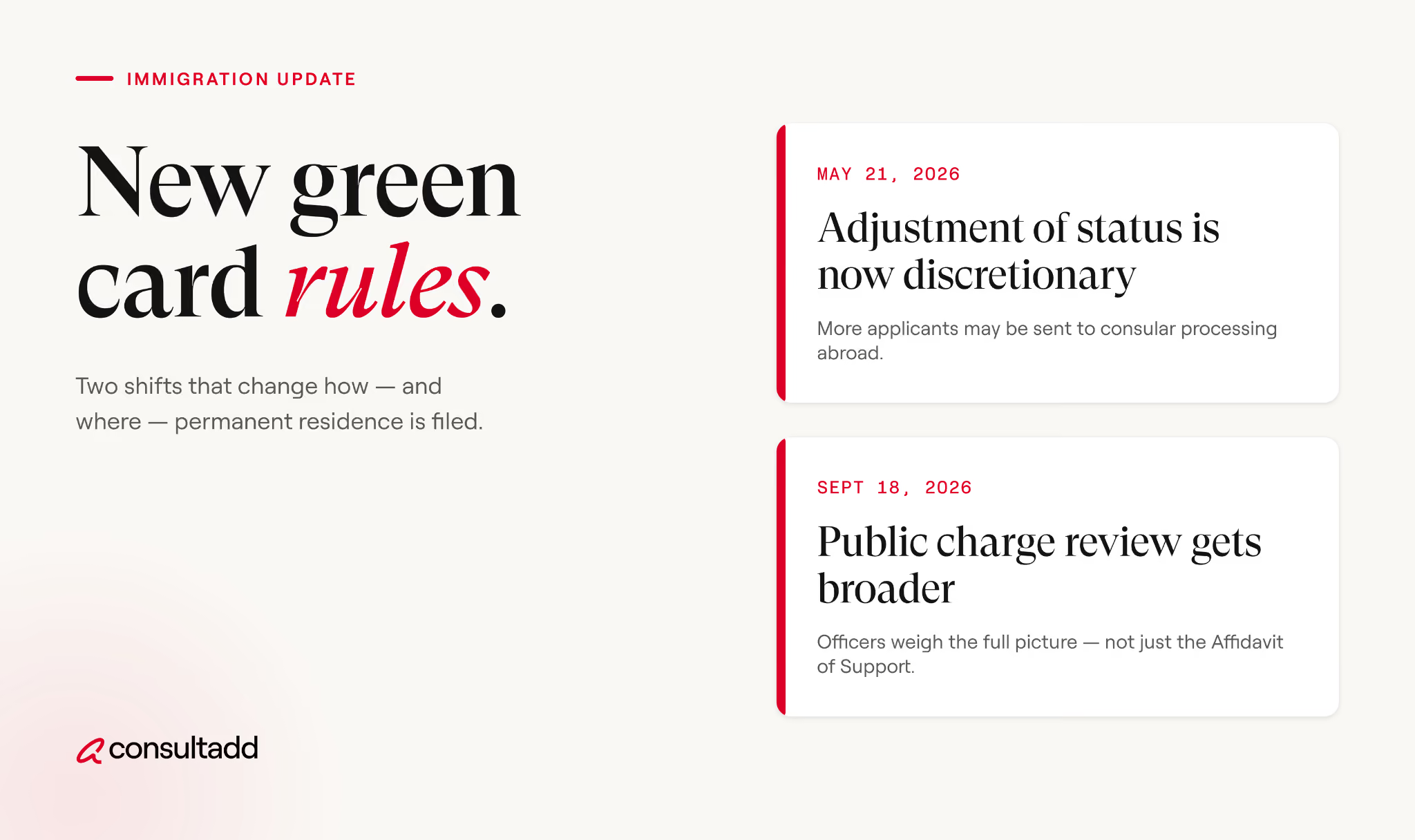
That framework is gone. DHS announced the rescission on July 16, 2026, published it in the Federal Register on July 20, and set it to take effect September 18. USCIS issued matching Policy Manual guidance on August 18.
Here is the timeline, since the dates do real work in this rule:
The rule applies to applications for admission made on or after September 18, 2026, or applications for adjustment of status postmarked or electronically submitted on or after that date. Receipt of means-tested public benefits before September 18, 2026 will still be considered under the 2022 standard.
So the change is not retroactive. Anyone with a green card application already filed before September 18 will be decided under the prior, more favorable 2022 policy.
The benefits USCIS can now count
Under the guidance, officers weigh five statutory factors: age, health, family status, assets, resources and financial status, and education and skills.
Those five have always been in the statute. What is different is everything else officers can now stack on top.
The new USCIS guidance makes clear the agency will consider many more public benefits, including any means-tested benefit such as Medicaid, food stamps, and housing assistance.
It also allows adjudicators to consider means-tested benefits that certain family members receive, even where the applicant receives nothing themselves.
The timing split matters:
The affidavit of support is not the safety net it used to be
This one trips people up. A qualifying Form I-864, Affidavit of Support, alone does not establish that an adjustment applicant is admissible on public charge grounds.
It cuts one way only. No single factor generally decides the outcome, except that failing to submit a sufficient affidavit of support when one is required can independently result in a public charge finding. A strong I-864 helps. It does not close the question.
The new guidance leans harder on income, assets, job skills, employability, education, health, health insurance coverage, and age, and gives the affidavit of support less weight than it used to carry.
Who the new green card rules apply to
Not every green card applicant is subject to public charge. That has always been true and it stays true.
USCIS lists family-sponsored immigrants, several employment-based categories, and investors among those subject to public charge review.
Certain humanitarian categories remain exempt, including qualifying refugees, asylees, Special Immigrant Juveniles, T and U nonimmigrants, and certain VAWA applicants.
Two more limits worth knowing:
- Public charge never applies to U.S. citizens, and it does not apply to most people who already hold a green card.
- The rule's preamble states that public charge inadmissibility does not apply to change of status or extension of stay, so I-129 and I-539 filings are not directly affected.
If your H-1B extension is in progress, this rule does not touch it. If your I-485 goes in next month, it does.
Why the Form I-485 edition matters more than usual
USCIS released a revised Form I-485 on the same day. The 09/18/26 edition replaced the 01/20/25 edition immediately, with no grace period for the transition, and the old edition is rejected if postmarked or electronically submitted on or after September 18.
A rejected package loses its postmark. For anyone near a priority date window, that is a real cost, not a paperwork annoyance.
The form itself was reworked to match the new standard. The four public benefit questions tied to the 2022 definitions become two, keyed to means-tested benefits generally, and for each benefit disclosed the applicant must give the dates, the amount, and the reason for receipt.
Fewer questions, broader scope, and more detail required per answer.
What this means for employment-based applicants and employers
Most of the coverage has focused on family-based cases. Employment-based applicants are squarely covered too, and staffing firms with sponsored consultants on the bench should be paying attention.
The official expectation is mild. DHS anticipates that most employment-based adjustment applicants "would see little change." A software engineer earning a market salary with continuous employment and no benefit history is not the profile this rule was written for.
The practical risk is different, and it is about consistency. USCIS acknowledges that the guidance grants officers wide latitude, which may produce divergent outcomes from one adjudicator to the next, including inconsistent requests for evidence on similar facts.
Translate that into recruiting terms: more RFEs, longer adjudication tails, and less predictability in when a consultant's EAD or green card actually lands. For staffing firms managing bench costs against client start dates, timeline variance is the expensive part.
What account managers should be asking now
Gaps in employment history now carry more weight than they did in August. A consultant who spent four months on the bench in 2025, filed for nothing, and has clean tax returns is fine.
A consultant whose household enrolled in a state health program during that gap has a fact to document, not hide.
Health insurance coverage is also on the list of things officers weigh. Continuous employer-sponsored coverage is a positive factor that costs nothing extra to demonstrate.
The lawsuits, and what happens if a court blocks the rule
The rule is being challenged hard.
A coalition including the attorneys general of California, Connecticut, Illinois, Massachusetts, New York, Washington and roughly fifteen other states, plus the District of Columbia and the governor of Pennsylvania, asked a federal judge to declare the 2026 public charge rule unlawful and vacate it.
New York City filed a separate challenge in the Southern District of New York alongside Chicago, San Francisco, Santa Clara County, Seattle, King County, and the Public Rights Project.
Both were filed on September 14. The rule took effect on September 18 regardless.
There is precedent for this going either way. A federal appeals court upheld an injunction against portions of the 2019 version of the rule in New York, Connecticut and Vermont, and the rule was later abandoned and replaced with the narrower 2022 standard.
The rule is in effect now, but it may be paused or halted by the ongoing litigation. Nobody should plan around a court win that has not happened. Plan around the rule as written, and treat relief as upside.
One more wrinkle for anyone considering consular processing instead. The Department of State has already issued its own guidance likely to expand the number of people denied a visa on public charge grounds, and anyone leaving the United States for a consular interview should get advice before traveling.
Separately, a federal court struck down the State Department's visa pause affecting nationals of 75 countries on August 21, 2026, and the government appealed.
How to prepare an I-485 under the new green card rules
The guidance rewards documentation. A thin filing that met the 2022 bar may not clear this one.
One thing not to do: do not file Form I-945 unless USCIS invites you, because an unsolicited public charge bond will not be accepted.
And do not rush a weak filing to beat a deadline that has already passed. The September 18 cutoff is behind us. A complete, well-documented package under the new standard beats a fast, thin one.
Start Strong With Consultadd
With 15 years in business and 5,000+ successful staffing engagements, we don't just fill roles, we build reliability into your process. We've supported 65 staffing companies in the past year alone and maintain MSAs with industry leaders like Robert Half and TEKsystems.
Here's what working with Consultadd looks like:
- Talent sourced in under 24 hours
- Ready-to-deploy candidates, vetted for experience and compliance
- Lower turnover risk: we match long-term goals, not just short-term needs
- Seamless compliance: visa, documentation, onboarding? Handled.
- Dedicated 1:1 account managers for responsive, personalized support
- Top 100 candidate matches delivered in the past year
- Strong partnerships with universities to tap into fresh, committed talent
- Post-placement support so your investment grows beyond day one
For candidates, your next opportunity is more than just a job title, it's a chance to build skills, gain experience, and move your career forward. At Consultadd, we connect technology professionals with projects and employers that align with their goals, whether they're looking for contract, contract-to-hire, or long-term opportunities.
The tech job market moves fast, but the right guidance can make all the difference. Ready to take the next step in your career journey? Explore Opportunities >>
Key takeaways
- The new green card rules apply only to Form I-485 applications postmarked or e-filed on or after September 18, 2026. Earlier filings keep the 2022 standard.
- Almost any means-tested public benefit can now factor into a public charge decision, including some benefits received by family members.
- The 09/18/26 edition of Form I-485 is mandatory with no grace period, and the wrong edition means rejection.
- Employment-based applicants are covered, and the bigger operational risk is inconsistent adjudication rather than mass denials.
- Over 20 states and several major cities are suing, but the rule is in effect and should be planned around as written.
FAQs
Do the new green card rules affect my pending I-485?
No. If USCIS accepted your application before September 18, 2026, it will be decided under the 2022 criteria even if it is still pending. The filing date controls, not the decision date.
Does using Medicaid or SNAP automatically mean my green card gets denied?
No. Receiving a benefit is one factor among several, and there is no bright-line test. Officers weigh it against your income, assets, employment, education, health and household situation. Talk to an immigration attorney if you have a benefits history.
Do the new rules apply to green card renewals or naturalization?
No. Public charge is a ground of inadmissibility assessed when someone applies for permanent residence or admission. It does not apply to most people who already hold a green card, and it does not apply to U.S. citizens.
Are H-1B extensions or change of status filings affected?
Not directly. The rule's preamble states that public charge inadmissibility does not apply to change of status or extension of stay, so Form I-129 and Form I-539 filings sit outside this framework. Your I-485 is a different matter.
Which Form I-485 edition should I use?
Applications postmarked or submitted electronically on or after September 18, 2026 must use the 09/18/26 edition. The 01/20/25 edition is rejected. Check the official USCIS Form I-485 page immediately before filing, since editions can change again.
Could the courts stop the rule?
Possibly. More than 20 states, the District of Columbia, and a coalition of cities filed suit in September 2026 asking a federal judge to vacate the rule. It took effect anyway and remains in effect while the litigation proceeds, so prepare your filing under the current standard.
.webp)


.avif)
.png)
