
.avif)

Introduction
Enterprise technology budgets are growing faster than they have in years. For a lot of IT services firms, that hasn't made 2026 any easier.
Most of the new money is going to AI infrastructure and software. The share that still reaches services comes with harder questions about pricing, contract length, security and who actually does the work.
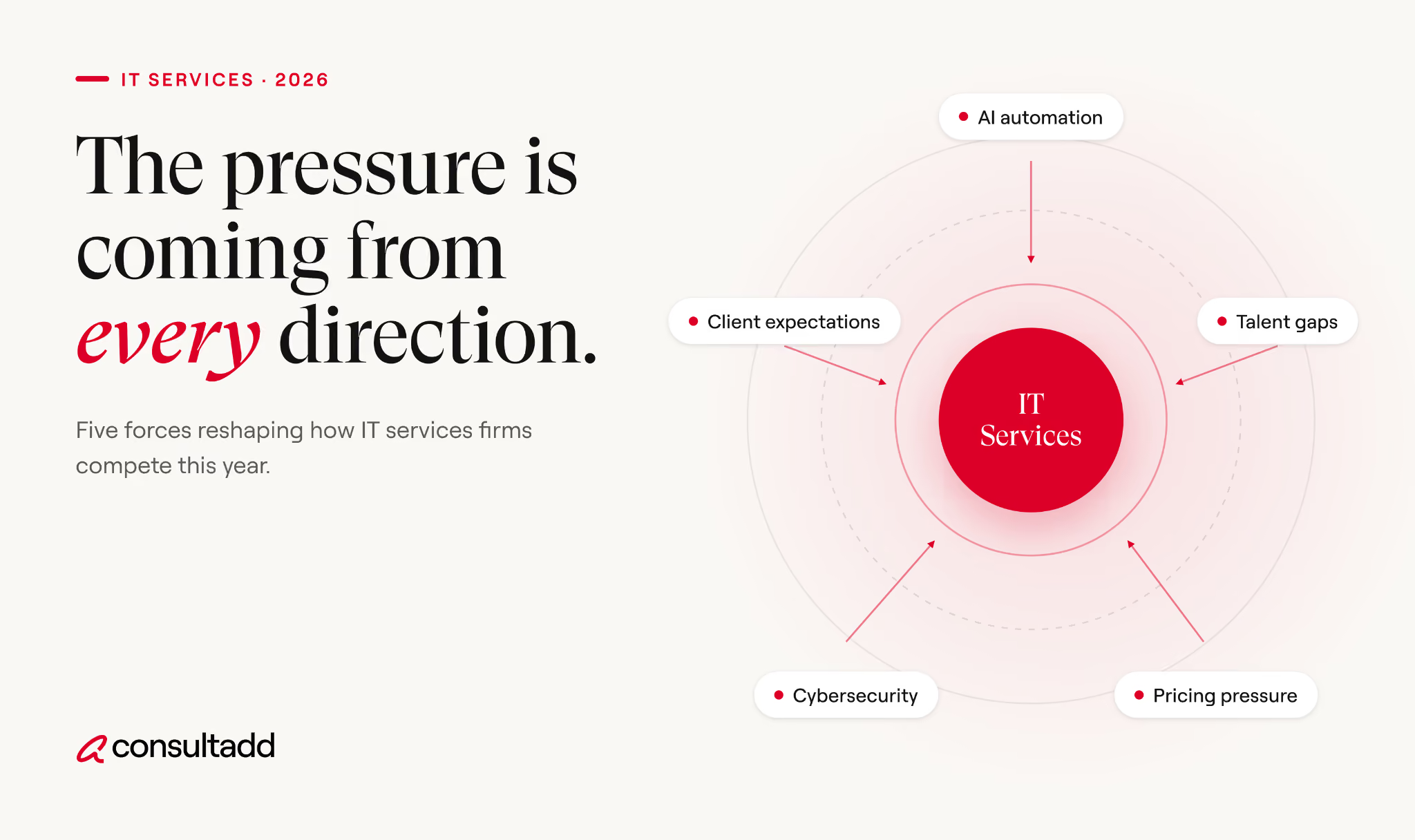
Those are the IT services industry challenges 2026 has put in front of consulting firms, managed service providers and systems integrators.
This guide covers seven of them, with the data behind each and a practical first move. It's written for people who run or buy IT services.
If you're after hiring trends, our IT staffing trends breakdown covers that side.
TL;DR
- IT services spending is still growing, but far more slowly than data center systems, software and cloud infrastructure, according to Gartner's July 2026 forecast.
- AI is pushing clients away from time-and-materials billing and toward fixed-price and outcome-based contracts, which cuts revenue tied to hours.
- Clients are reopening long contracts early and signing shorter ones, so pipelines turn into revenue more slowly.
- H-1B fee rules are still moving through the courts, and nearly half of all breaches in Verizon's latest data involved a third party.
- Providers that price for outcomes, rethink their junior talent model and tighten security and AI governance will be in a better position than those waiting for 2027.
Where the IT services market stands in 2026
Start with the good news. Gartner expects worldwide IT spending to reach $6.37 trillion in 2026, up 14.2% from 2025.
The first challenge sits inside that number. Services is growing at roughly a third of the rate of software and a small fraction of the rate of data center systems.
Gartner analyst John-David Lovelock described it as "not a rising tide lifts all boats" market, and pointed to tech budgets under strain from inflation, supply shortages, higher hardware and memory prices, AI funding and changing priorities.
In practice, a CIO with a fixed budget funds GPU capacity, AI platforms and the cloud bill first. Services projects compete for what's left. When a client says "we liked the proposal, but the budget moved," this is usually where it went.
AI pricing deflation is breaking time-and-materials billing
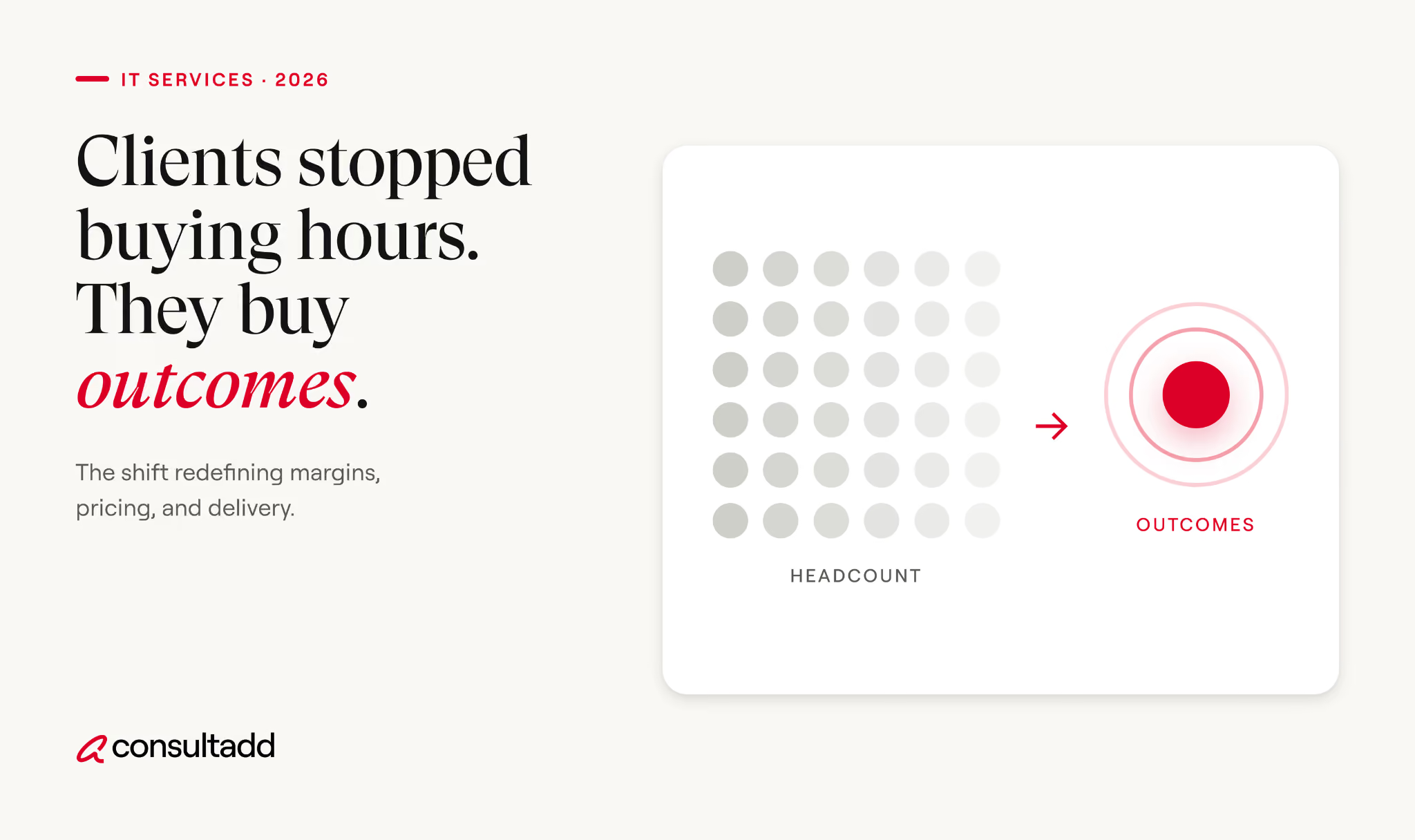
For decades the model was simple. Sell hours, staff the hours, bill the hours. AI coding assistants, generated test suites and automated tier-1 support now let the same work get done with fewer hours, and clients know it.
Large providers have started calling this "AI deflation" on their earnings calls. HCLTech's leadership expects AI to deflate traditional services by 2 to 3% a year, and clients are cutting deal tenures by 15 to 30% because AI tools change every few months, as Business Standard reported.
The response from the biggest firms has been to change what they sell. Cognizant's fixed-price and outcome-based contracts went above half of its revenue for the first time this year, with the company taking on overrun risk to keep part of the productivity gains AI creates, according to Pzena Investment Management's Q2 2026 holdings note.
What changes when the client pays for results
Outcome-based pricing sounds clean on a slide. In practice it moves delivery risk onto the provider, and it only works when both sides agree on a baseline and how to measure it.
If a client can't tell you their current ticket resolution time, you can't price a 30% improvement. That's why most outcome deals start with a short measurement phase billed the old way.
Hourly billing isn't dead. It still makes sense when the client directs the work, because the client captures the AI productivity directly.
Our comparison of managed services vs staff augmentation covers where each model fits.
Clients are renegotiating IT outsourcing contracts early
Long annuity deals signed in 2021 and 2022 were priced for delivery without AI. Many clients now consider them overpriced and aren't waiting for renewal.
HFS Research reports companies reopening IT services contracts within 24 months of signing, with talks shifting away from FTE counts, rate cards and offshore ratios toward productivity commitments, outcome pricing and gain-sharing.
The same report notes that TCS, Infosys and Wipro announced healthy deal pipelines in FY26, but AI-led price deflation kept revenue conversion weak.
For a mid-size provider, this rarely arrives as a dramatic cancellation. It looks like a renewal that was supposed to roll over but now comes with a productivity clause. A five-year deal becomes three. A client asks for AI savings to be passed through every year.
Providers that bring a productivity offer to the table first tend to keep more control of the terms. Showing your own AI usage data on the account, and a phased savings schedule, is far easier than defending a rate card line by line.
The talent pyramid behind IT services no longer fits
The classic delivery model has a wide base. Lots of junior engineers bill at lower rates, a smaller layer of seniors reviews their work, and a few architects sit on top. Margin comes from that leverage.
1. Fewer junior hours to bill
AI tools now handle much of what juniors used to do: boilerplate code, test scripts, documentation and L1 tickets. On an outcome-priced contract there's no reason to staff twelve juniors when six people with good tools can do the job.
The demand data points the same way. Staffing Industry Analysts has reported weaker demand for QA testers, entry-level programmers and help desk support, as more of that work is automated or assisted by AI.
Our 2026 tech job market report goes deeper on that split.
That raises a harder question for providers. If juniors aren't getting hands-on project time, where do the seniors of 2032 come from? Firms that redesign junior roles around reviewing and testing AI-generated work will have a bench to draw on later. Firms that simply stop hiring juniors may not.
2. Bench time costs more when deals get shorter
Shorter contracts mean more transitions and more gaps between projects. For H-1B employees, those gaps aren't free. The U.S. Department of Labor's guidance on H-1B nonproductive time says the required wage generally has to be paid when the employer has no work assigned.
Our guide to bench sales in IT staffing explains how firms keep that waiting time short.
H-1B rules and immigration costs stay unsettled
Many IT services firms depend on H-1B talent, and the rules have changed several times in twelve months. Here is where things stood in early October 2026.
There's another cost that hits services firms specifically. Under a 2026 DHS rule, covered employers must pay the 9-11 Biometric Fee on all H-1B and L-1 petitions.
A covered employer has 50 or more U.S. employees, with more than half of them in H-1B or L-1 status. That description fits a lot of offshore-heavy IT services companies.
The practical move is to budget for more than one scenario and to keep job titles, duties and worksites consistent across every filing, since closer review is now policy. Check the USCIS H-1B specialty occupations page before each filing.
See our H-1B sponsorship guide for tech professionals for the consistency issues that come up most.
This is general information, not legal advice.
Third-party cyber risk now lands on service providers
From a client's point of view, an IT services firm is a third party with deep access. That's becoming a commercial problem as well as a security one.
According to the 2026 Verizon Data Breach Investigations Report, a third party was involved in 48% of breaches, up from 30% the year before. The same data shows that only 23% of third-party organizations fully fix missing or misconfigured MFA on their cloud accounts.
Clients have noticed. Security questionnaires are longer, audit rights are standard, cyber insurance minimums are going up and liability caps are harder to negotiate.
The weak spot for most providers is the access lifecycle. Consultants rotate between clients, and an account that should have been closed on Friday is still active on Monday. Same-day access removal, MFA on every client-facing account and per-client credentials are boring fixes that win deals.
AI adds a newer risk. The 2026 DBIR found that 45% of employees now use AI regularly on corporate devices, up from 15%. A consultant pasting client code into an unapproved AI tool can breach a contract even if no attacker is involved.
AI regulation and governance clauses in client contracts
Regulation is the slowest-moving of these challenges, but it's already showing up in contracts.
In the EU, the Digital Omnibus pushed high-risk obligations for stand-alone Annex III AI systems to December 2, 2027, and for AI embedded in regulated products to August 2, 2028.
That's a delay, not a pause. Article 50 transparency obligations for AI-generated content still applied from August 2, 2026, as Gibson Dunn's summary explains. Providers building chatbots or generative AI features for EU-facing clients are working under those rules now.
U.S. clients without EU exposure are also writing AI clauses of their own. Typical asks include disclosure of which AI tools touch their code or data, who owns AI-generated code, and proof that a person reviewed it before release.
Keeping an approved AI tool list per client, and a simple record of where AI was used in each deliverable, answers most of these questions before procurement asks them.
How IT services providers can respond
None of these challenges has a single fix, but each has a sensible first step. Here's a working checklist.
Flexible capacity helps with several of these at once. When deal lengths shrink, locking in fixed headcount for every skill is risky. Many providers now keep a permanent core and add contract or contract-to-hire specialists per project.
Our guides on IT contract staffing as a business strategy and IT staffing service models cover how that mix works.
Final thoughts on IT services industry challenges 2026
The IT services industry challenges 2026 has brought are not a demand collapse. Clients are still spending.
They're repricing what they buy, shortening how long they commit, and asking providers to carry more of the risk around security, compliance and results.
Providers that can show output per dollar, rather than hours per role, will have an easier time in renewals. Pick one item from the checklist this quarter.
Rewrite one contract, close one access gap, or model one H-1B scenario. Waiting for the market to settle is the riskiest option.
Start Strong With Consultadd
With 15 years in business and 5,000+ successful staffing engagements, we don’t just fill roles, we build reliability into your process. We’ve supported 65 staffing companies in the past year alone and maintain MSAs with industry leaders like Robert Half and TEKsystems.
Here’s what working with Consultadd looks like:
- Talent sourced in under 24 hours
- Ready-to-deploy candidates, vetted for experience and compliance
- Lower turnover risk: we match long-term goals, not just short-term needs
- Seamless compliance: visa, documentation, onboarding? Handled.
- Dedicated 1:1 account managers for responsive, personalized support
- Top 100 candidate matches delivered in the past year
- Strong partnerships with universities to tap into fresh, committed talent
- Post-placement support so your investment grows beyond day one
For candidates, your next opportunity is more than just a job title, it's a chance to build skills, gain experience, and move your career forward. At Consultadd, we connect technology professionals with projects and employers that align with their goals, whether they're looking for contract, contract-to-hire, or long-term opportunities.
The tech job market moves fast, but the right guidance can make all the difference. Ready to take the next step in your career journey? Explore Opportunities >>
Key takeaways
- IT services spending is growing in 2026, but much more slowly than AI infrastructure, cloud and software, so services projects compete harder for budget.
- AI deflation is pushing clients from time-and-materials billing toward fixed-price and outcome-based contracts with shorter terms.
- The junior-heavy delivery pyramid is losing its margin advantage, and providers need a new way to grow senior talent.
- H-1B costs remain uncertain, with the $100,000 fee blocked in court, a new proposed fee and closer review of filings.
- Third-party security and AI governance are now contract issues, so access control and AI usage records directly affect deal terms.
FAQs
What are the biggest challenges facing the IT services industry in 2026?
The main ones are slower services growth compared with AI and cloud spending, AI-driven price deflation, early contract renegotiations and a talent model built on junior hours. Providers also face unsettled H-1B costs, rising third-party security expectations and new AI governance clauses. Most of these affect how work is priced and delivered rather than whether clients need it.
How is AI affecting IT services companies?
AI lets the same work be done with fewer billable hours, so clients expect lower prices or measurable results. That's pushing contracts toward fixed-price and outcome-based models. It also reduces the routine work that junior engineers used to handle.
What is AI deflation in IT services?
AI deflation is the drop in contract values and service prices that happens when AI tools reduce the effort needed for a job. Clients ask for the productivity gains to be reflected in rates, shorter deals or outcome-based terms. Some large providers have publicly estimated it at a few percent a year on traditional services.
Is the IT services market still growing in 2026?
Yes. Gartner's July 2026 forecast shows services spending of about $1.57 trillion, up 5.3% from 2025. That growth is much slower than software, cloud infrastructure and data center systems, which is why many providers feel squeezed despite rising overall IT budgets.
Is the $100,000 H-1B fee in effect right now?
As of early October 2026, USCIS is not collecting it because a federal court vacated the policy and an appeals court declined to pause that ruling. A September 2026 proclamation extended the policy, and DHS has separately proposed a $103,265 fee for cap-subject petitions. Check the USCIS website before every filing, since the status can change quickly.
How can IT services firms protect their margins in 2026?
Start by piloting outcome-based pricing on accounts with clear baselines, and offer productivity commitments before clients demand them. Redesign delivery teams around smaller, more senior groups using AI tools. Use flexible contract talent for project peaks instead of carrying fixed headcount through shorter deal cycles.
.webp)

.webp)

.avif)