.avif)

Introduction
A recruiter marks a consultant as "1099," the client signs off, and everyone moves on. Six months later the consultant has a company email, fixed hours and a manager who runs their performance review.
On paper, nothing changed. Legally, quite a lot may have.
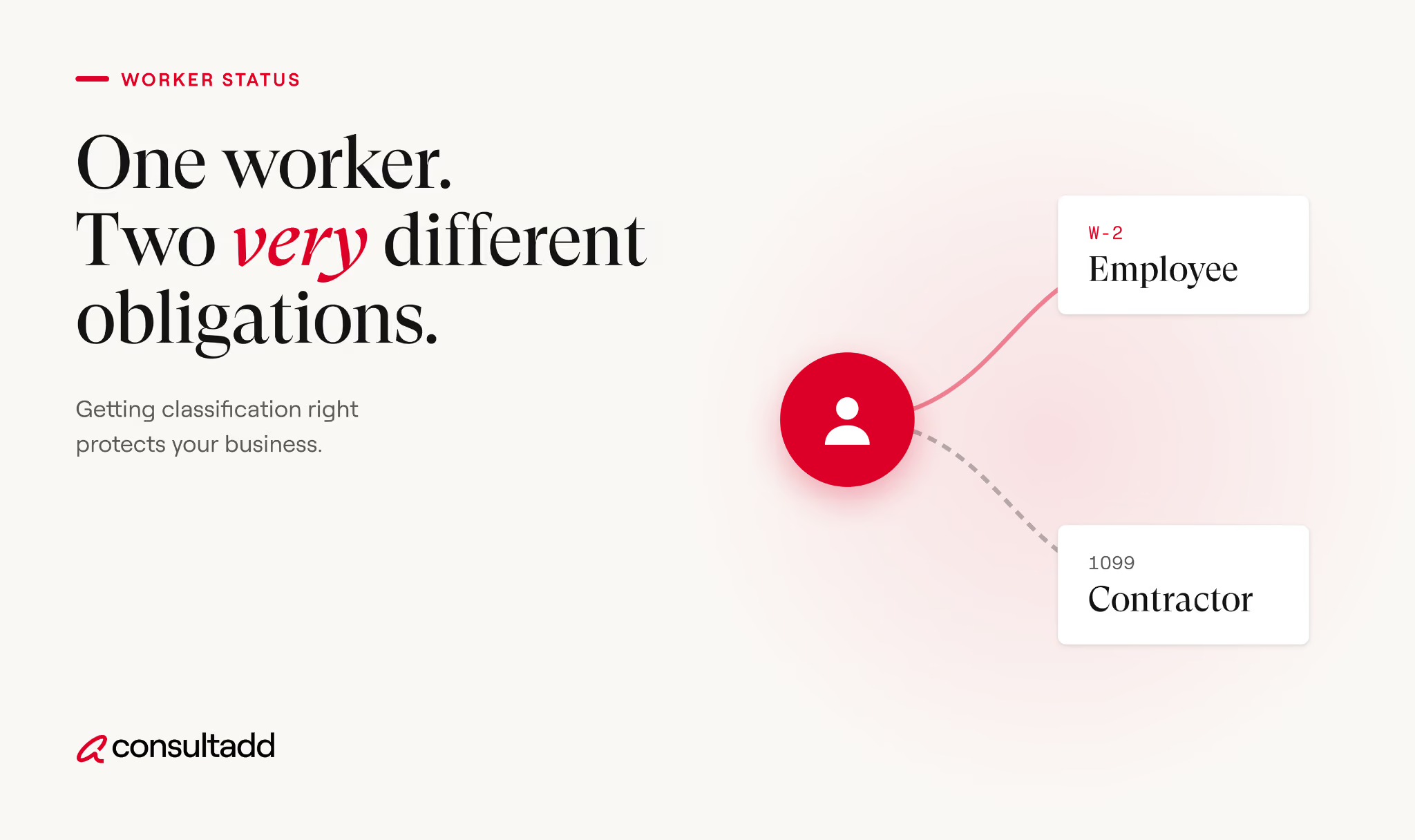
Worker status is the legal answer to one question: is this person an employee, or in business for themselves? The part most people miss is that no single agency answers it.
The IRS, the Department of Labor, state agencies, the NLRB and, for visa holders, USCIS each apply their own test, and several of those tests changed in 2026. This guide explains each one and how they play out in IT staffing.
TL;DR
- Worker status is decided by the facts of the working relationship, not by the contract label or the tax form.
- The IRS, DOL, state agencies, NLRB and USCIS each use a different test, so one worker can land in different places under different laws.
- In 2026, the DOL proposed returning to a two-core-factor economic reality test, and the NLRB restored a narrower joint employer standard.
- In staffing, status can drift over a long engagement as the client takes on more control, even if no one changes the paperwork.
- Review status at onboarding, at extension and whenever the role changes, and keep day-to-day direction aligned with the classification.
What worker status means, and what it doesn't
In the U.S., worker status usually means one of two classifications: employee or independent contractor. Employees get minimum wage and overtime protection, tax withholding, unemployment insurance and workers' compensation.
Independent contractors handle their own taxes and don't get those protections.
W-2, 1099 and C2C are not statuses. They're payment and paperwork arrangements, and they're supposed to follow from the status rather than decide it.
If you need the practical differences between those three, our guide to W2 vs C2C vs 1099 contract types covers them.
A quick note for readers outside the U.S.: in the UK, "worker" is a separate legal category that sits between employee and self-employed. This guide covers U.S. rules only.
The five tests that decide worker status
Each agency is asking a slightly different question for a different law. That's why a worker can be treated as a contractor for one purpose and an employee for another.
1. The IRS common law test
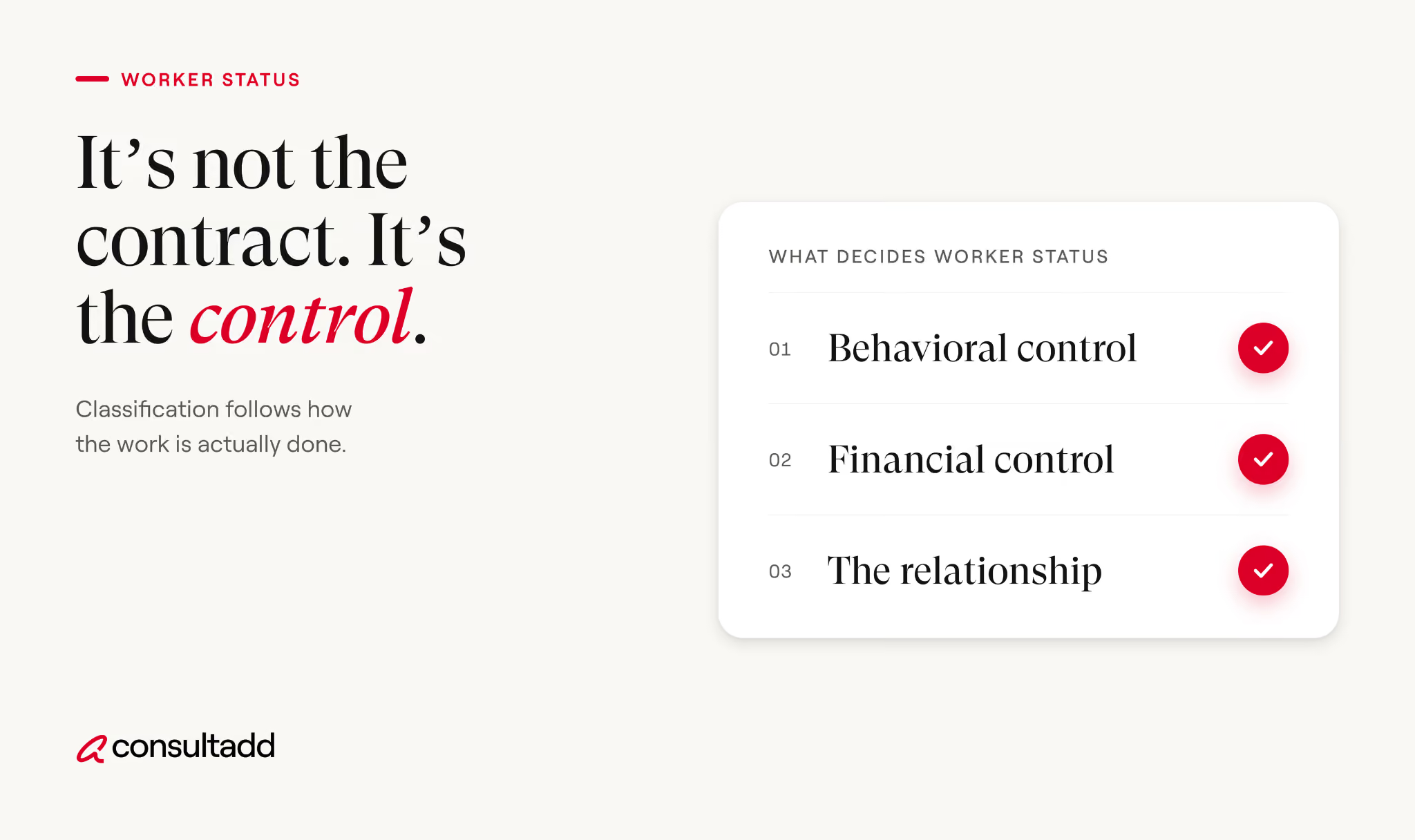
For federal taxes, the IRS groups the evidence into three categories: behavioral control, financial control and the relationship of the parties. Behavioral control asks whether the business directs what work is done and how.
Financial control asks whether it controls the business side of the job. The relationship category covers contracts, benefits and whether the work is expected to continue.
If the answer is still unclear, the business or the worker can file Form SS-8 and ask the IRS to decide. The IRS's own page on independent contractor or employee is the best starting point.
Our post on W2 vs W9 walks through the control questions in more detail.
2. The DOL economic reality test and the 2026 proposal
The DOL test has changed more than any other in recent years. On February 26, 2026, the department proposed rescinding the 2024 independent contractor rule and restoring a framework close to the 2021 rule.
It would focus on two core factors: how much control the business has, and whether the worker has a real opportunity for profit or loss. The proposal states that when both core factors point the same way, that classification is very likely correct.
The comment period closed April 28, 2026. In practice, the DOL told investigators in May 2025, through Field Assistance Bulletin 2025-1, to stop applying the 2024 standard and go back to the earlier test.
Check the DOL's misclassification rulemaking page for whether a final rule has been issued. The DOL's rule doesn't change the IRS test. A worker can pass one and fail the other.
3. State tests are often stricter
States run their own tests for unemployment insurance, wage claims and workers' compensation, and several are tougher than either federal test.
California is the best-known example. It uses an ABC test for many wage claims and the multi-factor Borello test in other situations.
If a consultant works remotely from a different state than the client, the worker's state usually matters for these purposes. A federal-only review misses this.
4. The NLRB joint employer standard
Joint employment matters most in staffing, where two companies touch the same worker. In February 2026, the NLRB withdrew its 2023 rule and confirmed the 2020 standard.
Under it, two companies are joint employers only if each has and actually uses substantial direct and immediate control over at least one essential term of employment, as Lathrop GPM summarizes.
That's narrower than the 2023 version, which could count indirect or unused control.
5. USCIS and visa holders
For H-1B workers, the sponsoring employer needs a real employer-employee relationship.
USCIS policy looks at whether the employer can hire, pay, fire, supervise or otherwise control the work. That's why a solo C2C or 1099 setup generally doesn't work for an H-1B consultant.
Our guide on W2 vs C2C for visa holders covers the details.
Worker status in a staffing arrangement: three parties, one worker
Staffing adds a layer most classification guides ignore. There are usually three parties: the client, the staffing firm and the consultant.
Sometimes there are more, with a prime vendor or implementation partner in the middle.
Here's how the common setups usually line up:
A W-2 arrangement through a staffing firm is the cleanest from a status point of view, because the firm is the employer of record and handles withholding, payroll and compliance.
The risk shifts to joint employment if the client starts controlling pay, schedules, hiring or firing. C2C only holds up when the consultant's entity operates like a real business.
Our corp-to-corp staffing guide explains what that takes.
A one-person LLC that works for one client, on that client's schedule, with that client's equipment, can still lose a status review.
Status drift: how a contractor becomes an employee without anyone deciding
This is the part of worker status that shows up most in staffing, and it's rarely deliberate.
An engagement starts cleanly. Over months, small changes stack up. The client adds the consultant to its org chart. A manager sets their hours.
They get a company laptop, a company email and an invitation to the annual review cycle. Nobody revisits the classification, because nobody thinks of these as classification decisions.
From the recruiting side, extensions are where drift tends to start. An extension feels like a formality, so it's the moment status gets checked least. It's also the best moment to check it.
What misclassification costs
When worker status turns out to be wrong, the costs come from several directions at once, because each agency has its own remedy.
- On the tax side, the business can owe the employment taxes it should have withheld and paid, plus penalties and interest.
- On the wage side, the DOL explains that misclassified employees may have been denied minimum wage and overtime they're owed.
States can add unemployment insurance contributions, workers' compensation exposure and their own penalties.
There are also costs that don't show up on a penalty notice. A misclassified consultant may have been eligible for benefits plans.
A visa holder's status may be at risk if the employer-employee relationship didn't really exist.
If a business finds it has been treating employees as contractors, the IRS offers a Voluntary Classification Settlement Program that lets eligible businesses reclassify going forward with reduced federal employment tax liability.
Talk to a tax adviser before using it.
This guide is general information, not legal or tax advice.
A worker status checklist for staffing firms and clients
No checklist can settle status on its own, because every test weighs the whole relationship. These questions catch most problems early.
Three habits keep status in line over time:
- Check status at three points. Do it at onboarding, at every extension, and whenever the role or reporting line changes.
- Keep direction where the classification says it is. If the staffing firm is the employer, pay, discipline and termination decisions should run through the firm, not the client manager.
- Write down the facts, not just the label. Record who sets hours, who supplies equipment and how long the work is expected to last. In a review, that record matters more than the contract heading.
When a role is ongoing and directed, W-2 is usually the simpler answer.
A contract-to-hire arrangement can also give both sides a clean path to permanent employment.
Final thoughts on worker status
Worker status isn't decided when someone picks W-2, 1099 or C2C. It's decided by how the work actually runs, and it can be decided differently by the IRS, the DOL, a state agency, the NLRB and USCIS.
With the DOL test in flux and joint employer rules reset in 2026, the safest approach hasn't changed. Match the paperwork to the facts, recheck it whenever the facts change, and treat every extension as a status review.
Start Strong With Consultadd
With 15 years in business and 5,000+ successful staffing engagements, we don’t just fill roles, we build reliability into your process. We’ve supported 65 staffing companies in the past year alone and maintain MSAs with industry leaders like Robert Half and TEKsystems.
Here’s what working with Consultadd looks like:
- Talent sourced in under 24 hours
- Ready-to-deploy candidates, vetted for experience and compliance
- Lower turnover risk: we match long-term goals, not just short-term needs
- Seamless compliance: visa, documentation, onboarding? Handled.
- Dedicated 1:1 account managers for responsive, personalized support
- Top 100 candidate matches delivered in the past year
- Strong partnerships with universities to tap into fresh, committed talent
- Post-placement support so your investment grows beyond day one
For candidates, your next opportunity is more than just a job title, it's a chance to build skills, gain experience, and move your career forward. At Consultadd, we connect technology professionals with projects and employers that align with their goals, whether they're looking for contract, contract-to-hire, or long-term opportunities.
The tech job market moves fast, but the right guidance can make all the difference. Ready to take the next step in your career journey? Explore Opportunities >>
Key takeaways
- Worker status depends on how the work actually happens, not on the W-2, 1099 or C2C label.
- The IRS, DOL, state agencies, NLRB and USCIS each apply their own test, so one worker can be classified differently under different laws.
- In 2026, the DOL proposed a return to a two-core-factor economic reality test, and the NLRB restored its narrower 2020 joint employer standard.
- In staffing, status often drifts during long engagements and extensions as the client takes on more control.
- Check status at onboarding, at every extension and at every role change, and keep day-to-day control aligned with the classification.
FAQs
What does worker status mean?
Worker status is the legal classification of a working relationship, usually as either an employee or an independent contractor in the U.S. It decides who handles taxes and whether protections like minimum wage, overtime and unemployment insurance apply. The classification depends on the facts of the relationship, not on what the contract calls it.
How is worker status determined?
Each agency uses its own test. The IRS looks at behavioral control, financial control and the type of relationship, while the DOL asks whether the worker is economically dependent on the business. States apply their own rules, and some use a stricter ABC test.
Can a worker be an employee for one agency and a contractor for another?
Yes. Because the IRS, DOL and state agencies apply different tests for different laws, the same person can be classified differently depending on the purpose. That's why a review against only one test can leave gaps.
What is the DOL independent contractor rule in 2026?
In February 2026, the DOL proposed rescinding its 2024 rule and returning to a framework close to the 2021 rule. That framework puts most weight on two core factors: control over the work and the worker's opportunity for profit or loss. Check the DOL's rulemaking page for whether the proposal has been finalized.
Is a C2C consultant an independent contractor?
Not automatically. In a C2C arrangement the client contracts with the consultant's business entity, and that only holds up if the entity operates like a real independent business. If the consultant works for one client on fixed hours under close direction, agencies may still treat them as an employee.
What happens if worker status is wrong?
The business may owe back employment taxes, penalties and interest, along with unpaid minimum wage or overtime and state unemployment contributions. Visa holders may face immigration problems if the required employer relationship didn't exist. The IRS Voluntary Classification Settlement Program may help eligible businesses correct the classification going forward.
.png)

.webp)