
.avif)

Introduction
A SQL data analyst spends most of the day answering business questions with data that already exists. Why did churn rise in March? Which region is behind on renewals? Is the new pricing page working?
SQL is how they get the answer out of the database. In 2026, though, AI tools can write a decent first draft of that SQL in seconds. That changes what employers pay a SQL data analyst for, and what they test in interviews.
This guide covers what the role involves, the SQL skills expected at each level, how AI has shifted the job, what SQL screens really check, and how to get hired.
TL;DR
- A SQL data analyst turns business questions into queries, checks the results and explains what they mean to non-technical teams.
- Entry-level roles test joins, aggregation and filtering. Mid-level roles add window functions, CTEs and data modeling. Senior roles add metric definitions and query performance.
- AI tools now write a lot of first-draft SQL, so the skill employers value most is spotting when a query looks right but returns the wrong number.
- SQL interviews mostly test whether you understand the grain of your data, how joins multiply rows and how NULLs behave, not whether you've memorized syntax.
- A small portfolio that answers one real business question end to end will do more for you than a long list of certifications.
What a SQL data analyst does day to day
The job title varies. You'll see data analyst, business intelligence analyst, reporting analyst and product analyst. The core of the work is the same.
A typical week mixes four kinds of work:
- Ad hoc questions. A sales director wants to know which accounts haven't been ordered in 90 days. You write the query, sanity-check it and send a short answer with the numbers.
- Recurring reports and dashboards. You maintain the SQL behind weekly dashboards in Power BI or Tableau, and fix them when a source table changes.
- Data checks. Numbers in two reports don't match. You trace both queries back to the tables and find where the definitions split.
- Metric definitions. You work with business teams to agree on what "active customer" or "net revenue" actually means, then write it down.
The last one sounds minor. In practice it's where a lot of an experienced analyst's value comes from, because two teams using different definitions will argue about numbers forever.
SQL data analysts sit close to two neighboring roles, and job postings blur them often.
Our plain-English technology glossary covers more of these role distinctions.
SQL skills a data analyst needs, by level
"Knows SQL" covers a huge range. Here's roughly what employers expect at each stage.
Two things stand out from requirement intake on data roles:
- First, window functions are the clearest dividing line between entry-level and mid-level candidates.
- Second, at senior level, clients care less about clever SQL and more about whether the person can stop a team from making a decision on a wrong number.
How AI changed the SQL data analyst job
AI assistants built into warehouses, BI tools and IDEs can now turn "revenue by customer last quarter" into a working query. Usage is widespread among developers.
In the Stack Overflow 2025 Developer Survey, 84% of respondents said they use or plan to use AI tools in their development work.
That doesn't remove the need for SQL skill. It moves it. The analyst now spends less time typing queries and more time checking whether a query that runs without errors actually answers the question.
Here's a common example. The query below looks reasonable and runs fine:
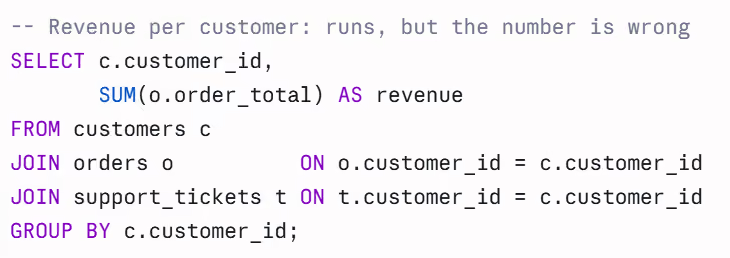
Every order gets repeated once for each support ticket the customer has. A customer with three tickets shows triple their real revenue. Nothing errors out. The dashboard just shows inflated numbers until someone notices.
A good SQL data analyst catches this because they think about grain first: one row per what? Orders and tickets are both "many per customer," so joining them directly multiplies rows. The fix is to aggregate each one separately before joining.
These are the mistakes AI-written SQL makes most often, and the ones analysts are now paid to catch:
If you're preparing for the job market, practice reviewing queries as much as writing them. It's the closest thing to what the work now looks like.
What SQL data analyst interviews actually test
Most SQL screens use a shared editor or a take-home with a small dataset. The questions look simple. What they're testing usually isn't the syntax.
Three habits help in almost every SQL interview:
- State the grain of each table out loud before you write the query.
- Run a quick row count after each join.
- And say what you'd check next, even if you run out of time.
Interviewers increasingly let candidates use AI tools in take-homes, then ask them to walk through the query live. If you can't explain why a join is a LEFT JOIN, the polished code won't help.
Tools a SQL data analyst uses beyond SQL
SQL is the core skill, but almost no job posting stops there. The usual supporting tools are:
- Spreadsheets. Excel or Google Sheets for quick checks and for stakeholders who want to see the rows.
- A BI tool. Power BI and Tableau show up most. Microsoft's Power BI Data Analyst Associate certification is one that recruiters often recognize on data analyst resumes.
- A cloud warehouse. Snowflake, BigQuery, Redshift or Azure Synapse. The SQL dialects differ slightly, mostly in date functions.
- Python, at a basic level. Pandas for analysis that's awkward in SQL, like some statistical tests or reshaping data.
- Version control. Git, especially on teams that manage their SQL as code with tools like dbt.
You don't need all of these to start. One BI tool plus solid SQL covers most entry-level postings.
SQL data analyst pay and job outlook
The U.S. Bureau of Labor Statistics doesn't track "data analyst" as its own occupation, so exact salary figures depend on which source you use.
The closest BLS category is data scientists, which had a median annual wage of $112,590 in May 2024 and is projected to grow 34% from 2024 to 2034, according to the Occupational Outlook Handbook.
Analyst roles focused mainly on SQL and reporting typically pay less than that category, especially at entry level.
Pay for a SQL data analyst depends mostly on four things:
- Level. Mid-level analysts who handle window functions, modeling and stakeholder work earn noticeably more than entry-level report builders.
- Industry. Finance, healthcare and technology tend to pay more than nonprofits or retail.
- Location. Large metro areas pay more, though remote roles have narrowed the gap.
- Employment type. Contract roles usually pay a higher hourly rate than full-time roles but don't include benefits.
Our guide to W2 vs C2C vs 1099 contracts explains the trade-offs.
SQL itself isn't going anywhere. It ranked among the most used languages in the Stack Overflow 2025 survey, behind JavaScript and HTML/CSS.
The demand question is less about SQL and more about whether you can do the parts of the job AI doesn't do well.
How to get hired as a SQL data analyst
1. Build one project that answers a real question
A portfolio of ten tutorial exercises looks the same as everyone else's. One project that starts with a business question and ends with a recommendation stands out.
For example, take a public dataset of city bike trips and answer: "Which stations run out of bikes during the morning commute, and how many bikes should be moved overnight?"
Show the SQL, the checks you ran on the data, the chart, and a three-sentence recommendation.
Our guide on key IT skills and how to prove you have them has more on turning projects into resume lines recruiters can verify.
2. Write your resume around results, not tools
"Proficient in SQL, Tableau, Excel" tells a recruiter nothing they can screen on.
"Wrote the SQL behind a weekly retention dashboard used by 25 account managers; found a duplicate-record issue that overstated churn by 8%" tells them exactly what you can do. Use your real numbers, not invented ones.
3. Consider contract and contract-to-hire roles
Many companies bring in SQL data analysts on contract for reporting backlogs, BI migrations or a new dashboard rollout.
These roles often move faster than full-time hiring and give early-career analysts real production experience.
A contract-to-hire arrangement can also lead to a permanent offer.
If you're on a student visa, data analyst roles can count as STEM work.
Our H-1B prerequisites guide explains how duties and degree field need to line up.
Final thoughts on the SQL data analyst role
The SQL data analyst role isn't disappearing because AI can write queries. It's shifting toward the parts that need judgment: knowing the grain of the data, catching numbers that are wrong but look right, and getting teams to agree on what a metric means.
If you're preparing for this path, practice reviewing SQL as well as writing it, learn window functions properly, and build one project that ends in a decision someone could act on. That combination is what interviewers are actually screening for.
Start Strong With Consultadd
With 15 years in business and 5,000+ successful staffing engagements, we don’t just fill roles, we build reliability into your process. We’ve supported 65 staffing companies in the past year alone and maintain MSAs with industry leaders like Robert Half and TEKsystems.
Here’s what working with Consultadd looks like:
- Talent sourced in under 24 hours
- Ready-to-deploy candidates, vetted for experience and compliance
- Lower turnover risk: we match long-term goals, not just short-term needs
- Seamless compliance: visa, documentation, onboarding? Handled.
- Dedicated 1:1 account managers for responsive, personalized support
- Top 100 candidate matches delivered in the past year
- Strong partnerships with universities to tap into fresh, committed talent
- Post-placement support so your investment grows beyond day one
For candidates, your next opportunity is more than just a job title, it's a chance to build skills, gain experience, and move your career forward. At Consultadd, we connect technology professionals with projects and employers that align with their goals, whether they're looking for contract, contract-to-hire, or long-term opportunities.
The tech job market moves fast, but the right guidance can make all the difference. Ready to take the next step in your career journey? Explore Opportunities >>
Key takeaways
- A SQL data analyst answers business questions with existing data, maintains reports and helps define metrics.
- Window functions separate entry-level from mid-level candidates, and metric ownership separates mid-level from senior.
- AI writes much of the first-draft SQL now, so catching join fan-out, NULL traps and wrong definitions is the skill employers value most.
- SQL interviews test your understanding of grain, joins and NULLs more than syntax, and often ask you to explain AI-assisted work live.
- One end-to-end project with a clear recommendation is stronger proof than a long list of tools or certificates.
FAQs
What does a SQL data analyst do?
A SQL data analyst uses SQL to pull and analyze data from databases to answer business questions. They build and maintain reports and dashboards, investigate why numbers don't match, and help teams agree on metric definitions. Most also explain their findings to non-technical colleagues.
Is SQL enough to get a data analyst job?
Strong SQL can get you through most technical screens, but almost every posting also asks for a BI tool like Power BI or Tableau and solid Excel skills. Being able to explain results clearly matters just as much. Basic Python helps but usually isn't required at entry level.
What SQL skills should a data analyst learn first?
Start with SELECT, WHERE, GROUP BY, joins and CASE statements, and learn how NULLs behave in each. Then move to CTEs and window functions like ROW_NUMBER and LAG. Those cover most of what entry-level and mid-level interviews test.
How much does a SQL data analyst earn?
Pay varies widely by level, industry and location. The BLS doesn't track data analysts separately. Its closest category, data scientists, had a median wage of $112,590 in May 2024, and roles focused on SQL and reporting usually pay less than that, especially at entry level.
Will AI replace SQL data analysts?
AI can write a lot of first-draft SQL, but it often produces queries that run but return wrong numbers, for example by multiplying rows in a join. Employers still need analysts who can check results, understand the data and define metrics. The role is shifting toward review and judgment rather than disappearing.
What questions are asked in a SQL data analyst interview?
Common questions include aggregations by group, finding records with no match, top N per category, month-over-month changes and removing duplicates. Interviewers watch how you handle joins, NULLs and dates, and often ask you to explain what the result means for the business.





.png)