.png)

Introduction
You don't need to write code to recruit engineers. You do need to know what the words mean, because a hiring manager who says "we need someone strong on Kubernetes and Terraform, ideally with SRE exposure" is describing a specific person, and you can't find that person by pattern-matching on keywords.
This is a working glossary of the technology terms that show up most in job descriptions, resumes, and screening calls. Each entry has a plain-English definition plus a short note on what it actually signals when you see it on a resume.
It's organized by category so you can jump to what you need. Nothing here requires a technical background to follow.
TL;DR
- Technology terms cluster into roles, languages, infrastructure, data, process, and security. Learning the clusters beats memorizing a long alphabetical list.
- The words that cause the most hiring mistakes are the ones that look similar, like Java and JavaScript, or DevOps and SRE.
- A tool name on a resume tells you less than the context around it. Two years of daily use and one weekend tutorial can read identically.
- Version and scale details matter more than the tool itself. React for a 5-person startup and React for a 200-engineer platform are different jobs.
- You don't have to fake expertise. Asking a candidate to explain something is a better screening move than pretending you already know it.
How To Use This Glossary
Two ways to read this.
If you're new to technical recruiting, skim the role definitions first, then the process section. Those two give you enough to follow a conversation with a hiring manager.
If you're already sourcing and just hit a term you don't recognize, jump to the category and move on.
One caution before the lists start. A glossary tells you what a word means, not how much someone knows. "Experience with AWS" covers everything from spinning up one server to architecting a multi-region system.
The follow-up question is always what matters, and there's a section at the end on how to ask it.
For broader context on where these skills sit in the job market, the BLS occupational outlook for computer and information technology is a reasonable baseline for role definitions and demand.
Roles And Job Titles
Programming Languages And Frameworks
A framework is a structure built on top of a language that handles common tasks so developers don't rebuild them. A library is a smaller collection of reusable code.
The distinction rarely changes a sourcing decision, but confusing a framework with a language does.
Cloud And Infrastructure
Cloud computing has a formal definition worth knowing, since the service model acronyms come directly from it. NIST Special Publication 800-145 defines cloud computing along with its three service models and four deployment models.
Data, Analytics, And AI
How Software Actually Gets Built
These terms come up in every hiring manager conversation, and knowing them makes you sound informed faster than knowing any language name.
If a hiring manager starts talking about delivery performance, they're often referring to a common set of measures.
Google's DORA research defines four software delivery metrics covering speed and stability, and those four show up in engineering leadership conversations often enough to be worth recognizing.
Security Terms Worth Knowing
Security roles split into offensive (finding weaknesses), defensive (detecting and responding), and governance (policy and compliance). They attract different candidates and different rates, so it's worth clarifying which one a req actually needs.
Technology Terms People Mix Up
This section prevents more bad submissions than any other list here.
Java and JavaScript. Different languages, unrelated origins, different jobs. A Java developer is generally not a JavaScript developer.
DevOps and SRE. DevOps is a set of practices connecting development and operations. SRE is a specific engineering discipline focused on reliability, typically with uptime targets and incident response responsibilities. A DevOps engineer and an SRE can both exist on one team doing different work.
AI and machine learning. ML is a subset of AI. "AI experience" on a resume usually means ML work or, increasingly, building on top of existing LLMs, which is a different skill from training models.
Data engineer, data scientist, and data analyst. The engineer builds pipelines, the scientist builds models, the analyst answers business questions with existing data. Submitting one for another is a common and avoidable miss.
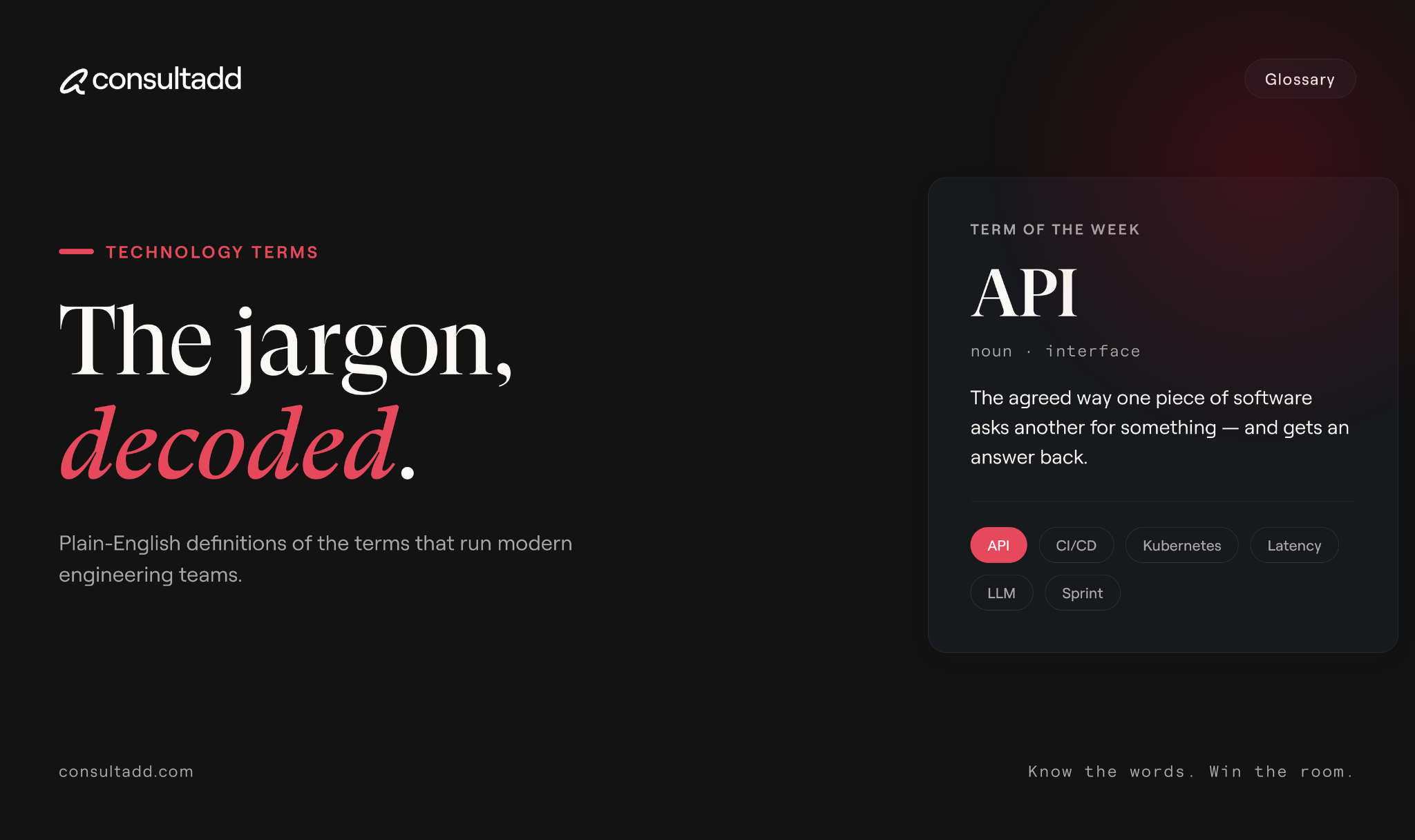
API and SDK. An API is the interface. An SDK is a package of tools and libraries for building against a platform.
Front-end and full-stack. Many candidates describe themselves as full-stack when their backend experience is thin. Ask what they built on the server side and how recently.
Cloud certification and cloud experience. A certification proves someone studied. It doesn't prove they've run anything in production. Both matter, neither substitutes for the other.
Using These Terms In A Screening Call
Knowing the vocabulary is step one. Using it without overreaching is step two.
Three questions that work regardless of how technical you are:
"Walk me through what you actually did with it." A candidate who used Kubernetes daily describes specific problems. One who touched it once describes what it is. You don't need to evaluate the answer technically to hear the difference.
"How big was the system and how big was the team?" Scale context changes everything. Same tool, very different job.
"What part of this stack would you not want to work on again?" Honest candidates answer specifically, and the answer usually tells you where their real depth is.
And when you don't know something, say so and ask. Candidates respond better to a recruiter who asks a clear question than one who bluffs through a term they've misread.
If you're building out the broader process around these conversations, Consultadd's guide to technical recruitment covers sourcing and screening structure, and the candidate vetting sequence covers what happens after the screen.
For candidates on the other side of this conversation, the 2026 coding interview playbook covers what these terms look like when they show up in technical rounds.
Start Strong With Consultadd
With 15 years in business and 5,000+ successful staffing engagements, we don't just fill roles, we build reliability into your process. We've supported 65 staffing companies in the past year alone and maintain MSAs with industry leaders like Robert Half and TEKsystems.
Here's what working with Consultadd looks like:
- Talent sourced in under 24 hours
- Ready-to-deploy candidates, vetted for experience and compliance
- Lower turnover risk: we match long-term goals, not just short-term needs
- Seamless compliance: visa, documentation, onboarding? Handled.
- Dedicated 1:1 account managers for responsive, personalized support
- Top 100 candidate matches delivered in the past year
- Strong partnerships with universities to tap into fresh, committed talent
- Post-placement support so your investment grows beyond day one
For candidates, your next opportunity is more than just a job title, it's a chance to build skills, gain experience, and move your career forward. At Consultadd, we connect technology professionals with projects and employers that align with their goals, whether they're looking for contract, contract-to-hire, or long-term opportunities.
The tech job market moves fast, but the right guidance can make all the difference. Ready to take the next step in your career journey? Explore Opportunities >>
Key Takeaways
- Technology terms are easier to learn in clusters, by role, language, infrastructure, data, process, and security, than as a flat alphabetical list.
- The most expensive confusions are between similar-sounding terms: Java and JavaScript, DevOps and SRE, data engineer and data scientist.
- A tool name on a resume carries no information about depth. Scale, team size, and recency do.
- Process vocabulary like sprint, pull request, and CI/CD buys you more credibility with hiring managers than memorizing framework names.
- Asking a candidate to explain something you don't know is a stronger screening move than bluffing, and it usually produces better information.
FAQs
What are the most important technology terms for a non-technical recruiter to learn first?
Start with role definitions and process vocabulary. Knowing the difference between front-end, back-end, DevOps, and data roles, plus terms like sprint, pull request, and CI/CD, covers most hiring manager conversations. Language and framework names can be looked up as they come up.
Is Java the same as JavaScript?
No. They are separate languages with different uses, different ecosystems, and different developer communities. The similar name is a historical marketing decision, and treating them as related is one of the most common sourcing errors in tech recruiting.
What's the difference between DevOps and SRE?
DevOps describes practices that connect software development and operations, usually with heavy automation. SRE is a specific engineering role focused on system reliability, often with defined uptime targets and on-call incident response. Some companies use the titles loosely, so confirm the actual responsibilities with the hiring manager.
Do candidates need cloud certifications?
It depends on the role and the client. Certifications demonstrate structured knowledge and sometimes satisfy a client or partner requirement, but they don't demonstrate production experience. Treat them as a supporting signal rather than a qualification on their own.
How do I tell whether a candidate really knows a technology?
Ask what they built with it, how large the system was, and what went wrong. Depth shows up in specific problems and specific trade-offs. Surface familiarity tends to produce textbook definitions instead of stories.
How often do these technology terms change?
Core concepts like APIs, containers, and version control stay stable for years. Specific tools and frameworks shift faster, particularly in front-end and AI work. Reviewing the tool names in your active job descriptions every six months is usually enough to stay current.
.webp)