.avif)

Introduction
If you've ever stared at a new-hire packet wondering whether you need a W-2 or a W-9, you're not alone. The confusion between these two forms is one of the most common questions we hear from employers building out their teams, and it's an easy one to get wrong.
Here's the short version of W2 vs W9: a W-2 is the form an employer sends to an employee, reporting wages and the taxes already withheld. A W-9 is the form a business collects from an independent contractor before paying them, so it has the information needed to issue a 1099 at year-end.
One form flows from employer to worker. The other flows from worker to the business paying them. Mixing the two up doesn't just create paperwork headaches, it can trigger IRS penalties and put your worker classification under a microscope.
This guide walks through what each form actually does, who's supposed to fill out which one, and how the IRS decides whether someone belongs on a W-2 or a W-9 in the first place.
TL;DR
- A W-2 reports wages and withheld taxes for employees; a W-9 collects tax ID information from contractors so a business can issue a 1099.
- Employers withhold Social Security, Medicare, and income tax for W-2 workers. Contractors who submit a W-9 handle their own taxes, including the full 15.3% self-employment tax.
- Worker classification comes down to the IRS's control test, not the title on someone's business card.
- A W-9 never gets sent to the IRS. It stays on file with the business that requested it.
- Misclassifying a W-2 employee as a 1099 contractor (or the reverse) can lead to back taxes, penalties, and in some cases federal investigation.
What is a Form W-2?
Form W-2, officially the Wage and Tax Statement, is the form an employer issues to every employee it pays. It shows total wages for the year alongside federal income tax, Social Security, and Medicare withheld from each paycheck.
Employers fill this out, not the worker. It's sent three places: to the employee, to the Social Security Administration, and to the IRS, generally by January 31 following the tax year. If you've withheld any taxes for a worker, or paid them more than a small threshold, a W-2 is required regardless of whether they worked full time or just a few shifts.
A W-2 employee typically works set hours, uses equipment the company provides, and takes direction on how the work gets done, not just what the end result should look like. That distinction matters more than it sounds, because it's exactly what the IRS looks at when a classification question comes up.
What is a Form W-9?
Form W-9, the Request for Taxpayer Identification Number and Certification, works completely differently. A business asks an independent contractor to fill one out before the first payment goes out. The contractor lists their name, business name if applicable, tax classification, and Social Security number or EIN.
The business doesn't send this form anywhere. It just keeps the W-9 on file and uses the information to prepare a 1099-NEC if it pays that contractor $600 or more during the year. No taxes are withheld on a W-9 basis. The contractor is responsible for paying their own income tax and self-employment tax, which is why freelancers and consultants often set aside a chunk of every invoice for tax season.
One detail trips people up constantly: employees never fill out a W-9. If someone is on your payroll, they get a W-4 during onboarding and a W-2 at year-end. The W-9 belongs strictly to the contractor relationship. If a worker starts the year as a contractor and converts to an employee partway through, they'd actually receive both a 1099 for the contractor period and a W-2 for the employee period. That's normal and doesn't indicate an error.
W2 vs W9 at a glance
How the IRS decides: employee or contractor
The IRS doesn't care what the contract says. It looks at the actual working relationship using what it calls the common law rules, grouped into three categories, per IRS Publication 15-A guidance on independent contractor status.
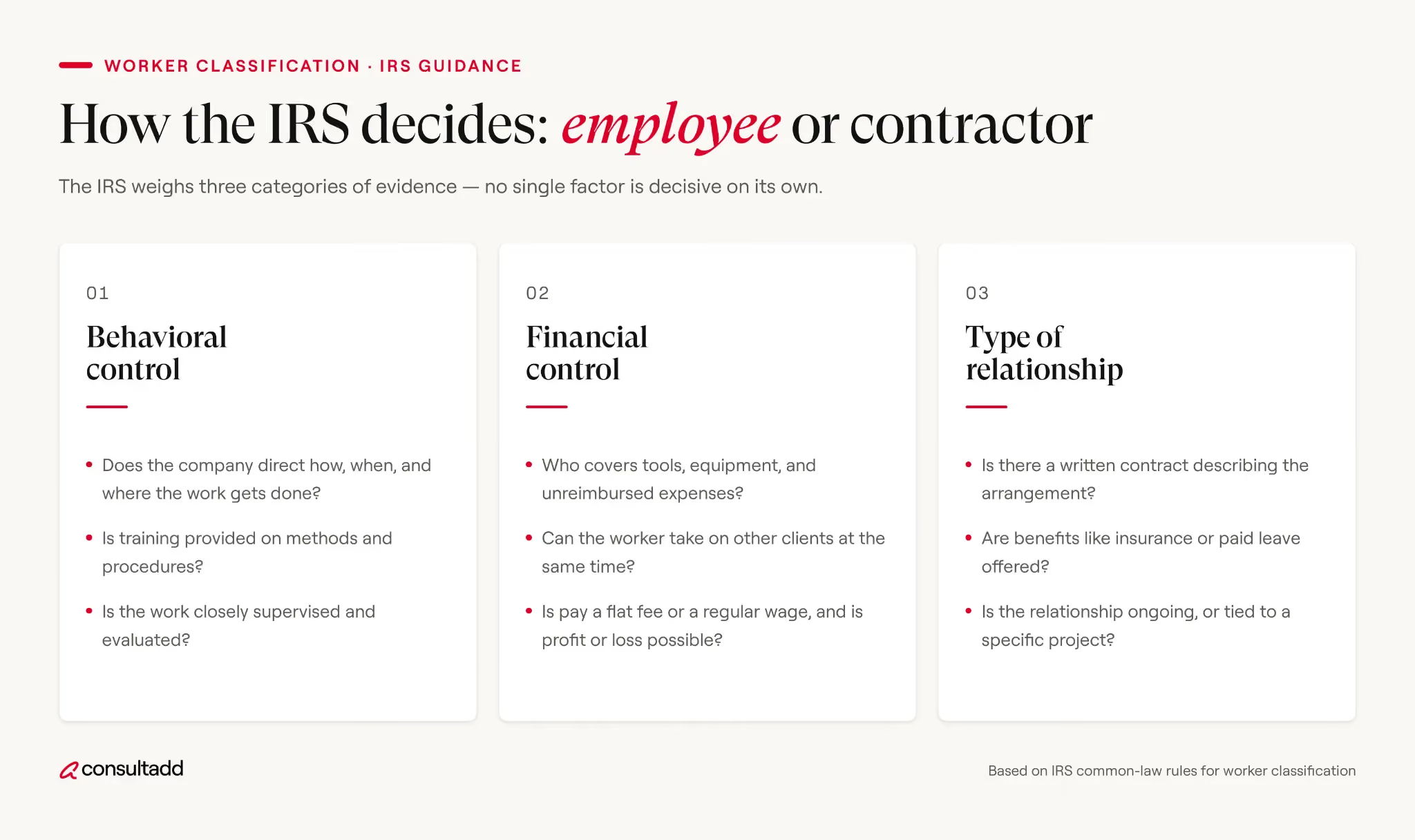
Behavioral control
- Does the business dictate when, where, and how the work happens, or does the worker decide that on their own?
- Setting someone's schedule and requiring them to use company equipment leans toward employee status.
Financial control
- Does the worker have unreimbursed expenses, their own tools, and the ability to work for other clients at the same time?
- Independent contractors typically carry more financial risk and independence than employees do.
Type of relationship
- Is there a written contract describing an independent engagement? Does the worker receive benefits?
- Is the relationship expected to continue indefinitely, or is it tied to a specific project?
According to the IRS, an individual is generally an independent contractor if the business only has the right to control the outcome of the work, not the details of how it gets done.
If the business retains the right to direct the process itself, that points to employee status even if the worker has a lot of day-to-day freedom. This same debate plays out at the federal labor level too.
The Department of Labor has gone back and forth on its own independent contractor test in recent years, and as of early 2026 it's reviewing proposed changes to how it evaluates worker classification under the Fair Labor Standards Act.
The IRS test and the DOL test aren't identical, so a worker classified correctly for tax purposes can still raise questions under labor law. It's worth checking both if you're building out a contractor-heavy team.
Tax withholding: where the real difference shows up
The forms themselves take five minutes to fill out. The tax consequences are where W2 vs W9 actually matters for take-home pay.
That last row catches a lot of new business owners off guard. If a contractor won't hand over a completed W-9, the IRS requires the paying business to withhold 24% of future payments until it gets one.
Which form should you actually use?
If you're the one hiring: figure out the classification first, then pick the form.
Don't reach for a W-9 just because it avoids payroll taxes on paper.
If the role has set hours, company-provided equipment, and ongoing supervision, it's a W-2 employee regardless of what you'd prefer to call it.
If you're the one being hired: ask before you start.
If the company controls your schedule and tools, expect a W-4 and W-2.
If you're setting your own hours, invoicing for deliverables, and working with other clients, a W-9 and eventual 1099 are the right fit.
Workers weighing a corp-to-corp setup versus straight 1099 work will find the tax math differs enough to matter, especially once self-employment tax enters the picture.
What happens if you get the classification wrong
Worker misclassification isn't a paperwork technicality. Treating someone who should be a W-2 employee as a 1099 contractor means the business skipped payroll taxes, unemployment insurance contributions, and potentially overtime pay it legally owed.
- If the IRS or a state agency catches it, the business can be on the hook for back payroll taxes, penalties, and interest, sometimes going back several years.
- Workers who believe they were misclassified can also request a formal determination from the IRS using Form SS-8.
- On the labor side, misclassification can trigger separate claims for unpaid overtime or minimum wage under the FLSA, independent of anything the IRS does.
None of this means every contractor relationship is a ticking time bomb.
- Plenty of businesses use contractors correctly for project-based work, specialized skills, or short-term coverage.
- The risk shows up when a "contractor" is functionally indistinguishable from an employee: fixed hours, company equipment, ongoing work with no defined end date, and day-to-day supervision.
If a contractor engagement is meant to lead somewhere permanent, a contract-to-hire arrangement is worth understanding too, since it runs on a W-2 basis through a staffing partner rather than a straight 1099 setup.
W2, W9, and 1099: how the pieces connect
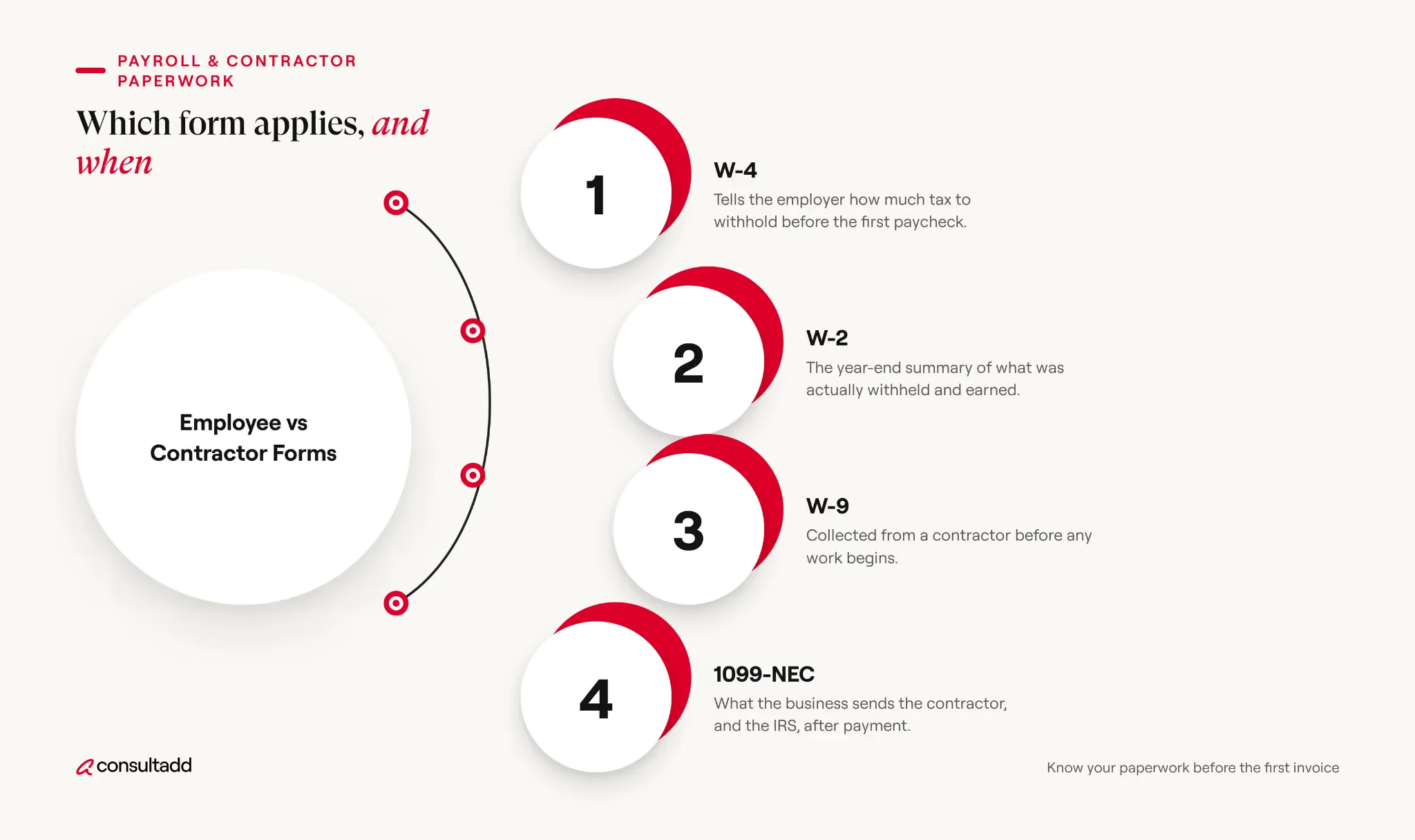
It helps to think of these as steps in a chain rather than competing options.
- A W-4 tells an employer how much to withhold from a new employee's paycheck.
- A W-2 is the year-end summary of what was actually withheld and earned.
- A W-9 is collected from a contractor before work begins.
- A 1099-NEC is what the business sends the contractor (and the IRS) at year-end, built from the W-9 information.
There's also a third path that comes up a lot in staffing and IT contracting: corp-to-corp arrangements, where a business contracts with a worker's registered company instead of the individual.
If you're weighing options beyond a straight W-9 relationship, our breakdown of W2 vs C2C vs 1099 contract types covers how pay, taxes, and risk shift across each structure.
Start Strong With Consultadd
With 15 years in business and 5,000+ successful staffing engagements, we don't just fill roles, we build reliability into your process. We've supported 65 staffing companies in the past year alone and maintain MSAs with industry leaders like Robert Half and TEKsystems.
Here's what working with Consultadd looks like:
- Talent sourced in under 24 hours
- Ready-to-deploy candidates, vetted for experience and compliance
- Lower turnover risk: we match long-term goals, not just short-term needs
- Seamless compliance: visa, documentation, onboarding? Handled.
- Dedicated 1:1 account managers for responsive, personalized support
- Top 100 candidate matches delivered in the past year
- Strong partnerships with universities to tap into fresh, committed talent
- Post-placement support so your investment grows beyond day one
For candidates, your next opportunity is more than just a job title, it's a chance to build skills, gain experience, and move your career forward. At Consultadd, we connect technology professionals with projects and employers that align with their goals, whether they're looking for contract, contract-to-hire, or long-term opportunities.
The tech job market moves fast, but the right guidance can make all the difference. Ready to take the next step in your career journey? Explore Opportunities >>
Key takeaways
- A W-2 is issued by employers to report employee wages and withholding; a W-9 is collected from contractors to prepare a 1099.
- W-9 forms never go to the IRS. They stay on file with the business that requested them.
- Contractors on a W-9 basis cover the full 15.3% self-employment tax themselves, since nothing is withheld.
- The IRS classification test looks at behavioral control, financial control, and the nature of the relationship, not job titles.
- Getting the classification wrong can mean back taxes, penalties, and exposure under both IRS and Department of Labor rules.
FAQs
Can an employee also fill out a W-9?
No. W-9 forms are for independent contractors only. If someone is a common-law employee, they complete a W-4 instead and receive a W-2 at year-end.
Does a W-9 get submitted to the IRS?
No. The business collects it and keeps it on file, then uses the information to prepare a 1099-NEC if the contractor is paid $600 or more in a year.
What if a contractor refuses to submit a W-9?
The paying business is generally required to apply 24% backup withholding on future payments until a completed W-9 is received.
Can someone receive both a W-2 and a 1099 in the same year?
Yes. This happens when a worker starts as a contractor and converts to a full employee, or the reverse, within the same tax year.
Who decides if a worker is an employee or a contractor?
The business does, but the IRS can reclassify a worker after the fact if the actual working relationship doesn't match how it was labeled. Either party can file Form SS-8 to request an official determination.
Is a W-9 the same as a 1099?
No. A W-9 collects tax ID information before payments begin. A 1099-NEC is the year-end form reporting how much the contractor was actually paid.
Do W-2 employees get benefits that W-9 contractors don't?
Generally, yes. Health insurance, retirement contributions, and paid time off are typically reserved for W-2 employees, since contractors are considered self-employed and outside the company's benefits structure.


.webp)