


Introduction
Some tech professionals want fewer hours. A parent who can work 20 hours a week. A senior engineer easing toward retirement. A developer with a full-time job who wants a second income stream or a new skill on their resume.
Part time contract IT jobs fit all three. They're technology roles with a defined scope or end date where you work fewer hours than a standard full-time week, usually paid by the hour.
They're also harder to find than full-time contracts. Most IT contracts in the U.S. still expect around 40 hours a week.
This guide covers which roles do offer part-time hours, how those contracts are usually structured, what to charge, where to look, and the tax, visa and employment-agreement points that change when you work part time.
TL;DR
- Part time contract IT jobs exist, but they're a smaller slice of the market than full-time contracts. Specialists and experienced professionals find them most easily.
- IT support, QA, data and analytics, cloud and security reviews, and fractional leadership roles offer reduced hours more often than core development.
- Part-time contracts usually take one of five forms: fixed weekly hours, a retainer, on-call support, a fixed-scope project or after-hours coverage.
- Agree on a minimum number of weekly hours and response times in writing. Undefined part-time work tends to creep.
- If you have a full-time job, check your employment agreement for conflict-of-interest and IP clauses before you accept anything.
What part time contract IT jobs are
A part time contract IT job combines two things: contract terms (a defined project or end date, usually hourly pay) and reduced hours (fewer than a full-time schedule).
There's no single legal definition of part time. The U.S. Department of Labor notes that the Fair Labor Standards Act doesn't define full-time or part-time employment, so each employer sets its own threshold. For statistics, the Bureau of Labor Statistics counts people working 1 to 34 hours a week as part time.
Plenty of people work part time without wanting to. BLS reported that 4.5 million people worked part time for economic reasons in September 2026, meaning they'd have preferred full-time work.
This guide is for the other group: people who want fewer hours on purpose and want those hours to be in tech.
The pay arrangement also matters. A part-time contract can be W-2 through a staffing firm, 1099 as an independent contractor, or C2C through your own company.
Our guide to the three types of employment explains how part-time, full-time and contract work differ underneath the hours.
IT roles that offer part-time contracts most often
Not every IT role splits well into part-time hours. Work that needs constant coordination with a full-time team, like core product development, is harder to do on 15 hours a week. Work that's specialized, bounded or periodic splits much more easily.
From the staffing side, a pattern shows up again and again. The candidates who land part-time contracts most easily are senior specialists.
A client will happily take 20 hours a week from someone who can do in 20 hours what a mid-level contractor does in 40. Early-career candidates usually find full-time contracts easier to get.
How part-time IT contracts are usually structured
"Part time" covers several different arrangements. Knowing which one you're being offered helps you price it and protect your schedule.
Which structure to ask for
- If you need predictable income, fixed weekly hours or a retainer works best.
- If you have another job, a fixed-scope project gives you the most control over when you work.
- On-call work pays for your availability, so make sure the availability is actually paid, not just the hours you log.
Pay rates and minimum hours
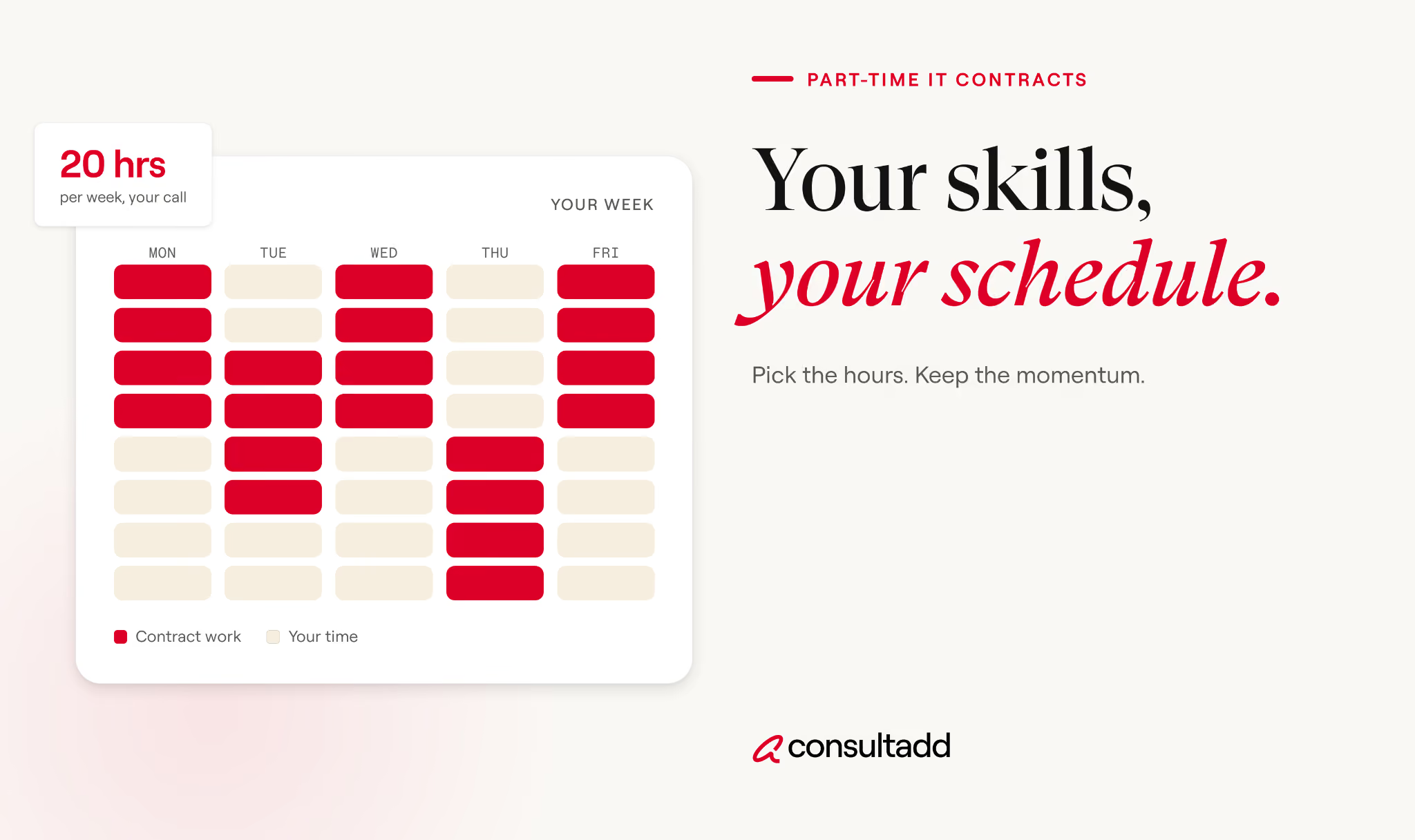
Part-time contract work is almost always paid by the hour or by the project. Rates depend on the same things full-time contract rates do: skill, seniority, location, industry and pay structure.
A few things are specific to part-time work:
- Ask for a minimum weekly or monthly commitment. A contract that says "up to 20 hours a week" can mean 3 hours in a slow week. A minimum protects your income and makes it easier to plan around.
- Price your availability. If a client expects you to answer within an hour during business days, that limits what else you can do. On-call or retainer fees should reflect it.
- Account for overhead. On a 1099 or C2C contract, you pay your own taxes, benefits and equipment, and you have unpaid time between clients. That overhead doesn't shrink just because your hours did.
- Compare like with like. A W-2 part-time rate and a 1099 rate for the same hours aren't equivalent.
Our guide to W-2 vs C2C vs 1099 contracts shows how to compare them.
For general contract rate context by role, our guide to IT contract jobs covers how to compare an hourly rate with a salary.
Where to find part-time contract IT work
Part-time roles get filled through the same channels as other contract work, but with a different mix. Many are never posted as "part time" at all.
They start as a conversation about a full-time contract that the client would accept at fewer hours.
Staffing agencies. Tell recruiters up front that you want part-time work and how many hours you can commit. A recruiter who knows that can pitch you for roles where the client is flexible, rather than submitting you to full-time reqs you'll turn down.
Your own network. Former managers and colleagues are the most common source of part-time work for experienced IT professionals. A team that already knows your work is far more willing to accept reduced hours.
Small and mid-size businesses. Many need IT help but can't justify a full-time hire. Managed service gaps, one-off cloud setups and security reviews often go to part-time contractors.
Job boards with filters. Use "part time" and "contract" filters together, and also search terms like "fractional," "retainer" and "hours flexible."
Converting a full-time contract. If you're already on a contract and the workload drops, ask whether the client would keep you at reduced hours rather than ending the engagement.
Our guide on how to find contract work goes deeper on running these channels together. If you want remote part-time roles, see how staffing agencies place remote candidates.
Taking a part-time contract alongside a full-time job
Many people looking for part time contract IT jobs already have a full-time job. That's common, but it comes with a few checks most people skip.
1. Read your employment agreement first
Look for these clauses before you accept outside work:
- Outside employment or moonlighting rules. Some employers require approval for any second job.
- Conflict of interest. Working for a competitor, client or vendor of your employer is usually off limits.
- Intellectual property assignment. Some agreements claim ownership of anything you build, even on your own time, if it relates to the employer's business.
- Use of company resources. Never use your employer's laptop, accounts, code or working hours for contract work.
If anything is unclear, ask HR or get legal advice before you start. This is general information, not legal advice.
2. Protect your schedule
Agree in writing on when you're available. "Evenings and Saturdays, response within one business day" sets clear expectations. Avoid contracts that need you on calls during your main job's working hours.
3. Be realistic about hours
Adding 15 hours a week to a 40-hour job is manageable for some people for a while. Adding 25 usually isn't sustainable. Start smaller than you think you can handle and increase only if it's working.
Taxes, visas and paperwork
Fewer hours don't mean fewer obligations. A few things work differently from a standard full-time job.
1. Taxes on 1099 and C2C work
If you're paid as an independent contractor, taxes aren't withheld from your payments. The IRS explains that you may need to make estimated tax payments during the year to cover income tax and self-employment tax.
Many part-time contractors set aside a share of every payment so tax time isn't a shock. On a W-2 part-time contract through a staffing firm, taxes are withheld for you, which is simpler if this is your first contract.
2. Benefits
Part-time contractors rarely get benefits. If you're on a W-2 contract through a staffing firm, ask what's offered at your hours. If you're on 1099 or C2C, budget for health coverage and retirement savings yourself.
3. Work authorization and visa limits
Visa holders need extra care. Many work visas tie you to a specific employer and job, so taking a second part-time role may require its own approval or petition. For H-1B holders, USCIS rules on H-1B specialty occupations govern who can employ you and on what terms.
4. Watch for scams
Part-time remote IT roles are a common target for fake job offers. The FTC's guidance on job scams lists warning signs, including offers made by text with no interview and requests to pay for equipment or training. A real client interviews you and never asks you to pay to start.
A checklist before you sign a part-time IT contract
Run through these before you accept. Most part-time contract problems come from things nobody wrote down.
For a fuller walkthrough of contract terms, see our guide to what to check in a work contract agreement.
Choosing the right part time contract IT jobs for you
The best part time contract IT jobs match three things: a role that splits naturally into fewer hours, a structure that fits your schedule, and terms that protect your time and income.
Before you start searching, write down three numbers: the minimum hours you need, the maximum you can handle and the hourly rate you won't go below.
Then tell every recruiter and contact those numbers up front. Clear limits make it much easier for the right part-time contract to find you.
Start Strong With Consultadd
With 15 years in business and 5,000+ successful staffing engagements, we don't just fill roles, we build reliability into your process. We've supported 65 staffing companies in the past year alone and maintain MSAs with industry leaders like Robert Half and TEKsystems.
Here's what working with Consultadd looks like:
- Talent sourced in under 24 hours
- Ready-to-deploy candidates, vetted for experience and compliance
- Lower turnover risk: we match long-term goals, not just short-term needs
- Seamless compliance: visa, documentation, onboarding? Handled.
- Dedicated 1:1 account managers for responsive, personalized support
- Top 100 candidate matches delivered in the past year
- Strong partnerships with universities to tap into fresh, committed talent
- Post-placement support so your investment grows beyond day one
For candidates, your next opportunity is more than just a job title, it's a chance to build skills, gain experience, and move your career forward. At Consultadd, we connect technology professionals with projects and employers that align with their goals, whether they're looking for contract, contract-to-hire, or long-term opportunities.
The tech job market moves fast, but the right guidance can make all the difference. Ready to take the next step in your career journey? Explore Opportunities >>
Key takeaways
- Part time contract IT jobs are less common than full-time contracts, and experienced specialists land them most easily.
- Support, QA, data, cloud, security, DBA and fractional leadership roles offer reduced hours more often than core development.
- Know which structure you're offered: fixed hours, retainer, on-call, fixed-scope project or after-hours coverage.
- Put minimum hours, availability, response times and overage rules in writing before you start.
- If you have a full-time job or a work visa, check your employment agreement and immigration status before accepting any second role.
FAQs
Are part-time contract IT jobs common?
They're less common than full-time contracts, since most IT contracts expect around 40 hours a week. They're more available for specialized or periodic work like IT support, QA, security reviews, database administration and fractional leadership. Many part-time roles also start as full-time contracts that the client agrees to scale down.
How many hours is a part-time IT contract?
There's no fixed standard. Many part-time IT contracts fall between 10 and 30 hours a week, and retainers are often set as a number of hours per month. BLS counts anyone working 1 to 34 hours a week as part time for statistical purposes.
Can I do a part-time IT contract while working full time?
Often, yes, but check your employment agreement first. Look for rules on outside employment, conflicts of interest and intellectual property, and never use your employer's equipment or working hours for contract work. Visa holders should confirm that a second job is allowed for their status.
How are part-time IT contractors paid?
Most are paid by the hour, either as W-2 employees of a staffing firm, as 1099 independent contractors, or through their own company on C2C terms. Some fixed-scope projects pay a flat fee per deliverable. On 1099 or C2C contracts, you handle your own taxes, including estimated payments.
Do part-time contractors get benefits?
Usually not. Some staffing firms offer limited benefits to W-2 contractors, so ask what's available at your expected hours. On 1099 or C2C contracts, you'll need to arrange health coverage and retirement savings yourself.
What IT skills are best for part-time contract work?
Skills tied to bounded or periodic work tend to be easiest to sell part time. Examples include cloud cost reviews, security assessments, database tuning, test automation, IT support and BI reporting. Senior experience helps, because clients are more willing to accept fewer hours from someone who works quickly without much supervision.
.webp)


.png)
.webp)