

Introduction
You've finished your degree in the U.S., you have a job offer or you're close to one, and now you have a clock running. That's what OPT for international students feels like in practice.
It gives you real work time in the U.S., but it comes with limits on what work counts, how long you can be between jobs, and what you have to report.
This guide covers who qualifies, how standard OPT and STEM OPT differ, the rules that keep you in status, and the 2026 policy proposals you should know about. It isn't legal advice.
Your designated school official (DSO) and, for complex cases, an immigration attorney should have the final word on your situation.
TL;DR
- OPT is temporary work authorization for F-1 students in a job directly related to their major, with up to 12 months available at each degree level.
- STEM graduates can add a 24-month STEM OPT extension, but the employer must use E-Verify and sign a Form I-983 training plan.
- You can be unemployed for up to 90 days on standard OPT and 150 days in total if you get the STEM extension.
- You must report employer and address changes, and STEM OPT students have extra reporting and evaluation duties.
- DHS proposed large new OPT fees in October 2026, but they are not in effect. Current OPT rules still apply.
What is OPT for international students?
Optional Practical Training (OPT) is temporary employment authorization for students in F-1 status. It lets you work in the U.S. in a job directly related to your major field of study.
According to DHS's announcement on OPT, eligible F-1 students can receive up to 12 months of OPT at each education level, and they can use it during their program (pre-completion) or after finishing it (post-completion).
OPT isn't a separate visa. You stay in F-1 status while you're on it, which is why F-1 rules still apply to you after graduation.
Who is eligible for OPT
Most F-1 students qualify if they meet these basic conditions:
- You're in valid F-1 status.
- You've been enrolled full time at an SEVP-certified school for at least one full academic year.
- The job you plan to do is directly related to your major.
- Your DSO has recommended you for OPT in SEVIS and issued an updated Form I-20.
- You haven't already used 12 months of OPT at the same degree level.
One rule catches students off guard. If you use 12 months or more of full-time curricular practical training (CPT), you lose eligibility for OPT at that degree level. Part-time CPT doesn't have that effect.
Pre-completion vs post-completion OPT
Both types draw from the same 12-month allowance at each degree level. Any pre-completion OPT you use reduces what's left after graduation.
Most students save their full 12 months for after graduation, because that's when a full-time role is easier to land and when the STEM extension becomes possible.
The STEM OPT extension
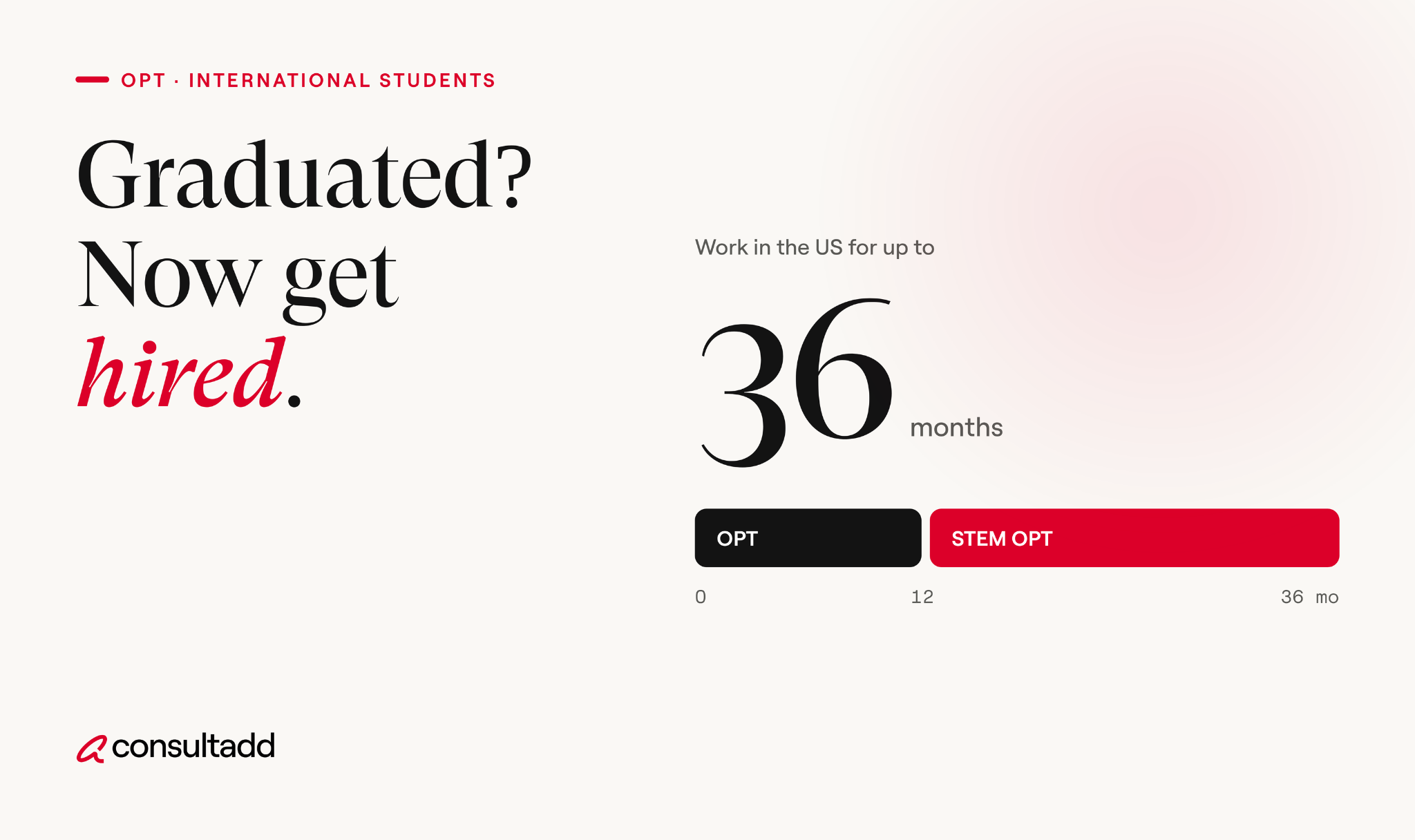
If your degree is on the DHS STEM Designated Degree Program List, you may qualify for a 24-month extension after post-completion OPT. That brings the total to up to 36 months of work authorization.
STEM OPT has stricter requirements than standard OPT.
According to USCIS's STEM OPT page, the employer must have a bona fide employer-employee relationship with you, sign Form I-983, run a formal training program tied to your degree, and report your termination or departure to your DSO within five business days.
USCIS also explains that if you file your STEM OPT application on time and your current OPT expires while it's pending, your employment authorization is automatically extended for 180 days. That cover ends once USCIS decides your application.
How the OPT application works
The process runs through your school first, then USCIS:
- Request an OPT recommendation from your DSO, who enters it in SEVIS and issues a new I-20.
- File Form I-765 with USCIS, online or by mail, within the required window.
- Wait for your Employment Authorization Document (EAD).
- Start working only on or after the start date printed on your EAD.
Timing is where many students lose time.
Our guide on how long before graduation you can apply for OPT explains the filing window in detail.
Check the current filing fee on the USCIS website before you apply, since fees change.
Rules for staying in status on OPT
Getting OPT approved is the first half. Keeping your status for the full period is the second, and most problems happen here.
1. Your work must relate to your major
Every job you hold on OPT has to be directly related to your field of study. Keep a short written note for each role that explains how your duties connect to your degree.
If you're ever asked, you'll have it ready.
2. Unemployment limits
The unemployment clock starts on the start date of your EAD, not on your graduation date. Standard OPT allows up to 90 days of unemployment. The STEM extension adds 60 more days, for 150 days total across both periods.
The DHS Study in the States guidance on STEM OPT notes that SEVP officials can terminate a student's record if they accrue more unemployment days than the rules allow.
Gaps between jobs count, so plan your next role before your current one ends.
3. Reporting changes
On post-completion OPT, you're responsible for reporting your employer details, address changes and any period of unemployment, usually through the SEVP Portal or your school's system. Report changes within 10 days.
STEM OPT adds more duties. You submit a new or updated I-983 when you change employers or when your training plan changes materially, complete self-evaluations, and confirm your information with your DSO every six months.
Travel while on OPT
International travel during OPT is possible but carries risk, especially before you have a job. Students typically carry their EAD, a valid passport and visa, an I-20 with a recent DSO travel signature, and an employment letter.
Talk to your DSO before booking anything, because the 2026 rule changes described below could affect travel around STEM OPT filings if they take effect.
If you're unsure how OPT affects job applications, our post on whether you're legally authorized to work in the U.S. explains how F-1 students on OPT usually answer the work authorization and sponsorship questions.
OPT changes and proposals to watch in 2026
Two federal actions in 2026 could change how OPT works. Neither has changed the program yet, but both are worth tracking.
The proposed OPT fee
On October 7, 2026, DHS proposed a rule that would set a $70,000 fee for each F-1 student's initial OPT and a $30,000 fee for any subsequent OPT, including a STEM OPT extension.
Under the proposal, the school would pay before the DSO enters the OPT recommendation in SEVIS. DHS has said schools may pass the cost on to students or employers.
This is a proposed rule only. The fees are not in effect, and the existing OPT process, fees and timelines still apply. If DHS finalizes the rule, the details could change from the proposal.
The duration of status rule
In July 2026, DHS published a final rule to replace "duration of status" for F and J visa holders with fixed admission periods.
A federal court postponed its September 15, 2026 effective date and blocked DHS from implementing it while the case continues.
Yale's Office of International Students and Scholars keeps a detailed FAQ on what the rule would change, including how it could affect students who travel before filing for STEM OPT.
Your DSO will be the first to know how these rules apply to you. Check your school's updates regularly, especially before travel or filing.
Working on OPT through a staffing firm
Many OPT graduates in tech land their first U.S. role through an IT staffing firm. It can be a fast route into contract or contract-to-hire work, but you should ask a few questions first.
From our experience placing early-career technology professionals, the questions that matter most are:
- Who is my employer? The firm that hires you should be your actual employer, running payroll and providing the job.
- Is the role directly related to my degree? Ask for a written job description you can match against your major.
- Does the firm use E-Verify? If you'll need STEM OPT later, this is required.
- Can the firm support STEM OPT? The employer signing your I-983 must have a bona fide relationship with you and oversee your training plan, which some staffing arrangements can't meet.
- What happens between projects? Unpaid time between assignments may count toward your unemployment limit.
For broader job search tactics, our guide to finding OPT jobs as an international student covers job boards, search terms and how to target OPT-friendly employers.
After OPT: what comes next
OPT is temporary, so it helps to plan your next step early. Many graduates move from OPT to H-1B status.
If your employer files a timely H-1B petition with an October 1 start date and you're selected, the cap-gap rule can extend your F-1 status and work authorization until the H-1B begins.
Our comparison of H-1B and OPT explains how the two differ and how students usually move from one to the other.
Making the most of OPT for international students
OPT for international students works best when you treat it as a timeline, not just a permit. Apply in your window, pick roles that clearly match your degree, keep unemployment days low, and report every change on time.
If you qualify for STEM, choose an employer that can support the I-983 before you need it. And with 2026 bringing proposed changes, check in with your DSO before any major decision.
Start Strong With Consultadd
With 15 years in business and 5,000+ successful staffing engagements, we don't just fill roles, we build reliability into your process. We've supported 65 staffing companies in the past year alone and maintain MSAs with industry leaders like Robert Half and TEKsystems.
Here's what working with Consultadd looks like:
- Talent sourced in under 24 hours
- Ready-to-deploy candidates, vetted for experience and compliance
- Lower turnover risk: we match long-term goals, not just short-term needs
- Seamless compliance: visa, documentation, onboarding? Handled.
- Dedicated 1:1 account managers for responsive, personalized support
- Top 100 candidate matches delivered in the past year
- Strong partnerships with universities to tap into fresh, committed talent
- Post-placement support so your investment grows beyond day one
For candidates, your next opportunity is more than just a job title, it's a chance to build skills, gain experience, and move your career forward. At Consultadd, we connect technology professionals with projects and employers that align with their goals, whether they're looking for contract, contract-to-hire, or long-term opportunities.
The tech job market moves fast, but the right guidance can make all the difference. Ready to take the next step in your career journey? Explore Opportunities >>
Key takeaways
- OPT gives F-1 students up to 12 months of work authorization per degree level in a job directly related to their major.
- STEM graduates can add 24 months, but only with an E-Verify employer that signs and follows a Form I-983 training plan.
- Unemployment is capped at 90 days on standard OPT and 150 days in total with the STEM extension.
- Reporting employer, address and training plan changes on time is as important as getting OPT approved.
- The October 2026 OPT fee proposal and the duration of status rule are not in effect, so current OPT rules still apply.
FAQs
What is OPT for international students?
OPT, or Optional Practical Training, is temporary work authorization for F-1 students in the U.S. It allows you to work in a job directly related to your major, either during your program or after you graduate. You stay in F-1 status while on OPT.
How long is OPT?
You can receive up to 12 months of OPT at each degree level. If your degree is on the DHS STEM list and you meet the employer requirements, you can apply for a 24-month STEM OPT extension, for up to 36 months in total.
Can I work any job on OPT?
No. Every job on OPT must be directly related to your major field of study. Post-completion OPT employment should be at least 20 hours per week to count, and STEM OPT employment must be paid and with an E-Verify employer.
How many days can I be unemployed on OPT?
You can be unemployed for up to 90 days on standard post-completion OPT. With the STEM extension, you get 60 more days, for 150 days in total. The count starts on your EAD start date, and gaps between jobs count toward it.
Do I need a job offer to apply for OPT?
Not for standard OPT. You can apply and receive your EAD before you have a job, though your unemployment days start once the EAD becomes valid. For the STEM OPT extension, you do need a qualifying employer, because the employer must sign your Form I-983.
Is the new $70,000 OPT fee in effect?
No. DHS proposed the fee in October 2026, and it is not final. Until a final rule is published and takes effect, current OPT rules, fees and timelines remain in place. Check your school's international office for updates.