


Introduction
You're filling out a job application, a rental form, or your LinkedIn profile, and there it is: a field labeled "type of employment." It looks simple until you realize you're not sure which answer it wants.
So, what does type of employment mean? It describes the arrangement you work under.
Most forms are asking one of three things: how many hours you work (full-time or part-time), how long the job lasts (permanent, temporary, or contract), or how you're paid and classified (employee or self-employed).
This guide explains each common type, what different forms are really asking, and how to answer when your situation doesn't fit neatly into a dropdown.
TL;DR
- Type of employment describes your work arrangement: your schedule, how long the job lasts, or whether you're an employee or self-employed.
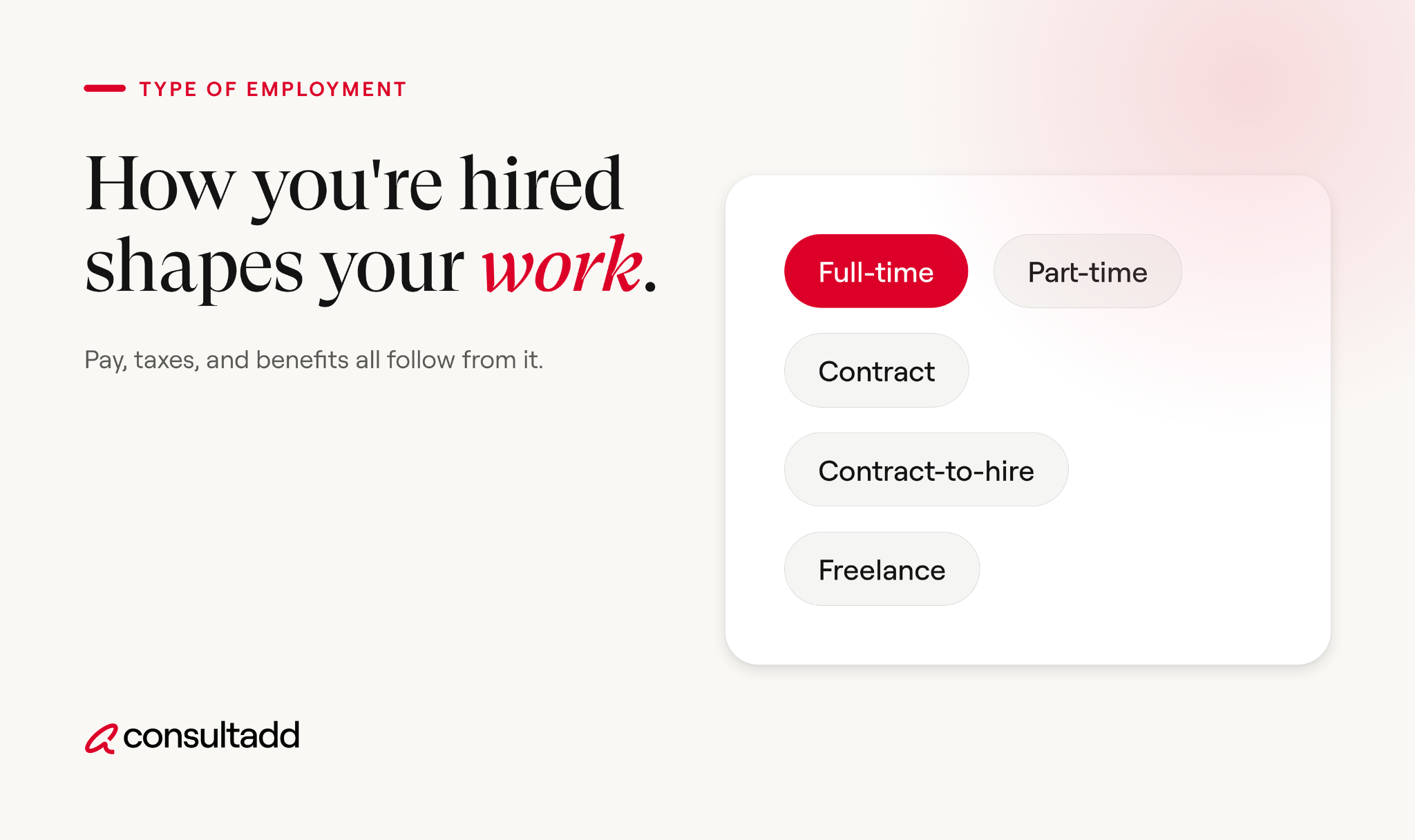
- Common types include full-time, part-time, temporary, seasonal, contract, contract-to-hire, freelance, and internship.
- There's no single federal definition of full-time. The Department of Labor leaves it to employers, while the IRS uses 30 hours a week for health coverage rules.
- The same field means different things on different forms, so answer based on what that form needs to know.
- If you work through a staffing agency, the agency is usually your employer, and your type of employment is often "contract" or "temporary."
What type of employment means in plain terms
"Type of employment" and "employment type" are used interchangeably. Both describe the terms you work under, not your job title or industry.
The confusion comes from the fact that forms bundle three different questions into one label.
Look at the dropdown options. If they say full-time and part-time, the form wants your schedule. If they include contract or freelance, it wants a mix. If it asks about W-2 or 1099, it wants your tax classification.
Common types of employment explained
These are the types you'll see most often on U.S. forms and job postings.
1. Full-time employment
You work a regular schedule set by your employer, usually 35 to 40 hours a week, often with benefits like health insurance and paid time off.
There's no single federal number for full-time. The Department of Labor says the Fair Labor Standards Act doesn't define full-time or part-time employment and leaves it generally to the employer.
You can read that answer in the DOL FLSA Advisor.
The IRS does use a number for one purpose. For employer health coverage rules, a full-time employee is one who works on average at least 30 hours a week, or 130 hours a month.
The details are on the IRS page on identifying full-time employees.
2. Part-time employment
You work fewer hours than the employer's full-time standard. Part-time roles may come with fewer benefits, but labor protections still apply.
Whether you're called full-time or part-time doesn't change how the FLSA applies to you.
3. Temporary employment
The job has a defined end, like covering a leave of absence or a short project. Temp workers are often hired and paid through a staffing agency.
4. Seasonal employment
A temporary job tied to a time of year, such as holiday retail, tax season, or summer work.
5. Contract employment
You're hired for a set period or project. In IT, contract work usually runs a few months to a year and is often renewed.
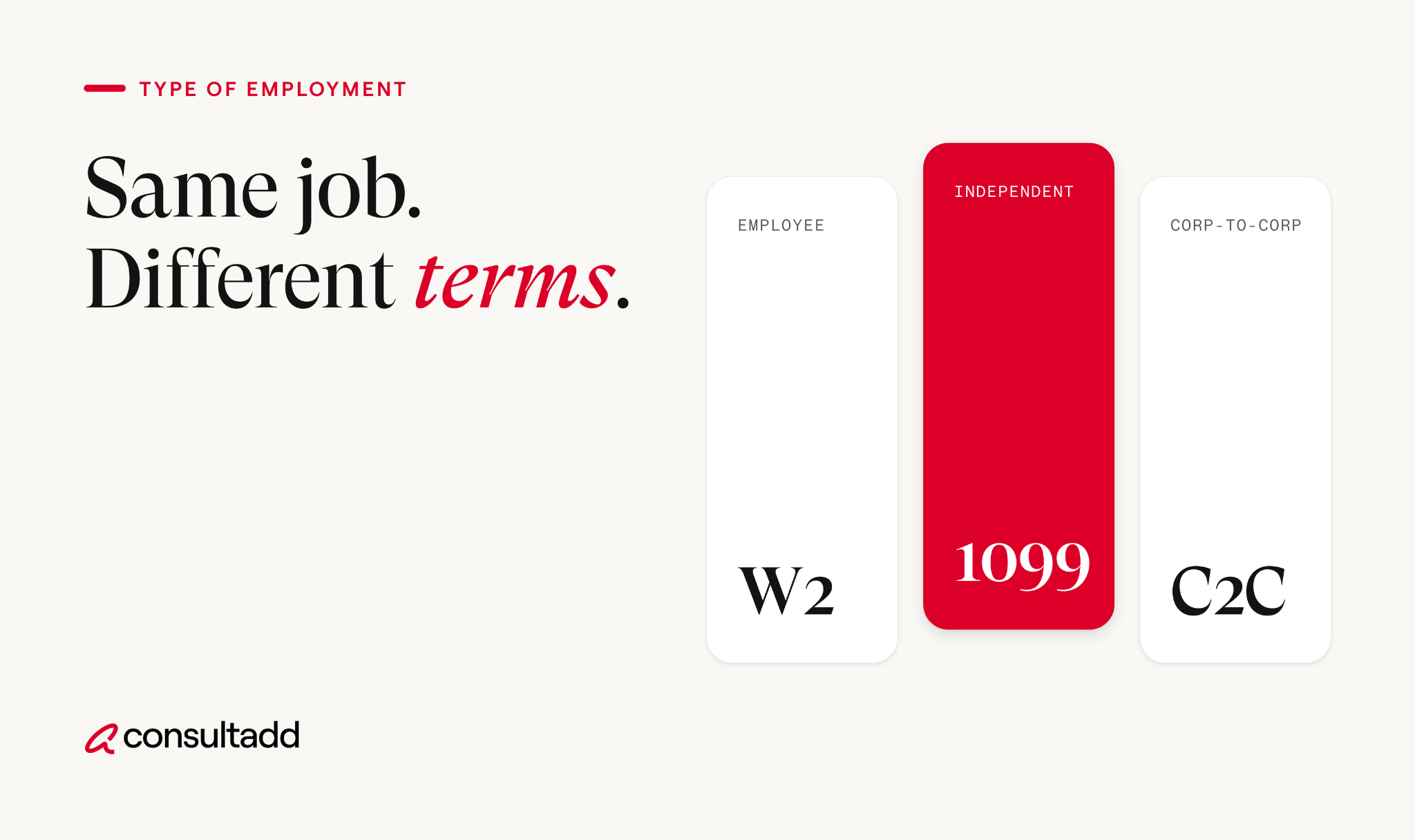
You may be paid as a W-2 employee of a staffing firm, as a 1099 contractor, or through your own company (C2C).
If you're weighing those three setups, our guide to W2 vs C2C vs 1099 explains the tax and benefits differences.
6. Contract-to-hire
You start as a contractor with the option of becoming a permanent employee after a trial period.
Our guide to contract-to-hire covers how conversion usually works.
7. Freelance or self-employed
You work for yourself and take on clients. You handle your own taxes and usually get a 1099-NEC instead of a W-2.
If you work through your own registered business, see our explainer on C2C employment.
8. Internship and apprenticeship
Training-focused roles, often short-term, for students or people entering a field.
Internships may be paid or unpaid depending on the role and the law that applies.
9. Per diem and on-call
You work as needed with no set schedule. This is common in healthcare and some support roles.
Types of employment at a glance
"Usually" matters in this table. Benefits and pay arrangements vary by employer and by contract, so check your offer letter for the real terms.
What does type of employment mean on different forms?
The same field asks for different things depending on who's asking and why.
1. On a job application
Employers usually want to know which arrangement you're applying for (full-time, part-time, or contract) or what you did in past roles.
Answer with the type you actually held, not the one that sounds better. Background checks often confirm it.
2. On LinkedIn and job sites
LinkedIn's "employment type" dropdown includes options like full-time, part-time, self-employed, freelance, contract, internship, apprenticeship, and seasonal.
Pick the one that matches the arrangement. If you were a contractor placed at a well-known company, list the contract role honestly and mention the client in the description if your agreement allows it.
3. On loan, mortgage, and rental applications
Lenders and landlords want to know how stable and verifiable your income is.
They'll often ask whether you're salaried, hourly, self-employed, or contract, and they may ask for pay stubs, W-2s, or tax returns to match.
Self-employed and contract workers are often asked for more documentation, so have it ready.
4. On staffing agency onboarding forms
Agencies usually ask how you'll be engaged: W-2 through the agency, 1099, or C2C through your company. This decides who withholds taxes and what benefits you get, so confirm it before you discuss a rate.
How to answer when your job doesn't fit one box
Plenty of real jobs fall between categories. Here's how to handle the common ones.
1. You're a contractor placed through a staffing agency
Your employer is usually the staffing agency, not the client company where you work. On most forms, your type of employment is "contract" or "temporary," and your employer is the agency.
This trips up a lot of IT consultants. In our experience, background checks are a common place for it to surface, because the client company has no record of employing you.
Listing the agency as the employer and the client in the description avoids that mismatch.
2. You work full-time hours on a contract
Some forms ask about schedule, others about duration. If you can only pick one, "contract" usually tells the reader more. Where there's a notes field, add "full-time hours, 12-month contract."
3. You have more than one job
List each job separately with its own type. A form asking for your "primary" employment wants the one that provides most of your income.
4. You're self-employed and also a W-2 employee
Report both if the form allows multiple entries. Lenders in particular will want to see each income source and its documents.
5. You're between contracts
If a staffing firm still employs and pays you between projects, you're still employed by that firm.
Our explainer on what a bench candidate is covers how that works in IT staffing.
Why your type of employment matters
The label isn't just paperwork. It can affect your pay, protections, and plans.
Benefits
Health insurance, paid leave, and retirement plans are usually tied to full-time employee status.
Under the ACA rules, larger employers are measured on whether they offer coverage to employees averaging 30 or more hours a week.
Taxes
W-2 employees have taxes withheld by their employer. Self-employed workers and 1099 contractors usually pay their own, including self-employment tax.
Labor protections
Minimum wage and overtime protections under the FLSA apply to employees, whether full-time or part-time. They generally don't apply to genuine independent contractors, which is why classification matters.
The Department of Labor explains the risks of worker misclassification.
Visa status
For workers on visas, the type of employment has to match the visa's rules. H-1B status, for example, requires a real employer-employee relationship, so a solo 1099 or C2C setup usually doesn't work.
Our guide to what an H1 visa is covers the basics.
This is general information, not legal or tax advice. If your situation is unusual, check with a tax professional or employment attorney.
Bottom line
So, what does type of employment mean?
It's a short label for the arrangement you work under: your hours, how long the job lasts, and whether you're an employee or self-employed. Most forms only care about one of those, and the dropdown options usually tell you which.
Answer with what's true and what your records will show. If you're a contractor, name the agency as your employer and the client in the description.
And when the field doesn't fit your job, use any notes space to explain in a few words rather than forcing the wrong box.
Start Strong With Consultadd
With 15 years in business and 5,000+ successful staffing engagements, we don't just fill roles, we build reliability into your process. We've supported 65 staffing companies in the past year alone and maintain MSAs with industry leaders like Robert Half and TEKsystems.
Here's what working with Consultadd looks like:
- Talent sourced in under 24 hours
- Ready-to-deploy candidates, vetted for experience and compliance
- Lower turnover risk: we match long-term goals, not just short-term needs
- Seamless compliance: visa, documentation, onboarding? Handled.
- Dedicated 1:1 account managers for responsive, personalized support
- Top 100 candidate matches delivered in the past year
- Strong partnerships with universities to tap into fresh, committed talent
- Post-placement support so your investment grows beyond day one
For candidates, your next opportunity is more than just a job title, it's a chance to build skills, gain experience, and move your career forward. At Consultadd, we connect technology professionals with projects and employers that align with their goals, whether they're looking for contract, contract-to-hire, or long-term opportunities.
The tech job market moves fast, but the right guidance can make all the difference. Ready to take the next step in your career journey? Explore Opportunities >>
Key takeaways
- Type of employment describes your work arrangement, covering your schedule, the job's length, or your classification as an employee or self-employed.
- The most common types are full-time, part-time, temporary, seasonal, contract, contract-to-hire, freelance, internship, and per diem.
- Federal wage law doesn't define full-time, but the IRS uses 30 hours a week or 130 hours a month for employer health coverage rules.
- Read the form's options to see what it's asking, and answer with what your employer's records will confirm.
- Contractors placed through staffing agencies should usually list the agency as employer and "contract" or "temporary" as the type.
FAQs
What does type of employment mean on a job application?
It asks about the arrangement for the job you're applying for or held in the past. Common answers are full-time, part-time, temporary, contract, or internship. Choose the option that matches the actual terms, since background checks often verify it.
What are the main types of employment?
The main types are full-time, part-time, temporary, seasonal, contract, contract-to-hire, freelance or self-employed, internship, and per diem. They differ in hours, length, benefits, and who pays you. Many forms only list a few of these, so pick the closest match.
How many hours is full-time employment?
There's no single federal rule for wages and overtime, and the Department of Labor leaves the definition to employers. Many employers use 35 to 40 hours a week. For employer health coverage under the ACA, the IRS uses an average of 30 hours a week or 130 hours a month.
Is contract work considered full-time employment?
It can be both. A contract describes how long the job lasts, while full-time describes your hours, so many contractors work full-time hours on a fixed-term contract. If a form only allows one answer, "contract" is usually more accurate.
What is employment status vs. type of employment?
Employment status usually means whether you're currently employed, unemployed, or self-employed. Type of employment describes the arrangement of a specific job, like full-time or contract. Some forms use the two terms interchangeably, so read the options before answering.
What type of employment should I list if I work through a staffing agency?
List "contract" or "temporary," depending on the options, and name the staffing agency as your employer since it usually runs your payroll. You can mention the client company in the job description. This keeps your application consistent with what a background check will show.
.webp)



.webp)
