


Introduction
If you've spent any time in US contract staffing, especially in IT, you've seen the phrase "C2C only" on job postings.
So what is C2C employment? C2C stands for corp-to-corp, an arrangement where a company pays another business entity for a worker's services instead of paying the worker directly. Your corporation bills their corporation. Hence the name.
That single structural change ripples into everything: how you're taxed, what benefits you get, who carries the liability, and even whether the arrangement is legal for your visa status.
Recruiters throw around C2C, W2, and 1099 like everyone was born knowing the difference, and honestly, the confusion costs people money on both sides of the table.
This guide breaks down how C2C works, how it compares to W2 and 1099, the compliance traps, and who it actually makes sense for.
TL;DR
- C2C (corp-to-corp) means the hiring company contracts with the worker's registered business entity, such as an LLC or S-corp, not with the worker as an individual.
- The contractor's corporation handles all taxes, including the full 15.3% for Social Security and Medicare, plus its own insurance and benefits.
- C2C rates run higher than W2 rates because no benefits, payroll taxes, or protections come from the client. The gross number isn't the take-home number.
- A registered entity alone doesn't guarantee compliance. The IRS and Department of Labor look at the actual working relationship, not the paperwork.
- Most H-1B professionals work "C2C" through an employer, like a consulting firm, that holds their visa. Independent solo C2C generally isn't an option on H-1B.
What is C2C employment and how does it work?
In a standard job, a company hires you, withholds your taxes, and sends you a W-2 each January.
In a C2C arrangement, the company never hires you at all. It signs a services contract with your business entity, and your entity is the one that employs you, invoices the client, and gets paid.
For that to work, the contractor side needs a real registered business: an LLC, an S-corporation, or a C-corporation. A sole proprietorship doesn't count. Many clients also require the entity to carry general liability insurance, and some ask for professional liability coverage on top.
The parties involved
A typical C2C chain in IT staffing looks like this:
- An end client needs a software engineer for a nine-month project.
- A prime vendor or staffing agency holds the contract with that client.
- The contractor's corporation (or a consulting firm that employs the contractor) signs a corp-to-corp agreement with the staffing agency.
- The contractor does the work. Their corporation invoices the agency, the agency bills the client, and money flows back down the chain.
Sometimes there are more layers than that, which is where the phrase "C2C" gets its slightly complicated reputation in tech staffing.
We covered how these layered contract models actually function in our piece on IT contract staffing as a business strategy.
What the contractor's corporation is responsible for
Once the money lands in the corporation's account, everything else is the corporation's job:
- All payroll and self-employment taxes, including both the employer and employee halves of Social Security and Medicare (15.3% combined)
- Health insurance, retirement contributions, and paid time off, if any
- Business liability insurance
- Invoicing, bookkeeping, quarterly estimated tax payments, and state filings
None of it comes from the client. That's the trade: a higher rate in exchange for carrying the full administrative and financial load yourself.
C2C vs W2 vs 1099: the real differences
These three terms describe who gets paid and who handles the obligations. Here's the side-by-side:
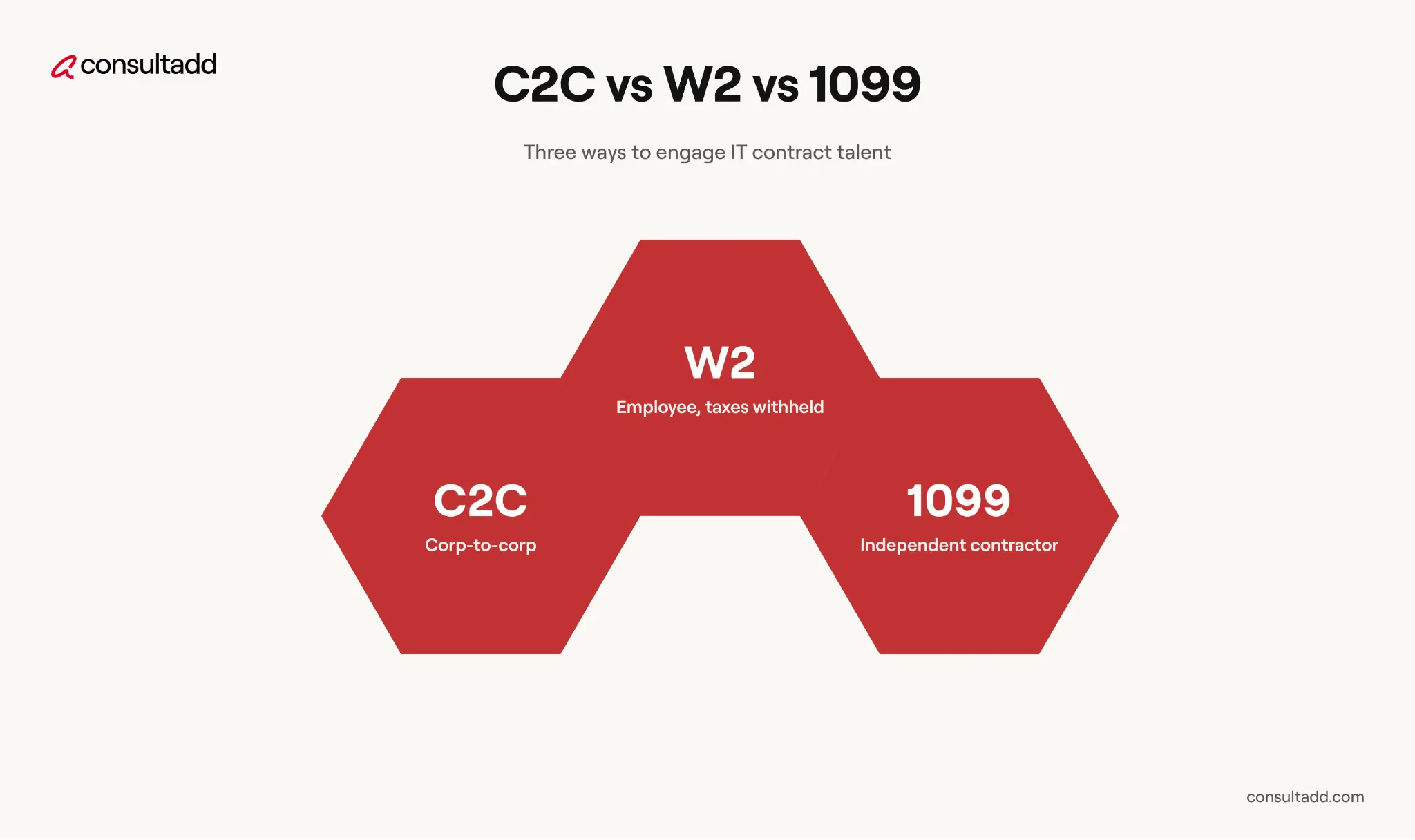
A pattern worth noticing: C2C and 1099 are cousins. Both are independent contractor arrangements. The difference is purely structural.
A 1099 contractor is paid as a person; a C2C contractor is paid as a company. That structural layer matters more to the client than to the worker, because contracting with a vetted corporation reduces (but doesn't eliminate) the client's misclassification exposure.
Under US law, the default assumption is that a worker is a W-2 employee unless the hiring party can show the relationship genuinely meets independent contractor criteria.
That's why W2 remains the dominant model in professional staffing, something we see reflected across the market in our review of the best IT staffing firms in 2026.
Pros and cons of C2C employment
C2C tends to attract experienced contractors who treat their work as a business. Here's the honest ledger, for both sides:
C2C and Work Visas: What H-1B and OPT holders should know
This is where a lot of misinformation circulates, so let's be precise.
H-1B status requires an employer to sponsor and employ you.
That means you can't simply form an LLC and contract yourself out solo the way a citizen or green card holder can. When an H-1B professional works "on C2C," what's really happening is that a consulting or staffing company employs them on W2 and holds their visa, and that company has a corp-to-corp agreement with the vendor or client upstream.
The C2C layer exists between companies, not between the worker and the client.
For F-1 students on OPT, the picture is different but has its own constraints.
Standard OPT allows properly documented self-employment related to your field, but STEM OPT requires an E-Verify enrolled employer and a formal training plan, which effectively rules out working through your own single-member entity for most students.
So when a recruiter asks a visa-holding candidate "are you open to C2C?", the practical question is usually "does your employer allow you to work through their corp-to-corp agreements?"
If you're navigating this, our guide on H-1B visa sponsorship for tech professionals explains the employer-side mechanics in detail.
Misclassification: the risk nobody prices in
Here's the uncomfortable truth about C2C: the entity is evidence, not a shield.
The IRS looks at behavioral control, financial control, and the nature of the relationship. The Department of Labor applies its own economic reality test under the FLSA, and it runs independently of the IRS analysis. Some states, notably California and Massachusetts, layer an ABC test on top that's stricter than both.
A worker who formed an LLC last month, has one client, works set hours under that client's daily direction, and uses the client's equipment is not running a business-to-business relationship. It's an employment relationship with extra paperwork, and regulators treat it that way.
Penalties can reach 100% of the taxes owed, plus fines per unfiled form, plus exposure to wage-and-hour claims.
What a legitimate C2C engagement looks like:
For staffing agencies, vetting the entity on the other side of a C2C agreement isn't optional paperwork. It's the difference between a clean audit and a very expensive year.
It's also one of the compliance gaps we flagged in our look at what's broken in IT recruitment in 2026.
Is C2C right for you?
Now that you know what C2C employment is, the decision comes down to your situation, not the label.
C2C fits well if you're an experienced independent contractor with multiple clients, you're comfortable running a business (or paying someone to), you have your own benefits sorted, and the higher gross rate genuinely outpaces the added costs.
It also fits consulting firms that deploy their own W2 employees to clients through corp-to-corp agreements, which is the standard model across US tech staffing.
W2 fits better if you value stability, employer-paid benefits, unemployment protection, and zero tax administration. And if you're on a work visa, W2 employment through a sponsoring company isn't just the better option, it's usually the only compliant one at the individual level.
Whichever side of the contract you're on, the fundamentals are the same: read the agreement, verify the entity, and make sure the substance of the relationship matches the label on it.
Start Strong With Consultadd
With 15 years in business and 5,000+ successful staffing engagements, we don't just fill roles, we build reliability into your process. We've supported 65 staffing companies in the past year alone and maintain MSAs with industry leaders like Robert Half and TEKsystems.
Here's what working with Consultadd looks like:
- Talent sourced in under 24 hours
- Ready-to-deploy candidates, vetted for experience and compliance
- Lower turnover risk: we match long-term goals, not just short-term needs
- Seamless compliance: visa, documentation, onboarding? Handled.
- Dedicated 1:1 account managers for responsive, personalized support
- Top 100 candidate matches delivered in the past year
- Strong partnerships with universities to tap into fresh, committed talent
- Post-placement support so your investment grows beyond day one
For candidates, your next opportunity is more than just a job title, it's a chance to build skills, gain experience, and move your career forward. At Consultadd, we connect technology professionals with projects and employers that align with their goals, whether they're looking for contract, contract-to-hire, or long-term opportunities.
The tech job market moves fast, but the right guidance can make all the difference. Ready to take the next step in your career journey? Explore Opportunities >>
Key takeaways
- C2C employment means a company contracts with the worker's registered business entity (LLC, S-corp, or corporation) rather than hiring the individual, and the entity handles all taxes, benefits, and insurance.
- Compared with W2, C2C offers higher gross pay and business deductions but no benefits, no unemployment coverage, and the full 15.3% Social Security and Medicare burden.
- Compared with 1099, C2C is structurally similar; the difference is that payment flows to a corporation, which lowers (but never eliminates) the client's misclassification risk.
- Regulators judge the substance of the working relationship, not the entity paperwork. A single-client LLC under daily client direction is an employee in everything but name.
- H-1B professionals participate in C2C through a sponsoring employer's corp-to-corp agreements, not through a personal entity, and STEM OPT students need an E-Verify employer.
FAQs
What does C2C mean in employment?
C2C stands for corp-to-corp. It's a contract arrangement where the hiring company pays the worker's business entity, such as an LLC or S-corporation, instead of paying the worker directly. The worker's corporation then handles payroll, taxes, insurance, and benefits.
What is the difference between C2C and W2?
A W2 worker is an employee: the employer withholds taxes, pays half of Social Security and Medicare, and usually provides benefits. A C2C contractor works through their own corporation, receives no benefits from the client, and their entity covers the full 15.3% in payroll taxes. C2C gross rates are higher precisely because all of that responsibility shifts to the contractor.
What is the difference between C2C and 1099?
Both are independent contractor arrangements without benefits or withholding. The difference is who receives payment: a 1099 contractor is paid as an individual and gets a 1099-NEC, while a C2C contractor is paid through a registered business entity. Clients often prefer C2C because contracting with a corporation reduces their misclassification exposure.
Do I need an LLC for C2C employment?
Yes, C2C requires a registered business entity, typically an LLC, S-corporation, or C-corporation. A sole proprietorship doesn't qualify. Many clients and staffing agencies also require the entity to carry general liability insurance before signing a corp-to-corp agreement.
Can H-1B visa holders work on C2C?
Not independently. H-1B status requires a sponsoring employer, so an H-1B professional can't contract through their own personal entity. In practice, H-1B workers on "C2C" projects are W2 employees of a consulting or staffing firm, and the corp-to-corp agreement exists between that firm and the client or vendor.
Is C2C better than W2?
Neither is universally better. C2C usually pays a higher gross rate and unlocks business tax deductions, but you give up benefits, unemployment coverage, and simplicity, and you take on the full self-employment tax load. Compare the full-year net of each option, including insurance costs and unpaid gaps between contracts, before deciding.
.webp)



.webp)
