

Introduction
A team is three sprints behind, the cloud migration is stalled, and leadership wants it fixed this quarter. One vendor offers two senior engineers by next week. Another offers to take over the whole migration for a fixed monthly fee.
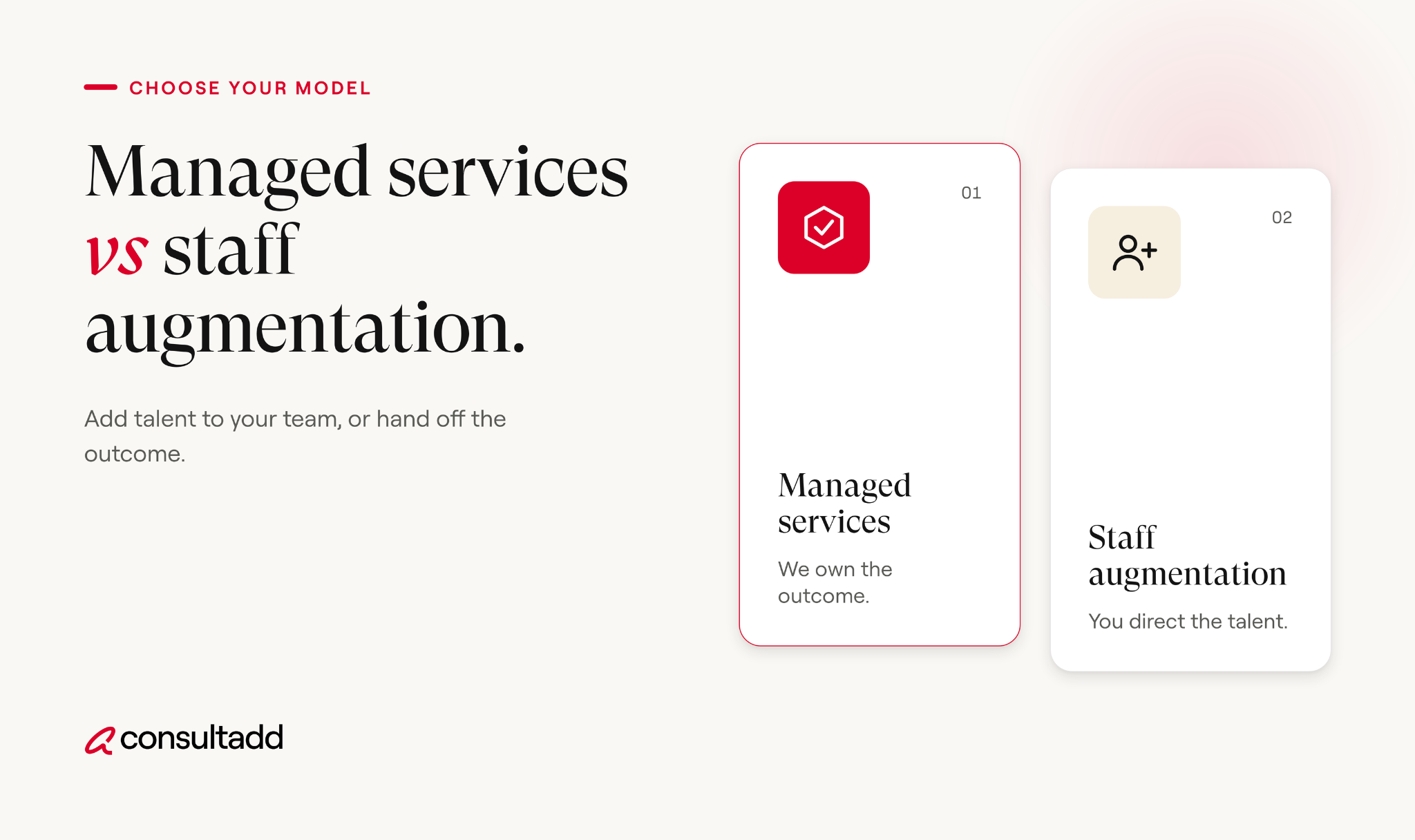
That's the managed services vs staff augmentation decision in its simplest form. With staff augmentation, you add people to your team and keep running the work. With managed services, you hand a function or outcome to a provider and hold them to a service level.
Neither model is better in general. The right one depends on how well you can define the work, how much control you want to keep, and whether the need is temporary or ongoing. This guide compares the two on cost, control, risk and contracts, and ends with a checklist you can use on your next decision.
TL;DR
- Staff augmentation adds external people to your team under your direction. Managed services hand a defined function or outcome to a provider.
- Staff augmentation is usually billed by the hour. Managed services usually run on a fixed fee tied to deliverables or a service level agreement.
- You carry delivery risk with staff augmentation. The provider carries more of it with managed services, in exchange for less day-to-day control.
- Augmentation suits time-bound work that's hard to define upfront. Managed services suit ongoing, well-defined functions that aren't core to your product.
- Many teams use both, and a function often moves from augmentation to managed services once its scope settles.
The core difference between managed services vs staff augmentation
The real question is who owns the outcome. The Virginia Information Technologies Agency's procurement guide on choosing staff augmentation or a statement of work draws the line clearly.
Under staff augmentation, the customer's IT manager supervises the contract resources and pays for hours worked. Under a statement of work, the firm manages the project and gets paid a fixed amount when agreed deliverables are accepted.
Staff augmentation in practice
You bring in a Java developer, a DevOps engineer or a data analyst through a staffing partner. They join your standups, use your tools and take tasks from your leads. The staffing partner handles sourcing, payroll and employment paperwork. You handle the work.
For a deeper look at how this model runs day to day, see our guide to IT staff augmentation.
Managed services in practice
You hand over a function, such as infrastructure monitoring, help desk support, application maintenance or security operations. The provider decides who works on it, how many people it takes and which tools they use. You measure them on results written into the contract, like uptime, response time or tickets resolved.
Side-by-side comparison
How the costs actually compare
Hourly rates don't tell you which model is cheaper. What matters is the total cost of getting the outcome you need.
Staff augmentation often looks cheaper per hour because you're paying for people, not for management or a service guarantee. But you're also paying for your own managers' time, your tools, and any delays when work slips.
Managed services cost more on paper because the fee includes the provider's management, processes and risk. You're paying for a result, not for hours.
A quick example
Say a product team needs two extra backend engineers for a 12-week release. The work will shift as requirements firm up. Staff augmentation fits here, because the team can redirect the engineers every sprint without renegotiating anything.
Now say the same company wants 24/7 monitoring and patching for its cloud environment. The work is ongoing, easy to define and not what the product team wants to spend time on. A managed service with clear uptime and response targets is usually the better buy.
Risk, security and compliance
Each model shifts risk in a different direction, so be clear about where it lands before you sign.
With staff augmentation, delivery risk stays with you.
- If a deadline slips, it's your management problem.
- The staffing partner is responsible for providing qualified people and handling employment obligations, such as payroll and correct worker classification.
- The U.S. Department of Labor explains why classifying workers correctly matters for wage and overtime rules, so confirm how the partner employs its contractors.
With managed services, the provider carries more delivery risk, but it usually gets deep access to your systems.
- A 2022 joint advisory from CISA and allied cybersecurity agencies on protecting managed service providers and their customers recommends multifactor authentication on provider accounts, disabling unused accounts, and contracts that spell out who owns which security responsibilities.
A few contract points worth settling in either model:
- Who owns code, documentation and data created during the engagement
- What system access each person or provider team gets, and how it's removed
- Notice periods and how knowledge is handed back at the end
- Service levels and penalties, for managed services
- Replacement terms if a contractor leaves early, for staff augmentation
When staff augmentation is the better fit
- The work is core to your product. You want your own leads making the technical calls.
- Scope is still moving. You can't write a detailed SOW yet, and forcing one would mean constant change orders.
- You have a specific skill gap. Your team is solid but missing one skill set, like Kubernetes, data engineering or a specific ERP platform.
- The need has an end date. A release, a migration phase or a backlog cleanup.
- You want to try before you hire. Some teams use augmentation, or a contract-to-hire arrangement, to test a role before making it permanent.
When managed services are the better fit
- The work is ongoing and repeatable. Monitoring, support desks, patching and maintenance run on a schedule.
- You can define success in numbers. Uptime, response times and resolution rates can go into an SLA.
- It isn't a differentiator. Keeping the lights on matters, but it's not where your team adds the most value.
- You lack the management capacity. You don't have leads available to direct extra people every day.
- You want a predictable budget. A fixed monthly fee is easier to plan around than variable hours.
A decision checklist
Run through these questions with your team. If most answers point one way, you have your model.
Using both models together
Most mid-size and large IT teams don't pick one model for everything. A common setup is a permanent core team, augmented engineers for project spikes, and a managed service for operations like monitoring or support.
Functions also move between models over time. A team might augment with two DevOps engineers while it builds a new platform, then move day-to-day operations to a managed service once the setup is stable and easy to describe in an SLA.
Our breakdown of IT staffing service models shows where each option fits, and our guide to choosing IT staff augmentation companies covers what to check in a partner.
Making the call
The managed services vs staff augmentation choice comes down to two things: how clearly you can define the work, and how much of it you want to direct yourself.
If the scope is fluid and the work is core, add people and keep control. If the scope is stable and the work is operational, buy the outcome and manage the vendor.
Start with the checklist above for your next request. If the answers are split, begin with augmentation for the uncertain parts and revisit once the scope settles.
Start Strong With Consultadd
With 15 years in business and 5,000+ successful staffing engagements, we don't just fill roles, we build reliability into your process. We've supported 65 staffing companies in the past year alone and maintain MSAs with industry leaders like Robert Half and TEKsystems.
Here's what working with Consultadd looks like:
- Talent sourced in under 24 hours
- Ready-to-deploy candidates, vetted for experience and compliance
- Lower turnover risk: we match long-term goals, not just short-term needs
- Seamless compliance: visa, documentation, onboarding? Handled.
- Dedicated 1:1 account managers for responsive, personalized support
- Top 100 candidate matches delivered in the past year
- Strong partnerships with universities to tap into fresh, committed talent
- Post-placement support so your investment grows beyond day one
For candidates, your next opportunity is more than just a job title, it's a chance to build skills, gain experience, and move your career forward. At Consultadd, we connect technology professionals with projects and employers that align with their goals, whether they're looking for contract, contract-to-hire, or long-term opportunities.
The tech job market moves fast, but the right guidance can make all the difference. Ready to take the next step in your career journey? Explore Opportunities >>
Key takeaways
- Staff augmentation keeps control and delivery risk with you. Managed services move both toward the provider.
- Compare total cost, including management time, tools, overruns and change requests, not just hourly rates.
- Choose augmentation for core, time-bound or loosely scoped work, and managed services for ongoing, well-defined operations.
- Put ownership of code and data, system access, exit terms and security responsibilities in the contract for either model.
- A hybrid setup is common, and many functions move from augmentation to managed services once their scope stabilizes.
FAQs
What is the main difference between managed services and staff augmentation?
Staff augmentation adds external people to your team, and you direct their work. Managed services hand a defined function or outcome to a provider, who manages the people and delivers against agreed service levels. The difference is who owns the result.
Which is cheaper, staff augmentation or managed services?
Staff augmentation usually has a lower hourly cost, but you also pay for management time, tools and any overruns. Managed services cost more on paper because the fee covers the provider's management and delivery risk. Compare total cost for the outcome you need, not rates alone.
Is staff augmentation the same as outsourcing?
Not quite. Staff augmentation is a type of outsourcing where only the people come from outside, while your team keeps control of the work. Project outsourcing and managed services hand over more of the responsibility for delivery.
What is a managed service provider?
A managed service provider (MSP) is a company that takes ongoing responsibility for running a function for you, often IT infrastructure, security, support or application maintenance. Work is usually governed by a contract with service levels and a recurring fee.
Can you switch from staff augmentation to managed services?
Yes, and it's a common path. Teams often augment while a system or process is being built, then move ongoing operations to a managed service once the scope is stable enough to define in an SLA. Plan the handover carefully so documentation and system knowledge transfer with it.
When should a company avoid managed services?
Avoid them when the work is core to your product, the scope changes often, or you need direct control over technical decisions. In those cases, change orders and handoffs can slow you down more than managing extra people yourself.
.png)