

Introduction
If you've been told to "try a temp agency," or your manager wants extra hands for a three-month project, you've probably wondered what you're signing up for.
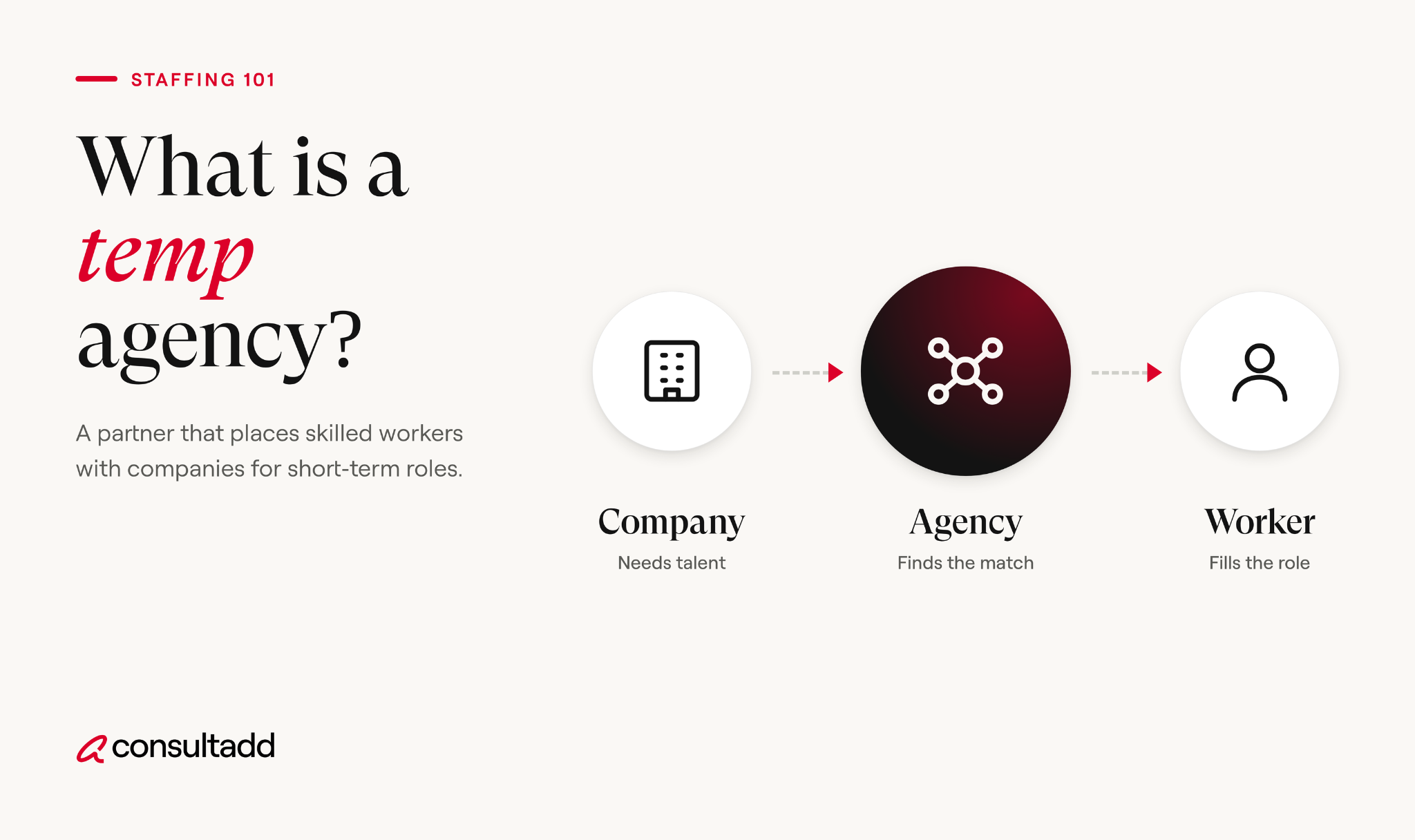
So, what is a temp agency? It's a company that hires workers and places them on short-term assignments at other businesses. The agency is the legal employer. The business where you show up each day directs the work.
That split explains most of what follows: who pays you, who handles your taxes, who's responsible for your safety, and what happens when the assignment ends. This guide walks through it from both sides, the worker's and the employer's.
TL;DR
- A temp agency employs workers and sends them to client businesses for short-term assignments, usually lasting days to several months.
- The agency handles payroll, taxes and paperwork, while the client business (the host employer) supervises the daily work.
- Clients pay the agency an hourly bill rate; legitimate temp agencies never charge workers a placement fee.
- Under OSHA guidance, the agency and the host employer share responsibility for a temp worker's safety.
- Temp work suits seasonal peaks, leave coverage, short projects and people who want flexible or trial-run jobs.
What is a temp agency, exactly?
A temp agency, also called a temporary staffing firm, recruits workers and keeps them on its own payroll. When a client business needs short-term help, the agency sends one of its workers on assignment. The worker does the job at the client's site, or remotely, under the client's direction.
The agency is the "employer of record." It issues your paycheck, withholds taxes, files your W-2, and completes your I-9 work eligibility check. The client is usually called the host employer.
The term "temp" can be misleading.
OSHA defines temporary workers as people supplied to a host employer and paid by a staffing agency, regardless of whether the job itself is actually temporary. Some temp assignments last a week. Others run for a year or more.
Temp work is a large part of the US job market. The Bureau of Labor Statistics counted about 2.49 million jobs in temporary help services in September 2026, down 10,900 from August.
That figure moves with the economy, which is why staffing analysts watch it closely as an early signal of hiring trends.
How do temp agencies work, step by step
The process looks a little different depending on which side you're on. Here's how it typically runs.
For workers
- Apply and register. You submit a resume or profile, and the agency interviews you about your skills, availability and pay expectations.
- Screening. Expect skills tests, reference checks and sometimes a background check or drug screen, depending on the role.
- Onboarding. You fill out tax forms and an I-9, and set up direct deposit with the agency.
- Assignment. When a client need matches your profile, the agency calls with details: pay rate, hours, location and expected length.
- Work and get paid. You submit timesheets (often through an app), and the agency pays you weekly or biweekly.
- Next step. When the assignment ends, the agency can place you somewhere new. Sometimes the client offers you a permanent job instead.
One thing that surprises first-time temps: registering doesn't guarantee work.
Agencies don't promise immediate placement and usually run an interview and vetting process to check your skills and fit. The more flexible you are on schedule and location, the faster you'll typically get called.
For employers
- Define the need. Share the role, skills, schedule, location, start date and expected duration.
- Agree on terms. The agency quotes a bill rate and sets out conversion terms if you might hire the person permanently.
- Review candidates. For light industrial or admin roles, the agency may simply send a qualified worker. For skilled roles, you'll usually see a short list first.
- Supervise the work. You direct daily tasks and approve timesheets.
- Pay one invoice. The agency bills you; it handles wages, payroll taxes, unemployment insurance and workers' compensation.
In practice, the speed is what most clients are paying for. A warehouse manager who learns on Thursday that three people are out next week can often have replacements by Monday.
Filling those seats through a normal hiring process would take weeks.
Who pays whom
Money flows in one direction: from the client to the agency to the worker. The worker never pays the agency.
The client pays an hourly bill rate. The worker earns an hourly pay rate. The difference is the agency's markup, which covers payroll taxes, insurance, recruiting costs, any benefits the agency offers, and its profit.
Markups vary widely by industry, skill level and location, so there's no single standard number.
If an agency asks you for a registration fee, a training fee or money for equipment, walk away.
Consultadd's guide to staffing agencies for remote jobs covers this red flag and others in more detail.
Temp agency vs staffing agency and other models
People use these terms loosely, and many firms offer more than one service. The real difference is who employs the worker and for how long.
A temp agency focuses on short-term placements. A staffing agency usually offers temp work too, plus contract, temp-to-hire and direct-hire placements.
In other words, most temp agencies are a type of staffing agency, but not every staffing agency is mainly a temp agency.
If you want the bigger picture on agencies that cover all of these models, read what to expect when working with a staffing agency.
For the trial-period route, see what contract to hire means and who it suits.
Pros and cons of temporary staffing
Temporary staffing works well in some situations and poorly in others. Here's a fair look at both sides.
For workers
Temp work gives you income quickly and lets you try different workplaces without long commitments.
It's a common way back into work after a gap, and plenty of temps get hired permanently by a client they impressed.
The trade-offs are real, though. Assignments can end early, often for budget reasons that have nothing to do with your performance. Benefits through agencies tend to be thinner than what permanent employees get, and hours may not be steady between assignments.
For employers
The main advantages are speed and flexibility. You can scale up for a busy quarter and scale back without layoffs. The agency handles recruiting and payroll administration.
On the downside, the hourly cost is higher than paying the same person directly. Temps also need time to learn your systems, and turnover between assignments can mean retraining.
For a closer look at the employer side in tech hiring specifically, see the pros and cons of using a staffing agency for tech roles.
Your rights and responsibilities as a temp worker
Being a temp doesn't mean having fewer protections. You're an employee, usually of the agency, with the same basic rights to minimum wage, overtime and a safe workplace as anyone else.
Safety is a shared job. OSHA treats the staffing agency and the host employer as joint employers, so both are responsible for keeping temp workers safe, including meeting training, hazard communication and recordkeeping requirements.
In practice, the host employer usually handles training on site-specific hazards, while the agency is expected to check that the host is actually doing it.
OSHA's Protecting Temporary Workers page lays out what each party should do. It also recommends that the agency and the host spell out each side's safety responsibilities in their contract.
A few practical points for workers:
- You should get the same safety training and protective equipment as the host's own employees.
- Ask the agency before taking on duties that weren't part of your assignment, especially anything involving machinery or hazards.
- Report pay problems to the agency, since it's the one issuing your paycheck.
- You'll complete an I-9 with the agency.
If you're not sure your documents qualify, Consultadd's guide on whether you're legally authorized to work in the US explains the options.
How to pick a good temp agency
Agencies vary a lot. Some focus on warehouse and light industrial work, others on office and admin, healthcare or IT. Picking one that specializes in your field matters more than picking the biggest name.
From the recruiter side, the best agencies ask a lot of questions before placing anyone. If an agency sends a worker to a client without asking about the tasks, the site or the supervisor, that's usually a sign it's optimizing for volume rather than fit.
Is a temp agency the right fit?
Coming back to the original question, what is a temp agency in practice? It's the employer in the middle, handling hiring, pay and paperwork so a business can get short-term help quickly and a worker can start earning quickly.
For workers, it makes sense if you need income soon, want to test different employers, or prefer flexible schedules. It makes less sense if you need guaranteed hours and full benefits right away.
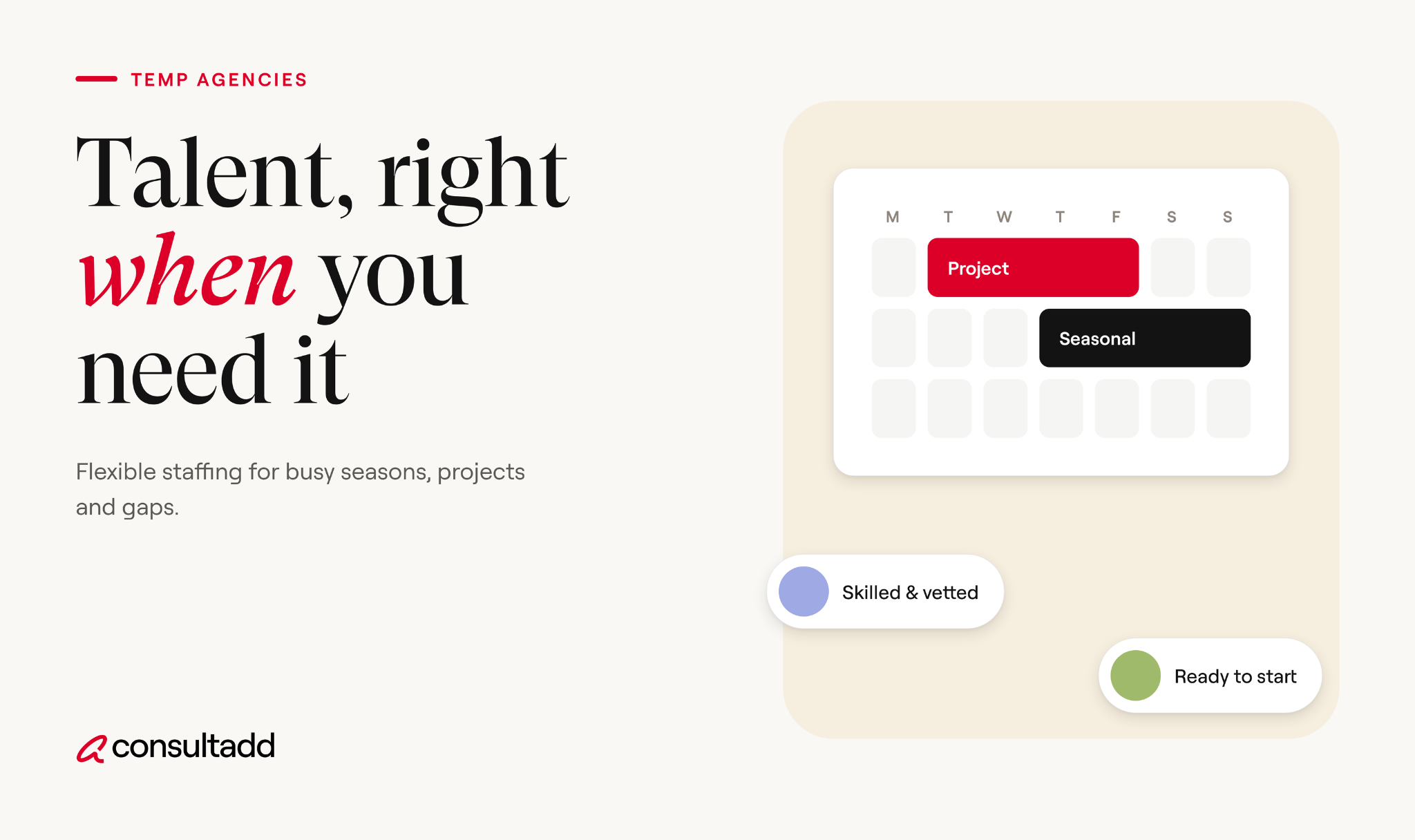
For employers, temp staffing fits seasonal peaks, leave coverage and short projects. For roles you know will be permanent and long-term, direct hiring or temp-to-hire usually costs less over time.
Start Strong With Consultadd
With 15 years in business and 5,000+ successful staffing engagements, we don't just fill roles, we build reliability into your process. We've supported 65 staffing companies in the past year alone and maintain MSAs with industry leaders like Robert Half and TEKsystems.
Here's what working with Consultadd looks like:
- Talent sourced in under 24 hours
- Ready-to-deploy candidates, vetted for experience and compliance
- Lower turnover risk: we match long-term goals, not just short-term needs
- Seamless compliance: visa, documentation, onboarding? Handled.
- Dedicated 1:1 account managers for responsive, personalized support
- Top 100 candidate matches delivered in the past year
- Strong partnerships with universities to tap into fresh, committed talent
- Post-placement support so your investment grows beyond day one
For candidates, your next opportunity is more than just a job title, it's a chance to build skills, gain experience, and move your career forward. At Consultadd, we connect technology professionals with projects and employers that align with their goals, whether they're looking for contract, contract-to-hire, or long-term opportunities.
The tech job market moves fast, but the right guidance can make all the difference. Ready to take the next step in your career journey? Explore Opportunities >>
Key takeaways
- A temp agency is the legal employer of its temp workers, handling pay, taxes and the I-9, while the host employer directs the daily work.
- Clients pay an hourly bill rate, and the gap between bill rate and pay rate covers the agency's costs and profit.
- Workers should never pay a temp agency to be placed; fees to job seekers are a clear warning sign.
- OSHA treats the agency and the host employer as joint employers, so both share responsibility for temp worker safety.
- Temp agencies fit short-term and seasonal needs best, while temp-to-hire or direct hire usually suits long-term roles.
FAQs
Do temp agencies charge you to find work?
No. Legitimate temp agencies are paid by the businesses that use their workers, not by job seekers. If an agency asks for a registration, training or equipment fee, treat it as a red flag and look elsewhere.
How long do temp jobs usually last?
It varies a lot. Some assignments last a single day, while many run a few weeks to several months. Longer projects can extend for a year or more, and some end with a permanent offer.
Can a temp job turn into a permanent job?
Yes, and it happens often. A client that likes a temp's work can offer a permanent role, usually after paying the agency a conversion fee or waiting out a set period in the contract. Temp-to-hire roles are set up with that outcome in mind from the start.
Do temp workers get benefits?
Some do. Many agencies offer health insurance or paid time off after a worker reaches a certain number of hours, and larger agencies may offer retirement plans. The details vary by agency, so ask for them in writing before you accept an assignment.
Who is responsible if a temp worker gets hurt on the job?
Both the agency and the host employer have responsibilities. OSHA considers them joint employers for safety purposes, and the agency typically carries the workers' compensation coverage. The host employer usually handles training on hazards specific to its site.
Is a temp agency the same as a staffing agency?
Not quite. A temp agency focuses on short-term placements, while a staffing agency usually offers temporary, contract, temp-to-hire and permanent placements. Most temp agencies are a type of staffing agency, but the terms aren't fully interchangeable.