
.avif)

Introduction
H1B 2026 has been the most eventful year the program has seen in a long time, and it isn't over. A wage-weighted lottery replaced the random draw.
A $100,000 fee was imposed, struck down in court, then extended by proclamation four days ago. A separate six-figure fee is sitting in proposed rulemaking. And on September 18, a new executive order told three federal agencies to factor employer layoffs into H-1B decisions.
Keeping track of what's actually in effect versus what's proposed versus what's blocked has become the hard part.
This piece is a status snapshot, current as of September 22, 2026. It covers what changed, where each change sits legally right now, and what employers and candidates should be doing before the next cap season.
Immigration policy is moving quickly this year and some of this will shift again. Verify current requirements with USCIS and with immigration counsel before making any filing decision.
TL;DR
- The wage-weighted lottery is live. It ran for the first time in the FY 2027 cap season and replaced random selection with 1 to 4 entries based on the offered wage level.
- Registrations fell about 38 percent year over year, to 211,600, and 71.5 percent of selected beneficiaries held US advanced degrees.
- The $100,000 proclamation fee was vacated by a federal court in June 2026 and cannot currently be collected, though it was extended by a new proclamation on September 18, 2026.
- DHS has separately proposed a $103,265 fee on cap-subject petitions through normal rulemaking. That one is not final.
- A September 18, 2026 executive order directs DOS, DOL, and DHS to weigh employer layoffs when reviewing H-1B filings.
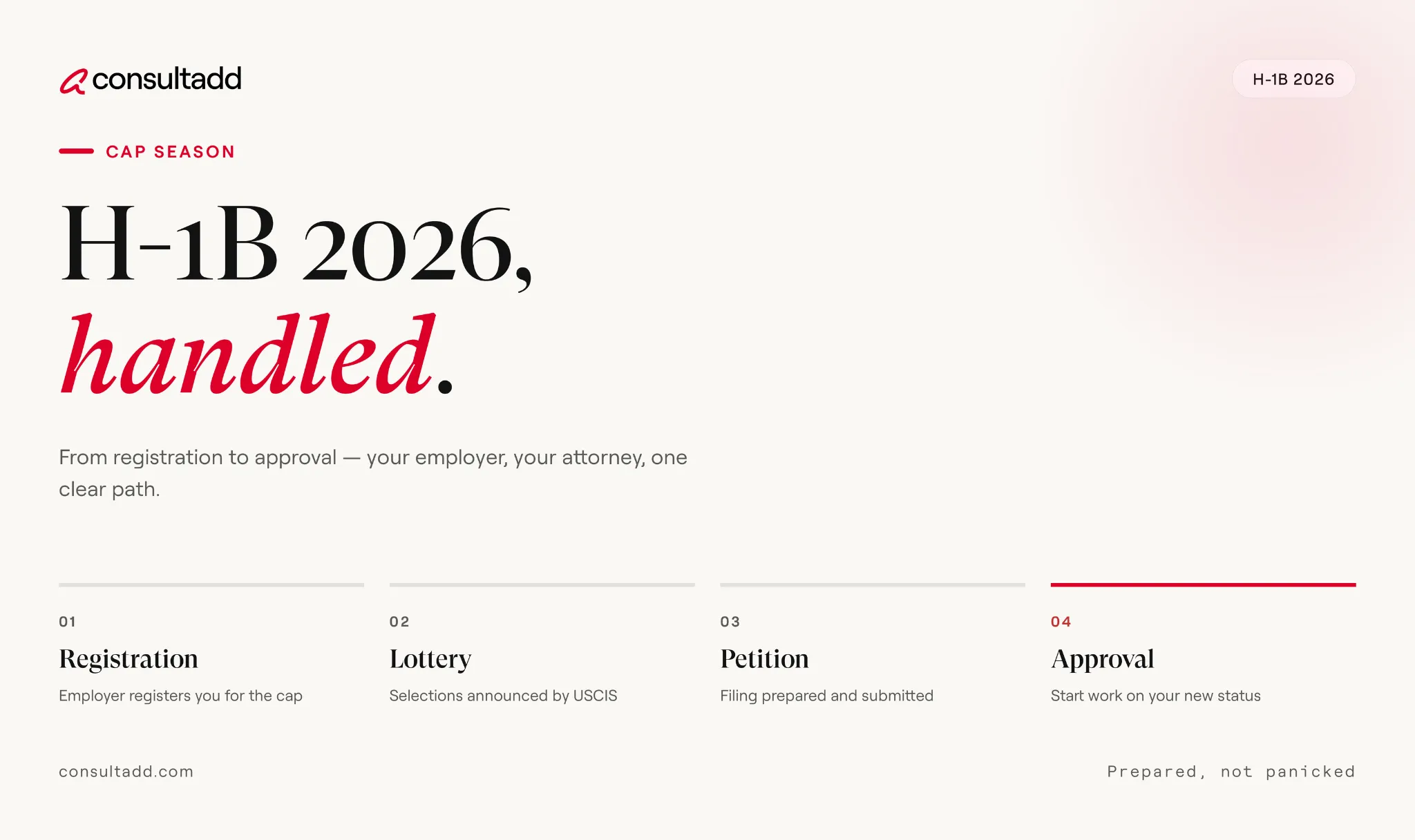
Where Things Stand Today
The pattern worth noticing: most of what's in effect affects selection odds and cost forecasting. Most of what's proposed affects what happens to workers already here.
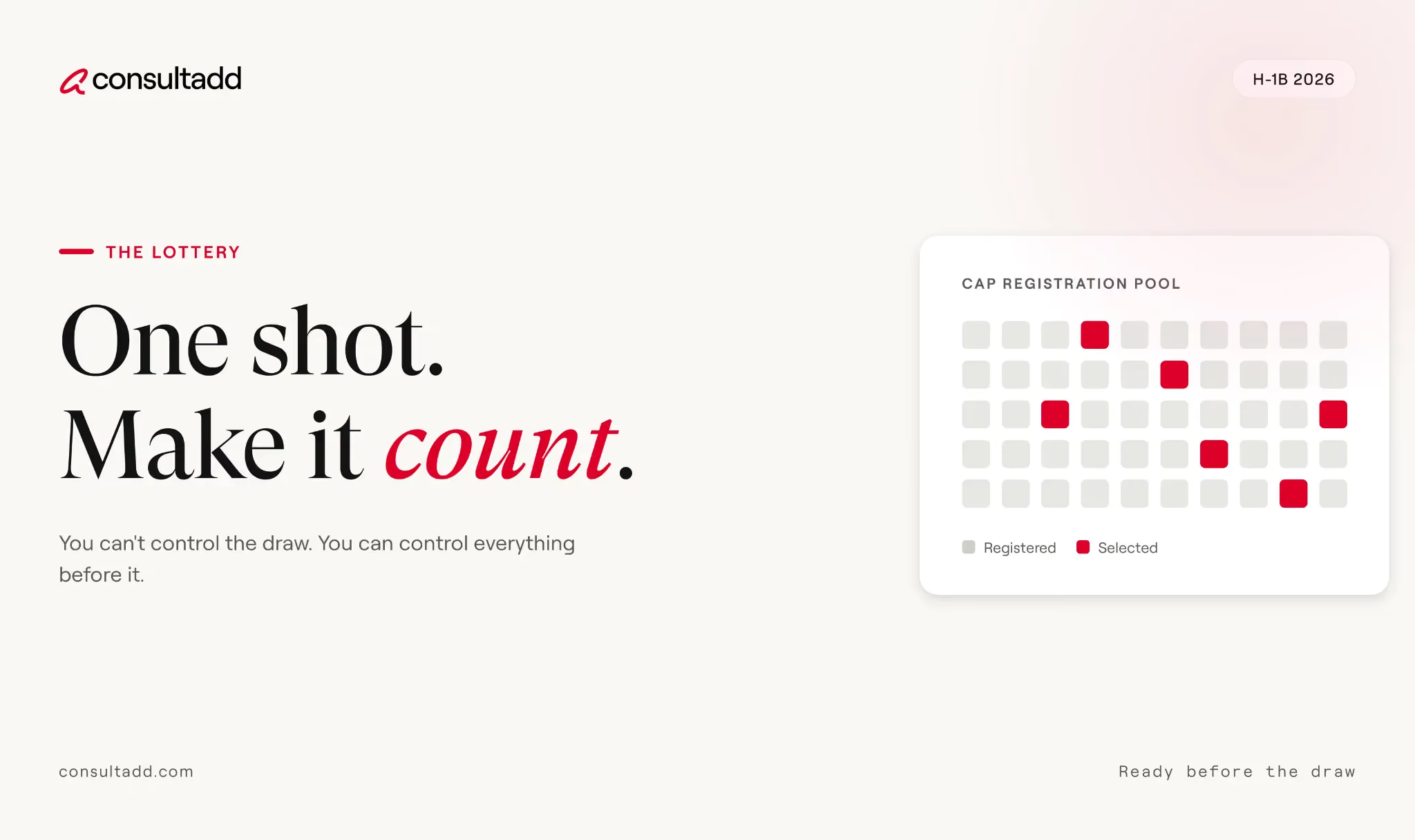
The Weighted Lottery Changed Who Gets Picked
DHS published the weighted selection final rule on December 29, 2025, effective February 27, 2026. It replaced the random lottery with a system that gives more entries to registrations tied to higher wage levels.
Every beneficiary still gets at least one entry, and the beneficiary-centric system from 2024 still applies, meaning one entry per person regardless of how many employers register them.
Two practical consequences.
- Employers now have to enter the OEWS wage level at registration, which means wage decisions happen earlier in the process than they used to.
- Cap petitions have to include the source material supporting the wage level claimed in the registration, so the number has to be defensible.
The rule hits early-career candidates hardest. A recent graduate at a Level I wage now competes against Level IV registrations holding four times the entries. In the final rule, DHS projected selection chances above 61 percent for Level IV and above 45 percent for Level III.
What The FY 2027 Numbers Showed
FY 2027 was the first season run under the new system, and the data is now in.
The timeline ran March 4 to 19, 2026 for registration, selections by March 31, filing from April 1 to June 30, and employment start dates from October 1, 2026.
Two things stand out:
- Registration volume dropped sharply, which was partly the weighted rule discouraging Level I filings and partly the $100,000 fee hanging over the season.
- The advanced degree share jumped 14 points, because graduate degrees correlate with higher offered wages.
The absence of a second lottery matters for planning. In several recent years, unselected registrations got a second chance in summer. That didn't happen this year, so candidates not picked in March had no further path through the FY 2027 cap.
The $100,000 Fee: Imposed, Blocked, Extended
This one has moved more than anything else, so the timeline is the clearest way through it.
The net position right now: the policy exists on paper and has been extended, but the court order vacating it remains in effect, so the payment is not currently being collected. Employers should treat enforceability as unsettled rather than resolved in either direction.
Scope has been narrower than the headline number suggests. The fee applies to petitions for beneficiaries outside the US, those requiring consular processing, and those not eligible for a change of status.
Most F-1 students converting from OPT inside the US were never covered. Extensions, transfers, and amendments were not covered.
Reporting by Forbes puts real-world usage in perspective: just over 700 payments were made in the year the fee was nominally live, which reflects both the narrow scope and the deterrent effect on covered filings.
Consultadd's earlier breakdown of the $100,000 fee ruling covers the litigation reasoning in more depth.
The Proposed $103,265 Cap Fee
On August 25, 2026, DHS published a notice of proposed rulemaking that would impose a $103,265 fee on cap-subject H-1B petitions.
Three things to understand about it:
It is a proposal, not a rule. Notice-and-comment rulemaking takes time, and the final version can differ from the proposal or not arrive at all.
It is legally distinct from the proclamation fee. The proclamation relied on presidential entry authority, which is what the Massachusetts court rejected. This one goes through agency rulemaking, a different legal route with different vulnerabilities.
DHS has indicated that if both were somehow in effect at once, employers would owe both. That's a scenario worth modeling on a budget even if it doesn't come to pass.
The September 2026 Executive Order On Layoffs
Alongside the fee extension, a September 18, 2026 executive order titled "Enhancing Program Integrity and Interagency Coordination in the Administration of the H-1B Nonimmigrant Visa Program" directs the State Department, Labor Department, and DHS to coordinate more closely and to consider an employer's layoff activity when reviewing H-1B-related filings.
The order points at layoffs conducted directly or indirectly in the preceding year, and planned future layoffs, as factors in decisions on labor condition applications and petitions.
Implementation details aren't public yet, so the practical effect is uncertain. What employers can reasonably expect is more scrutiny of companies that have recently reduced headcount while filing new H-1B petitions, and more attention to how contractor and vendor arrangements are described.
Other Proposals Worth Tracking
None of these are final. All would meaningfully change the picture if they were.
Removal of the 60-day grace period. DHS has proposed eliminating the discretionary period that currently lets H-1B, L-1, O-1, TN, and other status holders remain in the US for up to 60 days after employment ends. This would compress the window to find new sponsorship after a layoff.
H-4 work authorization. A pending proposal would end employment authorization for certain H-4 spouses, affecting household income for many H-1B families.
Automatic EAD extensions. Already changed. The automatic extension for EAD renewals was eliminated for applications filed on or after October 30, 2025, making early renewal filing more important than it used to be.
Prevailing wage increases. A DOL proposed rule would raise the wage levels used across the four-tier system. Combined with the weighted lottery, that would raise both the cost of sponsorship and the wage required to be competitive in selection.
For candidates currently on OPT trying to map the path forward, Consultadd's guide to OPT and CPT covers the timing rules that feed into an H-1B filing.
What To Do Before The FY 2028 Cap Season
Registration for FY 2028 is expected in March 2027. That's roughly five months out, and the work that matters happens now.
For candidates, the practical advice has shifted. Wage level now drives selection odds more than anything else you control, which makes negotiating the offered salary an immigration decision as much as a compensation one.
Consultadd's guide to H-1B sponsorship for tech professionals covers how to find sponsoring employers and what cap-exempt placements can offer.
Start Strong With Consultadd
With 15 years in business and 5,000+ successful staffing engagements, we don't just fill roles, we build reliability into your process. We've supported 65 staffing companies in the past year alone and maintain MSAs with industry leaders like Robert Half and TEKsystems.
Here's what working with Consultadd looks like:
- Talent sourced in under 24 hours
- Ready-to-deploy candidates, vetted for experience and compliance
- Lower turnover risk: we match long-term goals, not just short-term needs
- Seamless compliance: visa, documentation, onboarding? Handled.
- Dedicated 1:1 account managers for responsive, personalized support
- Top 100 candidate matches delivered in the past year
- Strong partnerships with universities to tap into fresh, committed talent
- Post-placement support so your investment grows beyond day one
For candidates, your next opportunity is more than just a job title, it's a chance to build skills, gain experience, and move your career forward. At Consultadd, we connect technology professionals with projects and employers that align with their goals, whether they're looking for contract, contract-to-hire, or long-term opportunities.
The tech job market moves fast, but the right guidance can make all the difference. Ready to take the next step in your career journey? Explore Opportunities >>
Key Takeaways
- H1B 2026 delivered one structural change that is fully in effect, the wage-weighted lottery, plus several fee and enforcement changes still working through courts and rulemaking.
- Wage level now drives selection odds. Level IV registrations get four entries, Level I gets one, and the FY 2027 data shows the shift toward higher-paid and advanced-degree candidates.
- The $100,000 proclamation fee was extended through September 2027 but remains blocked by a court order, so it is not currently collectible.
- A separate $103,265 fee on cap-subject petitions is proposed, not final, and would reach the same money through a different legal route.
- Preparation for the March 2027 registration window should start now, beginning with wage level mapping for every intended registration.
FAQs
What changed most for H-1B in 2026?
The selection process. Starting with the FY 2027 cap season, USCIS replaced the random lottery with a weighted system that gives registrations one to four entries based on the offered wage level. That single change reshaped who gets selected more than any fee proposal has so far.
Is the $100,000 H-1B fee currently being charged?
No. A federal court vacated the September 2025 proclamation in June 2026, and the First Circuit declined to pause that ruling in July. A new proclamation on September 18, 2026 extended the policy through September 2027, but the court order blocking collection remains in effect. Confirm current status with counsel before filing.
Did the $100,000 fee apply to students moving from OPT to H-1B?
Generally no. The fee targeted petitions for beneficiaries outside the United States and those requiring consular processing. Most F-1 students filing a change of status from inside the country were outside its scope, and USCIS guidance confirmed that amendments, extensions, and change of status petitions were not covered.
How many H-1B registrations were filed for FY 2027?
USCIS reported 211,600 properly submitted registrations, down about 38 percent from 343,981 the previous year. The cap was reached without a second lottery, which USCIS announced on July 17, 2026.
When is the next H-1B cap registration?
Registration for FY 2028 is expected around March 2027, following the recent pattern of a two-week window in early March. USCIS announces exact dates at least 30 days in advance, so watch for the announcement in late January or February.
Does a higher salary actually improve H-1B selection odds now?
Yes, through the wage level it maps to. A registration whose offered wage reaches Level IV gets four entries versus one at Level I. The level depends on the SOC code and geographic area as much as the raw number, so the classification matters alongside the salary.
.webp)



.webp)
