
.avif)

Introduction
If you've been trying to keep up with the H-1B $100,000 fee ruling over the past month, you're not alone. The story has flipped twice in under two weeks, and employers who paused hiring plans back in September 2025 are now wondering if they jumped the gun, or if they were right to wait.
Here's the short version. A federal judge in Massachusetts struck down the fee. Days later, the same judge paused his own ruling. The government appealed. And as of now, the fee is still being collected while the courts sort out who actually has the authority to impose it.
This guide breaks down what happened, why it matters, and what your company should do while the case works its way through the appeals process.
TL;DR
- A Massachusetts federal court vacated the $100,000 H-1B fee on June 8, 2026, ruling it was an unlawful tax that only Congress could impose.
- On June 12, the same court partially reinstated the fee through an administrative stay while the government appeals.
- The fee currently applies only to new H-1B petitions requiring consular processing, and it remains in effect for now.
- A parallel case at the D.C. Circuit upheld the fee, creating a circuit split that could send the issue to the Supreme Court.
- Employers should keep documenting fee payments, avoid assuming the fee is gone, and build flexibility into their H-1B hiring plans.
Where the H-1B $100,000 Fee Came From
On September 19, 2025, President Trump signed Proclamation 10973, titled "Restriction on Entry of Certain Nonimmigrant Workers." The proclamation added a $100,000 fee to new H-1B petitions filed for workers who need consular processing, meaning workers applying for their visa stamp from outside the United States.
The fee took effect on September 21, 2025.
The administration framed the fee as a way to reduce misuse of the H-1B program and protect STEM jobs for U.S. workers. Critics saw it differently.
Twenty state attorneys general, along with universities, healthcare groups, and labor unions, filed lawsuits arguing the fee was really a tax dressed up as an immigration rule, and that no president can impose a tax without Congress.
That disagreement is what landed the case in federal court.
The June 8 Ruling: Fee Vacated
On June 8, 2026, Judge Leo T. Sorokin of the U.S. District Court for the District of Massachusetts sided with the plaintiffs in State of California et al. v. Mullin et al. He granted summary judgment and vacated the fee entirely, pointing to three problems with how it was rolled out.
The fee functioned as a tax. Sorokin found that a $100,000 charge on visa petitions isn't really an immigration restriction. It's a revenue-raising measure, and the Constitution gives that power to Congress, not the president. His opinion referenced the Supreme Court's earlier ruling against the administration's tariffs, applying similar reasoning here. The court also issued declaratory relief for the plaintiffs but decided a permanent injunction wasn't necessary.
The rollout skipped proper procedure. The court found the agency guidance implementing the fee violated the Administrative Procedure Act because it bypassed the notice-and-comment process required for major policy changes.
It exceeded the president's statutory authority. The ruling held that nothing in the Immigration and Nationality Act gives the executive branch the power to attach a six-figure fee to a visa category Congress already created and funded through its own filing fee structure.
For a few days, this looked like a clean win for employers. Then came June 12.
The June 12 Reversal: Fee Reinstated (For Now)
Four days after his own ruling, Sorokin partially paused it. The government had asked for a full stay pending appeal. He denied that request on the merits, but granted a narrower administrative stay instead.
In his order, Sorokin stated the court would stay its June 8 order "pending a decision by the United States Court of Appeals for the First Circuit on the anticipated Motion to Stay pending appeal from the Defendants," on the condition that the government actually file that motion with the First Circuit by June 18, 2026.
The government met that deadline. On June 18, it formally asked the First Circuit to keep the fee in place while the broader appeal plays out. That request is still pending.
Practically, this means USCIS can currently require the $100,000 fee for H-1B petitions tied to consular processing. If you're filing one of those petitions today, you should plan on paying it unless your immigration counsel tells you otherwise.
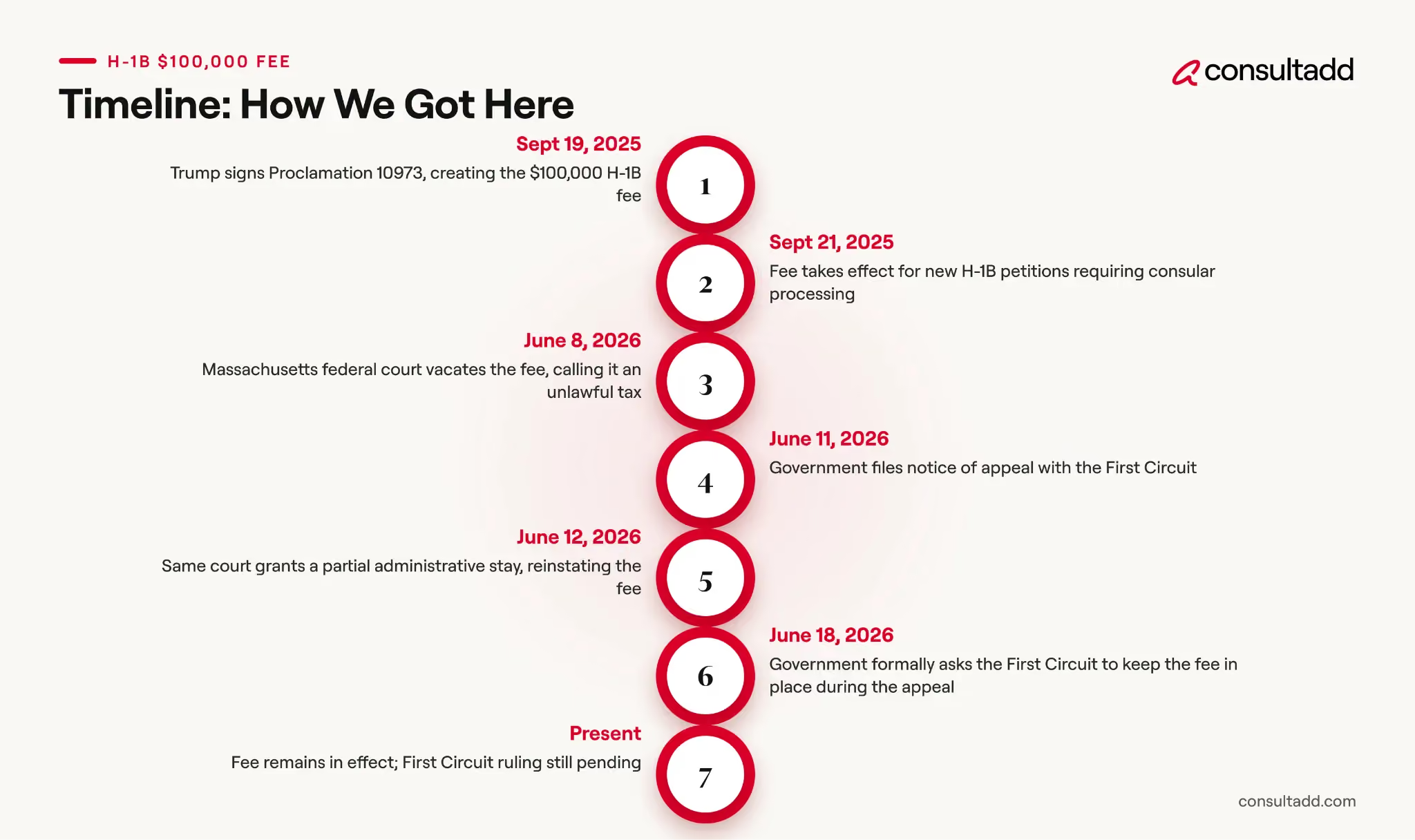
Timeline: How We Got Here
The legal status of the proposed $100,000 H-1B fee has changed several times in less than a year, creating significant uncertainty for employers and foreign professionals alike.
From its introduction through a federal court challenge and the government's appeal, each development has influenced whether the fee remains enforceable. The timeline below outlines the key events that have shaped the policy's current status.
Why There's a Circuit Split Brewing
Here's where it gets messier. The Massachusetts ruling isn't the only word on this fee. A separate case filed by the U.S. Chamber of Commerce and the Association of American Universities went the opposite direction. The U.S. District Court for the District of Columbia upheld the fee proclamation, and that decision is now on appeal before the D.C. Circuit, which already held oral argument back in March 2026.
So you've got one district court calling the fee an unconstitutional tax, and another upholding it as a valid exercise of presidential authority. Add in a third pending case in the Northern District of California, and you've got the ingredients for a genuine circuit split. When federal appeals courts disagree on the same question, the Supreme Court often steps in to resolve it. Immigration attorneys following the case expect this could eventually land there, though that's likely still six to eighteen months out.
I'll be honest: watching two courts reach opposite conclusions on the exact same proclamation is a little wild. It tells you how genuinely unsettled this area of law is right now, not just how contentious it is politically.
Who the Fee Actually Applies To
A lot of confusion around this fee comes from not knowing which petitions it touches. Here's the breakdown.
If your hiring pipeline is mostly domestic transfers and change-of-status cases, this litigation affects you far less than it does companies sponsoring candidates directly from overseas.
What This Means for Staffing Companies and Employers
For staffing firms and employers who lean on H-1B talent to fill specialized roles, the past ten months have been a lesson in building flexibility into hiring plans. A few practical takeaways:
Keep paying the fee where it applies. Until the First Circuit rules otherwise, USCIS is authorized to collect it.
Document every payment. If the fee is eventually struck down for good, employers who paid may be eligible for refunds, but only if the paper trail is solid.
Don't shelve international pipelines entirely. The June 8 ruling, even paused, signals real weakness in the government's legal position. Building a candidate pipeline now means you're ready to move fast if the fee goes away.
Keep other visa categories warm. Options like L-1, O-1, and TN visas remain useful fallback paths while H-1B economics stay uncertain. If you're mapping out a broader visa sponsorship strategy, this is a good moment to revisit it with your immigration counsel.
Talk to candidates honestly. If you're extending offers contingent on H-1B sponsorship, be upfront that the fee situation is still moving. A conditional offer tied to the litigation's outcome is often fairer than a firm promise you can't guarantee.
None of this is a reason to freeze hiring. It's a reason to build a plan that works whether the fee survives or not.
Start Strong With Consultadd
With 15 years in business and 5,000+ successful staffing engagements, we don't just fill roles, we build reliability into your process. We've supported 65 staffing companies in the past year alone and maintain MSAs with industry leaders like Robert Half and TEKsystems.
Here's what working with Consultadd looks like:
- Talent sourced in under 24 hours
- Ready-to-deploy candidates, vetted for experience and compliance
- Lower turnover risk: we match long-term goals, not just short-term needs
- Seamless compliance: visa, documentation, onboarding? Handled.
- Dedicated 1:1 account managers for responsive, personalized support
- Top 100 candidate matches delivered in the past year
- Strong partnerships with universities to tap into fresh, committed talent
- Post-placement support so your investment grows beyond day one
For candidates, your next opportunity is more than just a job title, it's a chance to build skills, gain experience, and move your career forward. At Consultadd, we connect technology professionals with projects and employers that align with their goals, whether they're looking for contract, contract-to-hire, or long-term opportunities.
The tech job market moves fast, but the right guidance can make all the difference. Ready to take the next step in your career journey? Explore Opportunities >>
Key Takeaways
- The $100,000 H-1B fee was vacated on June 8, 2026, then partially reinstated four days later through an administrative stay.
- The fee currently applies only to new H-1B petitions requiring consular processing, and it's still being collected.
- A separate D.C. Circuit case upheld the fee, setting up a circuit split that may eventually reach the Supreme Court.
- Employers should keep paying the fee where required, document payments carefully, and avoid assuming the litigation is settled.
- This is a good time to review your broader hiring and recruitment strategy so you're not caught flat-footed by the next court order.
FAQs
Is the H-1B $100,000 fee still in effect in 2026?
Yes, as of now. The fee was struck down on June 8, 2026, but a court-ordered administrative stay reinstated it four days later while the government's appeal moves through the First Circuit.
Why did a federal court strike down the H-1B fee?
The Massachusetts district court ruled the fee was effectively an unauthorized tax, something only Congress can impose. It also found the rollout violated the Administrative Procedure Act.
What happens if my company already paid the $100,000 fee?
If the fee is ultimately struck down and that ruling holds up on appeal, employers who paid may be able to request refunds. No formal refund process exists yet, so keep detailed records of every payment.
Does the $100,000 fee apply to H-1B extensions or transfers?
No. The fee only applies to new H-1B petitions for workers who need consular processing from outside the United States. Extensions, amendments, and change-of-status petitions filed within the U.S. aren't subject to it.
What is Proclamation 10973?
It's the presidential proclamation, signed September 19, 2025, that created the $100,000 H-1B fee. It's formally titled "Restriction on Entry of Certain Nonimmigrant Workers."
Will the H-1B fee case go to the Supreme Court?
Possibly. A separate case in the D.C. Circuit upheld the fee, creating a direct conflict with the Massachusetts ruling. When appeals courts disagree on the same rule, the Supreme Court often takes the case to resolve it, though that could still be a year or more away.
.webp)




.webp)
