
.webp)

Introduction
If your H-1B extension is coming up in the next year, the rules for how USCIS reviews it may be about to change.
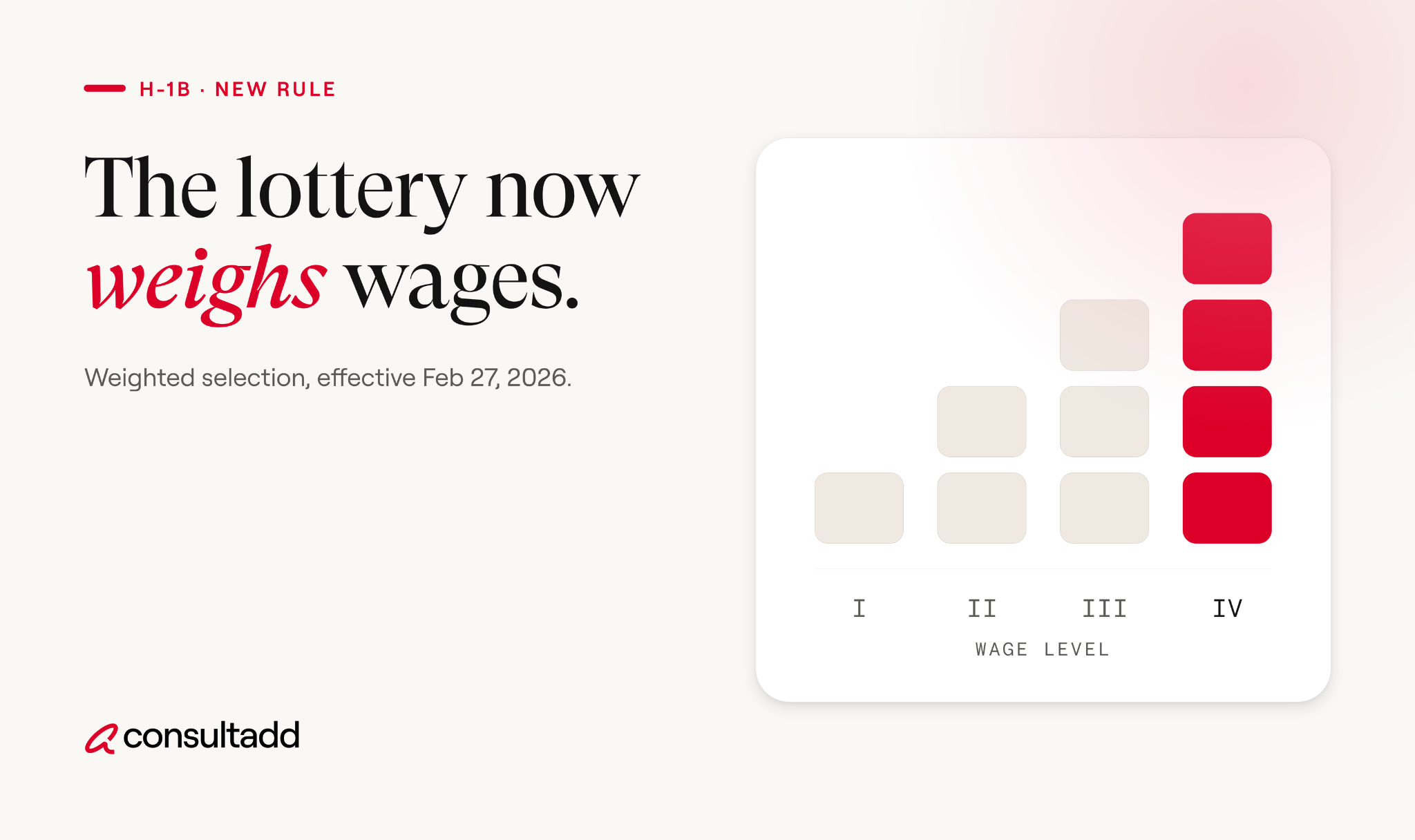
The H1B new rule, a DHS proposal published on October 14, 2026, would remove the requirement that officers defer to a prior approval when the employer, worker, and facts haven't changed.
This is a proposed rule, not a final one. The existing deference requirement stays in effect while DHS finishes the rulemaking process.
But if it's finalized, a routine extension with the same employer in the same role could get the same scrutiny as a brand-new petition.
Here's what the proposal says, who it reaches, and what employers and workers can do now.
TL;DR
- The H1B new rule would delete 8 CFR 214.1(c)(5), the regulation that tells USCIS to defer to earlier approvals on Form I-129 petitions with the same parties and facts.
- It covers H-1B and most other I-129 categories, including L-1, O-1, TN, and E visas.
- DHS projects about 6,044 extra requests for evidence a year, though its own data shows no matching rise in denials.
- An RFE added an average of 64 days to a decision between FY 2022 and FY 2025, so delays are the main practical risk.
- Comments close November 13, 2026. Nothing changes until a final rule is published.
What is the H1B new rule?
USCIS has proposed removing the requirement that its officers defer to prior eligibility decisions when they review extensions of nonimmigrant worker petitions filed on Form I-129.
The proposal was scheduled for Federal Register publication on October 14, 2026, with a 30-day comment window.
You can read the full text in the DHS proposed rule on removing deference to prior USCIS determinations.
Where the deference rule came from
Deference isn't new. USCIS followed it as policy for years, and the 2024 H-1B modernization rule wrote it into federal regulations.
The current proposal would bring back an approach the first Trump administration used.
What the proposal would and would not do
Officers could still look at a prior approval. They just wouldn't be required to defer to it, and the employer would carry the burden of proving eligibility with the evidence in each new petition.
The proposal leaves the underlying eligibility requirements for H-1B and other classifications unchanged. What changes is how USCIS reviews a petition that follows an earlier approval.
It doesn't end H-1B extensions or revoke approvals already granted.
How the USCIS deference policy works today
Under 8 CFR 214.1(c)(5), USCIS generally defers to an earlier eligibility decision when the petition is on Form I-129, it involves the same parties and underlying facts, and there's no material error, material change, or new adverse information.
The current text is on eCFR at 8 CFR 214.1.
In plain terms, if USCIS approved a software engineer's H-1B three years ago and nothing about the job has changed, the officer reviewing the extension starts from the assumption that the original decision was right.
Current rule vs. proposed rule
Who the H-1B proposed rule 2026 would affect
The change would apply to Form I-129 filings for H-1B and H-1B1 workers, L-1 intracompany transferees, O-1 and O-2 workers, E-1, E-2, and E-3 classifications, TN professionals, H-2A, H-2B, and H-3 workers, and some P, Q, and R nonimmigrants.
Cases with the most exposure
The biggest effect would fall on extension cases where the employer, worker, position, and relevant facts are mostly unchanged, because those are the cases most likely to get deference now.
That's the irony. The cleanest, most stable extensions are the ones that lose the most.
Cases with little or no change
The proposal doesn't touch the rules for F-1 status, CPT, OPT, or STEM OPT, and it leaves H-1B cap registration and selection alone.
Most students moving from F-1 or OPT to H-1B for the first time wouldn't have a prior H-1B approval with the same employer and facts, so deference mostly matters after a worker already holds H-1B status.
If you're still on OPT and planning the switch, our guide to OPT and CPT covers the timing rules that feed into a first H-1B filing.
More RFEs, longer waits: what DHS expects
DHS ran the numbers itself, and they're worth reading closely.
The agency estimates roughly 208,429 petitions a year may currently qualify for deference.
Using historical data, it projects that removing the policy could push the request for evidence rate up by 2.9 percentage points, or about 6,044 additional RFEs each year.
DHS also said its historical analysis didn't show a matching change in denial rates, so its estimates point to more scrutiny and paperwork rather than thousands of extra denials.
Why an RFE still costs you
Even without a denial, an RFE slows things down. DHS reported that from FY 2022 through FY 2025, petitions with an RFE took an average of 64 more calendar days to reach an initial decision than petitions without one.
The agency acknowledged this could create uncertainty for staffing and project planning.
For a staffing firm, 64 days is the difference between a consultant starting a client renewal on time and a project lead asking why the paperwork is still open. That's where the real cost sits.
How this fits with other recent H-1B changes
The deference proposal lands in a crowded few months. Each action below is separate, and each sits at a different legal stage.
The Federal Register notice for the fee proposal sets a $103,265 charge on each cap-subject H-1B petition, on top of other required fees.
Extensions, amendments, and transfers wouldn't be subject to that fee. You can read the DHS fee proposal for certain H-1B petitions directly.
The October 8 PERM suspension covered Cognizant, Infosys, TCS, Wipro, HCL, Capgemini, Microsoft, and Adobe. H-1B visas weren't suspended, so workers at those companies can keep working on their current H-1B.
Our breakdown of new green card rules for 2026 covers the green card side in more depth.
For a full status tracker of the lottery, the $100,000 proclamation, and every other 2026 change, see H1-B 2026: every rule change and where it stands now.
H-1B compliance for employers: how to prepare
Nothing has to change in your filings today. But if this proposal is finalized, the extension you file in mid-2027 will need to stand on its own evidence.
Build every extension like an initial petition
Assume the officer hasn't seen the first approval. Depending on the classification, useful documents include updated job duties, employment terms, work locations, wage records, and proof the worker kept lawful status.
For staffing firms placing consultants at client sites, the weak spot is usually the third-party documentation. In our experience, end-client letters go stale fast.
A letter from 2023 describing a project that has since changed scope invites exactly the kind of question an RFE asks.
Employer extension checklist
File early
If the rule becomes final, employers may need to send more complete current evidence with extensions instead of relying on the prior approval to settle eligibility questions.
More evidence takes more time to gather, so start 6 months before expiration, which is the earliest an H-1B extension can be filed.
Comment if you have something useful to say
The comment period runs until November 13, 2026. Employers with real data on extension delays or RFE costs can put it on the record.
DHS has to consider the comments before it finalizes anything.
What H-1B workers should do now
Your current status isn't affected by a proposal. Still, a few habits will help if the rule goes final.
- Keep your own copies of every approval notice, LCA, pay stub, and I-94.
- Tell your employer early if your duties, title, or work location have shifted. A change that isn't reported now can surface during an extension review later.
- Know the 240-day rule. If your employer files the extension on time, you can generally keep working for the same employer for up to 240 days past your I-94 expiration while it's pending.
If you're thinking about changing jobs, our guide to H-1B sponsorship for tech professionals explains how transfers work and what to ask a new employer.
New to the program entirely? Start with what an H1 visa is and how it works.
For official guidance, check the USCIS page on H-1B specialty occupations.
Bottom line
The H1B new rule doesn't change who qualifies for an H-1B. It changes how much a past approval protects you.
If DHS finalizes it, stable extensions lose the shortcut they have today, and employers should expect more RFEs and longer waits rather than a wave of denials.
The practical answer is the same for employers and workers. Keep documentation current, file extensions as early as the rules allow, and treat every renewal as if USCIS is seeing the case for the first time.
Immigration rules are moving quickly this year, so confirm details with immigration counsel before any filing.
Start Strong With Consultadd
With 15 years in business and 5,000+ successful staffing engagements, we don't just fill roles, we build reliability into your process. We've supported 65 staffing companies in the past year alone and maintain MSAs with industry leaders like Robert Half and TEKsystems.
Here's what working with Consultadd looks like:
- Talent sourced in under 24 hours
- Ready-to-deploy candidates, vetted for experience and compliance
- Lower turnover risk: we match long-term goals, not just short-term needs
- Seamless compliance: visa, documentation, onboarding? Handled.
- Dedicated 1:1 account managers for responsive, personalized support
- Top 100 candidate matches delivered in the past year
- Strong partnerships with universities to tap into fresh, committed talent
- Post-placement support so your investment grows beyond day one
For candidates, your next opportunity is more than just a job title, it's a chance to build skills, gain experience, and move your career forward. At Consultadd, we connect technology professionals with projects and employers that align with their goals, whether they're looking for contract, contract-to-hire, or long-term opportunities.
The tech job market moves fast, but the right guidance can make all the difference. Ready to take the next step in your career journey? Explore Opportunities >>
Key takeaways
- The H1B new rule is a proposal to remove 8 CFR 214.1(c)(5), which requires USCIS to defer to prior Form I-129 approvals when facts haven't changed.
- Same-employer, same-role extensions face the most change. First-time petitions after OPT see little difference.
- DHS expects about 6,044 more RFEs a year and an average 64-day delay when one is issued, but no matching rise in denials.
- The proposal is not in effect. Comments close November 13, 2026, and current deference rules apply until a final rule is published.
- Employers should prepare extensions as if they were initial petitions, with current client letters, wage records, and status proof.
FAQs
What is the new rule for H-1B in October 2026?
DHS proposed ending the requirement that USCIS defer to earlier approvals when reviewing Form I-129 extensions with the same parties and facts. Officers could still consider a past approval, but they wouldn't be bound by it. The proposal was published on October 14, 2026.
Is the H1B new rule in effect yet?
No. It's a proposed rule with a public comment period ending November 13, 2026. DHS must review comments before it can issue a final rule, and the existing deference regulation stays in force until then.
Does the new rule affect H-1B extensions with the same employer?
Yes, those are the cases it affects most. Today, an unchanged extension usually benefits from deference to the prior approval. Under the proposal, the employer would need to prove eligibility again with current evidence.
What is the USCIS deference policy?
It's the rule that tells officers to give weight to a previous approval when a new petition involves the same parties and underlying facts. Exceptions apply for material errors, material changes, or new adverse information. The 2024 H-1B modernization rule made it a formal regulation.
Will the new H-1B rule cause more denials?
DHS's own analysis says probably not in large numbers. It projects about 6,044 more RFEs a year but found no corresponding change in denial rates in historical data. The bigger risk is delay, since an RFE added an average of 64 days to decisions.
Can I keep working while my H-1B extension is pending?
Generally yes. If your employer files the extension before your status expires, you can usually continue working for that same employer for up to 240 days past your I-94 date while USCIS decides. Check your specific facts with an immigration attorney.
.webp)


.avif)
.avif)