
.avif)

Introduction
Most searches for AWS developers for hire start from the same place: a project has a cloud component, the internal team is at capacity, and someone needs a person in a seat within weeks rather than months.
The question is rarely whether to hire. It is which hiring model fits the timeline, what the rate should actually be, and how to tell a real AWS engineer from a resume with a lot of service names on it.
This guide covers all three, with the cost benchmarks pulled from federal wage data rather than salary aggregators.
TL;DR
- "AWS developer" is not one role. Decide first whether you need an application developer who deploys to AWS, a DevOps or platform engineer, or a solutions architect, because they screen and price differently.
- The U.S. median wage for software developers was $135,980 in May 2025 per the Bureau of Labor Statistics, with the middle 80% falling between roughly $82,000 and $215,000. AWS skills sit toward the upper half of that band, not outside it.
- Four realistic models: direct hire, contract, contract-to-hire, and staff augmentation. Speed and commitment trade against each other.
- Certifications confirm vocabulary and breadth, not judgment. The AWS Certified Developer exam guide is still useful as a screening map, because it tells you exactly what domains to probe.
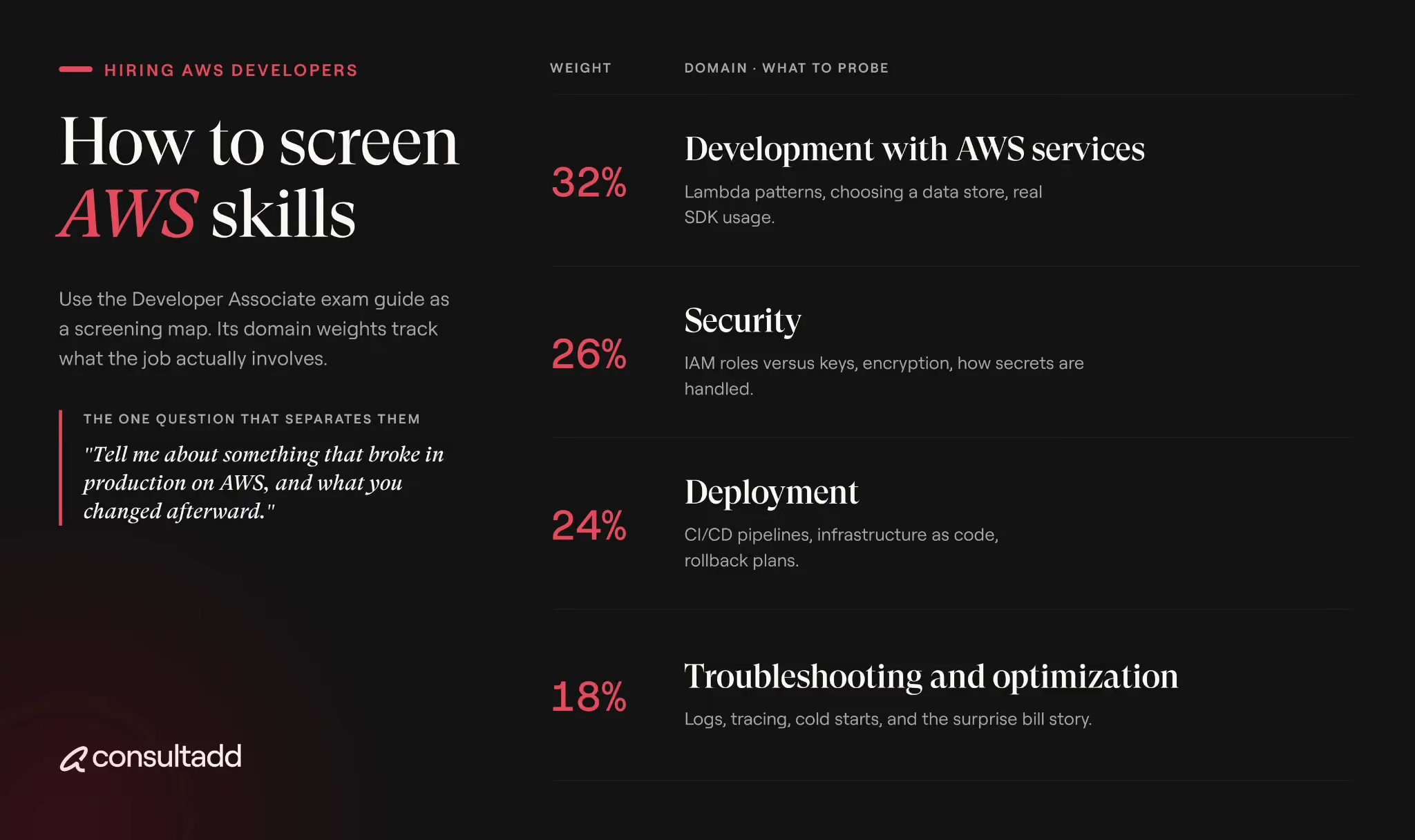
- The strongest signal in an interview is a candidate describing something that broke in production on AWS and what they changed afterward.
What an AWS developer actually does
The phrase covers at least four distinct jobs, and hiring the wrong one is the most common expensive mistake here. A team that needs someone to build serverless application logic does not need an architect, and an architect will be bored and gone in five months.
If you cannot say which row you are hiring for, that is the first thing to settle. Everything downstream, the rate, the screening questions, the job posting, depends on it.
One useful check: write down the three things this person will ship in their first 90 days. If those three things are all application features, you want the first row and you should weight language skill above AWS breadth.
Four ways to hire AWS developers
Direct hire is the right default for roles that will exist in three years. It is the wrong choice for a six-month migration, because you end up overstaffed the moment the project lands.
Contract and staff augmentation solve the timeline problem. The distinction is mostly scale and shape: contract tends to be one specialist for a defined scope, staff augmentation tends to be several engineers plugging into an existing team while you retain ownership of the roadmap.
Our buyer's guide to IT staff augmentation companies walks through how to evaluate partners in that model, and the IT contract staffing buyer's guide covers how the engagement mechanics and pricing actually work.
Contract-to-hire deserves more consideration than it usually gets for cloud roles specifically. AWS work is one of the areas where a resume and a two-hour interview genuinely under-predict performance, because so much of the skill is operational judgment that only shows up under load.
Freelance marketplaces are a fifth option and they work fine for small, bounded, low-risk pieces of work. They are a poor fit when the engineer needs production access, when compliance matters, or when someone has to be accountable six months from now.
What AWS developers cost in 2026
Start from real wage data rather than salary-aggregator averages, which are self-reported and skew high.
The Bureau of Labor Statistics puts the May 2025 median annual wage for software developers at $135,980, or about $65 an hour.
The distribution matters more than the median: the lowest 10% earned under $82,460 and the highest 10% earned over $214,670. Industry changes the picture too, with software publishers at a $164,550 median against $132,050 in computer systems design and related services.
Two honest caveats:
- BLS does not break out AWS as a skill, so treat these as the occupational band that AWS developers sit inside, generally in its upper half for experienced people.
- BLS wages exclude equity and annual bonuses, so for senior roles at large tech employers these are a floor on cash, not a ceiling on total compensation.
Converting to a contract bill rate is a separate calculation. A bill rate has to cover the engineer's pay plus employer payroll taxes, benefits, insurance, and the supplier's margin, so it always sits meaningfully above the equivalent salary hourly figure.
For direct hire through an agency, placement fees commonly run 15% to 30% of first-year salary, which on a $140,000 role is $21,000 to $42,000.
Geography still moves the number more than most single factors, even for remote roles, because compensation bands tend to anchor to where the engineer lives.
How to screen AWS skills
This is where most hiring processes are weakest, usually because the person running the screen is not a cloud engineer.
What certifications tell you, and what they don't
An AWS certification is a real signal about breadth and vocabulary. It is a weak signal about judgment, and it says nothing about whether someone has ever debugged a production incident.
Three credentials come up most for developer hiring, and all three are current in AWS's own exam guide index: Solutions Architect Associate (SAA-C03), Developer Associate (DVA-C02), and DevOps Engineer Professional (DOP-C02).
AWS revises and retires certifications periodically, so check the official AWS certification exam guides rather than a training vendor's list before you put a specific cert in a job requirement.
The more useful move is to treat the exam guide as a screening map. The Developer Associate exam guide weights its content like this, which is a reasonable proxy for what the role involves day to day:
AWS notes the exam runs 130 minutes with 50 scored questions and a passing scaled score of 720, which is worth knowing only so you understand a pass is a meaningful bar rather than a formality.
Questions that separate experience from keywords
Skip trivia. Nobody needs to recite S3 storage class names. Ask instead:
- Tell me about something that broke in production on AWS. What was the failure, how did you find it, and what did you change afterward?
- Walk me through how you handle secrets and credentials in a deployed application.
- When did you last get a surprising AWS bill, and what caused it?
- Where would you use a managed service instead of running it yourself, and where would you go the other way?
- How do you set up permissions for a new service? Talk me through the IAM decisions.
The cost question is unusually diagnostic. Engineers who have genuinely owned AWS environments all have a cost story, usually involving data transfer, an over-provisioned instance family, or logs nobody was rotating. Candidates who have only worked inside someone else's account typically have nothing.
For the technical stage itself, a short scoped exercise beats a whiteboard. Ask for something small and real, like a Lambda handler with the IAM policy it would need, or a review of a deliberately flawed CloudFormation template.
Writing a job description that filters properly
Vague postings produce vague applicant pools. Three fixes do most of the work.
Name the services. "Experience with AWS" filters nothing. "Lambda, API Gateway, DynamoDB, and CloudFormation in production" filters usefully.
Separate must-haves from nice-to-haves honestly, and keep must-haves to four or five items. Long requirement lists are the main reason strong candidates self-select out, and they disproportionately deter people who read requirements literally.
State the language and the scale. A Python-heavy serverless shop and a Java monolith being containerized onto ECS are different jobs that both call themselves AWS development.
Also be upfront about the engagement model and whether the role is remote, hybrid, or onsite. Ambiguity there wastes both sides' time at the offer stage more than anywhere else in the process.
If you are still weighing whether this is a staffing problem or a consulting one, our comparison of IT staffing and consulting companies draws the line between buying talent and buying advice.
Red flags worth taking seriously
Certifications with no matching project history. Three certs and no described production work is a study record, not an experience record.
Service lists without architecture. A resume naming 25 AWS services in a skills block, where the project descriptions never explain a single design decision, usually means exposure rather than ownership.
No cost awareness. Anyone who has run workloads on AWS at any scale has thought about spend. Silence here is informative.
Only greenfield stories. Most real AWS work is inheriting something awkward and improving it without downtime. Candidates who have only built from scratch often struggle with that.
Vagueness about their own contribution. "We migrated the platform" is not an answer. What did this person do?
Independent verification helps here, especially at volume. Structured processes usually combine resume screening, a skills assessment, a technical interview, and reference or background checks, each catching something the others miss.
Our breakdown of the online candidate vetting process covers how to sequence those stages without slowing the pipeline to a crawl.
How long hiring actually takes
The compressed timeline in the right-hand column depends entirely on whether your partner actually maintains a pre-vetted pool or starts recruiting the day you send the requirement. That is the single question worth pressing hardest when evaluating suppliers, because the pitch sounds identical either way.
Demand context, for what it is worth: BLS projects 10% employment growth for software developers from 2025 to 2035, faster than the average across occupations, with about 106,100 openings a year across the developer and QA group.
Staffing Industry Analysts puts U.S. IT staffing at roughly $37 billion, among the faster-growing staffing segments. Neither number tells you what your specific search will cost, but both explain why cloud searches rarely get easier by waiting.
Work authorization and compliance
Worth settling early rather than at the offer stage. Confirm work authorization status during screening, understand whether sponsorship is in play, and know who carries the employment relationship in a contract or augmentation arrangement, because that determines who handles I-9 verification, payroll taxes, and insurance.
If sponsorship comes up and you have not dealt with it before, how visa sponsorship works covers what the employer side actually involves and what it costs in time.
Start Strong With Consultadd
With 15 years in business and 5,000+ successful staffing engagements, we don't just fill roles, we build reliability into your process. We've supported 65 staffing companies in the past year alone and maintain MSAs with industry leaders like Robert Half and TEKsystems.
Here's what working with Consultadd looks like:
- Talent sourced in under 24 hours
- Ready-to-deploy candidates, vetted for experience and compliance
- Lower turnover risk: we match long-term goals, not just short-term needs
- Seamless compliance: visa, documentation, onboarding? Handled.
- Dedicated 1:1 account managers for responsive, personalized support
- Top 100 candidate matches delivered in the past year
- Strong partnerships with universities to tap into fresh, committed talent
- Post-placement support so your investment grows beyond day one
For candidates, your next opportunity is more than just a job title, it's a chance to build skills, gain experience, and move your career forward. At Consultadd, we connect technology professionals with projects and employers that align with their goals, whether they're looking for contract, contract-to-hire, or long-term opportunities.
The tech job market moves fast, but the right guidance can make all the difference. Ready to take the next step in your career journey? Explore Opportunities >>
Key takeaways
- Before you look at AWS developers for hire, decide which of the four cloud roles you actually need, because application developers, platform engineers, architects, and data engineers screen and price differently.
- Use BLS wage data as your cost anchor: a $135,980 median for software developers in May 2025, with the middle 80% spanning roughly $82,000 to $215,000, and remember contract bill rates sit above the salary-equivalent hourly figure.
- Match the hiring model to the work. Permanent and central means direct hire. Time-bound or uncertain means contract, contract-to-hire, or staff augmentation.
- Treat AWS certifications as evidence of breadth, and use the official exam domain weightings as a map for what to probe in interviews.
- The best screening questions are about failures, security decisions, and cost surprises. Those cannot be answered from a study guide.
FAQs
How much does it cost to hire an AWS developer?
Use the software developer occupational band as your anchor: a $135,980 U.S. median in May 2025, with the 10th percentile at $82,460 and the 90th at $214,670. Experienced AWS engineers generally sit in the upper half of that range. For contract engagements the bill rate runs above the salary-equivalent hourly rate because it also covers employer taxes, benefits, insurance, and supplier margin.
Should I hire an AWS developer full time or on contract?
Contract fits defined projects, migrations, and capacity gaps, and it gets someone working in days or weeks rather than months. Direct hire fits roles that will still exist in a few years and sit close to your core product. Contract-to-hire is a reasonable middle path for cloud roles specifically, since operational judgment is hard to assess in an interview.
Do AWS certifications actually matter when hiring?
They are a genuine signal of breadth and shared vocabulary, and they are useful for filtering large applicant pools. They do not demonstrate judgment or production experience. The more valuable use is reading the official exam guide domains and building your interview questions from them.
What is the difference between an AWS developer and a cloud engineer?
An AWS developer primarily writes and deploys application code that runs on AWS. A cloud engineer or platform engineer focuses on the infrastructure that code runs on, including networking, CI/CD, containers, and monitoring. The titles overlap in practice, so define the work rather than relying on the label in a resume.
How long does it take to hire an AWS developer?
A direct hire realistically takes two to four months from defining the role to a productive engineer, most of it in sourcing, interviews, and notice periods. Contract or staff augmentation can compress that to days or a few weeks, but only when the partner maintains an already-vetted pool rather than starting a search on receipt of the requirement.
How do I evaluate AWS skills if nobody on my team knows AWS?
Use a two-part approach. Ask experience questions that are hard to fake, particularly about production failures, IAM and secrets decisions, and unexpected bills. Then bring in an external technical screen or a staffing partner who runs one, and ask to see the actual assessment rather than a summary rating.
.webp)



.webp)
