

Introduction
A project slips because nobody on the team has run a Kubernetes migration before. A new hire with a strong resume struggles with the cloud platform your company actually uses.
Neither of these is a performance problem. Both are a skill gap.
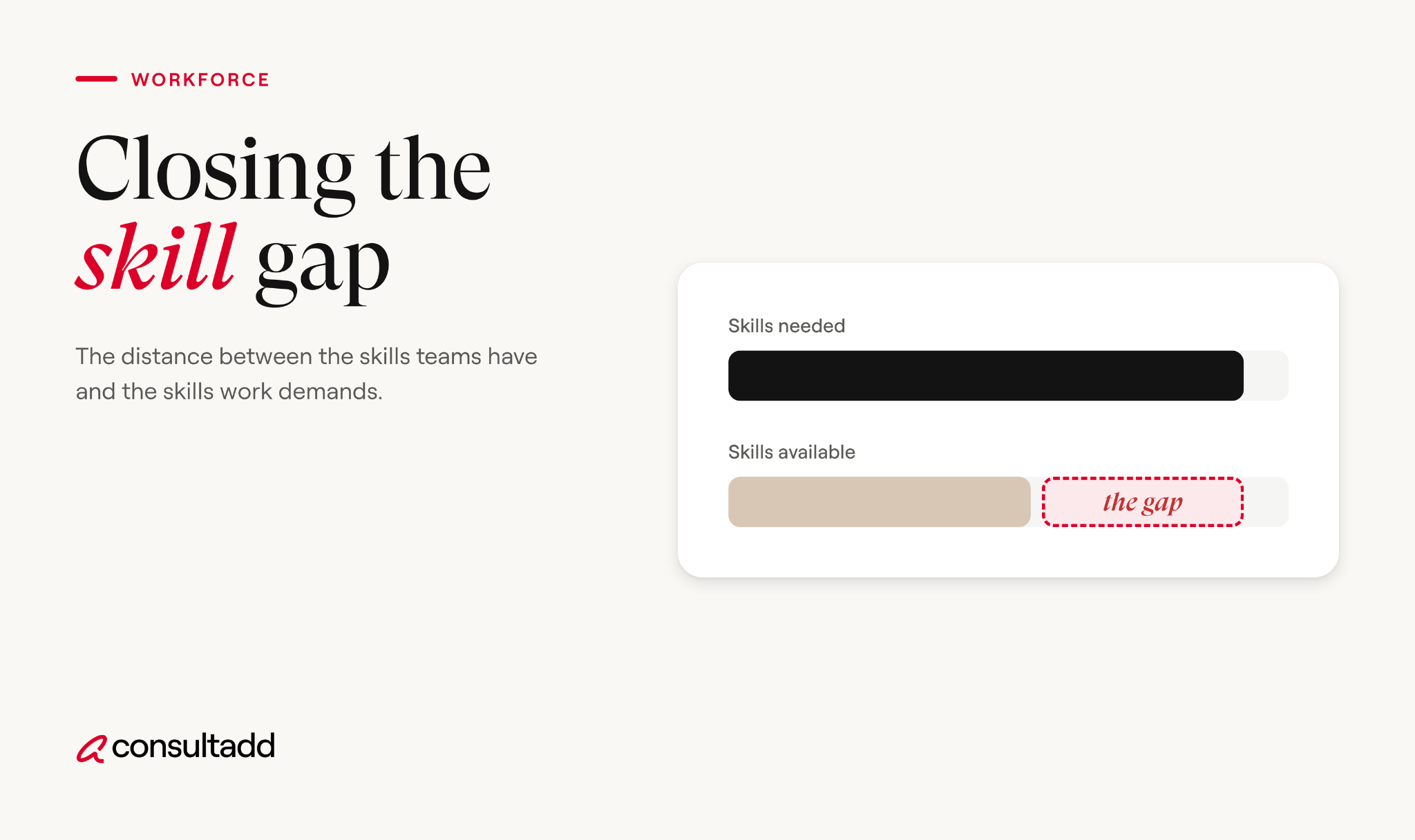
A skill gap is the difference between the skills a job or team needs and the skills people currently have.
This guide explains what causes skill gaps, how to spot and measure them with a skill gap analysis, and how to choose between training, hiring and contract talent to close them.
TL;DR
- A skill gap is the difference between the skills a role or team needs and the skills its people currently have.
- Skill gaps show up at four levels: individual, team, organization and the wider labor market.
- A skill gap analysis compares required skills against current skills, then ranks the gaps by business impact.
- You can close a gap by upskilling, reskilling, hiring, or bringing in contract specialists, and most companies use a mix.
- Fast-changing technology means a skill gap analysis isn't a one-time exercise; review it at least once a year.
What is a skill gap?
A skill gap is the mismatch between the skills needed to do a job well and the skills a person, team or workforce actually has.
It can be technical, like not knowing a specific programming language, or non-technical, like a senior engineer who can build systems but struggles to explain trade-offs to stakeholders.
The term gets used loosely, so it helps to know which level you're dealing with.
The labor market version is the one in the headlines. In the World Economic Forum's Future of Jobs Report 2025, 63% of surveyed employers named skill gaps as the main barrier to transforming their business over 2025 to 2030.
Skill gap vs capacity gap
Not every staffing shortfall is a skill gap. If your team knows how to do the work but doesn't have enough hours, that's a capacity gap. The fix is more people with the same skills.
A skill gap means nobody has done this kind of work before, so adding more of the same people won't help. Mixing these up is common and expensive.
Consultadd's guide to technical team augmentation breaks down how to tell capacity, skill and coverage gaps apart before you request help.
What causes a skill gap
Skill gaps rarely have a single cause. In our work placing tech professionals, a handful of drivers come up again and again.
Technology moves faster than training.
Tools, frameworks and cloud platforms change every year. Employers in the WEF survey expect 39% of workers' core skills to change by 2030. A team that was well matched to its stack three years ago may not be today.
New business priorities.
A company decides to launch an AI feature, move to the cloud, or enter a regulated industry. The work changes overnight; the team's skills don't.
Retirements and turnover.
When experienced people leave, they take knowledge with them, especially on older systems nobody else has touched.
Hiring for credentials instead of skills.
A degree or job title doesn't guarantee someone can do the specific work. Hiring on paper qualifications can create gaps on day one.
Too little time for learning.
Many teams are so busy delivering that training gets pushed aside. Skills fall behind slowly, then all at once.
Signs your team has a skill gap
Skill gaps often hide behind other problems. Look for these patterns:
- Projects that involve a new tool or platform consistently run late, while familiar work goes fine.
- The same one or two people get pulled into every hard problem.
- Teams lean heavily on vendors or outside consultants for routine decisions.
- Roles stay open for months because the requirements don't match who's available.
- New hires take far longer than expected to become productive.
- Quality issues, rework or security findings cluster around one area of the stack.
One useful check: ask team leads which tasks they'd be nervous to assign to anyone but a specific person. Those tasks usually sit right on top of a skill gap.
How to run a skill gap analysis
A skill gap analysis replaces guesswork with a clear list of what's missing and what matters most. Here's a process that works for a single team or a whole department.
1. Start with business goals
List the projects and priorities for the next 12 to 24 months. A skill gap only matters if it blocks something the business needs. Analyzing skills nobody plans to use wastes time.
2. Define the skills each role or project needs
For each priority, list the specific skills required, not vague categories. "Cloud" is too broad. "Designing and deploying containerized services on AWS with infrastructure as code" is useful.
The Department of Labor's O*NET OnLine database is a good starting point for standard skill definitions by occupation.
3. Assess current skills
Use more than one source. Self-assessments tend to be optimistic, so combine them with manager input, recent work samples, certifications and short practical tests where it makes sense. Rate each skill on a simple scale, such as 1 (none) to 4 (can teach others).
4. Compare and find the gaps
Put required and current levels side by side. The difference is the gap. Look at the team as a whole, not just individuals: a team may have one strong person in a skill, which is still a risk if that person leaves.
5. Rank gaps by impact and urgency
Not every gap needs closing right away. Prioritize gaps that block revenue, delivery dates, security or compliance.
6. Pick a fix for each gap
Decide whether to train, hire, or bring in contract help (covered in the next section). Assign an owner and a target date.
Here's a simple skill gap analysis template you can adapt:
Ways to close a skill gap
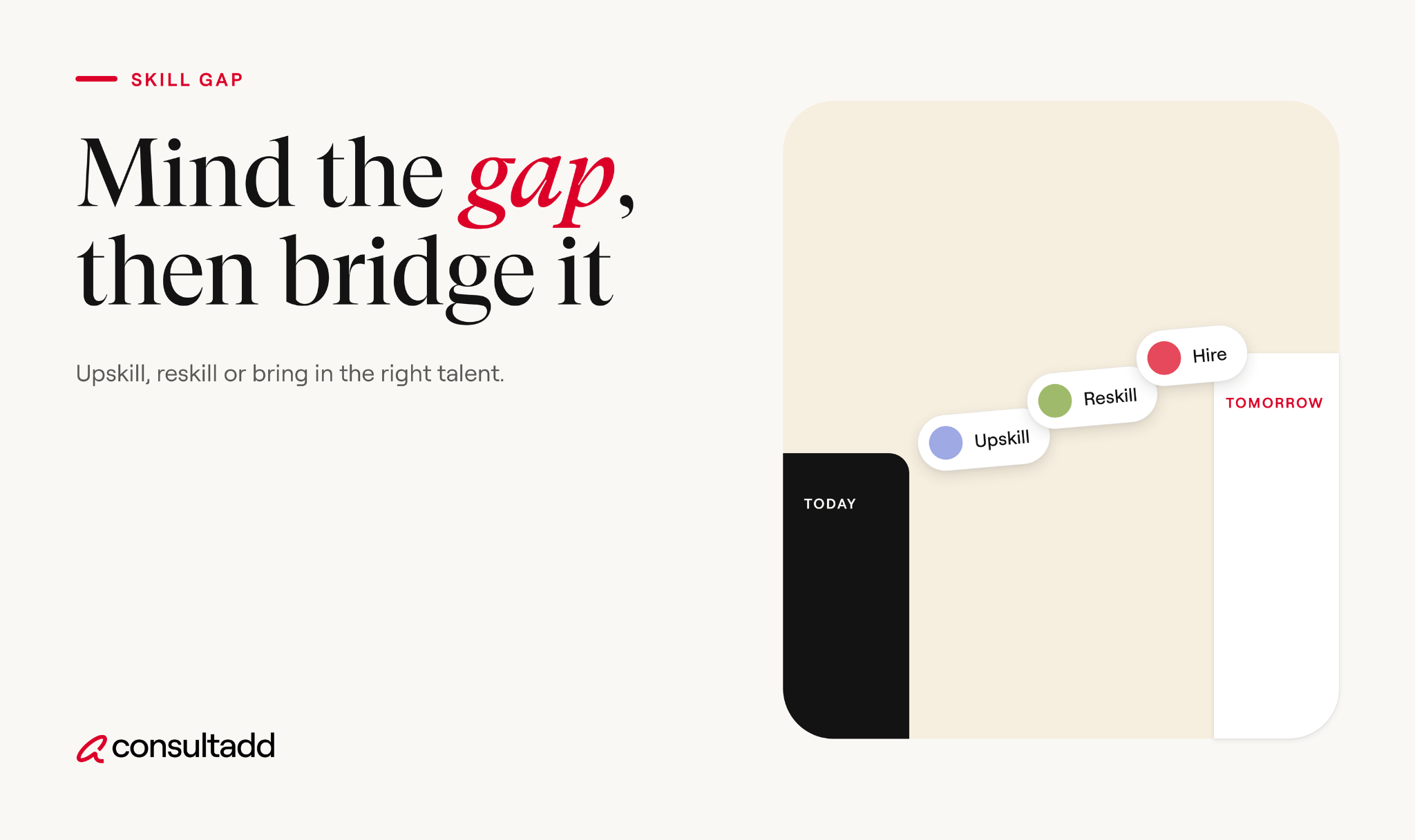
There are four main ways to close a skill gap. Each has a different speed, cost and level of risk.
Upskilling and reskilling
Training your existing people is usually the first move, and most employers plan to do it. The WEF found upskilling to be the most common planned workforce strategy, with 85% of surveyed employers expecting to use it over 2025 to 2030.
The scale is large: the report estimates that if the global workforce were 100 people, 59 would need training by 2030.
Training works best when it's tied to real work. A course followed by a project that uses the new skill sticks far better than a course alone. Pairing, internal workshops and job rotation are cheap and often underused.
Hiring for the skill
When a gap is permanent and central to the business, hiring is often the right call. The catch is speed. SHRM's 2026 benchmarking puts median time to fill for nonexecutive roles at 39 calendar days, and scarce technical roles often take longer.
Skills-based hiring, where you test for what candidates can do rather than where they studied, widens the pool.
Consultadd's roundup of hiring strategies companies are actually using covers how teams are making that shift.
Contract and project-based talent
When a gap is urgent or tied to one project, a contract specialist can close it in days. The best setups use the contractor to deliver the work and train the internal team at the same time, so the skill stays after the contract ends.
Consultadd's guide to project-based recruiting and staffing explains how these engagements are usually structured.
Most companies don't pick just one route. A common pattern is to bring in a contractor for an urgent project, upskill two internal people alongside them, and hire permanently if the need turns out to be long-term.
Skill gap examples in tech teams
These composite examples reflect situations we see often when companies come to us for help.
AI is where many of these gaps are showing up fastest. Consultadd's article on bridging the AI skills gap goes deeper on that specific challenge.
For a broader view of which skills employers are struggling to find, see IT staffing trends for 2026.
Closing your own skill gap as a professional
Skill gaps aren't only a company problem. If you're a tech professional, the same analysis works on your own career.
Compare five or six job postings for the role you want next against what you can do today. The skills that show up in most postings and that you can't yet demonstrate are your gaps.
Pick one or two and build real evidence: a project, a certification backed by hands-on work, or a production task at your current job.
Depth beats breadth. Recruiters trust a few skills you can discuss in detail more than a long list you've only touched.
Consultadd's guide to IT skills that get you hired covers how to prove skills on a resume and in interviews.
Measuring whether the gap is closing
Closing a skill gap should show up in results, not just in training completion numbers. Track a few indicators:
If training numbers go up but projects still stall, the training isn't reaching the actual gap. Revisit the analysis.
Closing the skill gap for good
A skill gap isn't a one-time problem you solve and forget. Technology, products and teams keep changing, so new gaps keep opening. The companies that handle this well treat skills like any other business resource: they measure them, plan for them and review them on a schedule.
Start small. Pick one team, run a skill gap analysis against next year's priorities, and choose a fix for the top two or three gaps. Then build the habit into your planning cycle.
Developing and retaining people once they've built new skills is the other half of the job, which Consultadd's strategic talent management framework covers in detail.
Start Strong With Consultadd
With 15 years in business and 5,000+ successful staffing engagements, we don't just fill roles, we build reliability into your process. We've supported 65 staffing companies in the past year alone and maintain MSAs with industry leaders like Robert Half and TEKsystems.
Here's what working with Consultadd looks like:
- Talent sourced in under 24 hours
- Ready-to-deploy candidates, vetted for experience and compliance
- Lower turnover risk: we match long-term goals, not just short-term needs
- Seamless compliance: visa, documentation, onboarding? Handled.
- Dedicated 1:1 account managers for responsive, personalized support
- Top 100 candidate matches delivered in the past year
- Strong partnerships with universities to tap into fresh, committed talent
- Post-placement support so your investment grows beyond day one
For candidates, your next opportunity is more than just a job title, it's a chance to build skills, gain experience, and move your career forward. At Consultadd, we connect technology professionals with projects and employers that align with their goals, whether they're looking for contract, contract-to-hire, or long-term opportunities.
The tech job market moves fast, but the right guidance can make all the difference. Ready to take the next step in your career journey? Explore Opportunities >>
Key takeaways
- A skill gap is the difference between the skills a role or team needs and the skills its people have, and it's different from a capacity gap.
- Skill gaps come from fast-moving technology, new business priorities, turnover and credential-based hiring.
- A skill gap analysis ties required skills to business goals, measures current levels, and ranks gaps by impact.
- Upskilling, reskilling, permanent hiring and contract talent each fit different gaps, and most companies combine them.
- Measure progress through delivery results and reduced dependence on single experts, not just training completions.
FAQs
What is a skill gap?
A skill gap is the difference between the skills required to do a job and the skills a person or team currently has. It can involve technical skills, like a programming language or cloud platform, or non-technical skills, like communication or leadership. Skill gaps can exist for individuals, teams, whole organizations or the labor market.
What are the main types of skill gaps?
Skill gaps are usually grouped by level: individual, team, organizational and labor market. They can also be grouped by skill type, such as technical skills, soft skills, and industry or domain knowledge. Identifying the type helps you choose the right fix.
How do you identify a skill gap?
Run a skill gap analysis. List the skills your goals require, assess current skill levels through manager input, work samples and practical tests, then compare the two. Warning signs include projects that stall on new technology and heavy reliance on one or two experts.
What causes skill gaps in the workplace?
Common causes include fast-changing technology, new business priorities, retirements and turnover, hiring based on credentials rather than skills, and too little time for training. Most skill gaps come from several of these at once.
How can companies close a skill gap quickly?
For urgent needs, contract specialists can start within days and close the gap for a specific project. Pairing them with internal staff helps the skill stay after the contract ends. For longer-term needs, combine upskilling with targeted hiring.
What is the difference between upskilling and reskilling?
Upskilling builds on someone's existing skills so they can do their current role better or take on more advanced work. Reskilling teaches someone new skills so they can move into a different role. Both are common ways to close skill gaps internally.