

Introduction
The global median time to hire sits at 38 days as of 2025, and for specialized or hard-to-fill roles it runs considerably longer. Meanwhile, according to LinkedIn's talent research, roughly 70% of the global workforce is passive, meaning they are not applying to job boards and are unlikely to see your listing at all.
If your hiring strategy depends primarily on inbound applications, you are already fishing in a shrinking pond. That gap between traditional hiring assumptions and the actual talent market is where most hiring problems live.
Companies assume the process is working because they are getting applications. What they are not always measuring is how many strong candidates never applied, how many dropped out mid-process because of a poor experience, or how many accepted elsewhere because the decision took too long.
The best hiring strategies in 2026 are built around a different assumption: that top talent has options, moves fast, and will make decisions about your company long before they walk into an interview. Everything that follows flows from that reality.
TL;DR:
- Skills-based hiring outperforms degree-based screening, helping companies access a wider and more qualified talent pool.
- Building talent pipelines before roles open significantly reduces time-to-hire for critical positions.
- Candidate experience directly impacts hiring success, with slow communication and lengthy processes causing candidates to reject offers.
- AI should automate repetitive recruiting tasks, while recruiters focus on relationship-building and hiring decisions.
- Strong employer branding, structured interviews, and employee referrals consistently lead to better quality hires and lower hiring costs.
Strategy 1: Skills-Based Hiring Over Credential Screening
The most widely adopted shift in talent acquisition right now is the move from credential-based filtering to skills-based evaluation. Over 85% of employers are now using some form of skills-based hiring, according to TestGorilla's 2025 State of Skills-Based Hiring report, and more than 80% of leaders say it is actively contributing to better hiring outcomes and organizational growth.
The logic is straightforward. A degree tells you that someone completed an academic program. It does not tell you whether they can do the specific work your role requires. Skills-based hiring replaces that proxy with direct assessment: coding challenges, portfolio reviews, work samples, competency-based interview questions, and scenario-based tasks that evaluate demonstrated capability.
The practical effect is a wider candidate pool, fewer mis-hires, and better first-year performance. When candidates are evaluated on what they can actually do rather than what institution they attended, companies access talent they would otherwise filter out entirely. Nearly 47% of technology hires in recent surveys came through non-traditional paths.
Requiring a four-year degree for those roles would have eliminated almost half of the people who turned out to be the best fits. For a detailed breakdown of how skills-based assessment works in practice, AIHR's guide to recruiting strategies covers the implementation side in depth.
Strategy 2: Build Talent Pipelines Before Roles Open
The companies that consistently hire fast and well are not starting from scratch every time a role opens. They are maintaining active pipelines of qualified candidates who have already been engaged, assessed, and kept warm.
Proactive pipeline building means identifying likely future skill needs, reaching out to candidates before positions are posted, revisiting strong finalists from past searches (the people who came second in a previous hire are often excellent fits for the next one), and staying connected with high-potential professionals even when there is no immediate opening. The difference this makes in practice is substantial.
When a role opens, teams with existing pipelines can move to first interviews within days rather than restarting the sourcing cycle from zero. For specialized roles where the qualified candidate pool is small, that head start is the difference between making the hire and watching the candidate be accepted elsewhere.
Strategy 3: Fix the Candidate Experience First
Here is a number worth sitting with: 26% of job seekers declined offers in 2026 because of a poor hiring experience, according to CareerPlug data, not because the compensation was wrong or the role was unappealing but because the process itself left a bad impression.
Seventy-two percent of candidates who have a bad experience share it, either online or through professional networks, amplifying the damage well beyond the individual hire. On the other side, employers who improved their Glassdoor rating by even 0.5 points saw 20% more job clicks and 16% more applications.
The fixes are usually not complicated:
- Publish clear timelines and stick to them.
- Communicate at every stage, including when the answer is "we're still deciding."
- Audit your application process to make sure it takes less than 10 minutes to complete.
- Cut interview rounds that are not doing real filtering work.
- Give feedback within 48 hours of each stage.
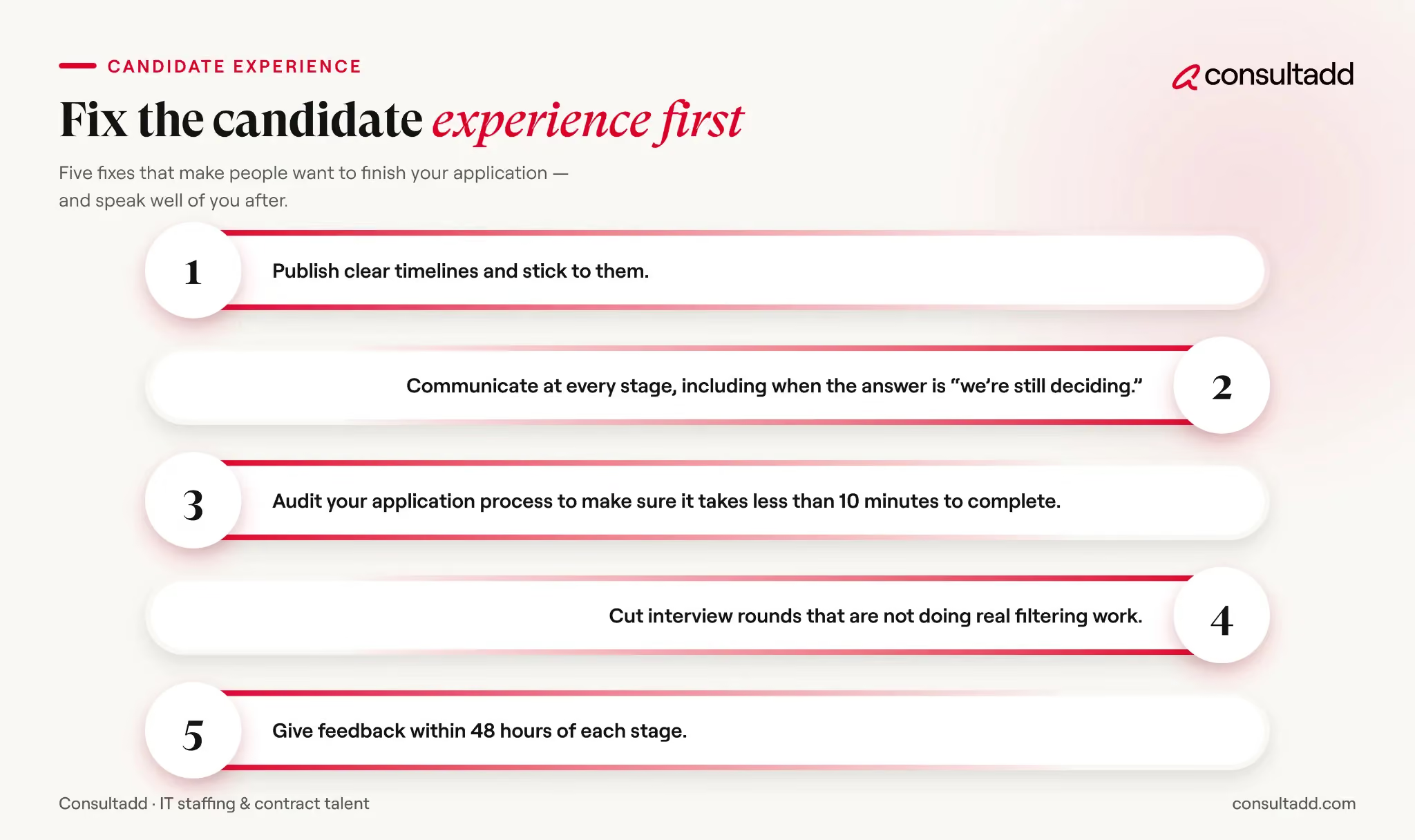
These things feel like table stakes, but most companies are not doing them consistently. Seventy-eight percent of job seekers say they expect a clear timeline for the hiring process.
Fast-track your hiring process without cutting corners. Consultadd handles technical assessments, background checks, visa support, and payroll management so you get fully trained, ready-to-deploy developers faster. Explore our immediately available core talent pool now.
Strategy 4: Use Structured Interviews Consistently
Unstructured interviews are one of the most reliable ways to introduce bias and noise into hiring decisions. Structured interviews standardize the process. Every candidate for the same role answers the same questions, which are designed to assess the specific competencies the role requires.
Evaluators use defined scoring rubrics rather than gut reactions. Interviewers from different functions rotate through the process to reduce the "feels familiar" bias that homogeneous panels produce.
The outcomes are measurable. Structured interviews reduce bias, improve the consistency of candidate evaluations, and make it significantly easier to compare candidates fairly.
They also make hiring managers better at interviewing, because preparation and criteria-setting forces clarity about what success in the role actually looks like. Combining structured interviews with skills-based assessments is where the real lift comes. The assessment tells you whether someone can do the technical work.
The structured interview tells you how they think, communicate, handle ambiguity, and operate under pressure.
Strategy 5: Invest in Employer Brand as a Recruiting Tool
Eighty-eight percent of candidates say employer branding influences their decision to apply, according to MSH data. Companies with a strong employer brand experience a 50% reduction in cost-per-hire.
The practical implication is that your careers page, Glassdoor profile, LinkedIn presence, and the stories your current employees tell publicly all function as recruiting infrastructure, whether you manage them or not.
Candidates research companies before applying. Eighty-three percent check company reviews and ratings when deciding where to send an application, and 87% say reputation directly influenced the decision to take their current role. Strong employer branding is not the same as good marketing copy on a careers page.
What candidates actually respond to is specific and honest: what does the day-to-day work feel like, how does leadership behave, do people grow in their careers here, and does the company follow through on what it says it values.
Employee testimonials, culture content, and transparent job descriptions that include pay ranges and growth paths consistently outperform polished generic messaging. For a thorough look at how employer branding statistics are shifting hiring outcomes in 2026, Vouch's employer branding data roundup pulls together the most relevant numbers.
Strategy 6: Use AI for Efficiency, Not as a Substitute for Judgment
AI has become embedded in hiring workflows at most technology-forward companies. According to Workday data, HR leaders rank recruitment and onboarding among the top three areas where they are realizing value from AI tools.
AI-powered screening tools can reduce time-to-hire by as much as 75% in high-volume scenarios, and AI-assisted sourcing dramatically expands the reach of a search beyond the candidates who happen to be using the right keywords on a given job board.
The important nuance is where AI creates value versus where it creates problems. AI is genuinely good at high-volume screening, interview scheduling, automated follow-up communication, sourcing across multiple channels simultaneously, and flagging potential skills matches that a human reviewer might miss.
It is less reliable at assessing cultural fit, evaluating soft skills, interpreting context in work histories, or making the kinds of judgment calls that experienced recruiters make instinctively. Application volumes have increased roughly 40% year-over-year at many organizations as candidates use AI tools to generate and submit applications at scale.
This creates a screening challenge that AI tools can help manage, but it also increases the value of experienced human judgment in separating strong candidates from well-optimized applications that do not reflect actual ability.
The teams getting the most out of AI in hiring are using it to remove administrative friction and handle volume, not to replace the recruiters who build candidate relationships and make final calls.
Strategy 7: Make Referral Programs Work Actually
Employee referral programs are one of the most consistently effective sourcing channels in hiring. Forty-eight percent of companies say their best hires come through referrals.
Referred candidates tend to accept offers more often, ramp faster, and stay longer, partly because they already have a realistic picture of the culture and role from someone they trust before they even apply. Most referral programs underperform because they are either poorly structured or not promoted.
The fixes are not complicated. Incentives should be meaningful, whether cash, extra time off, or other perks employees actually value. The process for submitting a referral should take less than five minutes.
Hiring teams should respond to referrals faster than they respond to inbound applications, both because the candidates are typically stronger and because failing to do so signals to the referring employee that their effort was not taken seriously.
Updates on referred candidates should flow back to the person who referred them. Referral programs also serve as retention tools. When employees are bringing in people from their professional networks, they become more invested in the team's composition and more connected to colleagues. People are significantly more likely to stay in roles where they like the people around them.
Strategy 8: Build Diversity Into the Process, Not Onto It
Diverse teams make better decisions, understand broader customer bases more effectively, and show measurably lower turnover rates. Companies with inclusive cultures report 22% lower turnover and 22% higher productivity scores, according to research cited by Wandify.
The business case is solid. The implementation question is whether diversity is built into how you hire or added as an afterthought.
Built-in means: job descriptions reviewed for exclusionary language before posting, structured interviews and standardized scoring to reduce the "feels familiar" effect, diverse hiring panels across function and seniority, sourcing through channels that reach candidates outside your usual networks, and skills-based criteria that do not filter by proxies for access to education.
Added on means: a diversity section in the job description, a commitment statement on the careers page, and no changes to the actual process. The latter does not move the needle.
Fifty-seven percent of candidates actively consider a company's diversity and inclusion initiatives when deciding whether to accept an offer, according to Deloitte data. What they are looking at is whether the evidence matches the messaging.
Start Strong With Consultadd
With 15 years in business and 5,000+ successful staffing engagements, we don't just fill roles, we build reliability into your process. We've supported 65 staffing companies in the past year alone and maintain MSAs with industry leaders like Robert Half and TEKsystems.
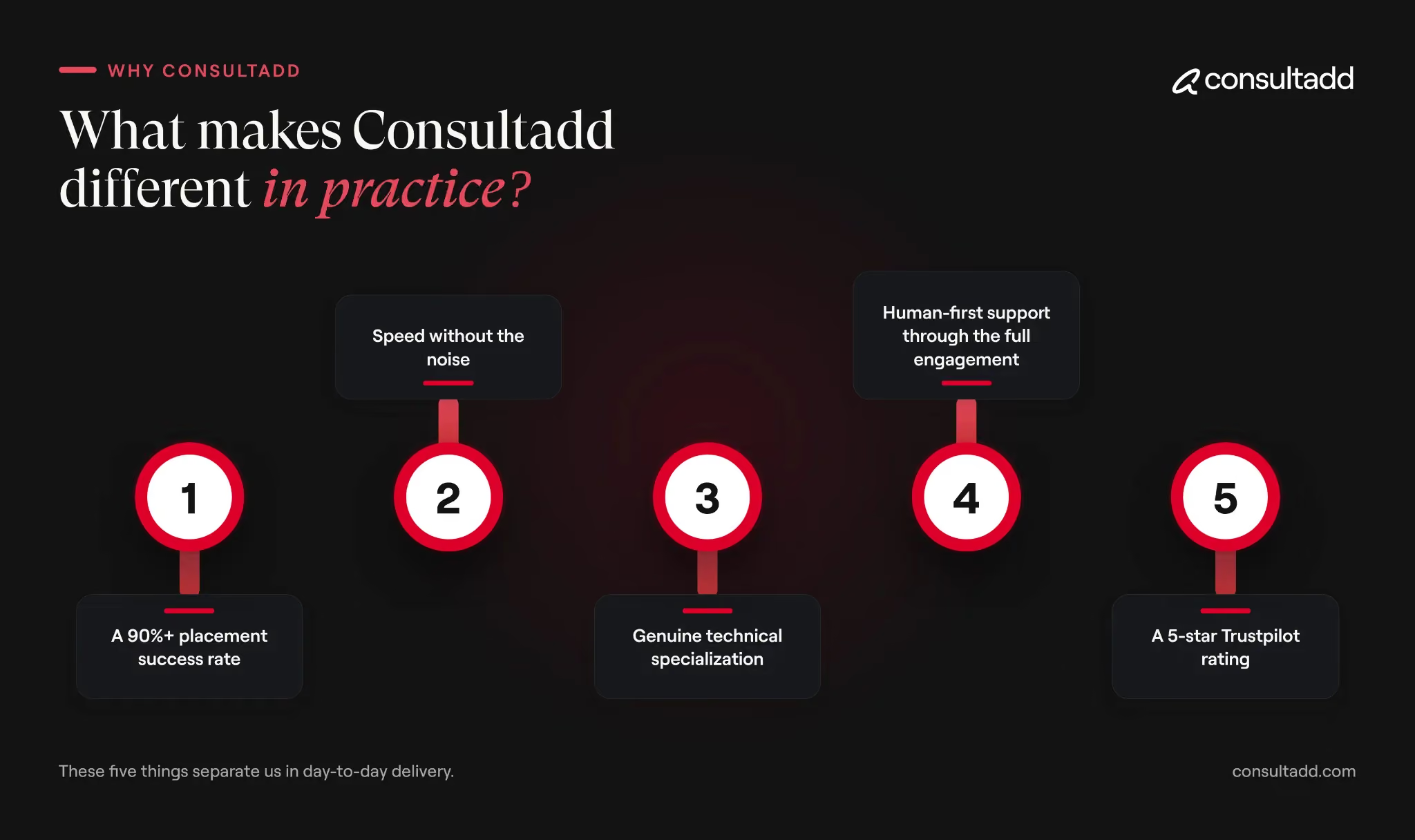
Here's what working with Consultadd looks like:
- Talent sourced in under 24 hours
- Ready-to-deploy candidates, vetted for experience and compliance
- Lower turnover risk: we match long-term goals, not just short-term needs
- Seamless compliance: visa, documentation, onboarding? Handled.
- Dedicated 1:1 account managers for responsive, personalized support
- Top 100 candidate matches delivered in the past year
- Strong partnerships with universities to tap into fresh, committed talent
- Post-placement support so your investment grows beyond day one
For candidates, your next opportunity is more than just a job title, it's a chance to build skills, gain experience, and move your career forward. At Consultadd, we connect technology professionals with projects and employers that align with their goals, whether they're looking for contract, contract-to-hire, or long-term opportunities.
The tech job market moves fast, but the right guidance can make all the difference. Ready to take the next step in your career journey? Explore Opportunities >>
Key Takeaways
- Focus on skills, not credentials, to improve quality of hire and reduce hiring bias.
- Create and nurture proactive talent pipelines instead of recruiting only after vacancies arise.
- Optimize the candidate experience with faster communication, fewer interview rounds, and clear timelines.
- Combine AI with human expertise. Use AI for screening and scheduling, but leave final hiring decisions to recruiters.
- Invest in employer branding, structured interviews, and referral programs to attract, evaluate, and retain top talent more effectively.
FAQs
What is a hiring strategy?
A hiring strategy is a structured plan that defines how an organization will attract, evaluate, and hire candidates for open roles. It covers sourcing channels, assessment methods, the candidate experience, and the metrics used to measure whether the process is working.
What is the most effective hiring strategy in 2026?
No single strategy works in isolation. The companies seeing the best results are combining skills-based evaluation, proactive talent pipeline building, structured interviews, and strong employer branding into a coherent process. Each element reinforces the others.
How does skills-based hiring work in practice?
Instead of filtering candidates by degree or job title, skills-based hiring evaluates what candidates can demonstrate they can do. This typically means using technical assessments, work samples, coding challenges, portfolio reviews, and competency-based interview questions designed to assess the specific capabilities the role requires.
Why do so many job seekers decline offers?
In 2026, the most commonly cited reason candidates decline offers is a poor hiring experience, including slow communication, unclear timelines, too many interview rounds, and a general sense of being left in the dark.
How important is employer branding for hiring?
Very. Eighty-eight percent of candidates say employer branding influences their decision to apply. Fifty percent reduction in cost-per-hire is the commonly cited advantage for companies with strong employer brands.
.webp)