
.avif)

Introduction
A recruiter opens a resume with 34 IT skills listed across four rows. Python, AWS, Kubernetes, Terraform, React, SQL, Kafka, and on it goes. She spends about eight seconds on it and moves to the next one.
Not because the skills are wrong. Because a list that long tells her nothing about what the candidate can actually do on Monday.
That gap is the real story with IT skills right now. The market has plenty of people who can name technologies and far fewer who can show evidence of using them under pressure.
Understanding which IT skills matter is the easy half. Proving you have them is where most candidates lose the screen.
TL;DR
- IT skills fall into five groups, and mixing them up on a resume is one of the fastest ways to get filtered out.
- The difference between tool skills and fundamentals decides how long your skill set stays valuable.
- BLS projects computer and IT occupations to grow much faster than average through 2034, with roughly 317,700 openings a year, so demand isn't the constraint.
- Employers expect 39% of workers' core skills to change by 2030, which means your current stack has a shelf life.
- Screens now test for evidence, not keywords. Every skill you claim should have a specific artifact behind it.
What counts as an IT skill
An IT skill is any capability that lets you build, run, secure, or improve computer systems. That covers writing code, configuring infrastructure, querying data, responding to incidents, and explaining a tradeoff to someone who doesn't write code.
The last one surprises people. It shouldn't.
Most engineers we've watched stall out didn't stall on technical ability. They stalled because they couldn't explain why they picked one approach over another, so nobody trusted them with the decision. That's an IT skill too, even though it doesn't look like one on a certification page.
The category is broader than "programming languages I know." Treating it that way is why so many resumes read as a tool inventory.
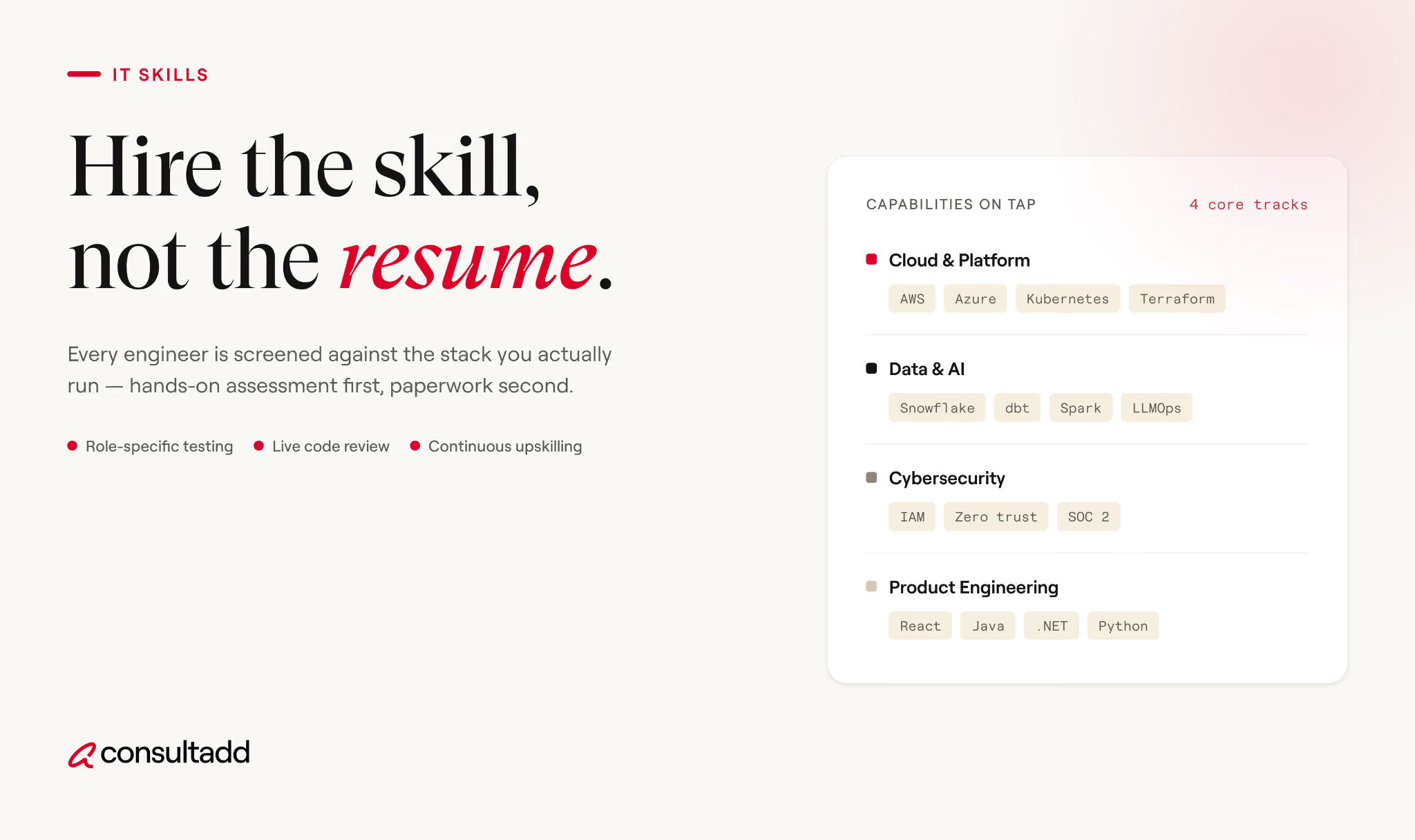
The five groups IT skills fall into
Grouping matters because employers screen by group, not by individual item. A cloud role and a data role might both want Python, but they want it doing completely different things.
Most job descriptions draw from three or four of these. The ones that draw from all five are usually either a small company where everyone does everything, or a poorly written req.
Tools versus fundamentals
This is the distinction that separates a five-year career from a fifteen-year one.
Tool skills are specific: Terraform, Snowflake, a particular CI system, whatever framework was popular the year you learned it. They get you hired quickly and they expire. Some expire fast.
Fundamentals are the layer underneath: how networks route, why a database picks one query plan over another, what actually happens when a container starts. These don't expire. They're also what makes picking up the next tool take two weeks instead of six months.
The World Economic Forum's Future of Jobs Report 2025 found employers expect 39% of workers' core skills to change by 2030, down from 44% in 2023.
Note what that number means in practice. It's not that 39% of your knowledge becomes useless. It's that the tool layer churns while the foundation holds.
Candidates who over-index on tools get hit hardest by that churn. Candidates who understand fundamentals switch stacks and keep their seniority.
Worth being honest about the tradeoff though. Fundamentals don't get you past a keyword filter. You need both, and early in a career the tools usually have to come first.
Which IT skills are actually in demand
Demand isn't the problem in this market. Distribution is.
The Bureau of Labor Statistics projects computer and information technology occupations to grow much faster than the average for all occupations from 2024 to 2034, with about 317,700 openings projected each year.
Median annual wage for the group was $105,990 in May 2024, against $49,500 for all occupations.
In the broader employment projections, computer and mathematical occupations are projected to grow the second fastest of any occupational group at 10.1%, more than three times the projected rate for the total economy at 3.1%.
But those openings aren't spread evenly across skill sets, which is the part the headline numbers hide.
Consultadd's breakdown of how the U.S. tech job market split in 2026 goes into where the demand concentrated and where it didn't.
Where hiring has been most consistent:
- Cloud and infrastructure
AWS, Azure, and GCP alongside Terraform and Kubernetes. Still the broadest base of open roles.
- Data engineering
SQL remains the most durable skill on this entire page. It's forty years old and still on nearly every req.
- Security
Growing across industries, not just in security teams. If you want the credential path here, Consultadd covers which cybersecurity certifications carry weight.
- AI and ML engineering
The fastest-moving category and the most crowded at entry level. The gap between "I've used an API" and "I've shipped a model to production" is enormous, and Consultadd's guide to AI and machine learning engineer roles covers what employers expect at each level.
WEF also found analytical thinking remains the most sought-after core skill, with seven out of ten companies calling it essential. That one never appears in a tech stack list, and it's on more requirement sheets than any framework.
Why listing IT skills stopped working
Here's the shift that most career advice hasn't caught up to.
When everyone can generate a polished skills section in thirty seconds, the skills section stops carrying information. Recruiters adjusted. Technical screens got heavier, take-homes came back, and reference checks got more specific.
So the question changed from "which skills do I list" to "what proof do I attach."
The pattern is consistent. Evidence has a number, a timeframe, or a specific thing that broke. Claims have adjectives.
Understanding the stages of an IT recruitment process helps here too, because different evidence matters at different stages.
Keywords get you past the first filter. Artifacts get you past the technical screen. Stories get you past the hiring manager.
Building IT skills that hold their value
Half the advice on upskilling assumes unlimited time. Most working engineers have four or five hours a week, so where those hours go matters.
Two things we'd push back on in the standard advice.
Certifications aren't worthless, but they work as a filter-clearing device and a study structure, not as proof of ability. A cert with no project behind it gets you an interview and then hurts you in it.
And breadth is overrated below senior level. Three skills you can discuss in depth beat twelve you can name. WEF found 50% of workers have now completed some training or reskilling, up from 41% in 2023, which means the credential itself no longer distinguishes you. What you built with it does.
Putting IT skills on a resume
Short version: fewer skills, more specificity.
Cut anything you wouldn't want a 45-minute technical conversation about. If Kafka is on your resume, someone will ask about partition strategy, and "I've seen it in our stack" is a bad answer.
Group skills by category rather than dumping them in one block. Recruiters scan for the group that matches the req.
Put your strongest three to five where the eye lands first. Nobody reads to the end of a skills section.
And move your best evidence into the experience bullets instead of the skills list. "Migrated 40 services from EC2 to ECS over eight months" proves more about your AWS skills than the word AWS ever will.
Start Strong With Consultadd
With 15 years in business and 5,000+ successful staffing engagements, we don't just fill roles, we build reliability into your process. We've supported 65 staffing companies in the past year alone and maintain MSAs with industry leaders like Robert Half and TEKsystems.
Here's what working with Consultadd looks like:
- Talent sourced in under 24 hours
- Ready-to-deploy candidates, vetted for experience and compliance
- Lower turnover risk: we match long-term goals, not just short-term needs
- Seamless compliance: visa, documentation, onboarding? Handled.
- Dedicated 1:1 account managers for responsive, personalized support
- Top 100 candidate matches delivered in the past year
- Strong partnerships with universities to tap into fresh, committed talent
- Post-placement support so your investment grows beyond day one
For candidates, your next opportunity is more than just a job title, it's a chance to build skills, gain experience, and move your career forward. At Consultadd, we connect technology professionals with projects and employers that align with their goals, whether they're looking for contract, contract-to-hire, or long-term opportunities.
The tech job market moves fast, but the right guidance can make all the difference. Ready to take the next step in your career journey? Explore Opportunities >>
Key takeaways
- IT skills span five groups, and employers screen by group, so organize your resume the way they read it.
- Tool skills get you hired and expire. Fundamentals decide how fast you pick up the next tool.
- Demand is strong overall, with BLS projecting about 317,700 annual openings in computer and IT occupations, but it's concentrated in cloud, data, security, and AI engineering.
- Since 39% of core skills are expected to change by 2030, treat your current stack as temporary and your fundamentals as permanent.
- Attach evidence to every skill you claim. A number, a timeframe, or a specific failure you fixed beats any adjective.
FAQs
What are IT skills?
IT skills are the capabilities used to build, run, secure, and improve computer systems. They include programming languages, cloud platforms, databases, networking, and security, along with operational skills like incident response and technical communication. Most roles need a mix from several of those areas rather than depth in just one.
What is the difference between hard and soft IT skills?
Hard IT skills are measurable and specific, like writing SQL or configuring a Kubernetes cluster. Soft skills cover how you work: explaining a tradeoff, reviewing a colleague's code, or handling an outage without panic. WEF's research found analytical thinking is the most sought-after core skill among employers, so the split matters less than people assume.
Which IT skills are most in demand right now?
Cloud platforms, SQL and data engineering, security, and AI or machine learning engineering see the most consistent demand. BLS projects computer and mathematical occupations to grow 10.1% from 2024 to 2034, more than three times the rate for the economy overall. Demand within that growth is uneven, so the specific skill matters more than the category.
How many IT skills should I list on my resume?
Fewer than you think. Eight to twelve organized by category works better than thirty in a block. Only list skills you'd be comfortable discussing for 45 minutes, because a technical screen will find the ones you padded.
Do certifications prove IT skills?
They prove you studied a body of knowledge and passed a test, which helps clear automated filters and gives your learning a structure. They don't prove you can apply the material under real conditions. Pair any certification with a project you can describe in detail.
How long do IT skills stay relevant?
Tool-level skills often need refreshing within two to four years as versions and platforms shift. Foundational knowledge like networking, operating systems, and data modeling stays useful across an entire career. Employers expect 39% of core skills to change by 2030, and most of that churn hits the tool layer.
.webp)



.png)
