
.avif)

Introduction
Search for AI machine learning engineer jobs and you'll get two contradictory stories. One says this is the fastest-growing, highest-paying corner of tech. The other says new graduates are sending out hundreds of applications and hearing nothing.
Both are accurate. They're describing different parts of the same market.
Demand is real and pay is high, but the roles concentrate heavily at mid and senior levels. Entry-level postings are a small slice of what's out there. And the job title itself covers at least four different jobs that people keep confusing with each other.
Here's what the postings and the wage data actually show.
TL;DR
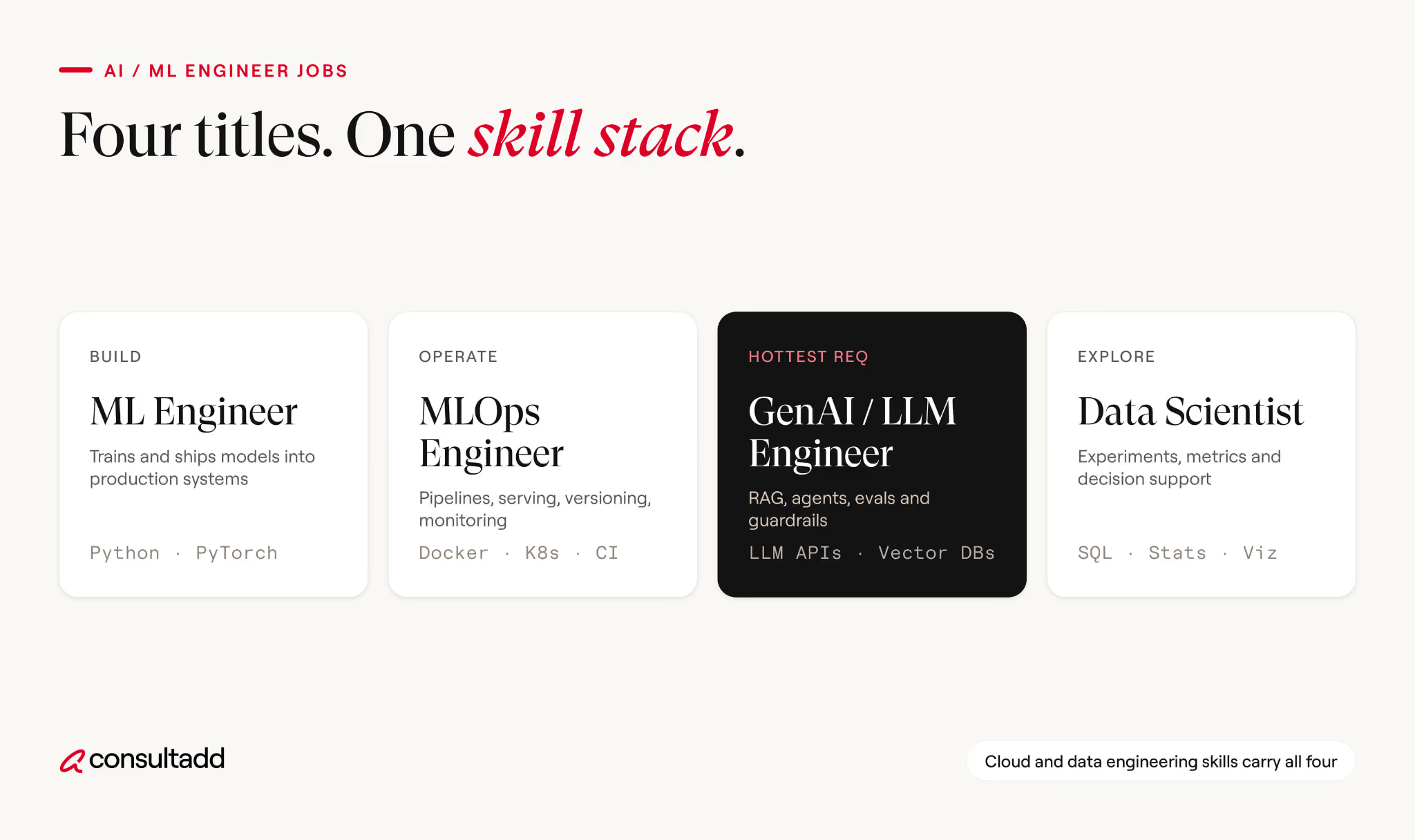
- "AI/ML engineer" covers four distinct roles, and applying to the wrong one is a common reason for silence.
- BLS has no occupation code for machine learning engineer, which is why published salary figures vary by $60,000 or more.
- Postings analyses put the experience sweet spot at 2 to 6 years, with entry-level roles a small minority.
- What employers ask for is production engineering, not research. Advanced research methods appear in under 2 percent of listings.
- Certifications show up in roughly 6 percent of postings. Shipped work counts for more.
The four jobs hiding under one title
Job titles in this space are used inconsistently, and that inconsistency costs candidates interviews. Before applying to anything, work out which of these the posting actually describes.
The distinction that matters most is between ML engineer and data scientist. ML engineering leans heavily toward software engineering. If you can train a good model but can't write maintainable code, deploy it, or debug it in production at 2am, most ML engineer postings aren't describing your job.
The newest category is AI engineer. These roles often don't require training models at all. They involve building applications on top of existing models, which means retrieval architecture, prompt design, and evaluation matter more than gradient descent. That shift has opened a door for experienced software engineers who never did formal ML work.
What these jobs pay
Salary numbers for this role vary wildly across sources, and there's a structural reason for that.
The Bureau of Labor Statistics has no occupation code for machine learning engineers. These jobs get classified across three different categories depending on what the work actually involves, and the wage data reflects three different populations.
Two things stand out. Data scientists lead the BLS list of fastest-growing occupations at 35 percent, while software developers sit at 10 percent. AI isn't only adding jobs to tech, it's redistributing them within it.
And the openings figures matter more than the growth percentages. Research scientist roles grow at 22 percent but produce fewer than 3,000 openings a year nationally. That's a genuinely small field. Data science produces roughly eight times as many openings.
Private postings data runs higher than BLS medians because it skews toward large technology employers.
An analysis of over 10,000 AI/ML engineering postings by Axial Search found a median advertised salary of $187,500, with the middle 80 percent of roles between roughly $122,000 and $265,000. Glassdoor's 2026 average for ML engineers sits around $166,000.
Treat the high numbers as what senior roles at well-funded companies pay, not as a typical first offer.
What employers actually ask for
This is where a lot of preparation goes wrong. Candidates study the wrong things because the popular image of ML work doesn't match what companies hire for.
The Axial Search analysis found machine learning fundamentals appearing in 24 percent of listings, with communication at 21 percent and cross-functional collaboration at 19 percent.
Meanwhile a separate 2026 postings analysis found advanced research methods like GANs, graph neural networks, and Bayesian approaches appearing in under 2 percent of postings.
Read that again. The research techniques that dominate online ML curricula show up in roughly one job posting in fifty.
That last row deserves a note. Only about 6 percent of AI/ML postings request a certification of any kind. A cloud ML certification from a provider like AWS has some signaling value for candidates without production experience, but it won't substitute for a system you actually built and deployed.
The domain depth finding is worth taking seriously too. One 2026 postings analysis found that 57.7 percent of ML engineer listings preferred domain specialists over generalists.
Employers increasingly want someone who understands fraud detection, or clinical data, or recommendation systems specifically, rather than someone who has touched a bit of everything.
The entry-level problem
Here's the uncomfortable part, stated plainly.
Analyses of ML engineer postings consistently find entry-level roles making up a small single-digit percentage of listings. 365 Data Science's review of over 1,100 postings put roles requiring up to two years of experience at around 3 percent of the market, with the demand concentrated at 2 to 6 years.
Axial Search found 78 percent of AI/ML engineering positions targeting 5 or more years, and roughly 70 percent at mid or senior level.
So if you're applying to ML engineer roles straight out of a degree or bootcamp and hearing nothing, the market structure explains most of it. It isn't necessarily your resume.
What actually works:
1. Enter sideways.
- Data engineering, backend engineering, and analytics roles all sit adjacent to ML teams and hire at entry level far more often.
- Two years building data pipelines makes you a credible ML engineering candidate in a way that two years of coursework does not.
- Several people who've made this transition describe taking a hybrid data engineering role specifically to get proximity to ML work.
2. Build one deep thing, not five shallow ones.
- A deployed system with real users, monitoring, and a writeup of what broke beats a folder of notebooks.
- Interviewers ask follow-up questions, and depth is what survives them.
3. Target AI engineer roles if you come from software.
- Building LLM applications requires strong engineering and system design more than ML theory.
- For experienced backend engineers, this is currently the shortest path into AI work.
4. Consider contract routes.
- Hiring managers approve a six-month engagement with less scrutiny than a permanent headcount, which makes contract and contract-to-hire a realistic way to get first production ML experience on a resume.
Our guide to contract-to-hire opportunities covers how those arrangements work, and IT contract staffing as a strategy explains why companies increasingly staff specialized work this way.
Where the jobs are
Geography is concentrated. California accounted for roughly 32 percent of US AI/ML engineering postings in the Axial Search dataset, with technology firms at 46 percent of postings, financial services at 14 percent, and IT services at 11 percent.
Remote work is more available here than in most technical fields but less than the field's reputation suggests. Among postings that specified a work arrangement, roughly 45 percent were hybrid and 32 percent fully remote.
Worth knowing: financial services and healthcare hire steadily for ML roles and compete less directly with the big technology employers for the same candidates. If you have domain knowledge in either, that combination is more valuable than a broader but shallower technical profile.
On the employer side, these roles remain among the hardest to fill in technology.
Our breakdown of what's changing in tech hiring covers where the pressure is sharpest, and what's broken in IT recruitment looks at why these searches stall.
Start Strong With Consultadd
With 15 years in business and 5,000+ successful staffing engagements, we don't just fill roles, we build reliability into your process. We've supported 65 staffing companies in the past year alone and maintain MSAs with industry leaders like Robert Half and TEKsystems.
Here's what working with Consultadd looks like:
- Talent sourced in under 24 hours
- Ready-to-deploy candidates, vetted for experience and compliance
- Lower turnover risk: we match long-term goals, not just short-term needs
- Seamless compliance: visa, documentation, onboarding? Handled.
- Dedicated 1:1 account managers for responsive, personalized support
- Top 100 candidate matches delivered in the past year
- Strong partnerships with universities to tap into fresh, committed talent
- Post-placement support so your investment grows beyond day one
For candidates, your next opportunity is more than just a job title, it's a chance to build skills, gain experience, and move your career forward. At Consultadd, we connect technology professionals with projects and employers that align with their goals, whether they're looking for contract, contract-to-hire, or long-term opportunities.
The tech job market moves fast, but the right guidance can make all the difference. Ready to take the next step in your career journey? Explore Opportunities >>
Key takeaways
- AI machine learning engineer jobs split into four distinct roles, and targeting the right one matters more than volume of applications.
- BLS classifies this work across three occupations, which is why salary figures differ so widely between sources.
- The demand sits at 2 to 6 years of experience, so entry-level candidates usually enter through adjacent roles.
- Postings emphasize production engineering and domain depth, not research techniques or certifications.
- California and technology firms dominate the market, but finance and healthcare offer less crowded entry points.
FAQs
What does an AI machine learning engineer do?
They build and run machine learning systems in production: preparing data pipelines, training and evaluating models, deploying them, and monitoring performance once they're live. The work is closer to software engineering than to research at most companies, with the split between modeling and engineering varying by team.
How much do machine learning engineer jobs pay?
BLS median wages for the occupations this work falls under ranged from $120,230 to $140,300 in May 2025. Postings analyses focused on technology employers report higher figures, with a median around $187,500 and most roles between $122,000 and $265,000. Location, company size, and seniority drive most of the variation.
What qualifications do you need for ML engineer jobs?
Most postings expect strong Python, a framework like PyTorch or TensorFlow, cloud platform experience, and demonstrated production deployment work. A computer science degree is common but not universal, and certifications appear in only about 6 percent of listings. Evidence of shipped systems carries more weight than credentials.
Is it hard to get an entry-level machine learning engineer job?
Yes, currently. Postings analyses put entry-level roles at a small single-digit share of the ML engineer market, with demand concentrated at 2 to 6 years of experience. Most people entering the field now do so through data engineering, backend engineering, or analytics roles and move across once they have production experience.
What's the difference between an AI engineer and an ML engineer?
ML engineers typically train, deploy, and maintain models. AI engineers usually build applications on top of existing models, working with retrieval systems, prompts, agents, and evaluation. AI engineering demands strong software and system design skills but often less ML theory, which makes it a more accessible entry point for experienced developers.
Are machine learning engineer jobs remote?
More often than in most technical fields, though not universally. Among postings that state a work arrangement, roughly 45 percent are hybrid and 32 percent fully remote. Fully remote roles tend to be more competitive because the applicant pool is national rather than local.
.webp)



.png)
