

Introduction
Most people walk out of an interview thinking about the one answer they fumbled. Usually, that answer wasn't the problem. The problem started days earlier, when they skimmed the job description and assumed they'd figure it out in the room.
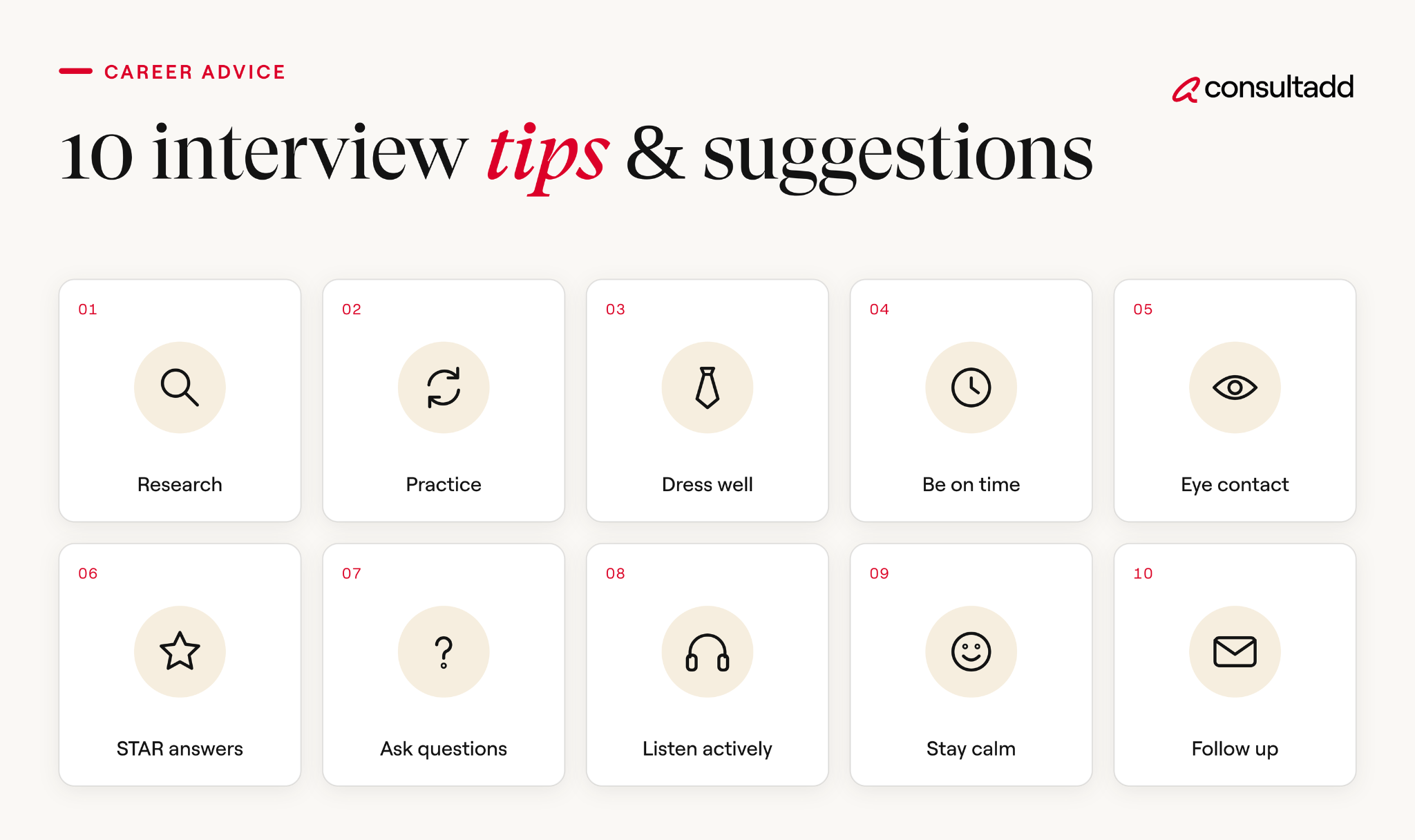
These 10 interview tips and suggestions come from what we see every week screening and preparing tech candidates for client interviews. They follow the order an interview actually happens in: what to do before, how to handle the conversation itself, and what to do once it's over.
None of them are tricks. They're habits that make it easier for an interviewer to say yes.
TL;DR
- Read the job description line by line and match each requirement to a real example from your work.
- Prepare five or six flexible stories instead of memorizing dozens of answers, and practice them out loud.
- Answer the question that was asked, keep it to a minute or two, and stop talking when you're done.
- Have honest, short answers ready for the hard topics: gaps, weaknesses, salary, and things you don't know.
- Ask real questions, send a short follow-up within a day, and write down what to fix before the next interview.
Before the interview: tips 1 to 5
Most of the results are decided here. The candidates we see do well rarely have the most experience. They're the ones who showed up knowing exactly what the role needed and how their background fit it.
1. Read the job description like a checklist
Print it or paste it into a document. Underline every skill, tool, and responsibility. Then write one real example next to each one.
This takes about 30 minutes and does more than anything else on this list. Interviewers build their questions from that same document, so you're preparing for the actual test.
If a line has no proof next to it, that's where you'll get caught. Either find an honest example or prepare to say how you'd learn it.
2. Research the company and the people you'll meet
Go past the homepage. Look at what the company sells, who its customers are, any recent news, and what the team you're joining actually works on.
Then look up your interviewers on LinkedIn. You're not trying to flatter anyone. You just want to know whether you're talking to a hiring manager, a senior engineer, or someone from HR, because each one cares about different things.
The U.S. Department of Labor's CareerOneStop also suggests making a list of questions you'd like to ask during the interview as part of your prep. Your research is where those questions come from.
3. Prepare five or six stories you can adapt
You don't need 40 memorized answers. You need a handful of real stories that can answer many different questions.
A good set usually covers a problem you solved, a time something went wrong, a disagreement with a coworker, a project you're proud of, and a time you learned something fast. One story about fixing a production issue can answer questions on pressure, ownership, teamwork, and problem-solving.
Structure each one using the STAR method: situation, task, action, result. Spend most of the time on what you personally did.
For how these stories fit into each round, Consultadd's interview format guide breaks down phone screens, panels, and structured interviews.
4. Practice out loud, not in your head
Answers always sound better in your head. Say them out loud and you'll notice where you ramble, where you skip the result, and where you use "we" when the interviewer wants to hear "I."
Record yourself on your phone, or practice with a friend. Google's Interview Warmup is a free tool that lets you answer practice questions out loud and review your responses.
The CareerOneStop list of common interview questions is a good starting set if you don't know where to begin.
Two or three practice runs are enough. More than that and you start sounding scripted.
5. Know every line of your resume
Anything on your resume is fair game. When we prep candidates for client interviews, we often pick one tool from their skills list and ask, "When did you last use this, and for what?" Strong candidates answer with a project. Weaker ones answer with a definition.
If you can't talk about something for two minutes, consider removing it before the interview rather than defending it during.
Consultadd's guide to technical skills for your resume shows how to list skills you can actually back up.
During the interview: tips 6 to 9
6. Get the logistics out of the way early
Logistics problems eat confidence. Confirm the time zone, the format, and the names of everyone you're meeting the day before.
For video interviews, test your camera, microphone, and the meeting link ahead of time, and keep a phone number handy in case the call drops. For on-site interviews, plan to arrive 10 to 15 minutes early.
Consultadd's interview checklist for every format covers what to bring and what to leave at home.
7. Answer the question asked, then stop
This sounds obvious, but it's where many good candidates lose points. They hear a question, latch onto one word, and answer something slightly different.
If a question is unclear, ask a short clarifying question. "Do you mean on the technical side or working with the team?" is completely fine.
Keep most answers to one or two minutes. When you've given the result, stop. Silence after a good answer isn't a problem. Filling it with extra detail usually is.
8. Be honest about gaps, weaknesses, and things you don't know
Interviewers expect hard questions. What they're watching is how you handle them.
CareerOneStop recommends that job seekers practice how to answer difficult questions about their work history, such as being fired or having large employment gaps. That advice holds for any tough topic.
That last row matters more in tech roles than people think. An honest "I haven't used Kafka in production, but here's how I'd approach it" often scores better than a confident wrong answer.
9. Have a salary range ready before anyone asks
Salary questions can come up as early as the first recruiter call. If you're caught off guard, you'll either undersell yourself or give a number that ends the conversation.
Research the market rate for the role and location before the interview. The Bureau of Labor Statistics' Occupational Outlook Handbook lists median pay by occupation, and recent job postings in your area often include salary ranges.
Give a range rather than a single number, and base it on the role, not on what you earn now. Something like: "Based on the scope of this role and the market for it, I'm looking at roughly X to Y, but I'm open to discussing the full package."
For contract roles, know whether you're discussing an hourly rate or an annual figure, and whether benefits are included. We see this mix-up regularly, and it causes awkward resets later in the process.
After the interview: tip 10
10. Ask real questions, follow up, and debrief yourself
Ending with "No, I think you covered everything" signals low interest, even after a strong interview. Prepare two or three questions about the work itself, such as what the first three months look like, what's hardest about the role, or how the team measures success.
For later rounds, Consultadd's list of good final round interview questions to ask goes deeper on what to ask senior interviewers.
Within 24 hours, send a short thank-you email. Three or four sentences are enough: thank them for their time, mention one specific thing you discussed, and restate your interest. If you're working with a recruiter, send your feedback to them too, since they can often pass along context the hiring team wouldn't share directly.
Then take five minutes for yourself. Write down which questions you were asked, which answers felt weak, and what you'd change. Candidates who do this after every interview get noticeably better within two or three rounds. Candidates who don't tend to repeat the same stumble.
A simple interview prep timeline
If you have about a week, here's how these tips fit together.
Short on time? Consultadd's 60-minute last-minute interview prep plan shows what to prioritize when you only have an hour.
Extra suggestions for tech interviews
Technical interviews add a layer on top of everything above. Most loops include some mix of coding, system design, and project deep dives, and each one rewards slightly different prep.
A few suggestions that apply across all of them:
- Think out loud. Interviewers grade your reasoning, not just your final answer. A silent correct solution often scores worse than a well-explained partial one.
- Ask clarifying questions before you start. Inputs, edge cases, and scale change the right answer.
- Pick one project to explain in depth. Know why you made each design choice and what you'd change now.
- Be ready to talk about AI tools. Many interviewers now ask how you use them and how you check their output.
For round-specific prep, see these Consultadd guides:
- Tech interview prep that actually gets you hired
- Mastering the coding interview
- System design interview questions with sample answers
- DevOps interview questions with sample answers
Common interview mistakes and fixes
These are the issues we flag most often when reviewing mock interviews with candidates.
Using these interview tips and suggestions
You don't need to do all 10 interview tips and suggestions perfectly to get an offer. If you only have time for three, pick these: map the job description to your proof, practice your stories out loud, and send a follow-up.
After that, treat each interview as practice for the next one. Keep your debrief notes, adjust your stories, and the interviews get easier. Most candidates who land good roles didn't get there in one try. They got a little sharper each round.
Start Strong With Consultadd
With 15 years in business and 5,000+ successful staffing engagements, we don't just fill roles, we build reliability into your process. We've supported 65 staffing companies in the past year alone and maintain MSAs with industry leaders like Robert Half and TEKsystems.
Here's what working with Consultadd looks like:
- Talent sourced in under 24 hours
- Ready-to-deploy candidates, vetted for experience and compliance
- Lower turnover risk: we match long-term goals, not just short-term needs
- Seamless compliance: visa, documentation, onboarding? Handled.
- Dedicated 1:1 account managers for responsive, personalized support
- Top 100 candidate matches delivered in the past year
- Strong partnerships with universities to tap into fresh, committed talent
- Post-placement support so your investment grows beyond day one
For candidates, your next opportunity is more than just a job title, it's a chance to build skills, gain experience, and move your career forward. At Consultadd, we connect technology professionals with projects and employers that align with their goals, whether they're looking for contract, contract-to-hire, or long-term opportunities.
The tech job market moves fast, but the right guidance can make all the difference. Ready to take the next step in your career journey? Explore Opportunities >>
Key takeaways
- The job description is your study guide, so match every requirement to a real example before the interview.
- Five or six flexible STAR stories, practiced out loud, cover most behavioral interview questions.
- Short, direct answers that stop at the result land better than long ones that drift.
- Honest answers about gaps, weaknesses, and unknowns build more trust than polished deflections.
- A thoughtful question, a follow-up email within 24 hours, and a quick self-debrief improve your odds in the next round.
FAQs
What are the most important interview tips?
Study the job description closely, prepare a few real stories from your work, and practice answering out loud. During the interview, answer the question asked and keep answers focused. Afterward, send a short thank-you email within a day.
How should I prepare for an interview the day before?
Confirm the time, format, and the names of your interviewers, and test your video setup if it's a virtual call. Review the job description and your top stories once. Then stop preparing and get some rest, since cramming the night before usually makes answers sound rehearsed.
How long should my interview answers be?
Most answers should run one to two minutes. Behavioral answers using the STAR method can take a little longer, but most of that time should go to what you did and the result. If the interviewer wants more detail, they'll ask.
What should I say when I don't know the answer?
Say so honestly, then explain how you would work it out or where you'd look. Interviewers respect a clear "I'm not sure, but here's my approach" far more than a confident guess. Bluffing on one question can make them doubt your other answers.
How do I answer "What are your salary expectations?"
Research the market rate for the role and location beforehand, then give a range rather than a single number. Base it on the job's scope, not your current pay. You can add that you're open to discussing the full package, including benefits.
Should I send a thank-you email after an interview?
Yes. Send a short email within 24 hours thanking the interviewer, mentioning one specific topic you discussed, and confirming your interest. It keeps you memorable, especially when the team is meeting several candidates in the same week.