.avif)

Introduction
Most tech interview prep advice tells you to "practice more" without saying what to practice or in what order. That's how candidates end up grinding 200 random coding problems while ignoring the system design round that's about to sink them.
Good tech interview prep means matching your preparation to the actual stages of the process: coding, system design, and behavioral. Each one tests something different, and cramming for one doesn't help with the others.
This guide breaks down what each stage looks like, how to prepare for it without wasting weeks, and where candidates usually lose points without realizing it.
TL;DR
- Most tech interviews run through three distinct stages: coding, system design, and behavioral, each requiring different prep.
- Practicing coding patterns beats memorizing solutions to specific problems.
- System design rounds reward structured thinking over encyclopedic knowledge of every architecture pattern.
- Behavioral interviews now take up a larger share of total interview time than they did a few years ago.
- Mock interviews close the gap between knowing the material and performing under time pressure.
Know what you're actually being tested on
A tech interview isn't one test, it's several tests stacked together. Recruiters typically start with a resume screen, then move candidates through a mix of the following:
- A coding or algorithm round, testing problem-solving under time pressure.
- A system design round, testing how you structure and reason about large systems.
- A behavioral round, testing communication, collaboration, and judgment.
Skipping prep for any one of these because you're strong in another is one of the most common reasons candidates make it to the final round and still don't get an offer.
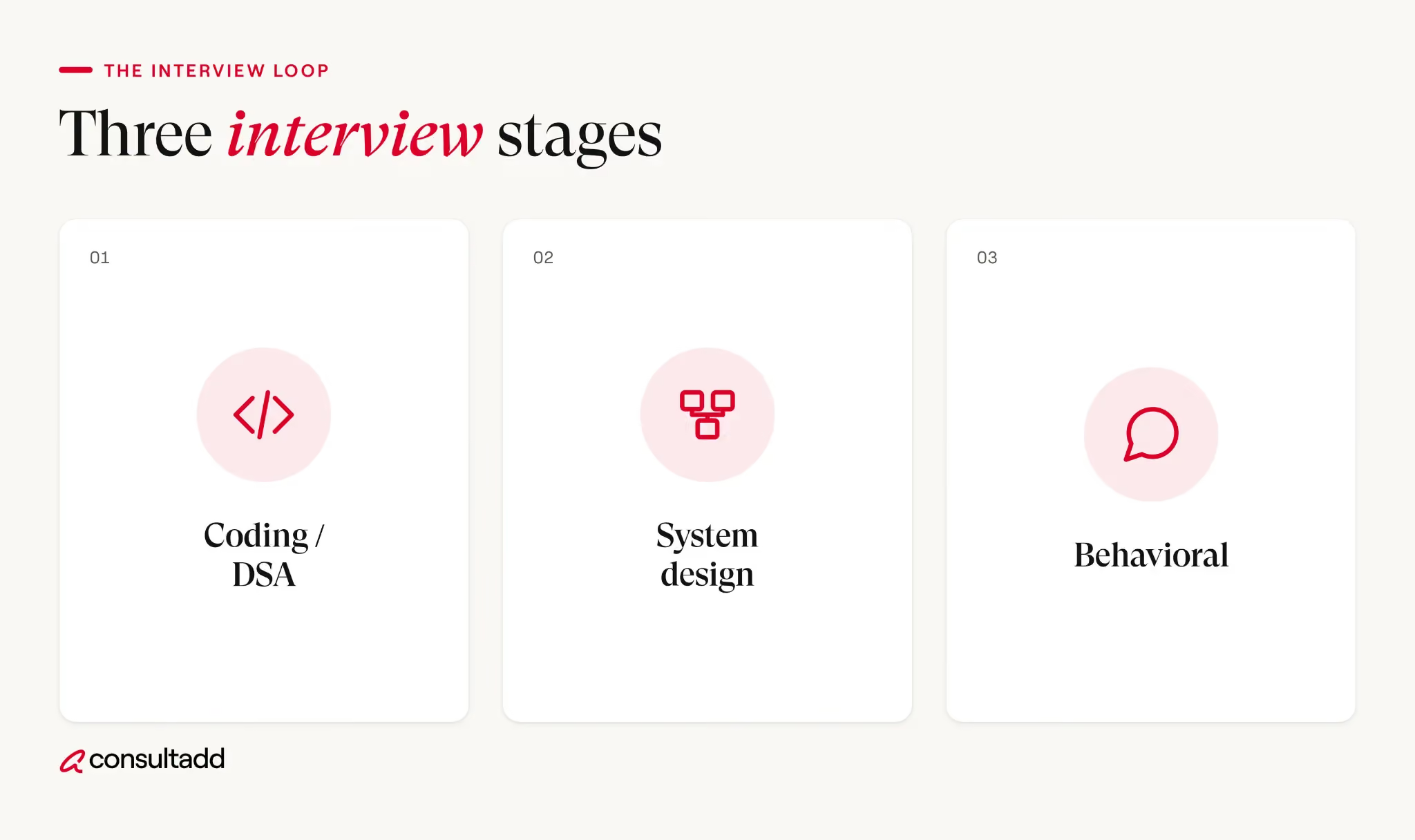
The three interview stages compared
Coding interviews: practice patterns, not problems
Coding interviews reward pattern recognition more than raw problem count. Someone who deeply understands five patterns, like two pointers, sliding window, and recursion, will usually outperform someone who's grinded 300 problems without noticing the patterns repeating.
When you sit down with a new problem, walk through it the same way every time:
- Restate the problem in your own words and ask clarifying questions.
- Work through two or three examples, including edge cases.
- Describe your approach out loud before writing any code.
- Write clean code with meaningful variable names.
- Trace through your solution against the examples and fix what breaks.
Interviewers are grading your thought process as much as your final answer. Silence while you code tells them nothing about how you think.
System design: structure beats memorization
System design interviews are open-ended by nature, which makes them intimidating if you've never practiced the format. The goal isn't to recite every pattern you've read about. It's to show you can reason through trade-offs out loud.
A workable structure for most system design questions:
- Clarify the requirements and scale before proposing anything.
- Sketch a high-level design first, then go deeper on the components that matter most.
- Call out trade-offs explicitly. Nothing in system design is free.
- Leave room to discuss bottlenecks and how the design would evolve under more load.
Practicing this with a peer, even informally, matters more than reading another article about distributed systems. The skill being tested is explaining your reasoning clearly, not just having the reasoning.
Behavioral interviews are carrying more weight than they used to
The behavioral round isn't a formality anymore. Companies use it to evaluate ownership, communication, and how candidates handle ambiguity, and it's taking up a larger share of total interview time at many tech companies than it did several years ago.
Prepare 4 to 5 STAR stories (Situation, Task, Action, Result) that cover different scenarios: a conflict you navigated, a project that didn't go as planned, a time you influenced a decision without formal authority.
Reusing the same one or two stories for every question makes interviewers question how much range you actually have.
Company-specific prep still matters
Generic prep gets you in the door. Company-specific prep is what separates candidates in a close decision.
Google's own candidate preparation guide for software engineering roles walks through what their interviewers evaluate at each stage, and reading it directly from the source beats relying on secondhand summaries.
If you're targeting a specific company, spend at least an hour understanding their product, recent technical decisions, and what their engineering culture actually values day to day.
It shows in how you answer both technical and behavioral questions.
Mock interviews close the performance gap
Knowing the material and performing it under interview conditions are two different skills.
- A mock interview, with a peer, a mentor, or a structured practice platform, exposes the gap between understanding a concept and explaining it clearly while someone is watching the clock.
- Record yourself if you can.
- Most candidates are surprised by how often they trail off mid-sentence or skip the clarifying questions they know they should ask.
This is a fixable problem, but only if you notice it before the real interview.
Why demand for prepared candidates keeps climbing
Employment in computing occupations is projected to keep growing much faster than the average across all occupations through the next decade, according to the U.S. Bureau of Labor Statistics.
More openings means more competition for the roles candidates actually want, not less, since companies can afford to be selective when the applicant pool is large.
That's also reflected in how universities are formalizing interview prep.
Yale's Office of Career Strategy treats the technical interview as a distinct skill separate from general interviewing, worth practicing on its own rather than folding into generic interview advice.
Putting a prep plan together
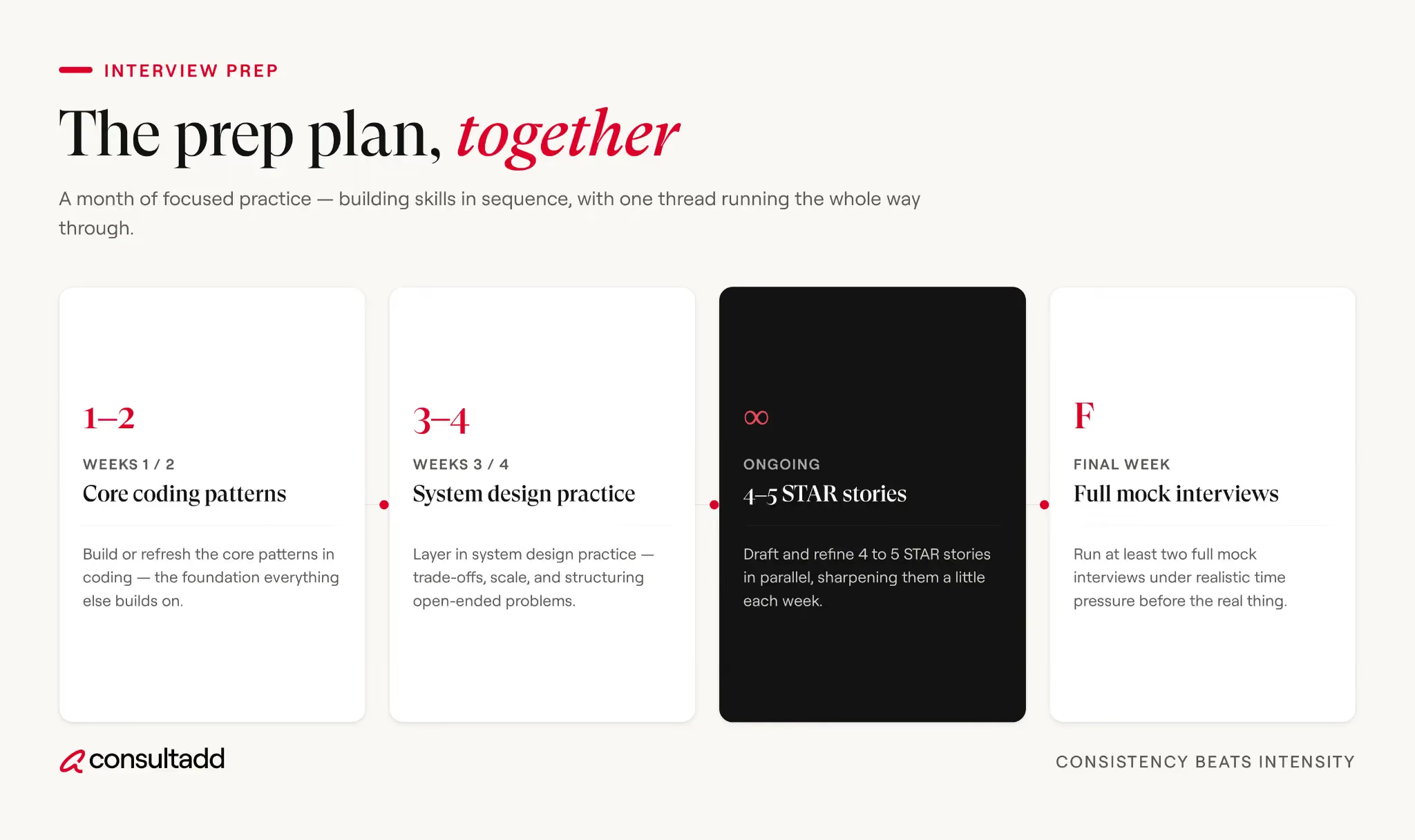
A reasonable timeline for someone with 4 to 6 weeks before an interview:
- Weeks 1/2: Build or refresh core patterns in coding, focusing on the patterns you're weakest in.
- Weeks 3/4: Add system design practice, one problem at a time, explained out loud.
- Ongoing: Draft and refine 4 to 5 STAR stories, testing them on a friend or mentor for clarity.
- Final week: Run at least two full mock interviews under realistic time pressure.
Candidates working with a staffing partner often get access to structured mock interviews and role-specific coaching as part of the placement process, which is worth asking about if you're job hunting through an agency rather than applying cold.
For a broader look at what that kind of support includes, our piece on what candidates should expect from a staffing partner covers the onboarding and prep side of working with a recruiter.
Start Strong With Consultadd
With 15 years in business and 5,000+ successful staffing engagements, we don't just fill roles, we build reliability into your process. We've supported 65 staffing companies in the past year alone and maintain MSAs with industry leaders like Robert Half and TEKsystems.
Here's what working with Consultadd looks like:
- Talent sourced in under 24 hours
- Ready-to-deploy candidates, vetted for experience and compliance
- Lower turnover risk: we match long-term goals, not just short-term needs
- Seamless compliance: visa, documentation, onboarding? Handled.
- Dedicated 1:1 account managers for responsive, personalized support
- Top 100 candidate matches delivered in the past year
- Strong partnerships with universities to tap into fresh, committed talent
- Post-placement support so your investment grows beyond day one
For candidates, your next opportunity is more than just a job title, it's a chance to build skills, gain experience, and move your career forward. At Consultadd, we connect technology professionals with projects and employers that align with their goals, whether they're looking for contract, contract-to-hire, or long-term opportunities.
The tech job market moves fast, but the right guidance can make all the difference. Ready to take the next step in your career journey? Explore Opportunities >>
Key takeaways
- Tech interview prep works best when it's matched to the specific stage: coding, system design, or behavioral.
- Pattern recognition in coding rounds beats memorizing individual problem solutions.
- System design interviews reward structured, out-loud reasoning over encyclopedic knowledge.
- Behavioral prep deserves real time, not last-minute improvisation, since it now carries more weight than before.
- Mock interviews are the fastest way to find the gap between knowing the material and performing it under pressure.
FAQs
How long should tech interview prep take?
Four to six weeks of focused practice is reasonable for most candidates, longer if you're weak in multiple areas or targeting highly competitive companies. Consistency across a shorter window usually beats a longer, unfocused one.
Should I focus more on coding or system design?
It depends on the role and seniority level. Entry-level roles weigh coding rounds more heavily, while senior roles put more emphasis on system design and how you make trade-offs.
What's the best way to practice system design if I've never done it before?
Start by explaining a system you already know well, like a URL shortener or a simple chat app, out loud to another person. The skill being built is verbal reasoning under scrutiny, not just technical knowledge.
How many STAR stories should I prepare?
Four to five well-developed stories usually cover most behavioral questions if you can adapt them to different prompts. More than that becomes hard to keep sharp and specific.
Do mock interviews actually help, or is reading enough?
Mock interviews matter because interviews are a performance skill, not just a knowledge test. Reading about system design or coding patterns builds the knowledge; mock interviews build the ability to communicate it under time pressure.
Is it worth tailoring prep to a specific company?
Yes, especially past the first round. Company-specific research on culture, recent technical decisions, and interview structure shows up in how confidently you answer both technical and behavioral questions.
.webp)

.webp)