

Introduction
Coding rounds have right answers. System design rounds mostly don't, and that's what throws people. You're handed a vague prompt like "design a chat app" and 45 minutes, and the interviewer watches how you think, not whether you land on one correct diagram.
This guide collects the system design interview questions that come up most often, grouped by difficulty, with an outline of what a strong answer covers for each.
It also gives you a repeatable framework and the core concepts you'll need, so you can handle prompts you haven't seen before.
TL;DR
- System design interviews test how you reason about scale, trade-offs and failure, not whether you've memorized a reference architecture.
- Use a fixed structure: clarify requirements, estimate scale, sketch a high-level design, go deep on one or two parts, then discuss bottlenecks.
- A small set of concepts covers most questions: load balancing, caching, sharding, replication, queues, consistency models and rate limiting.
- Classic prompts include a URL shortener, rate limiter, news feed, chat app and video streaming service.
- Practice out loud, one prompt at a time, and always name the trade-off behind each decision.
What a system design interview tests
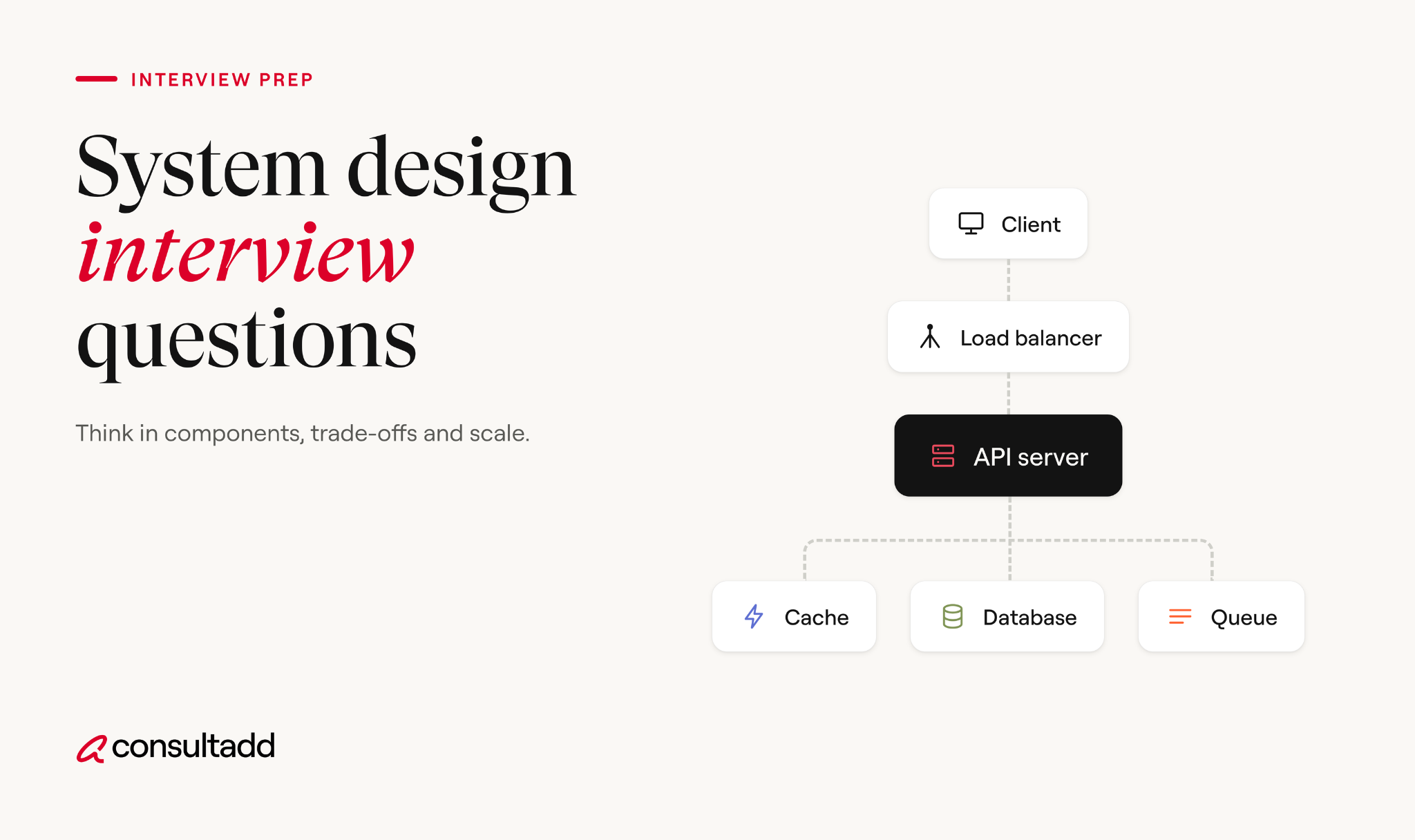
A system design interview asks you to design a large software system at a high level. You'll talk through components like servers, databases, caches and queues, and explain how data moves between them.
Interviewers aren't grading the final diagram.
They're watching for four things: whether you clarify the problem before solving it, whether you think in numbers, whether you can explain why you picked one option over another, and whether you notice where the system breaks.
Seniority changes the weight of this round.
For junior candidates, the technical deep dive tends to carry more weight, while senior interview loops largely hinge on system design. The round usually runs 45 to 60 minutes on a whiteboard or shared doc.
From the recruiting side, this is where we see strong coders lose offers. A candidate who writes clean code but jumps straight into a database schema without asking how many users the system has usually gets marked down. Interviewers want to see the questions first.
A framework for answering system design questions
You don't need a different approach for every prompt. The same five steps work for almost all system design interview questions.
1. Clarify requirements. Split them into functional requirements (what the system does) and non-functional ones (scale, latency, availability, consistency). Ask who the users are and what matters most.
2. Estimate scale. Rough numbers drive design choices. If a service has 100 million daily users who each make 10 requests, that's 1 billion requests a day, or about 11,600 requests per second on average. Peak traffic is often several times higher.
3. Sketch the high-level design. Draw the main boxes: clients, load balancer, application servers, data stores, caches and any async workers. Walk through one request end to end.
4. Go deep on one or two components. Pick the hardest part, usually the data model or the piece that has to scale, and design it properly. The interviewer may steer you.
5. Discuss bottlenecks and failures. What happens if a database node dies, a cache goes cold, or traffic spikes tenfold? Name the trade-offs you made and what you'd change with more time.
For general prep across coding, design and behavioral rounds, Consultadd's practical tech interview prep guide lays out a week-by-week plan.
Core concepts to know before the interview
Most system design interview questions reuse the same building blocks. If you can explain each of these and when you'd use it, you're well prepared.
On the last row: Google's Site Reliability Engineering book defines an SLI as a carefully chosen quantitative measure of some aspect of the service, and an SLO as a target value or range for that measure.
Using that vocabulary when you discuss availability sounds precise without sounding rehearsed.
For broader patterns, the AWS Well-Architected Framework and the Azure Architecture Center are both worth reading. AWS's framework is organized around six pillars, including operational excellence and reliability, which map neatly onto the non-functional requirements you'll discuss in an interview.
Beginner system design interview questions
These prompts show up in early-career and mid-level loops. They're small enough to finish in 45 minutes, which makes them good practice for pacing.
1. Design a URL shortener
What it tests: ID generation, read-heavy scaling, caching.
Clarify the read-to-write ratio first; it's usually very read-heavy. Generate a unique numeric ID and encode it in base62. Seven base62 characters give about 3.5 trillion combinations, which is plenty. Hashing the long URL also works but needs collision handling.
Store mappings in a key-value store, cache popular links, and discuss redirects: a 301 is cached by browsers and cuts load, while a 302 keeps every click visible for analytics.
2. Design a rate limiter
What it tests: algorithms, distributed state, placement.
Compare token bucket (allows short bursts), fixed window (simple but spiky at window edges), and sliding window (smoother, slightly more costly).
For a distributed setup, keep counters in a shared store like Redis and use atomic operations so two servers don't both allow the same request. Place it at the API gateway, and return HTTP 429 with a retry-after header.
3. Design Pastebin
What it tests: separating metadata from content, expiry.
Store the text in object storage and metadata (ID, owner, expiry, visibility) in a database. Reuse the ID approach from the URL shortener.
Handle expiry with a TTL plus a background cleanup job, and put a CDN in front of popular public pastes.
4. Design a notification system
What it tests: async processing, retries, third-party dependencies.
Accept notification requests through an API, write them to a queue, and have separate workers per channel: push, SMS and email. Each worker calls an external provider, which can fail, so you need retries with backoff and idempotency keys to avoid double-sending. Check user preferences and rate limits before sending.
5. Design a gaming leaderboard
What it tests: choosing the right data structure.
A sorted set (for example, Redis sorted sets) gives fast score updates and top-N queries. Discuss how to show a user's own rank, how to handle ties, and how to persist scores to a durable database in case the in-memory store restarts.
Intermediate system design interview questions
These add real distributed systems problems: fan-out, real-time connections and large datasets.
6. Design a news feed
What it tests: fan-out strategy, caching, ranking.
The core choice is fan-out on write (push posts into followers' feeds when created, fast reads) versus fan-out on read (build the feed when requested, cheaper writes).
Strong answers propose a hybrid: push for regular users, pull for accounts with millions of followers, so one celebrity post doesn't trigger millions of writes.
7. Design a chat application
What it tests: real-time connections, ordering, delivery guarantees.
Use WebSockets for persistent connections, with a service tracking which server each user is connected to. Order messages per conversation, not globally.
A wide-column store suits high write volume. Cover offline users (store and push later), read receipts, presence, and group chat fan-out.
8. Design a web crawler
What it tests: scale, politeness, deduplication.
Build a URL frontier queue, workers that fetch pages, a parser that extracts new links, and a dedupe step (a Bloom filter or content hash) so you don't crawl the same page twice.
Respect robots.txt and limit requests per domain. Cache DNS lookups, since they slow crawlers down more than people expect.
9. Design search autocomplete
What it tests: latency, precomputation.
Suggestions must return within tens of milliseconds, so compute top results per prefix ahead of time rather than at query time.
A trie works conceptually; in practice, many designs store the top-k results per prefix in a fast cache. Update rankings with an offline job from search logs, and filter offensive suggestions.
10. Design a distributed cache
What it tests: partitioning, eviction, consistency.
Use consistent hashing to spread keys across nodes so adding a node only moves a small share of them. Discuss LRU eviction, replication for availability, and cache invalidation strategies.
Mention hot keys: one viral item can overload a single node, so you may need key replication or a small local cache in front.
Advanced system design interview questions
Senior and staff loops lean on these. Expect the interviewer to push hard on consistency, failure handling and cost.
11. Design a video streaming service
What it tests: media pipelines, CDNs, adaptive bitrate.
Uploads go to object storage, then a queue triggers transcoding into multiple resolutions and bitrates. Players use adaptive bitrate streaming (HLS or DASH) to switch quality based on the viewer's bandwidth. Most traffic should be served from a CDN. Discuss storage costs for rarely watched videos and how metadata, views and recommendations scale separately.
12. Design a ride-sharing service
What it tests: geospatial indexing, real-time matching.
Drivers send location updates every few seconds. Index them with geohashes or a quadtree so you can find nearby drivers quickly. Matching needs to avoid assigning one driver to two riders, which means careful locking or a single owner per region.
Trip state (requested, accepted, in progress, completed) needs strong consistency; location updates don't.
13. Design a payment system
What it tests: correctness under failure.
This is where availability takes a back seat to consistency. Use idempotency keys so a retried request never charges twice. Record money movements in a double-entry ledger.
Calls to external payment processors can time out without telling you whether they succeeded, so run reconciliation jobs that compare your records with the processor's.
14. Design a collaborative document editor
What it tests: concurrent edits, conflict resolution.
Users editing the same paragraph at once need their changes merged sensibly. Explain operational transformation (OT) and conflict-free replicated data types (CRDTs) at a high level, plus the trade-offs: OT typically relies on a central server, while CRDTs handle offline edits more naturally but add data overhead. Cover WebSocket sync, cursor presence and version history.
15. Design a distributed key-value store
What it tests: the fundamentals, all at once.
Partition with consistent hashing, replicate each key to N nodes, and use quorum reads and writes: if R + W > N, a read overlaps with the latest write.
Discuss the CAP trade-off, conflict resolution (last-write-wins vs version vectors), failure detection through gossip, and how a failed node catches up when it returns.
Questions by role
The prompt you get depends on the job. Here's how system design interview questions usually shift by role.
If you're interviewing for full stack roles, Consultadd's list of interview questions for a full stack developer covers the frontend, backend and database rounds that sit alongside system design.
Java developers can use the Java full stack developer interview questions for Spring Boot and REST API prep.
Common mistakes and how to fix them
Most failed system design rounds come down to the same handful of habits.
Clear explanation matters as much as technical depth here.
Consultadd's piece on technical writing skills employers check makes the point that a design round is essentially a design doc delivered out loud.
How to practice system design interview questions
Reading about system design interview questions builds knowledge. Saying the answers out loud builds the skill. Pick one prompt from this list, set a 45-minute timer, and talk through it as if someone were listening, using the five-step framework every time.
After each session, write down where you stalled. It's usually the same spot: estimates, the data model, or failure handling. Spend your next session on that weak point.
A mock interview with a peer or mentor is worth more than several solo runs, because follow-up questions are what expose gaps. Don't neglect the coding round while you prep.
If you need a refresher, Consultadd's coding interview playbook covers data structures, patterns and how AI-aware interviews have changed the format.
Start Strong With Consultadd
With 15 years in business and 5,000+ successful staffing engagements, we don't just fill roles, we build reliability into your process. We've supported 65 staffing companies in the past year alone and maintain MSAs with industry leaders like Robert Half and TEKsystems.
Here's what working with Consultadd looks like:
- Talent sourced in under 24 hours
- Ready-to-deploy candidates, vetted for experience and compliance
- Lower turnover risk: we match long-term goals, not just short-term needs
- Seamless compliance: visa, documentation, onboarding? Handled.
- Dedicated 1:1 account managers for responsive, personalized support
- Top 100 candidate matches delivered in the past year
- Strong partnerships with universities to tap into fresh, committed talent
- Post-placement support so your investment grows beyond day one
For candidates, your next opportunity is more than just a job title, it's a chance to build skills, gain experience, and move your career forward. At Consultadd, we connect technology professionals with projects and employers that align with their goals, whether they're looking for contract, contract-to-hire, or long-term opportunities.
The tech job market moves fast, but the right guidance can make all the difference. Ready to take the next step in your career journey? Explore Opportunities >>
Key takeaways
- System design interviews score your reasoning, trade-offs and awareness of failure, not a single correct diagram.
- A five-step framework (requirements, estimates, high-level design, deep dive, bottlenecks) works for almost every prompt.
- Ten core concepts, including caching, sharding, replication, queues and the CAP theorem, cover most system design interview questions.
- The prompt changes with the role and seniority, so practice the questions most relevant to the job you're targeting.
- Timed, out-loud practice and mock interviews close gaps faster than reading alone.
FAQs
What are the most common system design interview questions?
The most common prompts are designing a URL shortener, rate limiter, news feed, chat application, notification system and video streaming service. Distributed caches and key-value stores also come up often in senior interviews. They're popular because each one tests several core concepts at once.
How do I prepare for a system design interview?
Learn the core building blocks first: load balancing, caching, databases, replication, sharding and queues. Then practice prompts with a fixed framework, timing yourself and speaking out loud. Mock interviews help most, because they force you to handle follow-up questions.
How long is a system design interview?
Most rounds last 45 to 60 minutes. Plan to spend the first few minutes on requirements, then move into estimates, the high-level design and a deep dive. Leave time at the end to discuss bottlenecks and trade-offs.
Do junior developers get system design interview questions?
Sometimes, though usually lighter ones. Junior candidates may be asked to design a small feature or a simple service like a URL shortener. The bar rises sharply at mid and senior levels, where system design often decides the offer.
What's the difference between high-level and low-level design interviews?
High-level design covers the overall architecture: services, databases, caches and how they connect. Low-level design focuses on classes, interfaces and object-oriented structure, such as designing a parking lot system in code. Some companies run both as separate rounds.
Is there one right answer to a system design question?
No. Interviewers expect different valid designs depending on the requirements you clarify. What matters is that your choices fit those requirements and that you can explain the trade-offs behind them.