.avif)

Introduction
Your interview is in an hour, or tomorrow morning, and you have done almost nothing to get ready. The good news is that most last minute interview tips people search for at this point are useless to you, because they assume a week of runway.
You do not have a week. You have a narrow window, and the right move is to spend it on the two or three things that actually change how the conversation goes.
This is a triage guide. Pick the section that matches the time you have and ignore the rest.
TL;DR
- With one hour, spend it on the job description, three prepared stories, and two questions to ask. Skip everything else.
- Behavioral answers work best in the STAR format, and a strong one runs one to two minutes, with most of that time on what you personally did.
- Have five answers loosely ready: tell me about yourself, why this role, a hard problem you solved, a conflict or failure, and what you want to ask them.
- With 15 minutes, reread the posting, pick one story you can tell cold, and test your camera and audio.
- Do not cram. Reading 40 sample answers an hour before an interview makes you sound rehearsed, not prepared.
Start here: how much time do you actually have
Be honest about the number, then work from this table.
The pattern holds at every tier: understanding the role beats accumulating facts. Preparation is the thing hiring managers respond to, and the U.S. Department of Labor makes the same point in its own interview guidance, that resumes do not hire people, hiring managers do.
The 60-minute prep plan
One hour, four blocks. Set a timer for each one so you do not sink 45 minutes into company research and arrive with no stories.
Minutes 0 to 15: reread the job description properly
Pull up the posting and go through it requirement by requirement. Next to each one, write down what you have actually done that matches. CareerOneStop, the U.S. Department of Labor's career site, recommends exactly this exercise, because it does two things at once. It surfaces your strongest evidence, and it shows you where you are thin.
Where you are thin, do not panic. Decide in advance how you will address the gap: what adjacent experience you have, and how quickly you have picked up similar things before. Interviewers rarely expect a perfect match. They do notice when a candidate has clearly never thought about the gap.
Minutes 15 to 35: build three stories, not thirty
This is the highest-value block, so protect it.
Pick three specific situations from your work, study, or volunteering. One where you solved a hard technical or analytical problem. One where you worked through friction with a person or a team. One where something went wrong and you handled it.
Write each as four short bullets, not a paragraph. Situation, task, action, result. You are not writing a script, you are laying down the shape of a story so you do not lose the thread while talking.
Reuse is fine. Three well-shaped stories can cover a dozen different questions, because most behavioral questions are asking about the same handful of underlying traits.
Minutes 35 to 50: research just enough
Fifteen minutes is enough to find four things:
- What the company sells, and to whom
- One recent, specific thing they did (a product launch, a funding round, an expansion, a partnership)
- The team or function the role sits in
- Who you are speaking with, and what their role is
Stop there. You are not preparing a market analysis. You are preparing to sound like someone who bothered to look, and to have one non-generic thing to reference when they ask if you have questions.
Minutes 50 to 60: your questions and your logistics
Write down three questions. When an interview winds down and you are asked whether you have any, saying no reads as disinterest or a lack of curiosity, which CareerOneStop flags directly.
Good ones that need no research:
- What does a typical week look like in this role?
- How is performance measured here, and by whom?
- What would you want the person in this role to have accomplished in the first three months?
- What is the biggest challenge the team is dealing with right now?
Then handle the boring things. Confirm the time and time zone. Confirm the meeting link or the address and how long it takes to get there. Charge your laptop. Put a printed or open copy of your resume where you can see it.
If you are interviewing for contract or contract-to-hire work, also have your availability, notice period, and work authorization status ready in one sentence each. Recruiters ask these in the first five minutes, and fumbling them makes the rest of the call feel shakier than it is.
How to answer behavioral questions on short notice
Anything that starts with "tell me about a time when" is a behavioral question, and the STAR format is the standard answer structure that career centers across universities teach for them.
STAR stands for situation, task, action, and result. The proportions matter more than most people realize:
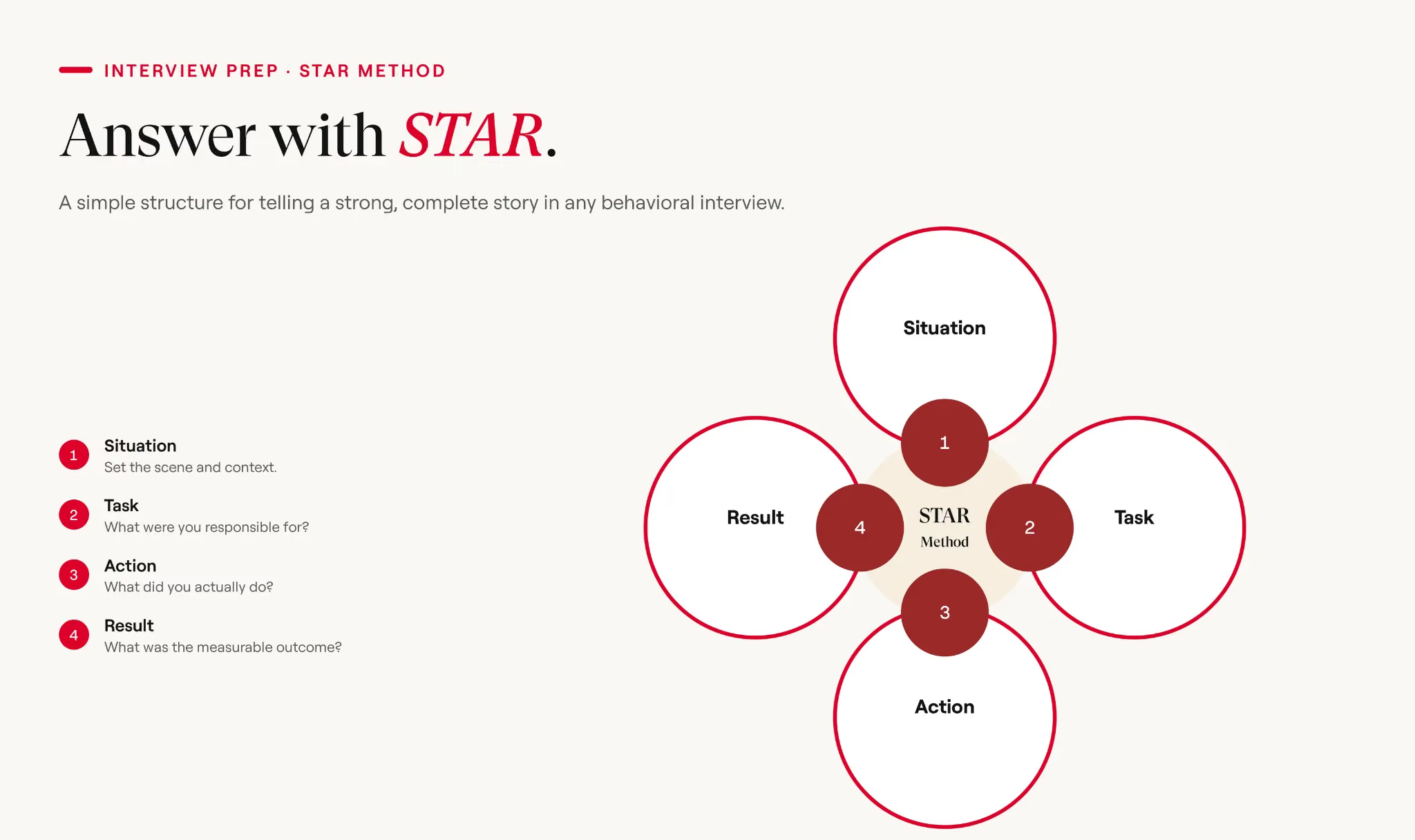
Duke's career team puts a strong STAR answer at one to two minutes. That is shorter than most people's instinct under pressure.
Three things that go wrong when people prepare in a rush:
Drifting into "we." The University of Iowa's career guide makes the point bluntly: describe what you did, not what the group did. Interviewers cannot evaluate a team.
Overloading the setup. Two minutes of background and fifteen seconds of action is the most common failure mode. Cut the setup.
Dropping the result. Students routinely have to be prompted for it, according to the same guide. Land it yourself, and use a number if one exists.
One more thing worth saying: do not embellish. A story built on a weak foundation falls apart the moment someone asks a follow-up question, and follow-up questions are the entire point of behavioral interviewing.
Five answers to have loosely ready
Loosely is the operative word. Bullets, not sentences.
For technical roles, the format of the interview matters as much as the content. If your interview involves live coding or a system design discussion, our guide on how to stand out in a full stack developer interview covers what interviewers are actually scoring, which is your reasoning out loud more than your final answer.
There is one more question that catches candidates cold, and it has nothing to do with skills: whether you will require sponsorship. Answer it accurately, not strategically, because it gets verified at the I-9 stage anyway.
If you are unsure what the right answer is for your status, who counts as legally authorized to work in the U.S. explains the difference between being authorized and needing sponsorship.
The 15-minute version
If the interview starts in a quarter of an hour, do only this:
- Reread the job posting. Two minutes.
- Pick the one story you could tell right now with no notes. Write four bullets for it. Five minutes.
- Find one specific recent thing about the company. Three minutes.
- Write down two questions to ask. Two minutes.
- Test your camera, mic, and link. Three minutes.
That is a genuinely functional interview. It is not a great one, but it will not read as unprepared, which is the actual risk you are managing.
Virtual interview checks that take five minutes
Most interviews are still remote, and most avoidable disasters here are technical.
Keep your notes on a second screen or on paper beside you, not in a window you have to alt-tab to. Eyes darting off-camera is more noticeable than you think.
What to skip when time is short
This part matters as much as the plan.
Skip sample answer roundups. Reading 30 model responses an hour before an interview does not build fluency. It builds a vague sense that your own answers are wrong. Career centers consistently advise paraphrasing your notes rather than memorizing them, and cramming pushes you the other way.
Skip deep company research. Revenue figures and org charts almost never come up. One specific recent thing does more work than ten data points.
Skip rewriting your resume. They already have it. If something on it is weak, prepare how you will talk about it instead.
Skip trying to eliminate nerves. Some anxiety is normal and does not read the way it feels from the inside. Preparation reduces it more reliably than any breathing trick.
The last five minutes before you join
Close your notes. Drink water. Reread only your three story bullets, nothing new.
Join about two minutes early. Let the interviewer open the conversation rather than filling the silence with a pitch.
Listen to the whole question before answering, and ask for clarification if you did not follow it, which the Department of Labor explicitly recommends rather than guessing at what was meant.
If you go blank, say so plainly and buy a moment: "Let me think about that for a second." A short pause reads as considered. A rambling non-answer does not.
After the interview
Send a short thank-you email within 24 hours. MIT's career office recommends that window, and the content is simple: thank them for the time, mention one specific thing from the conversation, restate your interest. Three or four sentences.
Then write down what came up while it is fresh, especially any question that caught you out. That is the prep for your next one, and it takes five minutes now versus an hour of guessing later.
Worth knowing what the other side of the table is doing, too. Structured hiring processes usually run resume screening, skills assessments, a video or live interview, and reference or background checks in sequence, each stage filtering for something different.
Our breakdown of the online candidate vetting process walks through how employers sequence those stages, which makes it easier to read where you are in a process and what the next conversation is likely to test.
For official, non-commercial preparation resources, the Department of Labor's interview tips and CareerOneStop's get-ready guide are both free and practical.
For behavioral questions specifically, MIT's STAR method walkthrough and the University of Washington's version include worksheets you can fill in quickly.
Start Strong With Consultadd
With 15 years in business and 5,000+ successful staffing engagements, we don't just fill roles, we build reliability into your process. We've supported 65 staffing companies in the past year alone and maintain MSAs with industry leaders like Robert Half and TEKsystems.
Here's what working with Consultadd looks like:
- Talent sourced in under 24 hours
- Ready-to-deploy candidates, vetted for experience and compliance
- Lower turnover risk: we match long-term goals, not just short-term needs
- Seamless compliance: visa, documentation, onboarding? Handled.
- Dedicated 1:1 account managers for responsive, personalized support
- Top 100 candidate matches delivered in the past year
- Strong partnerships with universities to tap into fresh, committed talent
- Post-placement support so your investment grows beyond day one
For candidates, your next opportunity is more than just a job title, it's a chance to build skills, gain experience, and move your career forward. At Consultadd, we connect technology professionals with projects and employers that align with their goals, whether they're looking for contract, contract-to-hire, or long-term opportunities.
The tech job market moves fast, but the right guidance can make all the difference. Ready to take the next step in your career journey? Explore Opportunities >>
Key takeaways
- The most useful last minute interview tips are subtractive: with an hour left, the job description, three stories, and two questions beat everything else you could do with the time.
- Behavioral answers follow STAR, run one to two minutes, and spend most of that time on your own actions rather than the setup or the team's contribution.
- Five loosely prepared answers cover most interviews, and the same three stories can be reused across many questions.
- Technical failures cause more avoidable damage in remote interviews than weak answers do, so test the link, audio, and lighting before anything else.
- Cramming sample answers, deep company research, and resume edits are the three things to cut when you are short on time.
FAQs
Can I really prepare for an interview in one hour?
Yes, for most non-technical interviews. An hour is enough to understand the role, shape three stories, find one specific thing about the company, and prepare questions. What an hour cannot do is build a skill you do not have, so technical assessments and case interviews still reward longer preparation.
What should I do the night before an interview?
Run the 60-minute plan, say your three stories out loud once, then stop. Career centers recommend practicing aloud or recording yourself rather than reading silently, because the gap between how an answer looks on paper and how it sounds is where most people get caught. Then sleep, because being alert matters more than one extra hour of prep.
How do I answer "tell me about yourself" with no preparation?
Keep it to about 90 seconds and structure it as present, past, and why here. Two sentences on what you do now, one or two on the experience that led there, and one on why this specific role interests you. Do not narrate your resume chronologically from your first job.
Is it obvious to interviewers when a candidate has not prepared?
Usually, though not in the way candidates fear. It shows up as vague answers with no specific examples, no questions at the end, and no apparent knowledge of what the role involves. Nerves and stumbles are not the giveaway. Emptiness is.
What questions should I ask if I did not have time to research?
Ask about the work itself, which needs no research. What a typical week looks like, how performance is measured, what the biggest challenge facing the team is right now, and what success in the first three months would look like all work in any interview and signal real interest.
Should I still send a thank-you email if the interview went badly?
Yes. Send it within 24 hours regardless. Keep it to a few sentences, and if there was a question you handled poorly, one short line adding the answer you wished you had given is fair. Do not apologize at length or relitigate the whole conversation.
.webp)


.webp)