
.avif)

Introduction
There's no single answer to which cybersecurity certification is best. There's only the best one for the job you're trying to get.
That's the honest framing for anyone researching the best cybersecurity certifications 2026 has on offer. A credential that gets a career changer past an HR filter is a waste of $1,700 for a working SOC analyst. A hands-on pentest cert impresses technical hiring managers and does almost nothing for a compliance role.
Two things make this year different. ISC2 cut its CISSP experience waiver list roughly in half in April, which broke a path a lot of people were already walking. And CompTIA raised prices across its lineup in June. Both changes affect what your plan should look like.
Here's the breakdown by career path, with real costs attached.
TL;DR
- Security+ is still the baseline credential for general security roles and DoD-adjacent work, now $439 after CompTIA's June 2026 price increase.
- ISC2 removed CEH, CISA, CRISC, OSCP and most GIAC certs from the CISSP one-year experience waiver on April 1, 2026.
- For offensive roles, OSCP remains the credential technical hiring managers actually respect, at $1,749 for the course and exam bundle.
- CISSP ($749 plus a $135 annual fee) and CISM ($575 for ISACA members) are management credentials, not technical ones.
- Pick the certification that matches the job posting you want, not the one with the best reputation in the abstract.
What changed in cybersecurity certifications in 2026
Two policy changes are worth knowing before you spend anything.
1. The CISSP experience waiver got cut.
ISC2 reduced its list of credentials that shave a year off CISSP's five-year experience requirement, going from roughly 50 approved certifications down to about 25.
The change took effect April 1, 2026, and applications submitted on or after that date fall under the new list.
The removals are the surprising part. CEH, CISA, CRISC, OSCP, and most of the GIAC catalog no longer count. Security+, CySA+, CASP+/SecurityX, CISM, the Cisco security track, and the full ISC2 family survived.
If you were taking CEH specifically to speed up your CISSP timeline, that plan doesn't work anymore. Verify the current list on ISC2's site before you build a roadmap around any credential.
2. CompTIA raised prices.
On June 1, 2026, CompTIA increased exam fees across its lineup.
Security+ went from $425 to $439, with similar increases on the certs people usually pair with it.
3. DoD deadlines moved forward.
Under the DoD 8140 implementation timeline, personnel in cyber IT, cyber effects, cyber intelligence, and cyber enabler work roles had to meet foundational qualification requirements by February 15, 2026.
If you're targeting federal contract work, the qualification matrices on the DoD Cyber Exchange tell you what actually counts for a given role.
Best entry-level cybersecurity certifications
If you're breaking in, the goal is getting past resume screening. Nothing more complicated than that.
1. CompTIA Security+
Still the default. It's the certification most "cybersecurity analyst" job postings name directly, it's vendor-neutral, and it satisfies DoD baseline requirements for IAT Level II. The current version is SY0-701 and the voucher is $439 at CompTIA's US list price.
A few things worth knowing before you buy:
- There's no free retake, so a second attempt is another full voucher.
- The certification expires after three years and renews through continuing education.
- Authorized resellers and the academic store routinely sell the same voucher for less, so the list price is a ceiling rather than a floor.
2. ISC2 Certified in Cybersecurity (CC)
A genuine entry-level credential from the organization behind CISSP. ISC2 has periodically offered the exam and training free under its certification pledge, which makes the value proposition hard to beat when that offer is running. Check whether it's still live before paying.
The signal is weaker than Security+ with most employers, but it costs a fraction as much and it puts an ISC2 credential on your resume.
3. Google Cybersecurity Certificate
Not a certification in the exam-and-proctor sense, but it works as an on-ramp for people with zero background. Treat it as preparation for Security+ rather than a replacement for it.
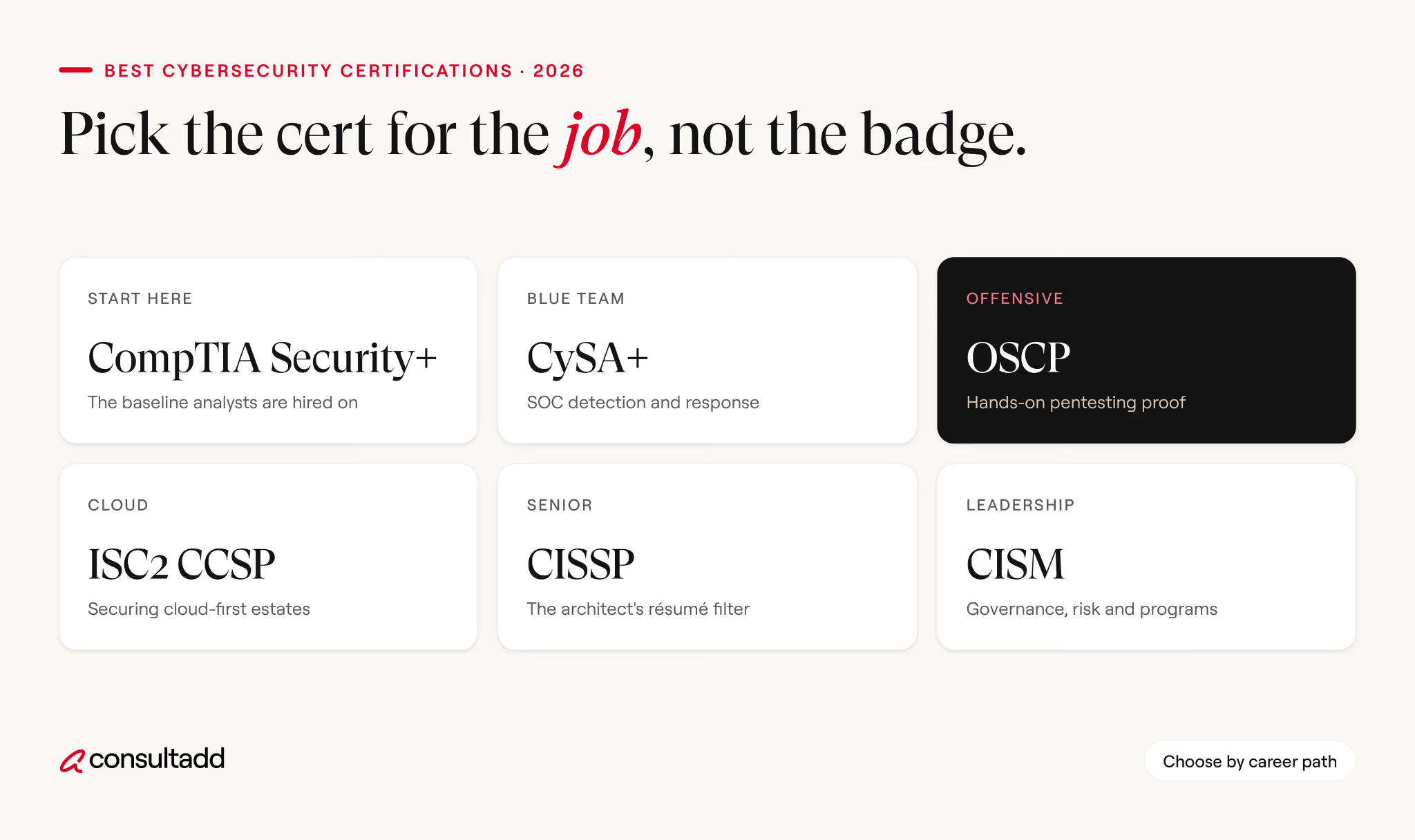
Certifications by specialization
Once you're in, the question changes from "how do I get noticed" to "how do I get deeper."
1. Defensive and SOC roles
CySA+ is the natural step up from Security+ for analysts working detection and response. It covers threat detection, log analysis, and incident response in a way that maps to what tier-one and tier-two analysts actually do.
GIAC certifications from SANS are the practitioner favorites here, particularly GCIH for incident handling and GCFA for forensics. They're well respected and they're also the most expensive tier in the industry once you factor in SANS training. Worth it if your employer pays. Hard to justify out of pocket.
2. Offensive security and pen testing
OSCP is the one hiring managers name in interviews. The exam is a roughly 24-hour hands-on assessment where you compromise live machines and write a professional report, and passing requires 70 out of 100 points. Nothing about it is multiple choice.
Pricing: the PEN-200 course and cert bundle runs $1,749 and includes 90 days of lab access plus one exam attempt. Retake vouchers are $249.
The Learn One subscription is $2,749 annually with a year of access and two attempts. Most candidates need three to six months of preparation, and failing once is common enough that budgeting for a retake is realistic rather than pessimistic.
CEH sits in a different lane. Voucher pricing generally runs somewhere between $950 and $1,199, and the exam is knowledge-based rather than practical. Take it when a job posting or a government contract names it specifically. Take OSCP when you want to prove you can actually do the work.
3. Cloud security
This is where demand has moved. ISC2's CCSP is the vendor-neutral option at around $599, and it carries experience prerequisites similar to CISSP.
Platform-specific credentials often matter more in practice. AWS Certified Security Specialty and Microsoft's SC-100 Cybersecurity Architect Expert both survived the CISSP waiver cull, which is a reasonable proxy for how seriously ISC2 takes them.
If your shop runs on one cloud, certify on that cloud.
Certifications for security leadership
These are management credentials. They test breadth and governance, not technical depth, and that's deliberate.
CISSP is the most frequently listed certification in security leadership job postings.
The exam is $749, there's a $135 annual maintenance fee, and you need 120 CPE credits per three-year cycle. The five-year experience requirement is real, though you can pass the exam first and hold Associate of ISC2 status while you accumulate it.
CISM is ISACA's governance and management credential, covering security governance, risk management, program development, and incident management.
Exam pricing is $575 for ISACA members and $760 for non-members, plus a $50 one-time application fee and an annual maintenance fee of $45 or $85 depending on membership. Since membership dues run around $135 plus chapter fees, joining usually pays for itself on the exam fee alone.
Choose CISSP if you're heading toward architect, security director, or CISO. Choose CISM if your work is audit-adjacent, risk-focused, or sits close to the compliance function.
Cost comparison
Confirm current pricing with each vendor before purchasing. These figures move.
How to choose
Skip the rankings. Do this instead.
Pull ten job postings for the role you actually want, in the market you actually want to work in. Count which certifications appear by name. That count is your answer, and it beats every listicle including this one.
Then check three things against your own situation:
The economics support the investment. The US Bureau of Labor Statistics reports a median annual wage of $129,180 for information security analysts as of May 2025, with employment projected to grow 21 percent from 2025 to 2035 and about 14,100 openings per year over the decade. That's much faster than the 3 percent average across all occupations.
But certifications alone don't get hired. Pair whatever you choose with something you built: a home lab, a detection rule you wrote, a CTF placement, a vulnerability you reported. The CyberSeek career pathway tool is useful for seeing which skills cluster around which roles before you commit.
One more practical note. Contract and contract-to-hire roles are often the fastest route into security for people with adjacent IT backgrounds, since hiring managers take more chances on a six-month engagement than a permanent headcount.
Our breakdown of IT staffing trends and what's changing in tech hiring covers where that demand is concentrated right now.
C2C and contract-to-hire opportunities explain how those arrangements work if you haven't contracted before.
Start Strong With Consultadd
With 15 years in business and 5,000+ successful staffing engagements, we don't just fill roles, we build reliability into your process. We've supported 65 staffing companies in the past year alone and maintain MSAs with industry leaders like Robert Half and TEKsystems.
Here's what working with Consultadd looks like:
- Talent sourced in under 24 hours
- Ready-to-deploy candidates, vetted for experience and compliance
- Lower turnover risk: we match long-term goals, not just short-term needs
- Seamless compliance: visa, documentation, onboarding? Handled.
- Dedicated 1:1 account managers for responsive, personalized support
- Top 100 candidate matches delivered in the past year
- Strong partnerships with universities to tap into fresh, committed talent
- Post-placement support so your investment grows beyond day one
For candidates, your next opportunity is more than just a job title, it's a chance to build skills, gain experience, and move your career forward. At Consultadd, we connect technology professionals with projects and employers that align with their goals, whether they're looking for contract, contract-to-hire, or long-term opportunities.
The tech job market moves fast, but the right guidance can make all the difference. Ready to take the next step in your career journey? Explore Opportunities >>
Key takeaways
- The best cybersecurity certifications 2026 offers depend entirely on target role, not on general reputation.
- Verify the CISSP experience waiver list before planning around any credential, since 31 certifications were removed in April 2026.
- Security+ stays the entry-level default at $439, with reseller and academic pricing well below list.
- OSCP is the credential that proves practical offensive skill, and it doesn't expire.
- Job postings for your target role are a better selection tool than any ranking article.
FAQs
Which cybersecurity certification is best for beginners in 2026?
CompTIA Security+ remains the most widely recognized entry-level option and is named directly in a large share of analyst job postings. It costs $439 at list price and satisfies DoD baseline requirements. ISC2's Certified in Cybersecurity is a lower-cost alternative when the free exam offer is available.
How much do cybersecurity certifications cost?
Entry-level exams run roughly $400 to $600. Mid-level technical credentials like OSCP cost $1,749 for the course and exam bundle. Senior credentials such as CISSP cost $749 for the exam plus a $135 annual maintenance fee. Training and retakes typically add more than the exam fee itself.
Is CISSP still worth it after the 2026 waiver change?
Yes, but the path to eligibility got longer for some people. The change only affects which certifications shave one year off the five-year experience requirement, not the requirement itself or the value of the credential. CISSP is still the most requested certification in security leadership postings.
Do cybersecurity certifications actually get you hired?
They get you past screening, which is not the same thing. Hiring managers consistently weigh demonstrated ability alongside credentials, so a certification paired with a home lab, CTF results, or real project work is far stronger than a certification alone.
Which certification is better, OSCP or CEH?
For penetration testing roles, OSCP carries more weight because the exam requires compromising live systems rather than answering multiple-choice questions. CEH is the better choice when a specific job posting or government contract names it, which happens often in federal contracting.
How long does it take to earn a cybersecurity certification?
Security+ typically takes two to three months of part-time study for someone with IT background. CISSP usually takes three to six months. OSCP commonly requires three to six months of hands-on lab work, and many candidates need more than one exam attempt.
.webp)



.png)
