
.avif)

Introduction
Most data engineer job postings ask for the same short list: SQL, Python, a cloud platform, and experience building pipelines. But the data engineer skills that actually get people hired go deeper than that list.
Hiring managers want proof that you can move messy data from one system to another, keep it accurate, and explain what you built to people who don't write code.
This guide covers the technical and non-technical skills that show up in real postings and screening calls, how employers test each one, and a sensible order to learn them in.
It's written for analysts moving into engineering, software developers switching tracks, and junior data engineers trying to reach the next level.
TL;DR
- SQL and Python are the two skills almost every data engineering role screens for first.
- Cloud platforms, data warehouses, and orchestration tools like Airflow separate junior candidates from mid-level ones.
- Data quality and testing get less attention from learners than they deserve, and interviewers notice.
- Certifications from AWS, Google Cloud, Microsoft, or Databricks help, but a working pipeline project helps more.
- Communication and documentation come up in nearly every interview loop, even for heavily technical roles.
What a data engineer does day to day
A data engineer builds and maintains the systems that collect, clean, and deliver data so other people can use it. Analysts query that data. Data scientists train models on it. If the pipeline breaks, both groups stop working.
In practice, most of the job is unglamorous. You write SQL transformations, fix jobs that failed overnight, figure out why yesterday's numbers don't match the source system, and argue with schema changes nobody warned you about.
If you're still sorting out how this role differs from a data scientist or analyst, our plain-English glossary of technology terms covers the distinction in a few lines.
Core data engineer technical skills
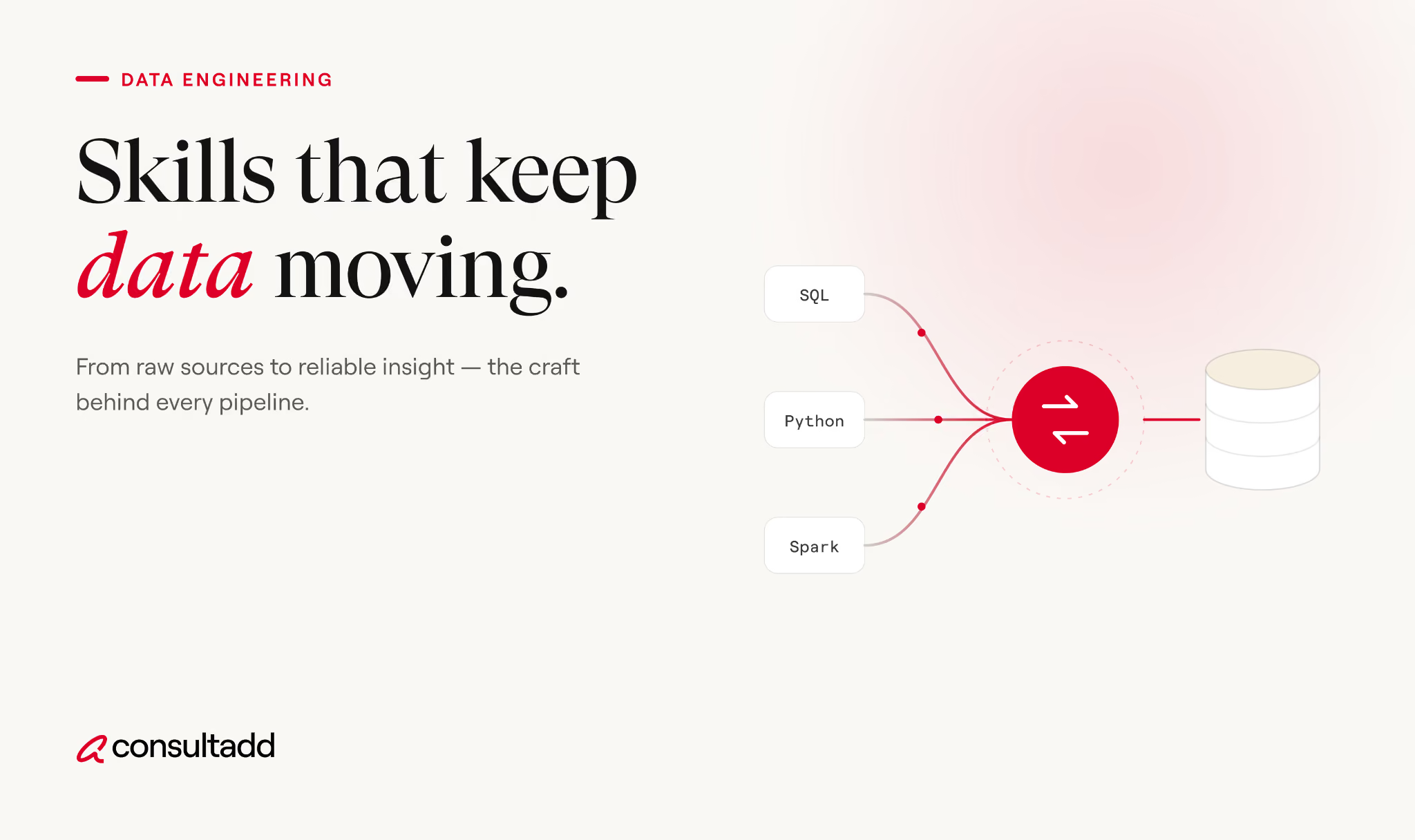
These are the data engineer technical skills that show up again and again in postings. You don't need all of them on day one, but you need a plan for each.
1. SQL and data modeling
SQL for data engineers goes past basic SELECT statements. Expect to write window functions, CTEs, and joins across large tables, and to explain why a query is slow.
Data modeling sits right next to SQL. You should understand star schemas, fact and dimension tables, normalization, and when to break those rules for performance.
2. Python, and sometimes Scala or Java
Python is the default language for pipeline code, API integrations, and data transformations.
You'll use libraries like pandas and PySpark, and you'll be expected to write code that other people can read and maintain.
Scala and Java still appear in postings for teams with older Spark or Kafka setups. Treat them as a second language, not a starting point.
3. ETL and ELT pipeline design
ETL means extracting, transforming, then loading data. ELT loads raw data first and transforms it inside the warehouse, which has become common with tools like dbt and Snowflake.
Interviewers care less about the acronym and more about your judgment.
Can you handle late-arriving data? What happens if a job runs twice? How do you backfill three months of history without breaking reports?
4. Cloud platforms and data warehouses
Most data work now runs on AWS, Azure, or Google Cloud. You should know at least one well: storage (S3, ADLS, or GCS), compute, permissions, and the main data services.
On the warehouse side, Snowflake, BigQuery, Redshift, and Databricks are the names you'll see most often. Pick one and build something real on it.
5. Orchestration and workflow tools
Pipelines need scheduling, retries, and dependency management. Apache Airflow is the most common orchestration tool in postings, with Prefect, Dagster, and cloud-native options like AWS Step Functions also showing up.
6. Big data and streaming
Apache Spark handles large batch workloads. Kafka and similar tools handle streaming data.
Plenty of teams don't need real-time pipelines at all, so learn the concepts first and go deep only if your target roles ask for it.
7. Data quality, testing, and governance
This is the skill learners skip and interviewers ask about. Know how to write data tests, set up alerts for null spikes or row count drops, and track lineage.
Basic security matters too: encryption, access control, and handling sensitive fields.
Data engineer soft skills that come up in interviews
Recruiters screening data engineering candidates often hear the same complaint from hiring managers: the candidate was technically strong but couldn't explain their own project. That's usually the end of the process.
The data engineer soft skills that matter most are practical ones:
- Explaining technical tradeoffs to analysts, product managers, and business stakeholders who don't care about partitioning strategies.
- Writing documentation that lets someone else run your pipeline when you're on vacation.
- Debugging calmly. When a dashboard shows wrong numbers before a board meeting, people watch how you work.
- Asking about the business. Knowing why a metric exists helps you build the right pipeline instead of the requested one.
None of these show up neatly on a resume. They show up in how you talk about past work.
Skills required for data engineer roles at each level
The skills required for data engineer roles shift as you move up. Junior roles test fundamentals. Senior roles test judgment.
Here's a real example of what a mid-level posting looks like:
Consultadd's own opening for a Data Engineer with 3 to 5 years of experience asks for strong Python and SQL, experience on AWS, Azure, or GCP, familiarity with orchestration tools like Airflow or Prefect, and knowledge of warehouses such as Snowflake, Redshift, or BigQuery. That's a fairly standard mix for the level.
Data engineer certifications worth considering
Data engineer certifications won't replace experience, but they help when you're switching careers or when a client specifically asks for one.
Choose based on the cloud platform your target employers use.
The AWS exam guide is a useful checklist even if you never sit the exam.
It weights data ingestion and transformation at 34% of scored content, data store management at 26%, data operations and support at 22%, and data security and governance at 18%.
That split roughly mirrors how the job itself divides up.
One note for Azure candidates: Microsoft retired DP-203 and the Azure Data Engineer Associate credential on March 31, 2025, and replaced it with DP-700, which leads to the Fabric Data Engineer Associate credential.
Older guides still mention DP-203, so check before you start studying.
A practical data engineer roadmap for learning these skills
There's no single correct data engineer roadmap, but this order works for most people because each step builds on the one before it.
- Get solid at SQL. Practice on real datasets, not just tutorial tables. Aim to write window functions without looking them up.
- Learn Python for data work. Focus on reading files, calling APIs, transforming data, and writing simple tests.
- Study data modeling. Build a small star schema from a public dataset.
- Pick one cloud platform. Set up storage, load data, and query it in that platform's warehouse.
- Build an end-to-end pipeline. Pull data from an API, land it in cloud storage, transform it, and load it into a warehouse.
- Add orchestration and tests. Schedule the pipeline in Airflow and add data quality checks.
- Branch out. Try Spark, streaming, or dbt depending on what your target roles ask for.
Steps one through five can take a few months for someone with an analytics background. Career changers starting from scratch usually need longer, and that's fine.
How to prove your data engineering skills to recruiters
Listing tools on a resume tells a recruiter almost nothing. Showing what you built with them does.
A strong data engineering resume bullet names the tools, the scale, and the outcome. "Built a Python and Airflow pipeline that loads 2 million daily rows into Snowflake, cutting report refresh time from 6 hours to 40 minutes" beats "Experienced with Python, Airflow, and Snowflake" every time.
A few other things that help:
- A public GitHub repo with one well-documented pipeline project, including a README that explains your design choices.
- A short write-up of a problem you hit and how you fixed it.
- Contract or contract-to-hire roles, which can get production experience on your resume faster than waiting for the perfect full-time offer.
Our guide on key IT skills employers want and how to prove you have them goes deeper on resume framing across tech roles.
For a look at what happens once your resume gets through, see how recruiters approach technical interview screening.
Where demand for data engineering skills stands
The Bureau of Labor Statistics doesn't track "data engineer" as its own occupation, so the closest official comparison is database architects.
BLS reported a median annual wage of $139,500 for database architects in May 2025, with employment in that occupation projected to grow 9% over the decade.
You can review the full figures in the BLS Occupational Outlook Handbook for database administrators and architects. Data engineering also feeds into AI work.
Many people move from data engineering into machine learning roles once they have production experience, which our AI/ML engineer jobs guide covers in detail.
For the wider hiring picture, see our breakdown of IT staffing trends and what's changing in tech hiring.
Building your data engineer skills, one layer at a time
The data engineer skills employers screen for aren't a secret. SQL and Python come first, then a cloud platform, then pipelines with orchestration and tests on top.
What separates candidates is proof: a project that works, a resume that shows scale, and the ability to explain your choices in plain language.
If you're starting today, open a public dataset and write ten SQL queries against it this week. The rest builds from there.
Start Strong With Consultadd
With 15 years in business and 5,000+ successful staffing engagements, we don't just fill roles, we build reliability into your process. We've supported 65 staffing companies in the past year alone and maintain MSAs with industry leaders like Robert Half and TEKsystems.
Here's what working with Consultadd looks like:
- Talent sourced in under 24 hours
- Ready-to-deploy candidates, vetted for experience and compliance
- Lower turnover risk: we match long-term goals, not just short-term needs
- Seamless compliance: visa, documentation, onboarding? Handled.
- Dedicated 1:1 account managers for responsive, personalized support
- Top 100 candidate matches delivered in the past year
- Strong partnerships with universities to tap into fresh, committed talent
- Post-placement support so your investment grows beyond day one
For candidates, your next opportunity is more than just a job title, it's a chance to build skills, gain experience, and move your career forward. At Consultadd, we connect technology professionals with projects and employers that align with their goals, whether they're looking for contract, contract-to-hire, or long-term opportunities.
The tech job market moves fast, but the right guidance can make all the difference. Ready to take the next step in your career journey? Explore Opportunities >>
Key takeaways
- SQL, Python, and one cloud platform form the base that nearly every data engineering role expects.
- Mid-level roles add orchestration, warehouse design, and ownership of data quality.
- Pick certifications based on the platform your target employers actually use.
- One documented, end-to-end pipeline project tells recruiters more than a long list of tools.
- Clear communication about your work often decides interviews between technically similar candidates.
FAQs
What skills does a data engineer need?
A data engineer needs strong SQL, Python, data modeling, and hands-on experience with at least one cloud platform. Most roles also expect knowledge of ETL or ELT pipelines, a data warehouse like Snowflake or BigQuery, and an orchestration tool such as Airflow. Communication and documentation skills matter in almost every interview.
Is SQL enough to become a data engineer?
SQL alone usually isn't enough, though it's the most important starting point. Employers also expect Python for pipeline code and some cloud experience. Analysts with strong SQL often make the move by adding Python and one cloud platform.
Do data engineers need to know how to code?
Yes. Data engineers write code every day, mostly in SQL and Python. The coding is usually focused on moving and transforming data rather than building applications, but it still needs to be clean, tested, and maintainable.
How long does it take to learn data engineering skills?
It depends on your starting point. Someone with an analytics or software background can often build job-ready skills in several months of focused practice. Career changers starting from zero typically need longer, especially to build a portfolio project.
Which certification is best for data engineers?
The best certification is the one that matches the cloud platform your target employers use. AWS, Google Cloud, Microsoft Fabric, and Databricks all offer data engineering certifications. A certification helps most when paired with a real project on the same platform.
Can a data analyst become a data engineer?
Yes, and it's one of the most common paths into the field. Analysts already know SQL and understand how data gets used. Adding Python, pipeline design, and cloud skills usually closes most of the gap.




.png)