


Introduction
Are staffing agencies worth it? If you have ever watched a job request sit open for two months while your team quietly picks up the slack, you have probably asked yourself exactly that.
The honest answer is that it depends on the role, your timeline, and what the delay is actually costing you.
Sometimes an agency is the smartest money you will spend all quarter. Other times you are better off hiring in-house and keeping the fee in your pocket.
This guide skips the sales pitch. We will walk through what agencies really charge, what a slow or bad hire costs you, and how to tell which of those two situations you are actually in, with real numbers behind every claim. By the end, you should be able to make the call for your own team instead of guessing.
TL;DR
- Agencies charge a real fee, roughly 15% to 30% of first-year salary for a direct hire or a 25% to 75% markup on contract pay. The whole question is whether that fee buys enough speed and quality to pay for itself.
- For hard-to-fill tech roles, it usually does. More than 1.2 million tech jobs sit unfilled in the U.S., and the average technical role takes around 66 days to fill on your own.
- A bad hire is the cost nobody budgets for. The U.S. Department of Labor puts it at about 30% of first-year pay, and SHRM says replacing someone can run one-half to two times their salary.
- Most of a contract markup is not agency profit. Payroll taxes, insurance, and benefits eat up 60% to 85% of the bill rate; the agency's net margin usually lands around 3% to 8%.
- Agencies earn their fee when speed, niche skills, or flexible headcount matter. They are harder to justify for stable, easy-to-fill roles you can source yourself.
What does a staffing agency actually do?
A staffing agency finds qualified candidates, screens them, and presents the best talent for your hiring needs. For contract and temporary roles, it also acts as the legal employer of record, handling payroll, tax withholding, workers' compensation, and compliance, reducing the administrative burden on employers.
Key benefits include:
- Finding and screening qualified candidates
- Managing payroll and compliance for contract workers
- Reducing hiring time and administrative effort
The U.S. staffing industry generated around $184 billion in 2024, connecting 11 million people with work, with nearly 2.2 million temporary and contract workers on assignment in an average week. Hiring through a staffing agency means tapping into an established talent pipeline that operates at national scale.
If you want to see how a well-run engagement should look on your side of the table, our guide to IT staffing done right breaks down the practices that separate good partners from bad ones.
The real question behind "are staffing agencies worth it?
Here is the trap most hiring managers fall into. The agency fee is a big, visible number sitting on an invoice, so it feels like the cost.
The far larger cost, the one that never shows up on any invoice, is the role staying empty or getting filled by the wrong person. Nobody sends you a bill for a missed product deadline or a project that stalled because a seat sat empty for a quarter.
So the question is not really "is the fee expensive?"
It obviously is, in absolute terms. The better question is whether the fee is smaller than what the vacancy or the mis-hire would have cost you. To answer that, you need both numbers on the table. Let's put them there.
What staffing agencies actually cost
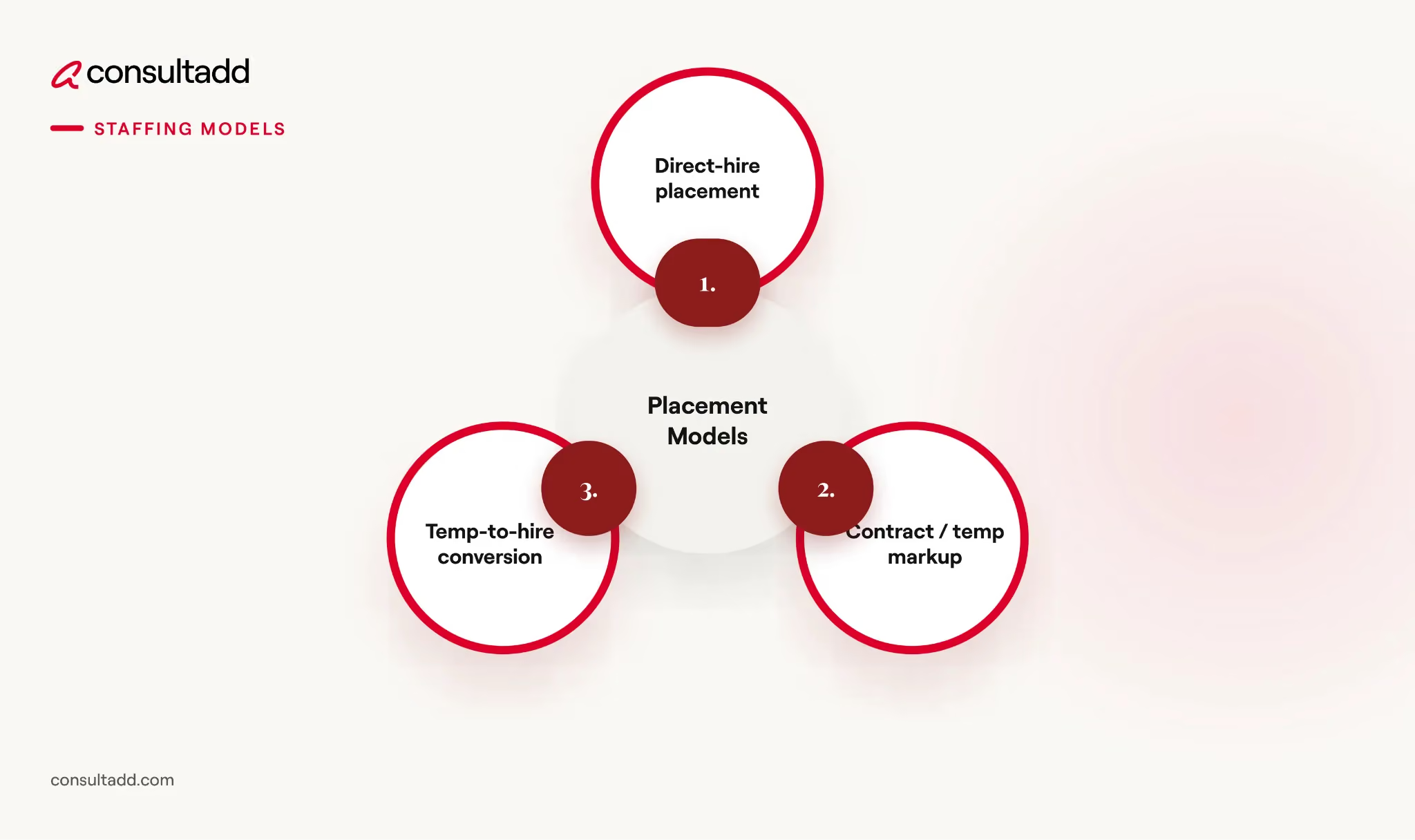
There are three fee structures you will run into, and they behave very differently. A direct-hire fee is a one-time charge when the person starts. A contract markup is an ongoing rate added to every hour worked. A conversion fee applies when you decide to bring a contractor on permanently.
Cost is often one of the first factors businesses consider when deciding whether to work with a staffing agency, but there isn't a single pricing model that fits every hiring scenario.
The amount you pay depends largely on the type of role you're filling and the hiring arrangement that best suits your business needs.
Whether you're recruiting a permanent employee, hiring contract talent for a short-term project, or evaluating a candidate through a temp-to-hire arrangement, each model has its own fee structure, advantages, and trade-offs.
Understanding how these pricing models work can help you compare agencies more effectively, budget accurately, and choose a solution that delivers the best return on your hiring investment rather than simply the lowest upfront cost.
Here is roughly what each one looks like:
One thing worth clearing up, because it is where a lot of the "agencies are a rip-off" feeling comes from. When you see a $50/hour contractor billed to you at $80/hour, that $30 gap is not profit.
According to KORE1's breakdown, the employer costs you would pay anyway, things like FICA, unemployment tax, workers' comp, and benefits, make up 60% to 85% of the bill rate.
After recruiting, screening, and account management come out, the agency's actual net margin usually sits around 3% to 8%. You are mostly paying the true cost of employing someone, plus a modest fee for finding and carrying them.
The cost of getting the hire wrong
It is easy to focus on staffing fees because they are visible and appear directly in your hiring budget. The costs of a poor hiring decision, however, are often much larger and far less obvious.
Every vacant role can slow projects, reduce team productivity, and place additional pressure on existing employees, while a bad hire can lead to onboarding expenses, lost time, lower morale, and the need to restart the recruitment process.
When viewed from this broader perspective, hiring becomes less about minimizing recruitment costs and more about minimizing business risk. The benchmarks below highlight why making the right hiring decision the first time is often far more valuable than simply choosing the least expensive hiring option.
Why the tech talent shortage changes the math
For general or high-volume roles, you can often self-source and skip the fee. Tech is a different animal, and this is where the case for an agency gets much stronger. The talent simply is not sitting there waiting for your job post.
Globally, ManpowerGroup's 2026 survey found that 72% of employers are struggling to fill open roles, with technology and cybersecurity among the hardest-hit fields (the cybersecurity workforce gap alone is around 4.8 million people). In the U.S. specifically, 87% of tech leaders report trouble finding skilled workers and 95% say it is harder now than three years ago.
Those open roles do not fill themselves quickly. Technical positions take roughly 66 days to fill, about 50% longer than non-technical jobs, and the U.S. Bureau of Labor Statistics projects around 1.4 million unfilled computing jobs by 2027.
Every one of those 66 days is a day your roadmap slips. A good tech-focused agency already has vetted specialists in its network, which is the whole point: you are buying back weeks you would otherwise lose to sourcing. If you want the full picture of why this shortage keeps getting worse, we dug into the key drivers of the tech talent shortage separately.
In-house hiring vs a staffing agency
Neither option wins every time. It comes down to how urgent, specialized, and permanent the role is, plus how much recruiting muscle you already have in-house. Here is a side-by-side to make the trade-offs concrete.
If you are hiring for one stable, easy-to-source role and you have a recruiter with time on their hands, doing it yourself often makes sense. If you need three engineers for a six-month migration, or a security specialist you cannot find on your own, the agency route usually wins.
For the roles you do choose to run internally, our checklist on what to look for when hiring software developers will help you avoid the expensive mistakes.
So, are staffing agencies worth it?
The answer is yes in many situations, but not in every one. Whether an IT staffing agency is worth the investment depends on the type of role you're hiring for, how quickly you need to fill it, and the resources your organization already has.
Looking only at the placement fee can make staffing services seem expensive. However, when you consider the hidden costs of prolonged vacancies, missed project deadlines, lost productivity, and poor hiring decisions, the equation often changes dramatically.
For most technology roles today, the challenge is not simply finding candidates but finding the right candidates before your competitors do. Skilled software developers, cloud engineers, cybersecurity professionals, data scientists, DevOps specialists, and AI experts are in high demand, and many are off the market within days of beginning their job search.
Every additional week spent sourcing resumes, coordinating interviews, and restarting unsuccessful hiring cycles represents time your business cannot recover. In these situations, the value of an experienced staffing partner extends well beyond introducing resumes. They bring established talent networks, market insights, technical screening expertise, and the ability to significantly reduce hiring timelines.
Staffing agencies are particularly valuable when hiring for specialized or difficult-to-fill positions, when project deadlines leave little room for lengthy recruitment cycles, or when your workforce needs to scale quickly to meet changing business demands.
They also provide flexibility during periods of rapid growth, seasonal hiring, product launches, digital transformation initiatives, or contract-based projects where permanent hiring may not be the best solution.
In these scenarios, the placement fee is often outweighed by the savings generated through faster hiring, stronger candidate quality, and reduced business disruption.
That said, staffing agencies are not the right solution for every hiring need. If you're recruiting for roles that consistently attract a large number of qualified applicants, have well-established internal recruiting capabilities, and can comfortably manage sourcing, screening, and interviewing without delaying business operations, the additional cost of an external staffing partner may not provide enough incremental value.
In those cases, your internal recruitment team may be fully capable of delivering successful hires while keeping costs lower.
The key is to view staffing agencies as a strategic business tool rather than a default hiring expense. Like any business investment, their value depends on how and when they are used.
Choosing to partner with an agency simply because one is available can lead to unnecessary spending. Choosing one because it solves a genuine hiring challenge can significantly improve recruitment outcomes, strengthen your workforce, and accelerate business growth.
Ultimately, the benefits of working with an IT staffing agency are real, but they should be valuated in the context of your hiring goals, budget, timeline, and internal capabilities. When the cost of leaving a position vacant or making the wrong hire exceeds the agency's fee, partnering with the right staffing firm is often one of the smartest investments an organization can make.
The most successful companies are not necessarily the ones that always hire internally or always outsource recruitment. They are the ones that understand when each approach makes the most business sense and choose the strategy that delivers the greatest long-term value.
Start Strong With Consultadd
With 15 years in business and 5,000+ successful staffing engagements, we don't just fill roles, we build reliability into your process. We've supported 65 staffing companies in the past year alone and maintain MSAs with industry leaders like Robert Half and TEKsystems.
Here's what working with Consultadd looks like:
- Talent sourced in under 24 hours
- Ready-to-deploy candidates, vetted for experience and compliance
- Lower turnover risk: we match long-term goals, not just short-term needs
- Seamless compliance: visa, documentation, onboarding? Handled.
- Dedicated 1:1 account managers for responsive, personalized support
- Top 100 candidate matches delivered in the past year
- Strong partnerships with universities to tap into fresh, committed talent
- Post-placement support so your investment grows beyond day one
For candidates, your next opportunity is more than just a job title, it's a chance to build skills, gain experience, and move your career forward. At Consultadd, we connect technology professionals with projects and employers that align with their goals, whether they're looking for contract, contract-to-hire, or long-term opportunities.
The tech job market moves fast, but the right guidance can make all the difference. Ready to take the next step in your career journey? Explore Opportunities >>
Key takeaways
- The fee is not the real cost. Compare it against the cost of an empty seat or a bad hire, not against zero.
- A bad hire runs at least 30% of first-year pay, and replacement can hit two times salary, which often dwarfs a placement fee.
- Most of a contract markup covers real employer costs; the agency's net margin is usually just 3% to 8%.
- In tech, speed is everything. With 1.2 million-plus unfilled roles and ~66-day fill times, an agency's ready pipeline buys back weeks.
- Use an agency for specialized, urgent, or flexible roles. Handle stable, easy-to-source roles in-house when you have the capacity.
FAQs
How much does a staffing agency cost?
For a permanent placement, expect 15% to 30% of the hire's first-year salary. For contract workers, expect a 25% to 75% markup on their hourly pay, which in IT usually lands between 35% and 50%. Converting a contractor to a full-time employee typically adds an 11% to 21% conversion fee.
Isn't the markup just pure profit for the agency?
No, and this is the biggest misconception. Employer costs like payroll taxes, insurance, and benefits account for 60% to 85% of the bill rate. After recruiting and overhead, the agency's net margin is usually only 3% to 8%.
Are staffing agencies worth it for small businesses?
Often yes, because a small team feels a bad hire harder. With SHRM pegging replacement cost at half to two times salary, a smaller company has less margin to absorb the mistake, so the vetting an agency provides can be more valuable, not less.
How much faster is hiring through an agency?
It varies, but the gap is real. Technical roles take around 66 days to fill on your own, and a good agency shortens that by starting with candidates it has already sourced and screened, rather than building a pipeline from scratch after you post the job.
When is a staffing agency not worth it?
When the role is permanent, easy to fill, and central to your operations, and you have the internal recruiting capacity to source well. In that case a one-time markup buys you work you could have done yourself, so hiring in-house is usually the cheaper long-term call.



.webp)
.png)
