


Introduction
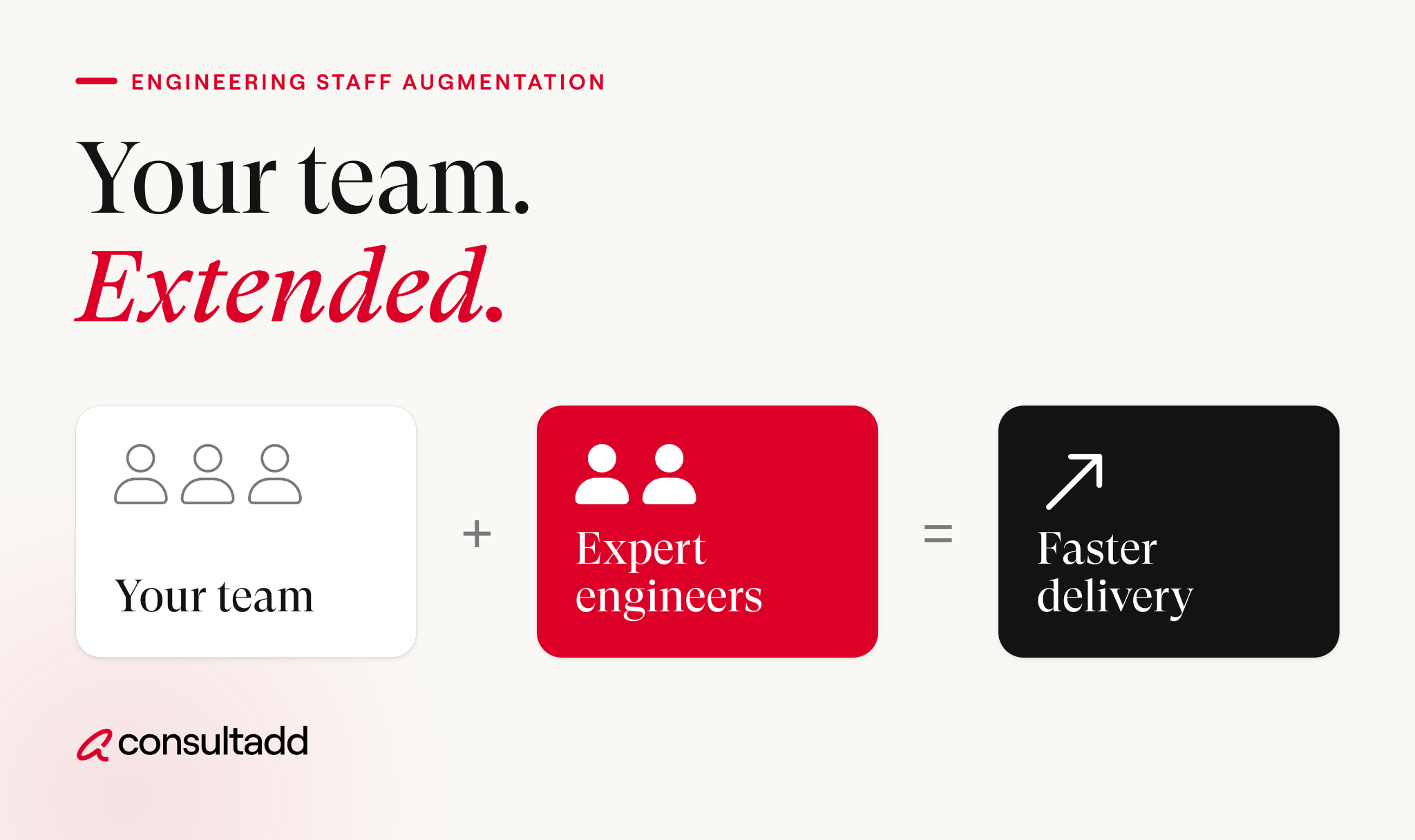
Engineering staff augmentation means adding contract engineers, such as developers, QA automation engineers, DevOps engineers, or data engineers, to your existing engineering team through a staffing partner.
They work in your repositories, follow your sprint process, and report to your engineering managers, while the partner acts as their employer of record. Teams use it to add capacity or a missing skill without adding permanent headcount.
Getting engineers in the door is the easy part. This guide covers what engineering leaders have to get right after that: which roles to augment, how to size the engagement, how to onboard, how to handle access and IP, how to measure results, and how to roll off cleanly.
TL;DR
- Engineering staff augmentation adds contract engineers to your team under your direction, while a staffing partner handles employment and compliance.
- Augment roles with a defined backlog or a clear skill gap, and keep architecture, security ownership, and people management in-house.
- Keep augmented engineers a minority on any one team so your reviewers and leads aren't overwhelmed.
- Have accounts, a dev environment, and a starter ticket ready before day one, and aim for a first merged pull request in week one.
- Measure delivery at the team level, plan knowledge transfer before the contract ends, and revoke access the same day it does.
What engineering staff augmentation looks like day to day
From the outside, an augmented engineer looks like any other member of the team. They pick up tickets from your backlog, open pull requests in your repositories, join stand-ups, and get code reviewed by your engineers.
The difference is contractual: they're employed and paid by the staffing partner, and you pay the partner an hourly rate.
That supervision line matters.
The Virginia Information Technologies Agency's guide on choosing staff augmentation or a statement of work puts it simply: under staff augmentation, the customer's own manager supervises the contract resources and pays for hours worked.
If you want a vendor to own a deliverable and manage its own people, that's a different model.
If you're still deciding between models, our comparison of managed services vs staff augmentation covers cost, control, and risk.
For the basics of the model itself, see our practical breakdown of what staff augmentation is.
Which engineering roles to augment, and which to keep in-house
Not every seat on an engineering team suits a contractor. The useful question is whether the role depends on long-term context and authority, or on skills applied to well-defined work.
A common pattern: a team keeps its tech lead and two or three senior employees, and adds contract engineers for a migration, a new product surface, or a backlog that has grown past what the team can clear.
How to size an engineering staff augmentation engagement
The biggest sizing mistake is adding more engineers than your team can absorb. Every augmented engineer needs code reviews, answers, and context from someone in-house.
If your two senior engineers spend half their week reviewing contractor pull requests, your own roadmap slows down.
A practical guideline is to keep augmented engineers a minority on any single team, and to give each one a named in-house reviewer with time set aside for it. If you need more people than that, consider splitting the work into a separate team with its own in-house lead.
Here's how that plays out in a few typical situations. These are illustrations, not fixed rules.
Contract length also affects who you can attract. In our experience placing contract engineers, longer engagements tend to draw more senior candidates than very short ones.
If the role might become permanent, a contract-to-hire setup gives you the option to convert.
Onboarding augmented engineers: the first two weeks
Most wasted contract hours happen in the first two weeks, usually because accounts and environments aren't ready. Treat onboarding as a checklist that starts before day one.
The goal of a first merged pull request in week one isn't speed for its own sake. It proves the environment, access, and review process all work, and it surfaces problems while they're cheap to fix.
Write down your working agreements too: branching strategy, code review expectations, definition of done, meeting norms, and how on-call works if it applies.
Contract engineers can't absorb unwritten rules the way long-tenured staff do.
Security, access, and IP
Augmented engineers often need access to production-adjacent systems, so treat access as carefully as you would for an employee, with a few extra steps.
- Grant the minimum access needed. NIST's definition of least privilege is the right default: give each user only the access their tasks require. Start narrow and expand as the work requires.
- Use individual, company-issued accounts with multi-factor authentication. Shared logins make it impossible to audit who did what.
- Keep work on company systems. Code, credentials, and data should stay in your repositories and approved tools, not on personal devices or accounts.
- Confirm IP assignment in writing. Your agreement with the staffing partner should state that work product belongs to you, and the partner's agreement with the engineer should assign rights to the partner so they can pass them on. Ask to see that clause.
- Revoke access on the last day. Build the offboarding checklist when you onboard, not when the contract ends.
If your augmented engineers work remotely or across state lines, there are extra employment and compliance points to plan for. Our guide to remote IT staffing services covers them.
How to measure whether it's working
Measure the team, not individual contractors in isolation. DORA's guide to the four key software delivery metrics, change lead time, deployment frequency, change failure rate, and failed deployment recovery time, is a solid starting point.
DORA also cautions against turning those metrics into goals, which applies doubly if you're tempted to rank individual engineers by them.
Pair the team-level view with a few signals specific to augmentation.
Check in with the staffing partner monthly. A good partner wants to hear about problems early, while there's still time to adjust or replace someone.
Planning the roll-off
The end of an engagement is where knowledge gets lost. Start planning at least two weeks before the contract ends.
- Ask the engineer to update documentation and runbooks for anything they built or changed.
- Pair them with the in-house engineer who will own the work, and have that person handle the last few tickets while the contractor reviews.
- Record short walkthroughs of complex areas.
- Close or reassign open pull requests and tickets.
- Revoke access, collect equipment, and confirm the end date with the partner.
If the engineer did strong work and the role continues, ask your partner about conversion terms before the end date, not after.
Common engineering staff augmentation mistakes
Adding engineers without adding review capacity. More pull requests with the same number of reviewers just moves the bottleneck.
Augmenting roles that should stay permanent. Contract architects and contract security owners leave gaps when they go.
Hiring on skills alone. Communication and comfort with your team's way of working matter as much as framework experience.
Our guide to screening AWS developers for hire shows how to test both.
Skipping onboarding prep. Two weeks of a contractor waiting for access is two weeks of paid time with nothing shipped.
Treating contractors as outsiders. Engineers left out of planning and retros can't make good decisions about the code they write.
Choosing a partner on rate alone. Screening depth, replacement terms, and responsiveness matter more over a six-month engagement.
Our guide to choosing an IT staffing agency covers what to compare.
Making engineering staff augmentation work
Engineering staff augmentation works when you treat it as an engineering management problem, not only a hiring one.
Pick roles with defined work, keep long-term ownership with employees, size the engagement to your review capacity, prepare onboarding before day one, lock down access and IP, measure at the team level, and plan the roll-off early.
Teams that do this get the capacity they paid for. Teams that skip it usually pay for engineers who spend weeks waiting.
Start Strong With Consultadd
With 15 years in business and 5,000+ successful staffing engagements, we don't just fill roles, we build reliability into your process. We've supported 65 staffing companies in the past year alone and maintain MSAs with industry leaders like Robert Half and TEKsystems.
Here's what working with Consultadd looks like:
- Talent sourced in under 24 hours
- Ready-to-deploy candidates, vetted for experience and compliance
- Lower turnover risk: we match long-term goals, not just short-term needs
- Seamless compliance: visa, documentation, onboarding? Handled.
- Dedicated 1:1 account managers for responsive, personalized support
- Top 100 candidate matches delivered in the past year
- Strong partnerships with universities to tap into fresh, committed talent
- Post-placement support so your investment grows beyond day one
For candidates, your next opportunity is more than just a job title, it's a chance to build skills, gain experience, and move your career forward. At Consultadd, we connect technology professionals with projects and employers that align with their goals, whether they're looking for contract, contract-to-hire, or long-term opportunities.
The tech job market moves fast, but the right guidance can make all the difference. Ready to take the next step in your career journey? Explore Opportunities >>
Key takeaways
- Engineering staff augmentation puts contract engineers inside your team, under your managers, with a partner handling employment.
- Augment well-defined work like feature development, QA automation, and migrations, and keep architecture, security, and management in-house.
- Size the engagement to your in-house review capacity, not just to the size of the backlog.
- A prepared onboarding plan and a first merged pull request in week one prevent most wasted contract hours.
- Least-privilege access, written IP assignment, team-level metrics, and a planned roll-off protect your code and your knowledge.
FAQs
What is engineering staff augmentation?
It's the practice of adding contract engineers to your existing engineering team through a staffing partner. The engineers work under your managers and in your codebase, while the partner employs them and handles payroll and compliance.
How long does it take to onboard an augmented engineer?
With accounts, environments, and a starter ticket ready before day one, most engineers can merge a small pull request in their first week. Full productivity on complex parts of a codebase usually takes longer and depends on documentation quality and system complexity.
Who owns the code written by augmented engineers?
You should, but only if the contracts say so. Make sure your agreement with the staffing partner assigns work product to you, and that the partner's agreement with each engineer assigns rights to the partner first.
How much does engineering staff augmentation cost?
You pay the staffing partner an hourly bill rate, which varies by skill, seniority, location, and engagement length. When comparing it to direct hiring, include recruiting time, benefits, and the cost of carrying permanent headcount after the project ends.
Can augmented engineers work remotely?
Yes, many do. Remote and cross-state arrangements add compliance considerations for the staffing partner and time-zone planning for your team, so settle working hours and overlap expectations before the engagement starts.
Can you hire an augmented engineer permanently?
Usually, yes, under the conversion terms in your agreement with the staffing partner. Check whether a conversion fee applies and when it drops or expires, and raise conversion before the contract end date.
.webp)


.png)

.avif)