
.avif)

Introduction
You need help. Maybe it's a backend developer who can start next week, or maybe it's someone who can look at your whole tech stack and tell you what's broken.
Those are two different problems, and staff augmentation vs consulting is really a question about which one you're facing.
Staff augmentation gives you people who slot into your team and take direction from you. Consulting gives you a team that studies a problem and hands you a plan, or executes that plan on their own terms.
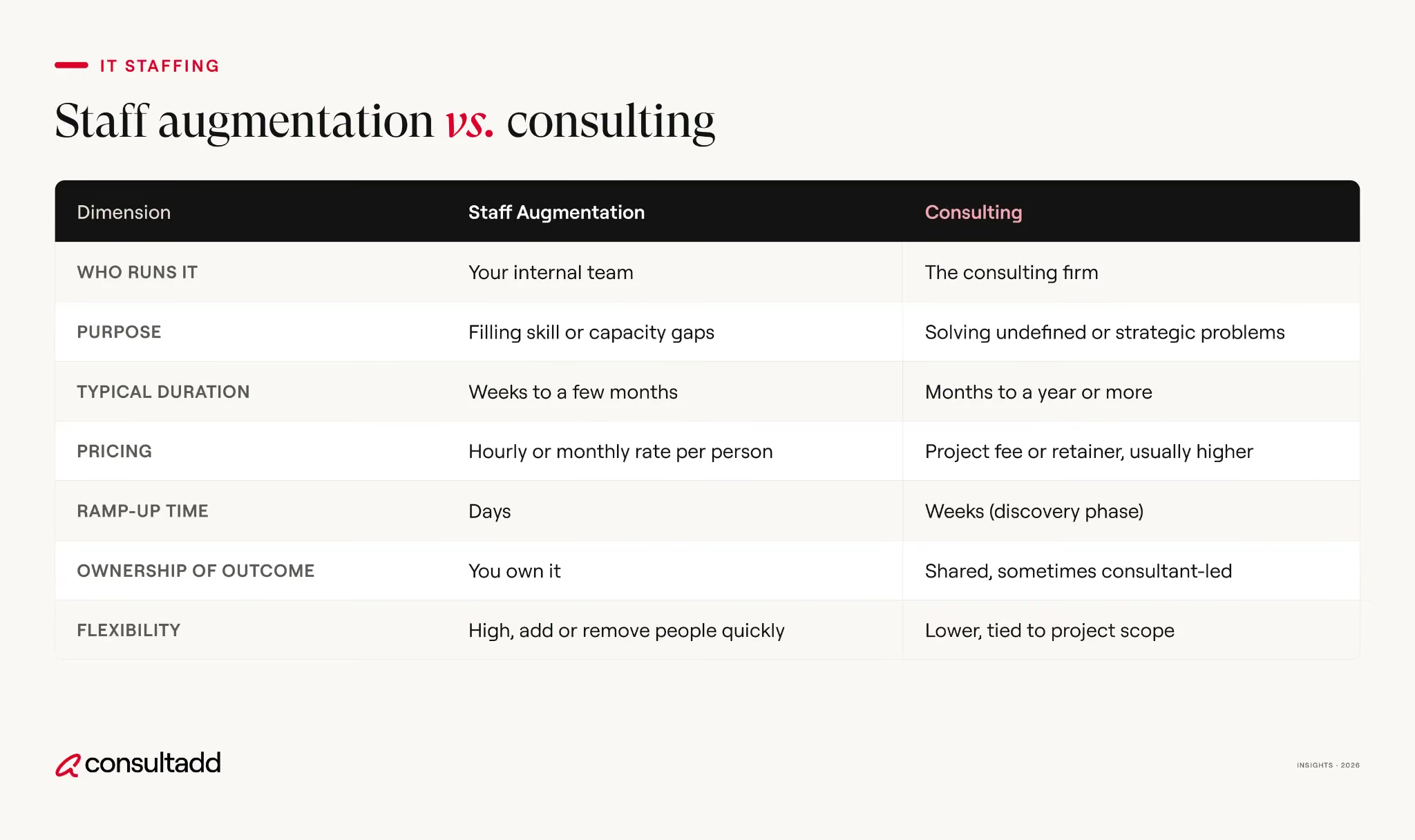
Mixing the two up is how companies end up paying consulting rates for what was really a staffing need, or hiring a contractor when what they actually needed was a strategy.
This guide breaks down how each model works, what they cost, and how to pick between them without guessing.
TL;DR
- Staff augmentation adds people to your existing team who work under your management; consulting brings in outside experts who often manage the work themselves.
- Staff augmentation usually costs less per hour but requires you to direct the work; consulting costs more but includes strategy and oversight.
- Staff augmentation fits short-term skill gaps and scaling; consulting fits complex problems where you don't have an internal answer yet.
- Compliance, visa handling, and onboarding speed vary a lot between staffing vendors, so vetting matters as much as the model you pick.
- Many companies use both at different points in the same project, not one or the other permanently.
What staff augmentation actually means
Staff augmentation is straightforward. A vendor supplies you with a person, or several people, who have a specific skill set.
- That person reports to your project lead, follows your processes, and works inside your existing team structure.
- You're not buying a solution. You're buying capacity. If you need three .NET developers for four months, staff augmentation gets you three .NET developers for four months, and you tell them what to build.
- This is common in software development, where a team knows what it's building but doesn't have enough hands to build it fast enough.
- It's also common when a specific skill, say, a Salesforce migration specialist, isn't something worth hiring full-time for.
What consulting actually means
Consulting works differently. A consulting firm doesn't just supply labor, it supplies judgment. You bring them a problem, sometimes a vague one, and they figure out what's actually wrong and what to do about it.
- A consultant might spend the first few weeks just interviewing your team and reviewing your systems before recommending anything.
- Once they do recommend something, they often stay involved to implement it, and they'll push back if they think you're making the wrong call.
- This model shows up when the problem itself is unclear. Should you rebuild your platform or patch it? Is your data pipeline the bottleneck or is it your reporting layer?
- Consultants are paid to answer questions like that, not just to write code against a spec you already have.
Staff augmentation vs consulting: side-by-side comparison
Cost differences worth understanding
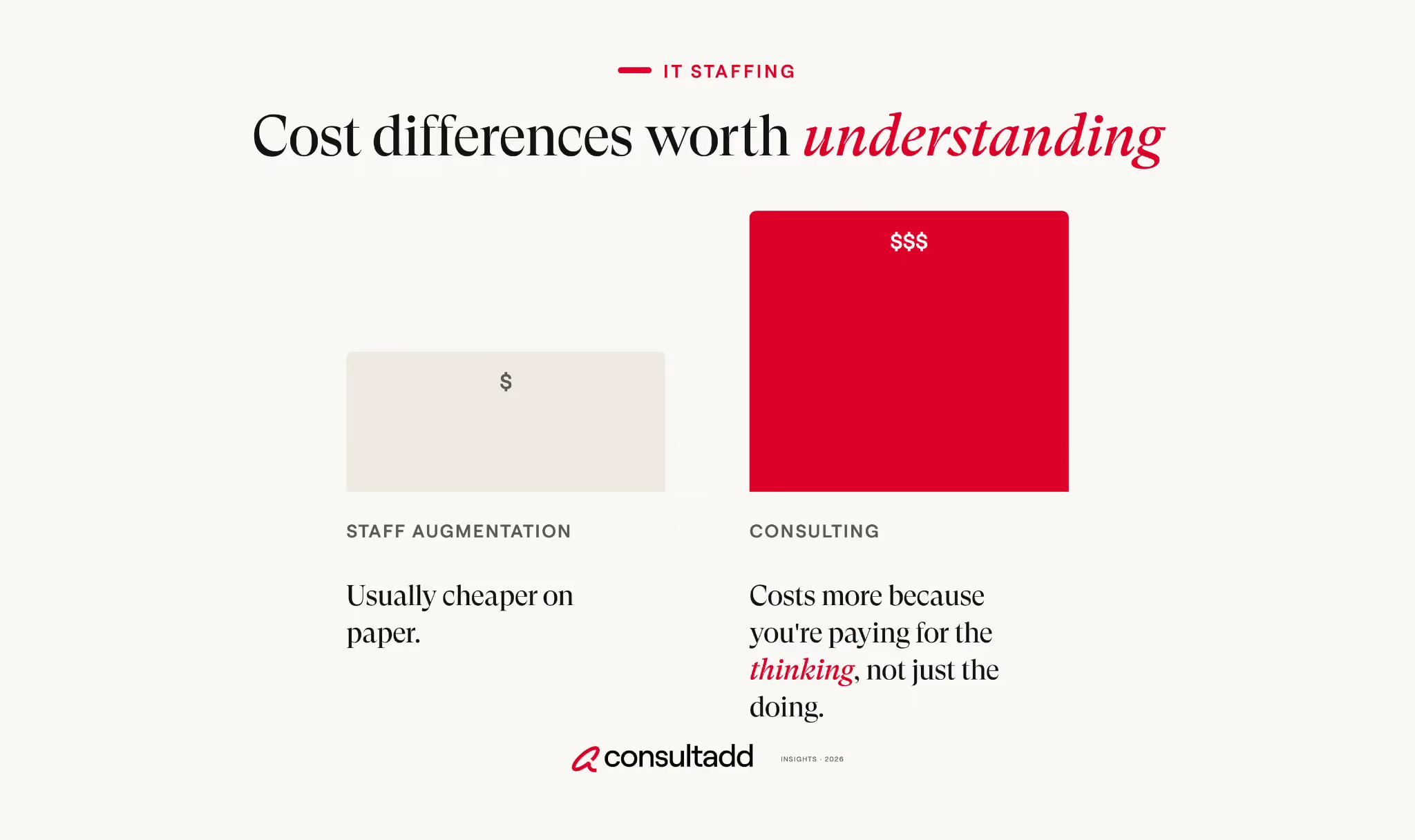
Staff augmentation is usually cheaper on paper. You're paying for a person's time, not for a firm's overhead, research phase, or account management layer.
A mid-level developer through a staffing vendor might run you a fraction of what a boutique consulting firm charges for a similar skill set, because you're absorbing the management cost yourself.
Consulting costs more because you're paying for the thinking, not just the doing. A consultant's rate includes the time they spend diagnosing your problem, the risk they take on by recommending a direction, and often a smaller team of specialists rather than one generalist.
Neither is automatically the better deal. If you already know exactly what needs to be built, paying consulting rates for that certainty is wasted money.
If you don't know what needs to be built, staff augmentation without direction just burns hours.
When staff augmentation makes sense
A few situations where this model tends to work well:
- Your roadmap is set and you just need more hands to execute it.
- You need a rare skill for a short window, like a specific cloud certification for a migration.
- You're scaling a team quickly and don't want the delay of full-time hiring.
- The budget is tight and you can manage the work internally without added oversight.
We've seen this play out often with staffing partners who fill a role in under 24 hours when a client's internal recruiting pipeline stalls mid-project. Speed matters more than strategy in those moments.
If this sounds like your situation, our guide on how to hire dedicated developers walks through what to check before signing with a vendor.
When consulting makes sense
Consulting tends to be the better fit when:
- You don't know why a system, process, or metric is underperforming.
- The decision affects multiple departments, not just engineering.
- You need an outside, unbiased view because internal opinions are split.
- The project requires specialized methodology, like a security audit or a compliance overhaul.
A quick decision checklist
Compliance and onboarding: the part people forget
Whichever model you pick, the onboarding process determines whether it actually works.
- A staffing vendor that can't handle visa documentation or background checks will slow you down no matter how fast they source candidates.
- The same applies to consulting firms that don't understand your industry's regulatory requirements.
Visa sponsorship and work authorization, for example, are governed by federal rules that neither model gets to skip.
If your staffing or consulting partner is hiring international talent, checking their process against USCIS guidance is worth the ten minutes it takes.
The U.S. Bureau of Labor Statistics also tracks employment services as a distinct industry category, which gives some sense of how large the staffing and support services sector has become.
Worldwide IT spending is projected to climb to $6.37 trillion in 2026, a 14.2% jump from the prior year, with IT services and infrastructure investment among the fastest-growing categories, according to Gartner's latest IT spending forecast.
That kind of spending growth means more companies are making the staff augmentation vs consulting decision right now, not later.
Can you use both?
Yes, and most mature companies do. A common pattern: bring in a consultant to define the strategy and architecture, then use staff augmentation to execute it at scale once the plan is clear.
This avoids paying consulting rates for repetitive execution work, while still getting expert direction where it matters.
If you're building out a new product line, you might start with a small consulting engagement to validate the technical approach, then pull in augmented staff to build the actual product against that validated plan.
If you're further along and just need to hire dedicated developers to keep pace with your existing roadmap, staff augmentation alone usually does the job.
Start Strong With Consultadd
With 15 years in business and 5,000+ successful staffing engagements, we don't just fill roles, we build reliability into your process. We've supported 65 staffing companies in the past year alone and maintain MSAs with industry leaders like Robert Half and TEKsystems.
Here's what working with Consultadd looks like:
- Talent sourced in under 24 hours
- Ready-to-deploy candidates, vetted for experience and compliance
- Lower turnover risk: we match long-term goals, not just short-term needs
- Seamless compliance: visa, documentation, onboarding? Handled.
- Dedicated 1:1 account managers for responsive, personalized support
- Top 100 candidate matches delivered in the past year
- Strong partnerships with universities to tap into fresh, committed talent
- Post-placement support so your investment grows beyond day one
For candidates, your next opportunity is more than just a job title, it's a chance to build skills, gain experience, and move your career forward. At Consultadd, we connect technology professionals with projects and employers that align with their goals, whether they're looking for contract, contract-to-hire, or long-term opportunities.
The tech job market moves fast, but the right guidance can make all the difference. Ready to take the next step in your career journey? Explore Opportunities >>
Key takeaways
- Staff augmentation vs consulting comes down to who directs the work: your team, or the outside firm.
- Staff augmentation costs less per hour but needs internal management; consulting costs more but includes strategic direction.
- Pick staff augmentation when the plan is set and you need capacity fast.
- Pick consulting when the problem itself is still unclear or spans multiple teams.
- The two models aren't mutually exclusive, and pairing them is common on larger projects.
FAQs
Is staff augmentation cheaper than consulting?
Usually, yes, on an hourly basis. You're paying for a person's time rather than a firm's strategic input, research phase, and account management. But if you lack the internal capacity to manage augmented staff effectively, the total cost can end up higher than expected.
Can a staffing vendor also provide consulting?
Some do, especially larger firms that offer both models. It's worth asking directly rather than assuming, since the skill sets and pricing structures for each service differ significantly.
How long does it take to onboard staff augmentation talent?
With a strong vendor, candidates can be sourced and ready within days, sometimes within 24 hours for common tech roles. Specialized or hard-to-find skills take longer regardless of the model.
Do consultants take over full ownership of a project?
It depends on the engagement. Some consulting arrangements are advisory only, where your team implements the recommendations. Others include implementation, where the consulting firm owns delivery until handoff.
What industries use staff augmentation the most?
Software development, IT infrastructure, and data engineering rely on it heavily because skill needs shift project to project.
Is staff augmentation the same as outsourcing?
Not quite. Outsourcing typically hands off an entire function or project to an external company that manages it independently. Staff augmentation keeps management and process control with you; only the personnel come from outside.




.webp)
