.avif)

Introduction
Analytical interview questions aren't trying to trip you up. They're trying to see how your brain actually works when a problem doesn't have an obvious answer.
Employers ask them for almost every role now, not just data or finance jobs, because the ability to break a messy situation into pieces and reason through it shows up in customer service, operations, engineering, and management just as much as it does in analytics.
The good news is these questions follow patterns. Once you know what an interviewer is actually listening for, and you have a simple structure for telling your answer, they get a lot less intimidating.
This guide breaks down the most common analytical interview questions, what a strong answer sounds like, and a framework you can reuse across almost any version of the question.
TL;DR
- Analytical interview questions test how you break down problems and reason through them, not whether you land on a "perfect" answer.
- Most fall into three types: past-experience questions, hypothetical scenarios, and quantitative or data-based questions.
- The STAR framework, Situation, Task, Action, Result, works well for turning a real example into a clear, structured answer.
- Interviewers care more about your process than your conclusion. Walking through your reasoning out loud matters more than getting to a flawless solution.
- Weak answers are vague and generic. Strong answers use a specific, real example with a measurable outcome.
What interviewers are actually testing
When someone asks an analytical question, they're rarely grading you against one right answer.
What they're watching for is whether you can take an ambiguous problem, identify what actually matters, and walk through a logical path toward a solution, even if the scenario is hypothetical or you don't have all the information.
This matters because it changes how you should prepare. Memorizing a "perfect" response to a specific question doesn't help much, because the interviewer will usually adjust the scenario anyway.
What helps is having a handful of real examples ready, and a structure for walking through your thinking clearly under pressure.
The three types of analytical questions
Past-experience questions.
- These ask you to describe a real situation: "Tell me about a time you had to solve a complex problem."
- They're looking for evidence from your actual work history, not a hypothetical.
Hypothetical scenario questions.
- These present a made-up situation and ask how you'd approach it: "How would you design a system that processes a million requests at once?"
- The specific answer matters less than the reasoning you show while getting there.
Quantitative or data-based questions.
- These involve numbers directly: "How would you evaluate whether a marketing campaign was successful?"
- These test comfort with data and metrics, not necessarily a finance or analyst background.
15 common analytical interview questions
- Tell me about a time you had to solve a complex problem with limited information.
- Walk me through how you'd troubleshoot a process that suddenly stopped working.
- Describe a decision you made that required weighing several conflicting priorities.
- How do you approach a problem when you don't immediately know the solution?
- Tell me about a time your initial analysis turned out to be wrong. What did you do next?
- How would you evaluate whether a new initiative was actually successful?
- Describe a time you had to make a decision quickly without all the data you wanted.
- How do you decide which sources of information to trust when researching a problem?
- Walk me through how you'd approach an unfamiliar problem outside your usual area of expertise.
- Tell me about a time you identified a pattern or trend that others had missed.
- How would you prioritize tasks when everything seems urgent at once?
- Describe a situation where you had to convince others using data or logical reasoning.
- How do you approach a problem that has more than one reasonable solution?
- Tell me about a time you used data to change a decision that had already been made.
- How would you estimate a number you don't have direct data for, like the number of piano tuners in a city?
A framework for structuring any answer
The STAR method, Situation, Task, Action, Result, gives you a consistent shape for answering the past-experience and scenario-based versions of these questions.
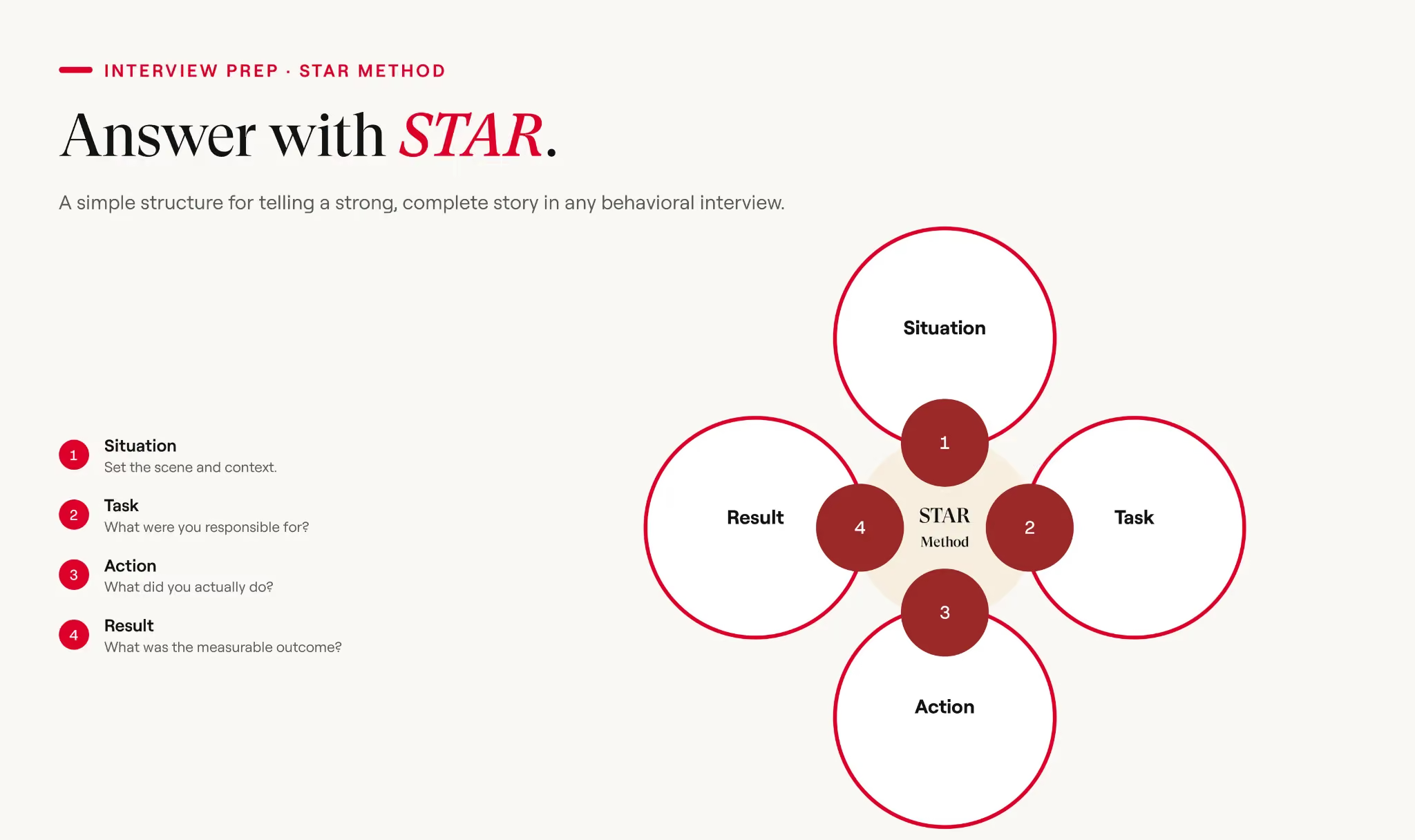
Most people naturally spend too much time on Situation and Task and not enough on Action, which is the part interviewers actually care about most. If you're only going to over-prepare one section, make it Action: the specific steps, not just the outcome.
For questions with no real past example to draw on, like the piano tuner estimate above, the same discipline applies without the story wrapper.
Say your assumptions out loud, walk through the math step by step, and don't apologize for the number being a rough estimate. Interviewers are grading the path, not the destination.
Sample answer: complex problem with limited information
Question: Tell me about a time you had to solve a complex problem with limited information.
Weak answer: "I'm pretty good under pressure. I once had a project where things weren't going well, but I figured it out and it worked out fine in the end."
Stronger answer: "In my last role, our team noticed a sudden drop in customer retention, but we didn't have clear data on why. I started by pulling whatever usage data we did have and segmenting it by customer type to see if the drop was concentrated anywhere specific. It turned out to be almost entirely in one plan tier. I interviewed a handful of customers in that segment directly, since the quantitative data alone didn't explain the cause, and found a recent pricing change had confused people about what was included. We clarified the messaging within two weeks, and retention in that segment recovered by about 80% of the original drop the following month."
The difference isn't confidence. It's specificity. The stronger answer names the actual steps, in order, and ends with a concrete result instead of a vague sense that things worked out.
Common mistakes that weaken analytical answers
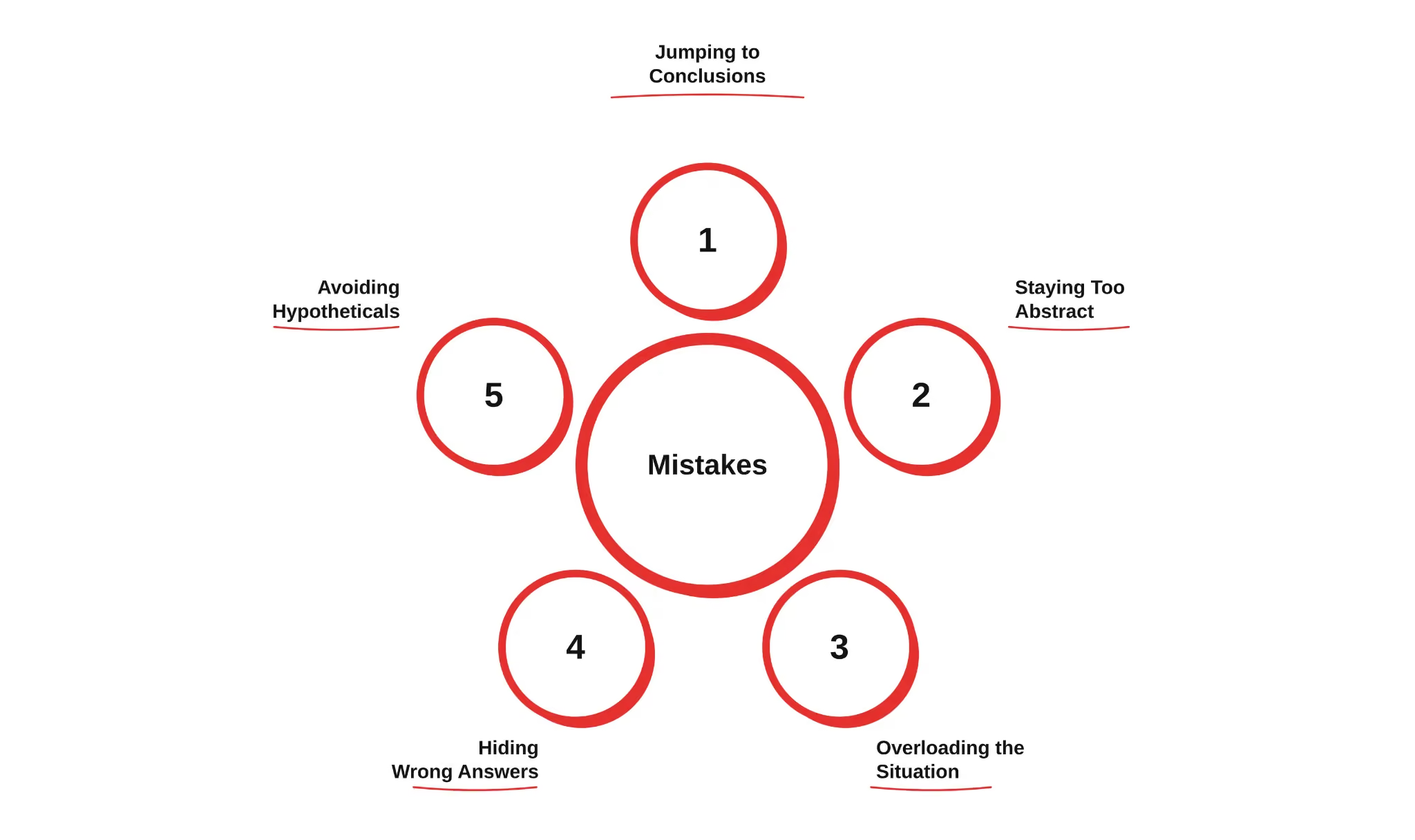
- Jumping straight to the conclusion. Interviewers want the reasoning path, not just the destination. Skipping straight to "and it worked" gives them nothing to evaluate.
- Staying too abstract. Answers that never name a specific project, number, or outcome are hard to distinguish from a rehearsed script.
- Overloading the Situation section. Spending most of your answer on background and rushing the actual steps you took reverses what the interviewer actually wants to hear.
- Treating a wrong initial answer as a failure to hide. If your first analysis turned out to be incomplete, saying so and explaining what you did next is usually a stronger answer than pretending you got it right the first time.
- Refusing to commit to hypothetical questions. With scenario questions, hedging endlessly instead of picking an approach and explaining your reasoning reads as avoidance, not caution.
Preparing before the interview
A little preparation goes a long way, since these questions reward specificity more than eloquence.
- Pull together four or five real examples from your work history that involved solving an ambiguous problem, ideally with a measurable result attached.
- Practice each one out loud using the STAR structure until the shape feels natural rather than memorized.
- For technical or quantitative roles, review basic estimation and back-of-envelope math, since scenario questions in those interviews often expect a rough calculation, not just a description.
- If you're prepping for a coding-heavy technical loop specifically, our step-by-step guide to coding interview prep covers the problem-solving side of that format in more depth.
- Review the general interview preparation basics as well, since analytical questions usually show up alongside standard behavioral ones rather than replacing them entirely.
Start Strong With Consultadd
With 15 years in business and 5,000+ successful staffing engagements, we don't just fill roles, we build reliability into your process. We've supported 65 staffing companies in the past year alone and maintain MSAs with industry leaders like Robert Half and TEKsystems.
Here's what working with Consultadd looks like:
- Talent sourced in under 24 hours
- Ready-to-deploy candidates, vetted for experience and compliance
- Lower turnover risk: we match long-term goals, not just short-term needs
- Seamless compliance: visa, documentation, onboarding? Handled.
- Dedicated 1:1 account managers for responsive, personalized support
- Top 100 candidate matches delivered in the past year
- Strong partnerships with universities to tap into fresh, committed talent
- Post-placement support so your investment grows beyond day one
For candidates, your next opportunity is more than just a job title, it's a chance to build skills, gain experience, and move your career forward. At Consultadd, we connect technology professionals with projects and employers that align with their goals, whether they're looking for contract, contract-to-hire, or long-term opportunities.
The tech job market moves fast, but the right guidance can make all the difference. Ready to take the next step in your career journey? Explore Opportunities >>
Key takeaways
- Analytical interview questions evaluate your reasoning process, not whether you land on one specific correct answer.
- Questions generally fall into three types: past-experience, hypothetical scenarios, and quantitative or data-based problems.
- The STAR framework, Situation, Task, Action, Result, gives a reusable structure, with most of your time spent on Action.
- Strong answers name specific steps and outcomes; weak answers stay vague and generic.
- For hypothetical or estimation questions, walking through your reasoning out loud matters more than the final number.
FAQs
What makes a question "analytical" versus just "behavioral"?
Behavioral questions generally ask about soft skills like teamwork or leadership. Analytical questions specifically focus on how you reason through a problem, whether that's a past situation, a hypothetical scenario, or a data-driven decision.
Is it okay to say I don't know the exact answer to an estimation question?
Yes, as long as you still walk through your reasoning and land on a defensible estimate. Interviewers expect the number to be rough. What they're evaluating is whether your approach to getting there makes sense.
How long should my answer to an analytical question be?
Around 60 to 90 seconds for most STAR-style answers. Longer answers tend to lose the interviewer's attention and bury the useful information under excess context.
Should I use the same example for multiple analytical questions?
You can, if the story genuinely fits more than one question and you adjust which part of it you emphasize. Just be careful not to reuse it so often that it starts to feel rehearsed rather than responsive to the actual question asked.
What if I can't think of a real example for a past-experience question?
Draw from any relevant experience, including school projects, volunteer work, or personal projects, as long as it genuinely demonstrates the reasoning process the question is asking about.
Do analytical questions matter for non-technical roles?
Yes. Employers ask them across operations, marketing, customer service, and management roles, since the ability to reason through an ambiguous problem is relevant well beyond data-specific jobs.



.webp)