

Introduction
The F-1 visa duration of status change is now final. DHS published the rule in the Federal Register on July 17, 2026, and it takes effect on September 15, 2026. If you study in the U.S. on an F-1 visa, the biggest thing to understand is this: your permission to stay will no longer last as long as you keep studying.
It will end on a fixed date printed on your Form I-94, capped at four years, and staying past that date without an approved extension starts a clock you really don't want running.
That's the whole story in one paragraph. The rest of this article breaks down the rule, who it affects most, what overstaying now costs, and the specific steps to take before the effective date.
TL;DR
- Duration of status (D/S) is going away for F-1, J-1, and I visa holders. Admission will now end on a fixed date on your Form I-94, capped at four years for F and J.
- The rule was published July 17, 2026, and becomes effective September 15, 2026, after which new arrivals get a fixed end date instead of "D/S."
- Need more time to finish your program? You must file a formal Form I-539 extension with USCIS. A DSO can no longer just update SEVIS to give you more time.
- The post-completion grace period for F-1 drops from 60 days to 30 days, and overstaying your I-94 date now triggers automatic unlawful presence plus possible 3-year or 10-year reentry bars.
- Current students keep their status through their I-20 end date, capped at four years from the effective date, so PhD candidates, medical trainees, and OPT/STEM OPT workers should map their dates immediately.
What the F-1 visa duration of status change actually does
For about three decades, F-1 students were admitted for "duration of status." Your I-94 said D/S, not a calendar date. You could stay as long as you kept enrolled, followed the rules, and kept your I-20 current. A four-year bachelor's, a six-year PhD, a long medical program, all of it ran on continued enrollment rather than a countdown.
The new rule ends that. Every F-1 student admitted under it gets a specific "admit until" date on Form I-94. That date matches your program end date on the I-20, and it can't exceed four years. J-1 exchange visitors work the same way. English language training tops out at 24 months. Foreign media on I visas get up to 240 days.
DHS says the point is oversight. The agency framed the change around ending what it called "forever students," and lists goals like cutting overstays, improving compliance, and tightening national security. Whatever you think of the reasoning, the practical result is simple: your stay is now tied to a date, not to your enrollment.
The old rule vs the new rule
Here's the side-by-side so you can see exactly what shifts.
The two columns describe two different mental models. The old one was "stay enrolled, stay legal." The new one is "watch your I-94 date, file on time, or lose status."
Who gets hit hardest by the duration of status change
Almost every new F-1 and J-1 arrival is affected. But some groups carry far more risk because their programs or work periods routinely run past four years.
Doctoral and research students
PhD programs regularly run five, six, or seven years. Medical residencies and fellowships often stretch well beyond four. Long research appointments and dual-degree tracks do too. If your program crosses the four-year cap, you'll need at least one Form I-539 extension mid-program, with the cost, paperwork, and processing wait that comes with it.
OPT and STEM OPT workers
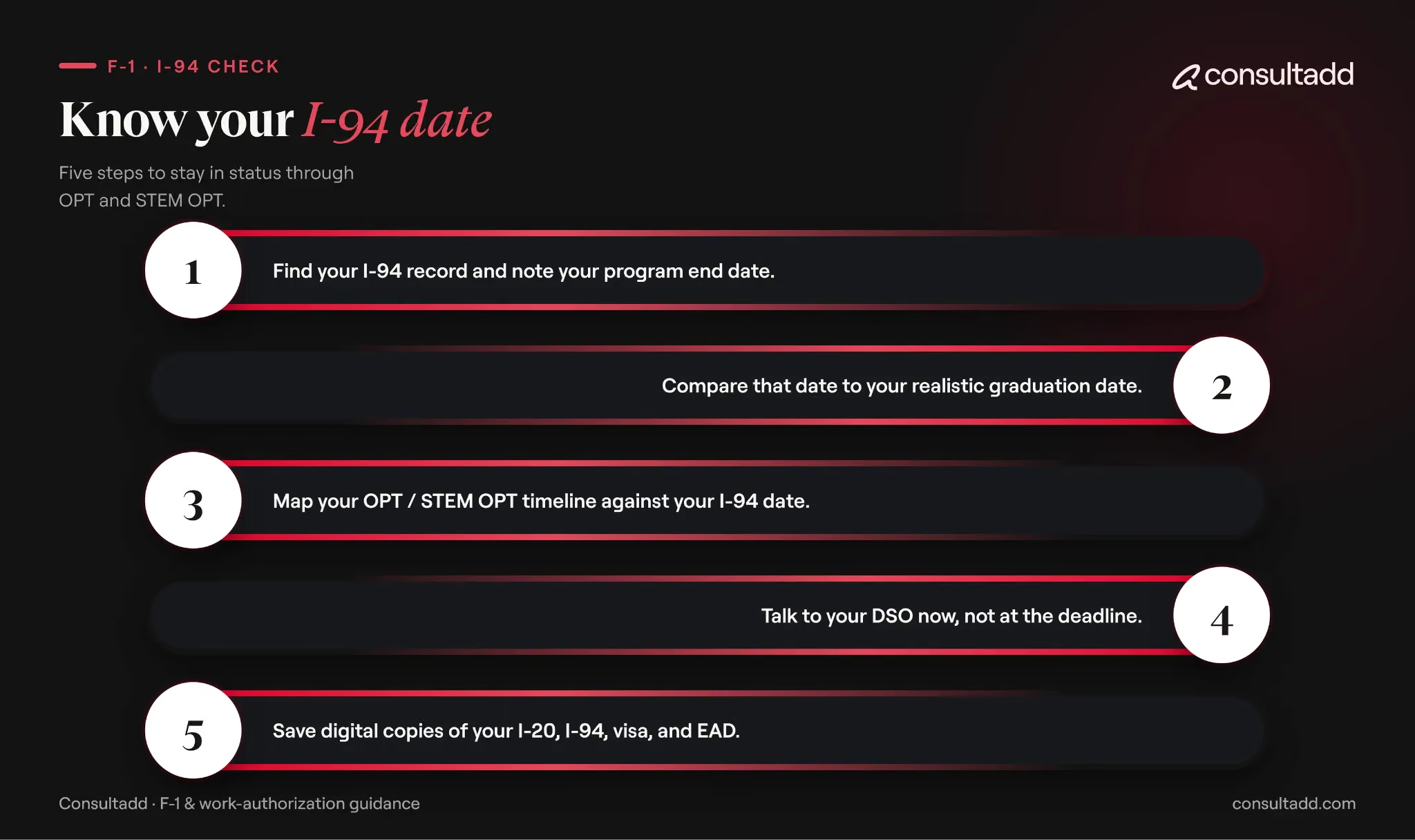
This is the one that surprises people. Filing for OPT or STEM OPT no longer extends your period of admission. If your I-94 date is approaching, you may need two filings on two clocks: Form I-765 for the work card and Form I-539 for the stay. There's one transition cushion here, discussed below, but plan for both. Staffing, consulting, and other employers with large OPT populations face real workforce-continuity risk, so this matters for hiring decisions too.
Our overview of OPT and STEM OPT work authorization for employers walks through how that plays out on a team.
Students relying on Day-1 CPT or same-level pivots
The rule closes a common bridge. F-1 students can no longer switch to a program at the same or lower academic level, which was the mechanic behind the "Day-1 CPT" move people used after missing the H-1B lottery. Graduate students also can't change majors or transfer schools mid-program without narrow SEVP authorization.
If your plan B depended on that pivot, it's time for a new plan B. If your goal is a work visa, compare paths in our guide to H-1B cap-gap timing and alternatives.
What happens if you overstay: unlawful presence and reentry bars
This is the part worth reading twice, because the consequence changed in a way that's easy to miss.
Under D/S, you generally started building "unlawful presence" only after a formal finding by USCIS or an immigration judge. Under the new rule, unlawful presence starts on its own, the day after your fixed admission date passes, if you haven't filed for an extension. No notice. No hearing. Just the calendar.
Why that's a big deal: accruing more than 180 days of unlawful presence triggers a 3-year bar on reentering the U.S. Accruing more than one year triggers a 10-year bar. A timely-filed extension pauses the clock while it's pending, which is exactly why filing early is the whole game now.
If an extension is denied, there's no grace period. You and any F-2 dependents are expected to leave.
Transition rules if you're already in the US
Good news for current students: you don't get kicked onto a four-year clock overnight, and you don't have to rush to file the day the rule takes effect.
If you're already here on D/S, you keep your status through your I-20 or DS-2019 program end date, capped at four years from the effective date. So a student with two years left generally has those two years, subject to the rule's specifics.
There's also a transition cushion for work authorization. From the effective date through roughly mid-March 2027, a timely-filed Form I-765 on its own protects your period of stay. After that window, the I-765 and I-539 split into two separate filings again. Because these provisions are fact-specific, confirm how they apply to your exact record with your DSO or an immigration attorney before you rely on them.
What to do right now: your action checklist
You asked for direct steps, so here they are.
Before September 15, 2026
If your program runs past four years
Start the extension conversation early. Form I-539 needs a real justification, like a documented academic delay or a medical reason. Academic probation does not count.
Build in months, not days, for processing, and avoid international travel near your admission expiry date since it complicates reentry. If you're weighing longer-term options, it's reasonable to look at categories that stand on their own, such as O-1A or an employment green card, well before your student status runs short.
One honest caveat: the rule is classified as a major rule subject to congressional review, so some details could still shift. That's not a reason to wait. The smart move is to prepare as if the September 15 date holds, because it very likely will.
For the official text and forms, go straight to the source: the DHS final rule in the Federal Register, the DHS announcement, and the USCIS Form I-539 page for extension filings.
Start Strong With Consultadd
With 15 years in business and 5,000+ successful staffing engagements, we don't just fill roles, we build reliability into your process. We've supported 65 staffing companies in the past year alone and maintain MSAs with industry leaders like Robert Half and TEKsystems.
Here's what working with Consultadd looks like:
- Talent sourced in under 24 hours
- Ready-to-deploy candidates, vetted for experience and compliance
- Lower turnover risk: we match long-term goals, not just short-term needs
- Seamless compliance: visa, documentation, onboarding? Handled.
- Dedicated 1:1 account managers for responsive, personalized support
- Top 100 candidate matches delivered in the past year
- Strong partnerships with universities to tap into fresh, committed talent
- Post-placement support so your investment grows beyond day one
For candidates, your next opportunity is more than just a job title, it's a chance to build skills, gain experience, and move your career forward. At Consultadd, we connect technology professionals with projects and employers that align with their goals, whether they're looking for contract, contract-to-hire, or long-term opportunities.
The tech job market moves fast, but the right guidance can make all the difference. Ready to take the next step in your career journey? Explore Opportunities >>
Key takeaways
- The F-1 visa duration of status change replaces open-ended stays with a fixed I-94 end date, capped at four years, effective September 15, 2026.
- More time now means a formal Form I-539 filing with USCIS, not a quiet SEVIS update from your DSO.
- Overstaying your fixed date starts unlawful presence automatically, and crossing 180 days or one year triggers 3-year or 10-year reentry bars.
- Doctoral students, medical trainees, and OPT/STEM OPT workers face the most exposure because their timelines often exceed four years.
- Current students keep status through their I-20 end date, capped at four years from the effective date, so check your dates and talk to your DSO now.
FAQs
When does the F-1 duration of status change take effect?
The final rule was published in the Federal Register on July 17, 2026, and takes effect 60 days later, on September 15, 2026. Students entering the U.S. on or after that date should expect a fixed admission date on their I-94 rather than the old "D/S" notation.
Does the new rule apply to students already in the U.S.?
Yes, but with a transition path. Current D/S holders keep their status through their I-20 or DS-2019 program end date, capped at four years from the effective date. You won't be forced to file an extension the moment the rule starts, but you should confirm your own dates with your DSO.
How do I extend my stay if my program runs long?
You file Form I-539, Application to Extend/Change Nonimmigrant Status, with USCIS, along with a documented reason such as an academic delay or medical issue. This is a real adjudication with a processing wait, so file well before your I-94 date, not at the last minute.
What happened to the F-1 grace period?
The post-completion grace period for F-1 students dropped from 60 days to 30 days. The J-1 grace period stays at 30 days. If an extension is denied, no grace period applies and you're expected to depart.
Do OPT and STEM OPT filings still protect my stay?
Not automatically anymore. Filing Form I-765 for work authorization no longer extends your admission period, so you may need a separate Form I-539 to keep lawful status. During a transition window running from the effective date through about mid-March 2027, a timely I-765 does independently protect your stay, after which the two filings separate again.
What are the penalties for staying past my I-94 date?
Unlawful presence now begins automatically the day after your fixed admission date if you haven't filed to extend. More than 180 days of unlawful presence brings a 3-year reentry bar, and more than one year brings a 10-year bar, which is why timely filing matters so much.
.webp)




.webp)
