


Introduction
Ask ten companies what a full stack developer should know, and you will get ten slightly different answers. But when the backend runs on Java, a clear pattern shows up.
The java full stack developer skills that actually get people hired sit across four areas: server-side Java, a frontend framework, databases, and the cloud tooling that ships it all to production.
This guide lays out each one, with the tools that matter and a checklist by experience level. Whether you are building toward the role or trying to hire for it, you will know exactly what "full stack Java" should mean by the end.
TL;DR
- A Java full stack developer builds both the server side (Java) and the client side (a JavaScript framework) of an application.
- Backend skills center on Core Java, Spring Boot, REST APIs, and a data access layer like Hibernate.
- Frontend skills mean HTML, CSS, modern JavaScript, and usually React or Angular.
- Databases (SQL and NoSQL) plus DevOps tooling (Git, Docker, CI/CD, a cloud platform) round out the role.
- Demand stays strong: the BLS projects software developer jobs to grow much faster than average through 2034.
What a Java full stack developer does
A Java full stack developer builds an application from end to end.
- On the server, they write business logic, design APIs, and handle data using Java and its frameworks.
- On the client, they build the interface users actually touch, usually with a JavaScript framework. Then they help package and deploy the whole thing.
The demand behind the role is real, not hype.
The U.S. Bureau of Labor Statistics projects software developer employment to grow 15% from 2024 to 2034, far above the average for all jobs, with a median wage of about $133,080 as of 2024.
Java sits at the center of a lot of that work, especially in banking, enterprise systems, and large-scale cloud platforms.
Here is the honest part: Nobody is equally expert at all of it. A strong full stack developer is deep in a couple of areas and competent across the rest. That mix is exactly what makes them useful.
The core Java full stack developer skills at a glance
Before the deep dive, here is the whole picture in one view. Think of these as the four layers you need to cover.
Each layer builds on the one before it. You cannot design a clean API without solid Java, and you cannot deploy a service well without understanding what it does. Let's take them in order.
Backend skills every Java full stack developer needs
This is the heart of the role and where Java earns its keep. If your backend is shaky, no amount of frontend polish saves the project.
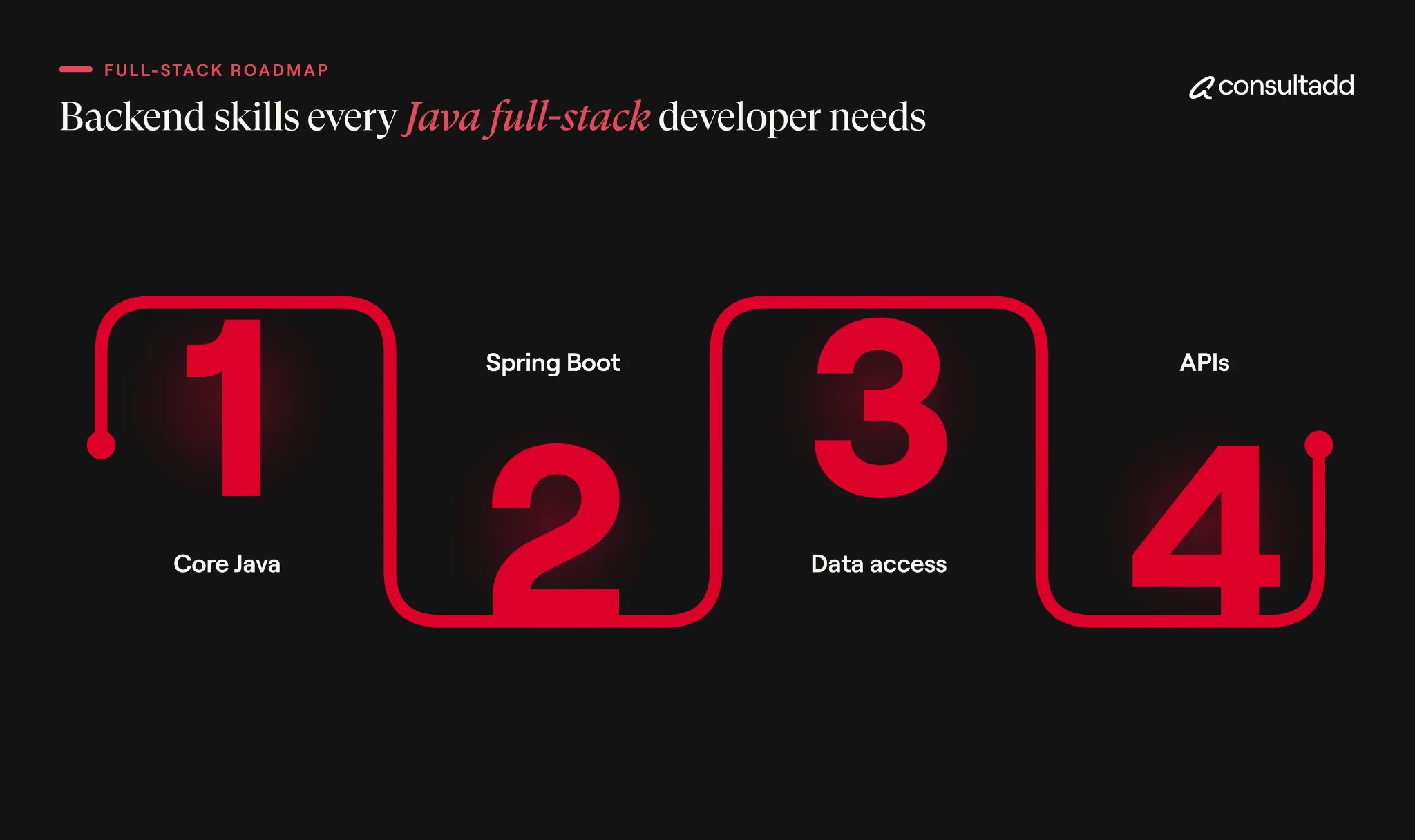
Core Java fundamentals
- Start here, always. That means object-oriented design, collections, exception handling, and generics, plus the modern features that show up in every codebase now: streams, lambdas, and the functional style.
- Concurrency and multithreading matter too, since real applications rarely do one thing at a time.
- Aim for a recent long-term support release. Java 17 or 21 is a safe target, and the fundamentals carry forward no matter which version your employer runs.
- Oracle keeps the official Java documentation and downloads current if you want the canonical reference.
Spring and Spring Boot
- If Core Java is the language, Spring Boot is how you actually build with it at work. It handles the wiring so you can focus on features.
- You will want dependency injection, Spring MVC for web layers, Spring Security for authentication, and Spring Data for the database side.
- The Spring Boot project site is the best starting point for what the framework covers and how its pieces fit.
Databases and data access
- Every application stores data, so you need to speak both dialects.
- Relational databases like PostgreSQL and MySQL cover structured, transactional data. NoSQL options like MongoDB handle flexible or high-volume cases.
- On the Java side, an ORM like Hibernate, usually through Spring Data JPA, maps your objects to tables without writing raw SQL for everything.
- You still need to read and write SQL well, though. Do not skip it.
APIs and microservices
- Modern Java systems are rarely one giant program.
- They are a set of services that talk over REST APIs. So you need to design clean endpoints, use HTTP methods and status codes correctly, and structure JSON responses that a frontend can actually consume.
- Microservice patterns, like splitting a monolith into independent services, are increasingly expected once you move past junior roles.
Frontend skills that round out the stack
The "full" in full stack lives here. You do not need to be a design specialist, but you do need to build a working interface and connect it to your APIs.
The practical advice:
- Get comfortable with HTML, CSS, and modern JavaScript first, then commit to one framework.
- React and Angular both dominate enterprise work, and knowing one well beats knowing both poorly.
- Since your backend already speaks REST, your job on the frontend is to call those APIs and turn the responses into something people can use.
DevOps, cloud, and tooling skills
Writing code is half the job. Shipping it is the other half. This layer is what turns a developer into someone who can own a feature all the way to production.
- Version control with Git, including branching and pull requests, since every team uses it.
- Build tools like Maven or Gradle to manage dependencies and package your app.
- Containers with Docker, and often orchestration with Kubernetes for larger systems.
- CI/CD pipelines (Jenkins, GitHub Actions) that test and deploy automatically.
- A cloud platform, most commonly AWS, for hosting, databases, and scaling.
- Testing with JUnit and Mockito, because untested code is a liability, not a feature.
You will not master all of these on day one, and that is fine. Git and basic testing are entry-level expectations. Docker, CI/CD, and cloud deployment tend to separate mid-level developers from juniors.
Soft skills that separate good from great
Technical range gets you in the door. These keep you in the room. Communication matters because you will explain trade-offs to people who do not code.
Problem-solving matters because most real bugs are not in any tutorial. And the willingness to keep learning matters because the stack you master this year will shift by the next.
Hiring managers notice this fast.
In fact, when Consultadd breaks down how to hire the best software engineers, the recurring theme is that technical brilliance means little if a developer cannot collaborate or adapt.
Skills checklist by experience level
Not every role needs every skill on day one. Here is a rough map of what tends to be expected as you move up.
For a deeper look at scoping technical roles accurately, Consultadd's guide to technical recruitment is worth a read.
The bottom line
The list of java full stack developer skills is long, but the shape is simple: be strong in backend Java and one frontend framework, competent with databases and cloud tooling, and easy to work with. Get those right and you cover what most teams actually need. The rest you pick up on the job, because in this field, you never really stop learning.
Start strong with Consultadd
With 15 years in business and 5,000+ successful staffing engagements, we don't just fill roles, we build reliability into your process. We've supported 65 staffing companies in the past year alone and maintain MSAs with industry leaders like Robert Half and TEKsystems.
Here's what working with Consultadd looks like:
- Talent sourced in under 24 hours
- Ready-to-deploy candidates, vetted for experience and compliance
- Lower turnover risk: we match long-term goals, not just short-term needs
- Seamless compliance: visa, documentation, onboarding? Handled.
- Dedicated 1:1 account managers for responsive, personalized support
- Top 100 candidate matches delivered in the past year
- Strong partnerships with universities to tap into fresh, committed talent
- Post-placement support so your investment grows beyond day one
For candidates, your next opportunity is more than just a job title, it's a chance to build skills, gain experience, and move your career forward. At Consultadd, we connect technology professionals with projects and employers that align with their goals, whether they're looking for contract, contract-to-hire, or long-term opportunities.
The tech job market moves fast, but the right guidance can make all the difference. Ready to take the next step in your career journey? Explore Opportunities >>
Key takeaways
- Java full stack developer skills span four layers: backend Java, frontend, databases, and DevOps or cloud.
- Core Java plus Spring Boot is the backbone, with REST APIs and a data access layer close behind.
- On the frontend, master HTML, CSS, and modern JavaScript, then go deep on React or Angular.
- Git, Docker, CI/CD, testing, and a cloud platform like AWS turn a coder into a shipping developer.
- Demand stays high, so both learners and hiring teams benefit from a clear, level-appropriate skills list.
FAQs
What skills does a Java full stack developer need?
A Java full stack developer needs backend skills (Core Java, Spring Boot, REST APIs, and a data layer like Hibernate), frontend skills (HTML, CSS, JavaScript, and React or Angular), database knowledge across SQL and NoSQL, and DevOps tooling such as Git, Docker, CI/CD, and a cloud platform.
Is Java good for full stack development in 2026?
Yes. Java remains a top choice for enterprise backends, banking systems, and cloud platforms because it is stable, secure, and scales well. Paired with a modern frontend framework, it supports building complete, production-ready applications.
Do I need to know both React and Angular?
No. Most employers want depth in one, not shallow knowledge of both. Pick the framework that matches your target jobs, learn it well, and you can pick up the other later if a role requires it.
How long does it take to become a Java full stack developer?
With consistent, project-based learning, many people reach a job-ready level in six to twelve months. The timeline depends on prior programming experience and how much you build. Real projects and a public portfolio speed things up more than courses alone.
What is the difference between a Java backend developer and a full stack developer?
A backend developer focuses on server-side logic, APIs, and databases in Java. A full stack developer does that plus the frontend, building the user interface and connecting it to the backend. Full stack roles trade some depth for broader coverage.
Which database should a Java full stack developer learn first?
Start with a relational database like PostgreSQL or MySQL, since most enterprise applications rely on structured, transactional data. Once you are comfortable with SQL and an ORM like Hibernate, add a NoSQL option such as MongoDB for flexible or high-volume use cases.
.webp)


.png)
