
.avif)

Introduction
Every recruiter has had the same week. You post a contract role, get 180 applications in four days, and spend the next two weeks discovering that most of them can't do the job, aren't actually available, or never intended to take a contract position in the first place.
Pre-vetted candidates exist to remove that two weeks.
The term gets used loosely, which is part of the problem. Some firms call a candidate pre-vetted after a ten-minute phone call. Others put them through a technical assessment, a background check, a work authorization review, and a conversation about salary and start date before the profile ever leaves their system. Same label, very different product.
This article covers what the label should mean, how a real vetting process is built, and how to tell whether the "pre-vetted" candidates you're being sent have actually been vetted.
TL;DR
- Pre-vetted candidates have already passed skills verification, background screening, work authorization checks, and an availability confirmation before a client ever sees them.
- The value is time. The SHRM 2025 Benchmarking Report puts median time-to-fill at roughly a month and a half, and most of that is screening work that vetting moves upstream.
- Not all vetting is equal. A resume review and a recorded technical assessment are both marketed as "vetting," and only one of them tells you whether someone can do the job.
- Compliance is where shortcuts get expensive. Work authorization and I-9 documentation have to be verified before placement, not after.
- Ask staffing partners for their specific vetting steps and rejection rate. A firm that can't describe either isn't vetting.
What "pre-vetted" actually means
A pre-vetted candidate is someone a staffing firm has already screened, tested, and cleared before presenting them to a client. The work happens on the agency's side. By the time the profile reaches your inbox, the basic questions are settled.
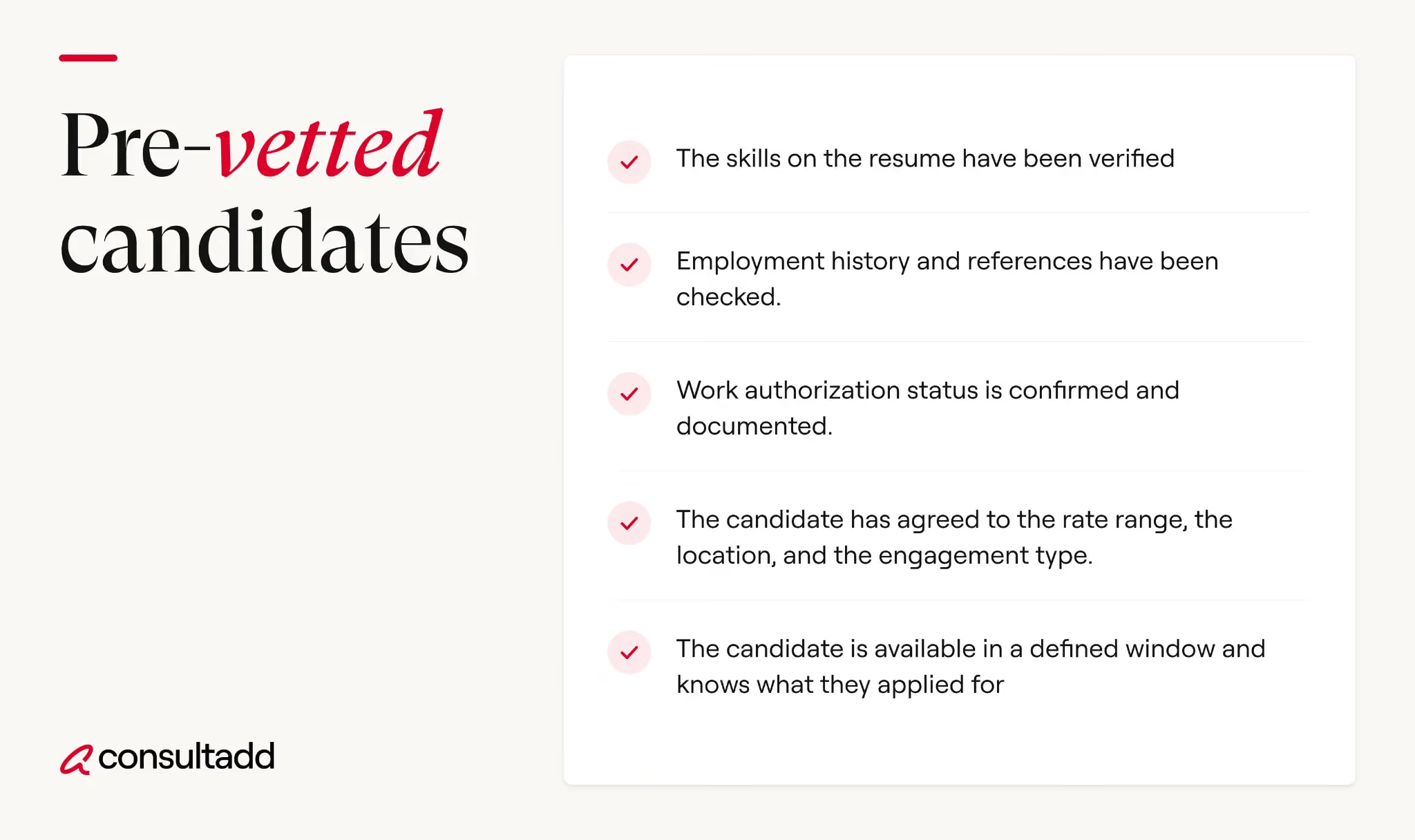
Here's what "settled" should cover:
- The skills on the resume have been verified, not just read.
- Employment history and references have been checked.
- Work authorization status is confirmed and documented.
- The candidate has agreed to the rate range, the location, and the engagement type.
- The candidate is available in a defined window and knows what they applied for.
That last point gets overlooked constantly. A technically brilliant engineer who wants a permanent role isn't a fit for a six-month contract, no matter how well they test. Vetting for intent is as useful as vetting for skill.
What pre-vetting is not
It's not a keyword match. Running a resume through an ATS filter and forwarding the top twenty results isn't vetting, it's sorting.
It's also not a guarantee. A pre-vetted candidate can still fail your interview, and they should be able to. Vetting removes the candidates who were never viable. It doesn't remove your judgment from the process.
Why the screening step costs so much when you own it
The numbers here are worth sitting with. The SHRM 2025 Benchmarking Report puts the average cost per hire at $5,475 for non-executive roles and $35,879 for executive roles, with median time-to-fill sitting around a month and a half for both.
Most of that time isn't spent interviewing. It's spent getting to the point where interviewing is worth doing.
And the market isn't making it easier. Bureau of Labor Statistics JOLTS data recorded 7.3 million job openings in July 2026, with 5.1 million hires and 3.1 million quits in the same month. That's a lot of churn to screen through, and technology roles carry an extra layer: you can't assess a data engineer's Spark experience from a resume bullet.
The client interview stage doesn't shrink, and it shouldn't. Everything above it does.
There's a second cost that rarely shows up in a spreadsheet: recruiter attention. A recruiter spending nine days screening one role isn't working on the other four. If you're running a staffing desk, that opportunity cost compounds quietly across a quarter.
How a real candidate vetting process works
Good vetting is sequential. Each stage is cheaper than the one after it, so the cheap checks go first and the expensive ones only run on people who've already cleared everything else.
Stage one: profile and history verification
Employment dates, job titles, and project scope get confirmed. This catches the gap between "worked on a migration to AWS" and "was on the team that ran a migration to AWS." Both are true statements. Only one of them means the candidate has done the work.
Stage two: technical evaluation
This is where firms differ most. The weak version is a conversational screen by a recruiter reading from a question sheet. The strong version is an assessment reviewed by someone who does the work, covering the specific stack the role requires.
For technology roles, the assessment should map to the job. A Kubernetes role needs a Kubernetes evaluation, not a general DevOps quiz.
Stage three: work authorization and compliance
Every US employer has to complete Form I-9 for every person they hire.
Per USCIS guidance, the employee completes Section 1 no later than their first day of work, the employer completes Section 2 within three business days of the hire date, and the form has to be retained for three years after the hire date or one year after employment ends, whichever is later.
For contract tech staffing, visa status adds real complexity. H-1B transfers, OPT and STEM OPT timelines, and green card processing all have their own constraints. A candidate who looks available in March may not be able to start until June.
This has to be verified before a client interview, not after an offer. Finding out at the offer stage that a candidate can't legally start in your timeline wastes everyone's time.
Stage four: intent and availability
A short, honest conversation. What rate will you accept? When can you start? Do you understand this is a contract-to-hire role? Are you interviewing elsewhere?
Candidates drop out of processes constantly, and a good portion of those drops were predictable at this stage.
Notice that the two cheapest stages catch the two most common failure modes. That's not a coincidence. It's why sequencing matters.
If you want more context on how these stages fit into different engagement types, our breakdown of IT staffing services and delivery models walks through direct hire, contract, contract-to-hire, and managed services.
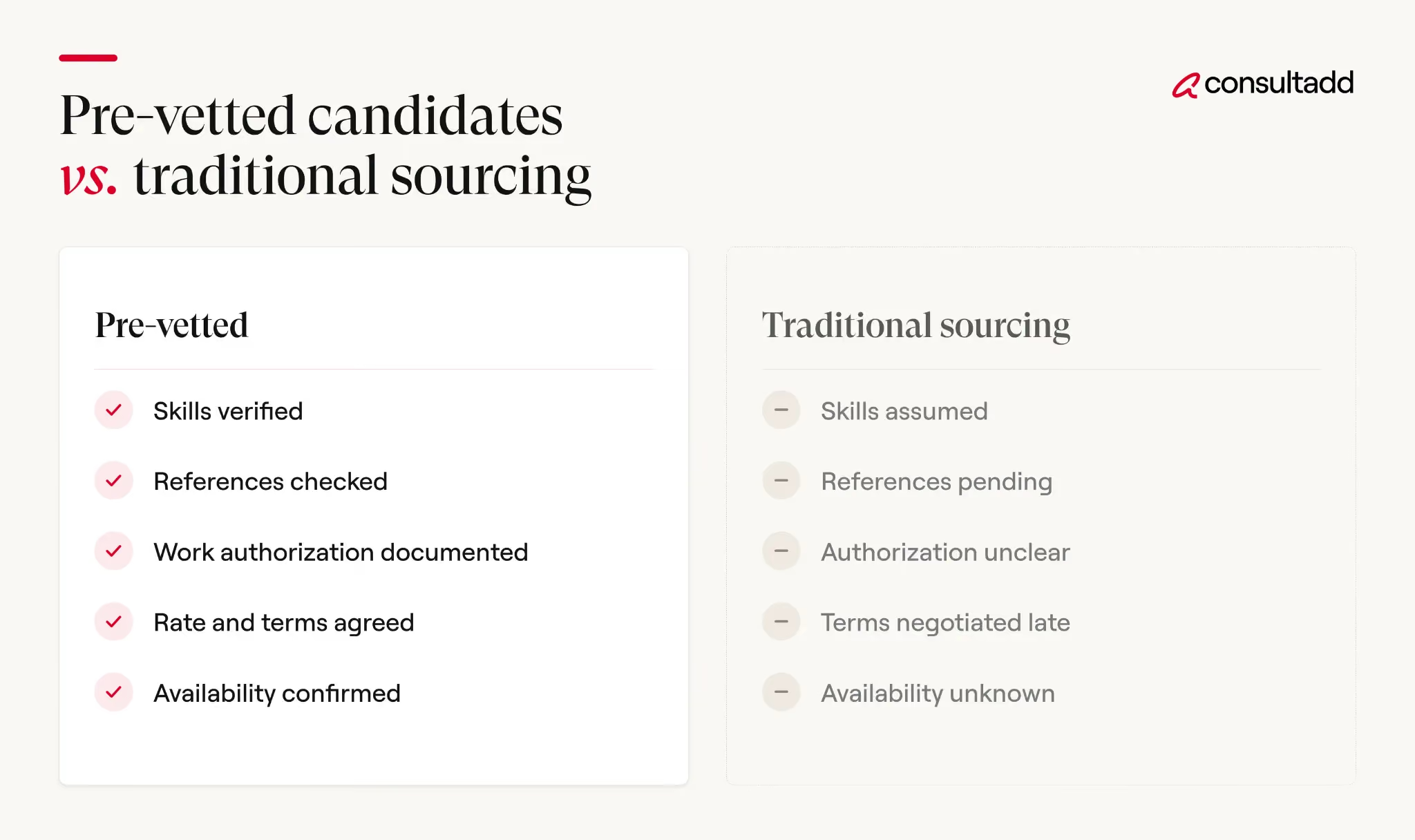
Pre-vetted candidates vs. traditional sourcing
Neither model wins outright. If you're hiring twenty support technicians with a well-staffed internal recruiting team, traditional sourcing is probably cheaper.
If you need a senior ML engineer with production LLM experience inside three weeks, pre-vetted candidates are the faster path and usually the cheaper one once you count recruiter hours.
Our comparison of staffing agency pros and cons covers the trade-offs in more detail, including where agency partnerships tend to underdeliver.
How to tell if "pre-vetted" is real
Ask direct questions. A firm with a genuine process will answer them without hesitating, and a firm without one will get vague fast.
The rejection rate question is the most useful one. If a firm accepts most applicants into its pre-vetted talent pool, the filter isn't doing anything. Selective pools are smaller and more useful.
The second most useful question is about recency. Talent pools decay. A candidate vetted eight months ago may have taken a permanent role, changed rates, or moved cities. Pool freshness is a real operational discipline, not a marketing claim.
Where pre-vetted talent helps most
Not every role justifies the premium. These situations usually do:
1. Specialized technical roles. Data engineering, ML and AI engineering, cloud architecture, and security roles have thin candidate markets. General sourcing returns volume, not fit.
2. Contract and contract-to-hire engagements. Contract hiring lives or dies on speed. A role that takes six weeks to fill has already lost most of its flexibility advantage.
Our piece on contract staffing as a planning decision gets into why timing matters so much here.
3. Staffing firms serving their own clients. This is a specific and underserved case. A recruiter who promises a client three qualified profiles by Thursday needs a source of vetted talent, not a LinkedIn search. Pre-vetted supply is the product.
4. Project ramp-ups with fixed deadlines. When a project has a start date, every day of screening is a day of delivery lost.
5. Roles with compliance sensitivity. Government contracts, regulated industries, and anything involving visa-dependent talent. Getting this wrong is expensive in a way that vacancy cost isn't.
Where it helps less: high-volume entry-level hiring, roles where you genuinely want to see a wide field of candidates, and situations where your internal team already has deep domain expertise and an active pipeline.
Start Strong With Consultadd
With 15 years in business and 5,000+ successful staffing engagements, we don't just fill roles, we build reliability into your process. We've supported 65 staffing companies in the past year alone and maintain MSAs with industry leaders like Robert Half and TEKsystems.
Here's what working with Consultadd looks like:
- Talent sourced in under 24 hours
- Ready-to-deploy candidates, vetted for experience and compliance
- Lower turnover risk: we match long-term goals, not just short-term needs
- Seamless compliance: visa, documentation, onboarding? Handled.
- Dedicated 1:1 account managers for responsive, personalized support
- Top 100 candidate matches delivered in the past year
- Strong partnerships with universities to tap into fresh, committed talent
- Post-placement support so your investment grows beyond day one
For candidates, your next opportunity is more than just a job title, it's a chance to build skills, gain experience, and move your career forward. At Consultadd, we connect technology professionals with projects and employers that align with their goals, whether they're looking for contract, contract-to-hire, or long-term opportunities.
The tech job market moves fast, but the right guidance can make all the difference. Ready to take the next step in your career journey? Explore Opportunities >>
Key takeaways
- Pre-vetted candidates have cleared skills verification, background checks, work authorization review, and an availability conversation before you see them.
- The time saved sits in the screening stages, not the interview stage. Your interview process stays the same length and should.
- A firm's rejection rate and pool recency tell you more about its vetting quality than any description of its process.
- Work authorization and I-9 compliance belong at the front of the process. Discovering a start-date blocker at the offer stage costs weeks.
- Pre-vetted sourcing pays off most on specialized, time-sensitive, or compliance-heavy roles, and least on high-volume entry-level hiring.
FAQs
What does "pre-vetted candidate" mean?
It means a staffing firm has already screened the candidate before presenting them to a client. That screening typically covers employment history, technical skills, references, work authorization, and availability. The client still interviews and makes the hiring decision.
How long does candidate vetting take?
A full vetting cycle on a new candidate usually runs three to seven business days, depending on how quickly references respond and whether visa documentation needs review. Firms that maintain an existing talent pool can present already-vetted candidates within 24 to 72 hours because the work was done in advance.
Are pre-vetted candidates more expensive?
The markup or placement fee is higher than a job board posting, yes. But the comparison isn't fee versus free. It's fee versus your recruiter's hours, your hiring manager's interview time, and the cost of the role sitting open. On specialized roles, pre-vetted sourcing often comes out cheaper once those are counted.
Do pre-vetted candidates still need interviews?
Yes, always. Vetting confirms that a candidate can do the job and is available to do it. It doesn't confirm that they fit your team, your codebase, or your working style. Skipping the interview defeats the purpose of having one.
How do staffing agencies verify work authorization?
They review documentation against the categories on Form I-9 and track visa status and expiration dates for candidates on H-1B, OPT, or other work-authorized statuses. Employers complete Section 2 of the I-9 within three business days of the hire date. Some employers also use E-Verify, which checks I-9 information against SSA and DHS records.
What's the difference between pre-screened and pre-vetted candidates?
The terms are often used interchangeably, but pre-screened usually means a lighter filter: a resume review and a short recruiter call. Pre-vetted implies deeper verification, including technical assessment and compliance checks. Ask any firm to define which one they mean, because the labels aren't standardized.


.png)
.png)
