


Introduction
If you have ever watched a good engineer slip away because your hiring took too long, you already understand the problem.
The IT staffing process is the sequence of steps that turns an open technical role into a working, productive hire. Done well, it fills seats with people who can actually do the job. Done poorly, it drags on for months and quietly bleeds money.
Here is the part most teams underestimate. Tech roles do not fill on the same clock as everything else. The average job across all industries fills in about 44 days, according to SHRM benchmark data.
Specialized tech roles routinely run longer, and some stretch well past three months. So the process you use is not a formality. It is the difference between hiring the person you want and settling for whoever is still available in week eight.
This guide walks through each stage, what it should produce, and where things usually break.
TL;DR
- The IT staffing process runs through eight stages, from requirement intake to post-placement support, and each stage has a clear owner and output.
- Tech roles fill slower than most, with senior and niche positions like AI/ML averaging close to 89 days to fill.
- Every day a role sits open costs real money, roughly $500 to $1,500 per day in lost productivity for a mid-level engineer.
- Choosing the right model, whether staff augmentation, contract-to-hire, or direct hire, shapes both speed and cost.
- A specialized partner can compress timelines from weeks to days, but only if intake and screening are done right.
What is the IT staffing process?
The IT staffing process is the structured way an organization identifies a technical need, finds qualified candidates, evaluates them, and gets the right person into the role.
It covers everything from the first conversation about what a project actually requires through the moment a new hire is set up and contributing.
It matters more now than it used to. Demand keeps climbing while supply stays tight. A February 2026 ManpowerGroup report found that 72% of employers worldwide struggle to fill roles, and the technology sector sits near the top of that list with a talent shortage rate around 76%.
The U.S. Bureau of Labor Statistics projects roughly 317,700 openings in computer and IT occupations every year through 2034. That is a lot of chairs to fill, and not enough people to fill them.
The IT staffing market itself reflects that pressure. It is projected to reach about $152 billion by 2031. Companies are leaning less on permanent headcount alone and more on flexible, contract-based talent to close gaps fast.
The 8 steps of the IT staffing process
Most solid staffing workflows follow the same backbone, whether you run it in-house or through an agency.
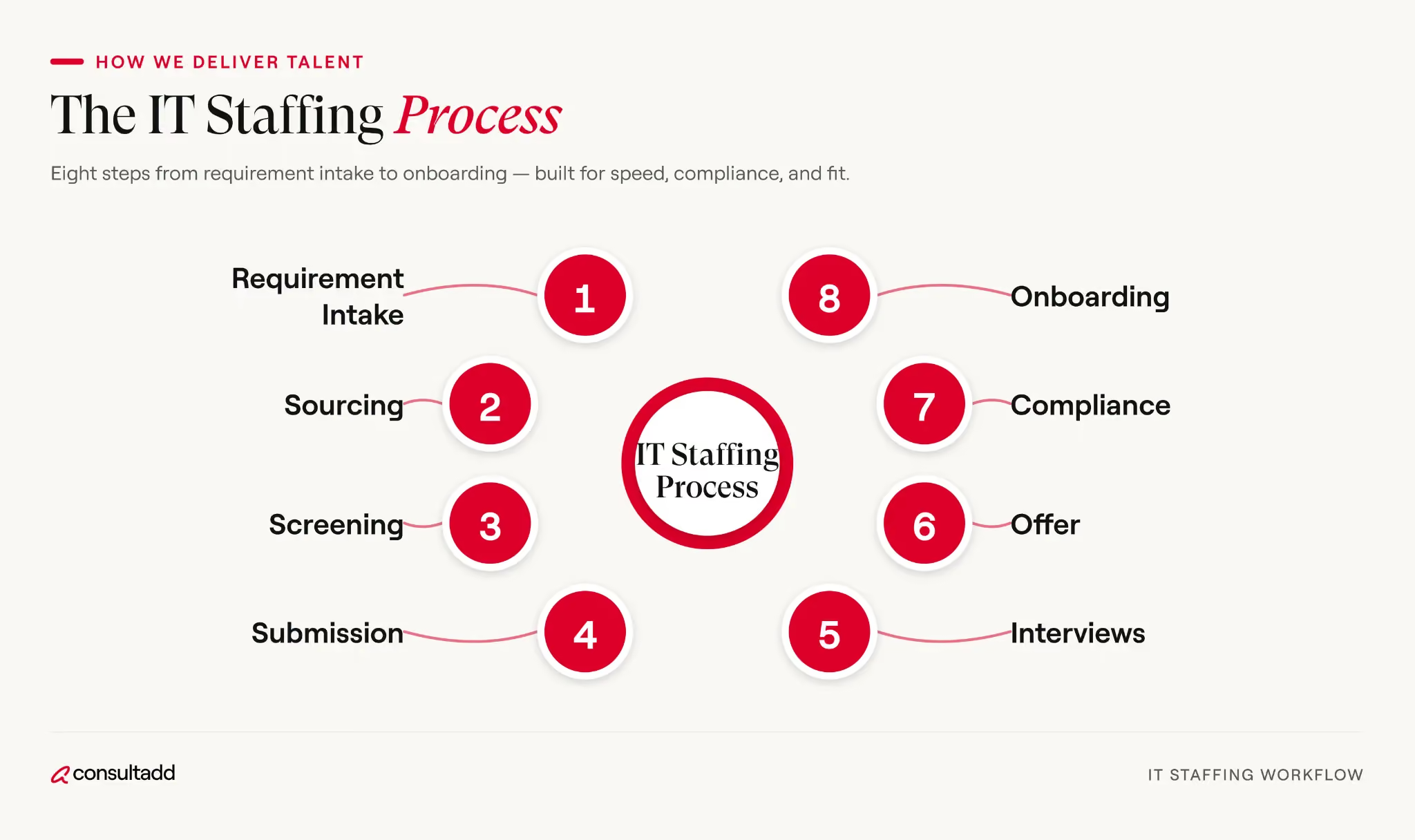
Here is how the full sequence looks, with who owns each part and what it should hand off.
1. Requirement intake and role scoping
- This is where good hires are won or lost, and it is the step people rush through.
- A recruiter reviews the job description, the technology stack, the experience level, and what the client actually expects day to day.
- If the intake is vague, everything downstream inherits that fog.
- We have seen requisitions ask for eight or ten "must-have" skills when the work really needs three.
- Pin down the non-negotiables early. It saves everyone a month.
2. Sourcing and talent mapping
- Now recruiters go looking. They search internal databases, referral networks, professional communities, and job boards, then build a longlist of realistic profiles.
- Talent mapping also happens here, which means understanding where the right people work today and what would make them move.
- The best pipelines are warm before the role even opens.
- Agencies that keep active talent pools can pull candidates who were never on the open market.
3. Screening and technical assessment
- A resume tells you what someone claims. Screening tells you what holds up.
- This stage combines a recruiter phone screen with a real technical assessment, often reviewed by an engineer.
- Skills-based evaluation has largely replaced the old degree filter.
- In 2026, more than half of mid-to-large tech employers dropped degree requirements for many roles and focused on what candidates can build instead.
- AI tools now handle a chunk of early screening, from resume parsing to scheduling. The smart teams use them to move faster, not to replace human judgment. AI-assisted, not AI-only.
4. Client submission and shortlisting
- The recruiter or account manager presents a tight set of vetted candidates.
- Quality beats volume here.
- Three strong, well-matched profiles help a hiring manager far more than thirty raw resumes.
- This is also where a staffing partner earns trust, because a curated shortlist signals they understood the brief.
5. Interviews and evaluation
- The hiring team runs technical and cultural interviews.
- The goal is to confirm the candidate can do the work and will fit how the team operates. Consolidating rounds matters.
- Dragging finalists through five separate loops over three weeks is how you lose them.
- Top technical candidates stay available for roughly 10 days before accepting an offer somewhere else.
6. Offer and negotiation
- Speed wins offers. Candidates who wait more than five days for a written offer are about 40% more likely to accept a competing one.
- Get the number, terms, and start date locked quickly.
- Negotiation is normal in a market where senior bill rates have climbed 15% to 30% year over year, so build a little room in from the start.
7. Compliance and documentation
- Before anyone starts, paperwork has to be cleared.
- Background checks, right-to-work verification, and any visa documentation get handled here.
- For sponsored roles, USCIS requirements set the rules, and getting them wrong is expensive.
- A good partner treats compliance as part of the process, not an afterthought that surfaces on day one.
8. Onboarding and post-placement support
- The role is not filled until the person is productive.
- Onboarding covers system access, tooling, introductions, and a real ramp-up plan. Post-placement check-ins catch small problems before they become resignations.
- This last mile is where a lot of "successful" hires quietly fall apart.
IT staffing models compared
There is no single right way to staff a tech team. The model you pick should match the length of the need and how much control you want. Here is how the common options stack up.
Staff augmentation works when you know exactly what to build but lack the hands or a specific skill. The professionals join your team and take direction from you.
Contract-to-hire has grown fast because both sides get to evaluate before signing anything permanent, which lowers the risk of a bad hire. Direct hire still makes sense for roles at the core of your business.
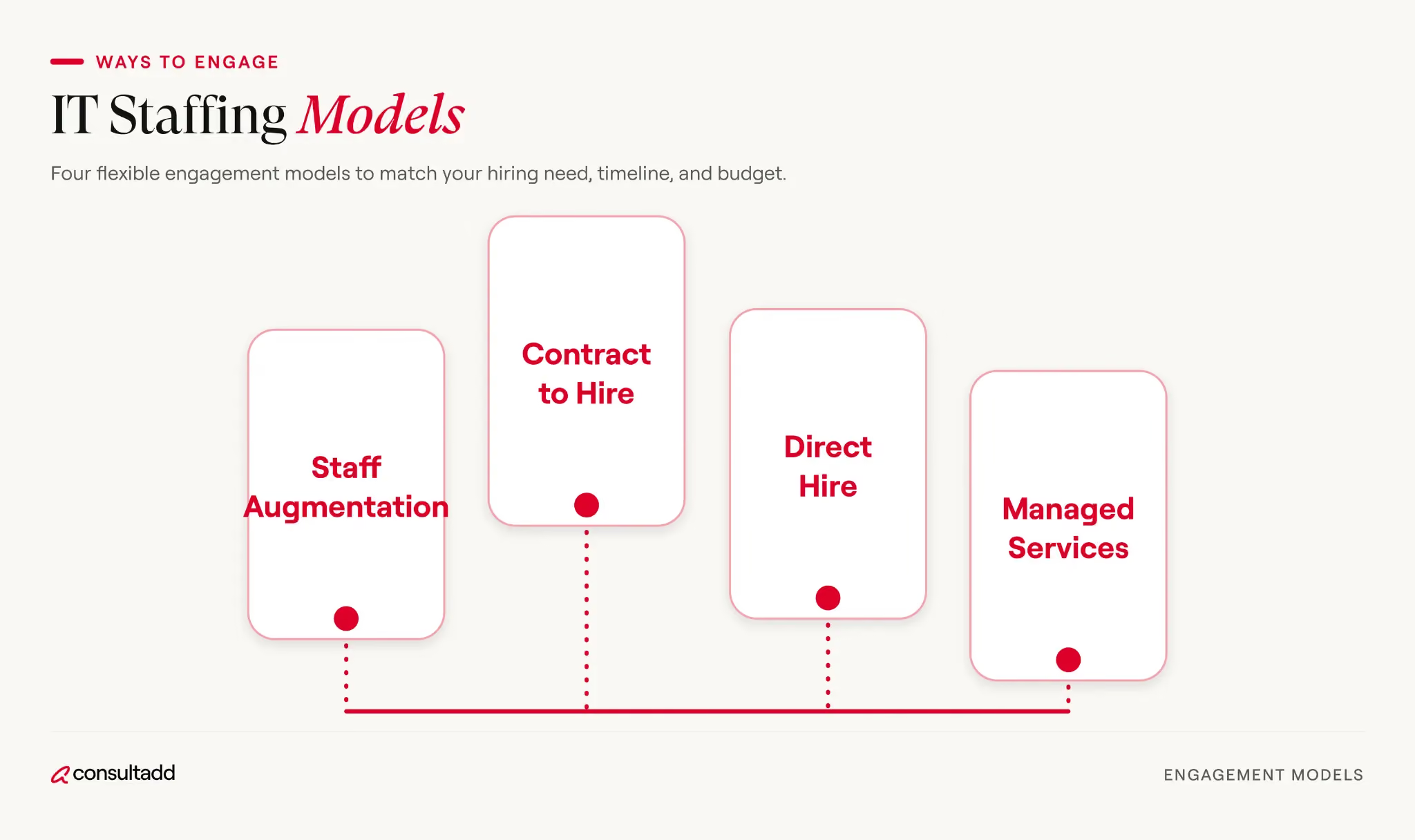
Managed services fit when you would rather hand an entire function to a provider and judge them on results.
Common bottlenecks and how to fix them
Most staffing delays are not mysteries. They repeat.
Once you can name them, you can shorten your timeline without cutting corners on quality.
The pattern here is speed and clarity. Candidates can feel when a process is confident and when it is wobbling, and they behave accordingly.
A tight, well-run process is itself a recruiting advantage.
In-house hiring versus a staffing partner
Running the process yourself:
- It gives you full control and keeps costs predictable for steady, ongoing roles.
- It works when your recruiting team has bandwidth and the roles are not especially rare.
A staffing partner:
- It changes the math when speed or scarcity is the problem.
- Specialized agencies often fill technical roles in a fraction of the internal average, because they maintain pipelines, run screening at scale, and handle compliance as routine work.
- The tradeoff is a fee, weighed against the vacancy cost of a role sitting empty for two months.
For a hard-to-find skill on a deadline, that trade usually favors the partner. If you want to go deeper on cutting your timeline, our guide on reducing time-to-hire breaks down the tactics that actually move the number.
Start Strong With Consultadd
With 15 years in business and 5,000+ successful staffing engagements, we don't just fill roles, we build reliability into your process. We've supported 65 staffing companies in the past year alone and maintain MSAs with industry leaders like Robert Half and TEKsystems.
Here's what working with Consultadd looks like:
- Talent sourced in under 24 hours
- Ready-to-deploy candidates, vetted for experience and compliance
- Lower turnover risk: we match long-term goals, not just short-term needs
- Seamless compliance: visa, documentation, onboarding? Handled.
- Dedicated 1:1 account managers for responsive, personalized support
- Top 100 candidate matches delivered in the past year
- Strong partnerships with universities to tap into fresh, committed talent
- Post-placement support so your investment grows beyond day one
For candidates, your next opportunity is more than just a job title, it's a chance to build skills, gain experience, and move your career forward. At Consultadd, we connect technology professionals with projects and employers that align with their goals, whether they're looking for contract, contract-to-hire, or long-term opportunities.
The tech job market moves fast, but the right guidance can make all the difference. Ready to take the next step in your career journey? Explore Opportunities >>
Key takeaways
- The IT staffing process has eight clear stages, and skipping intake is the most common way teams sabotage the rest.
- Tech roles fill slower than average, with scarce skills like AI/ML taking close to 89 days.
- Empty roles are expensive, often $500 to $1,500 per day in lost output for a single engineer.
- Match the model to the need: staff augmentation and contract-to-hire buy speed and flexibility that direct hire cannot.
- A specialized partner earns its fee when the role is urgent, rare, or bleeding money by staying open.
FAQs
What are the main steps in the IT staffing process?
The process moves through requirement intake, sourcing, screening, client submission, interviews, offer, compliance, and onboarding. Each step has a clear owner and a specific output, which keeps candidates moving instead of stalling between stages.
How long does it take to fill an IT position?
It depends heavily on the role. The tech average is around 52 days, but common roles like frontend engineering fill closer to 42 days while niche roles like AI/ML can take about 89 days. Scarcity of qualified candidates is the biggest factor.
What is the difference between staff augmentation and direct hire?
Staff augmentation adds external professionals to your team temporarily, and you direct their work while paying only for the engagement. Direct hire brings someone on permanently as your employee. Augmentation suits short-term gaps and specialized skills, while direct hire fits core, long-term roles.
Why is IT staffing so much harder than other hiring?
Supply is the root cause. Around 72% of employers report trouble filling roles, and the tech sector faces one of the highest shortage rates at roughly 76%. Skill requirements have also grown, so a role that once needed three competencies now often lists eight or more.
Does using an IT staffing agency actually save money?
It can, when a role is urgent or hard to fill. Agencies maintain warm candidate pools and can start people in days, which offsets the vacancy cost of a role sitting open for two months or longer. For steady, easy-to-fill roles, in-house hiring is often cheaper.
How is AI changing the IT staffing process?
AI now handles early screening, resume parsing, and scheduling, cutting tasks that once took days down to minutes. The most effective approach in 2026 is AI-assisted rather than fully automated, since human judgment still catches cultural fit and reduces bias.




.webp)
