

Introduction
Ask five recruiting teams how long it takes them to hire someone and you'll get five numbers measured five different ways.
That's the whole problem with the time to hire vs time to fill debate: the two metrics get used interchangeably, and they measure genuinely different things.
Time to fill tracks how long a role sits open, starting the day the requisition opens.
Time to hire tracks how fast a specific candidate moves through your pipeline, starting the day they apply or get sourced.
Mix them up and every benchmark comparison you make is meaningless. Worse, you'll fix the wrong bottleneck. A company can have a lightning-fast interview process and still leave roles open for two months because nobody's sourcing.
This guide defines both metrics precisely, shows the formulas, gives you current benchmarks, and explains how to use the gap between the two numbers as a diagnostic tool.
TL;DR
- Time to fill measures requisition open date to offer acceptance. Time to hire measures the candidate's entry into your pipeline to offer acceptance. Time to fill is always the equal or larger number.
- The widely cited SHRM benchmark puts average time to fill around 44 days, though it varies heavily by industry and role seniority.
- The gap between the two numbers is diagnostic: a big gap points to sourcing or approval delays, while two similarly high numbers point to a slow interview process.
- Speed has real stakes. Robert Half research shows top candidates leave the market within about 10 days, and SHRM estimates vacant roles cost $4,000 to $9,000 per month in lost productivity.
- Measure both in calendar days, segment by role type, and track your own trend over quarters rather than obsessing over national averages.
Time to Hire vs Time to Fill: The Core Difference
Both metrics end at the same moment: the day a candidate accepts your offer. Everything that separates them happens at the start line.
Time to fill starts its clock when the job requisition is formally opened or approved. It captures the entire business timeline: approval delays, writing the job post, sourcing, screening, interviews, decision-making, and the offer itself. It answers the question leadership actually asks, which is "how long is this seat empty?"
Time to hire starts its clock when a specific candidate enters your pipeline, either by applying or by being sourced. It captures only the candidate's journey and answers a narrower question: "once we find someone, how fast do we move?"
The distinction sounds academic until you see it in numbers. A company can post a 50-day time to fill with a 15-day time to hire, meaning 35 of those days were spent before the eventual hire ever appeared. Nothing about the interview process was slow. The sourcing was.
One is a process-level metric, the other is a funnel-level metric. You need both, and you need everyone in the company calculating them the same way, because if one recruiter starts the clock at requisition request and another at job posting, your data is useless for comparison.
How to calculate each metric
The formulas are simple. Consistency is the hard part.
The formulas
Three measurement rules that save you from garbage data:
- Use calendar days, not business days. Candidates don't pause their job search on weekends, and neither do your competitors.
- Record dates when events happen, not from memory at quarter's end. Any modern ATS does this automatically.
- Track quarterly or rolling averages. One 90-day executive search can skew a monthly number badly.
A Worked Example
Say a requisition for a marketing manager opens March 1. The recruiter spends three weeks on approvals and sourcing. The eventual hire applies March 22, interviews through mid-April, and accepts on April 20.
- Time to fill: March 1 to April 20 = 50 days
- Time to hire: March 22 to April 20 = 29 days
Same hire, two very different stories. The 29-day funnel looks healthy. The 21-day gap before any candidate is engaged is where the improvement opportunity lives.
Benchmarks: What "Normal" Looks Like in 2026
The most widely cited figure comes from SHRM's talent acquisition benchmarking research, which puts the average time to fill at roughly 44 days across industries. Around that average, sector differences are large:
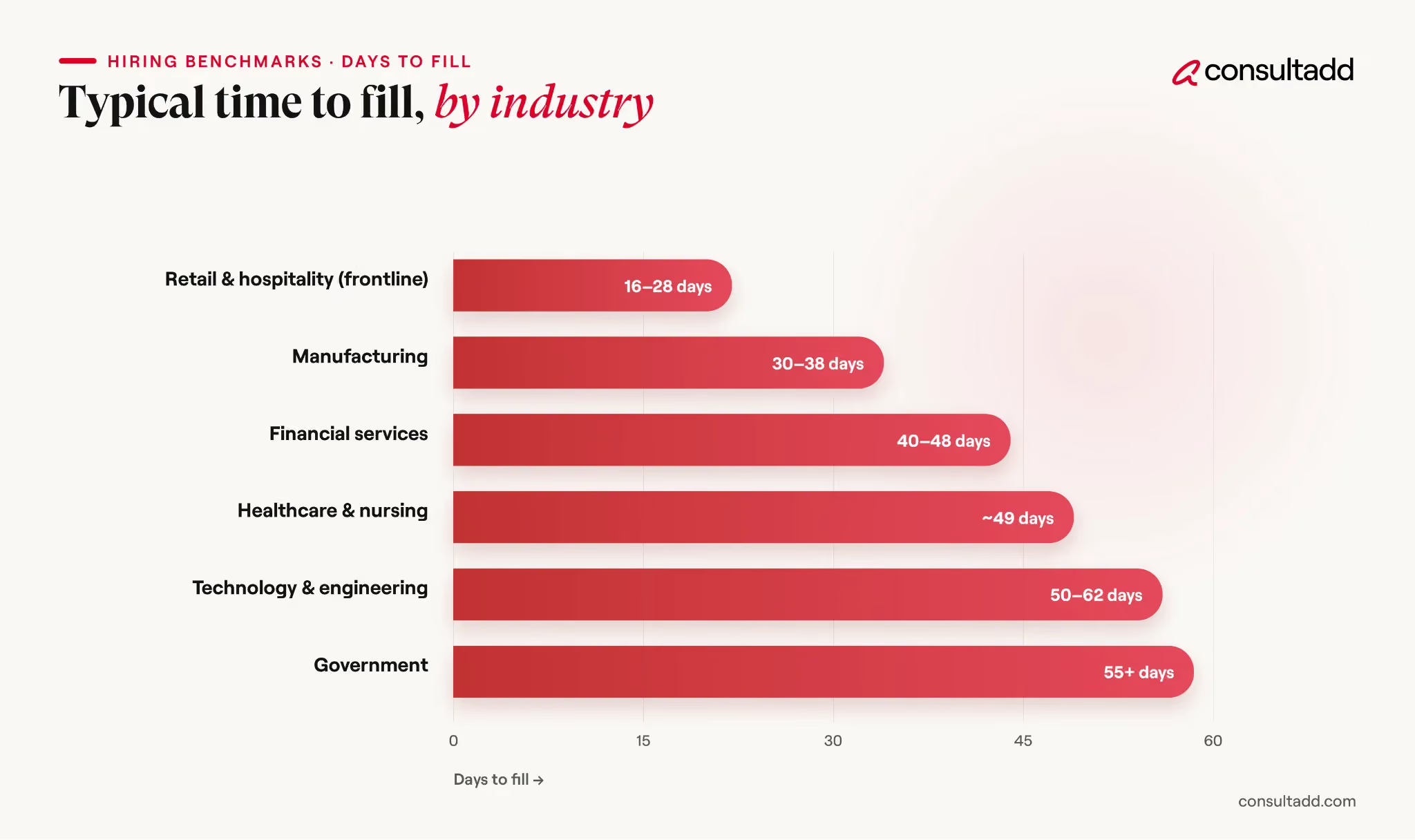
Two caveats before you pin these to a dashboard.
First, benchmarks are directional, not targets. A 25-day fill on a senior engineering role sounds great until you learn the team skipped reference checks to get there.
Second, your own trend matters more than any national average. Dropping from 52 days to 38 over three quarters is a bigger win than beating a median compiled from companies nothing like yours.
The labor market context shifts these numbers too. When openings outnumber available candidates in a sector, fill times stretch regardless of how efficient your process is.
The stakes behind the benchmarks are concrete. SHRM estimates an open position costs $4,000 to $9,000 per month in lost productivity, overtime, and delayed revenue. And Robert Half's research has long shown that top candidates are off the market within about 10 days. A 60-day process isn't just slow. It's selecting for whoever's left.
Using the gap as a diagnostic tool
Here's where tracking both metrics pays off. Neither number alone tells you what's broken. The relationship between them does.
That second pattern deserves a closer look, because interview bloat is the quiet culprit in most of the slow funnels I've seen. Hiring teams keep adding rounds "just to be sure," and each added stage brings scheduling delays, feedback loops, and candidate drop-off.
In a 2024 Greenhouse survey, 67% of recruiters named hiring manager delays as their top bottleneck. The candidates feel it too: SHRM research found 57% of job seekers lose interest in a role when the process drags.
Segmentation is the other non-negotiable. A company-wide 40-day average can hide an engineering pipeline running at 62 days while admin roles close in 18. Averages comfort; segments inform.
How to reduce both metrics without hurting quality
Speed and quality aren't opposites. Most hiring delay is dead time, not evaluation time: candidates waiting for feedback, interviews waiting for calendars, offers waiting for signatures. Cutting dead time costs you nothing in rigor.
Fix The Upstream (Improves Time to Fill)
- Set internal SLAs: hiring managers review shortlists within two working days, interview feedback lands within 24 hours. Boring, unglamorous, and consistently one of the highest-impact fixes.
- Build proactive pipelines for roles you hire repeatedly. Entering a new requisition with warm, partially assessed candidates changes the math entirely.
- Write the job post and align on must-have criteria before the requisition opens, not two weeks after.
- For hard-to-fill technical roles, a staffing partner with an existing bench can compress sourcing from weeks to days.
Our comparison of the best IT staffing firms in 2026 covers how to evaluate that option honestly.
Fix The Funnel (Improves Time to Hire)
- Cap interview rounds. Two well-structured stages, a competency-based screen plus a panel, are enough for most roles. Every round you remove typically saves five to ten days.
- Run stages in parallel where possible instead of strictly sequentially.
- Automate scheduling. It sounds trivial; it reliably saves days per hire.
- Use structured, criteria-based scorecards. SHRM's guidance is clear that structured screening improves 90-day performance and reduces early attrition, so speed achieved through structure upgrades quality rather than trading it away.
Contract and contract-to-hire models are another lever worth naming, since they decouple "seat filled" from "permanent hire decided."
We made the fuller case in IT contract staffing is a business strategy, not a backup plan.
Which metric should you report to leadership?
Both, but for different audiences and decisions. That's the practical resolution to the time to hire vs time to fill question.
Report time to fill to executives and finance. It maps directly to cost of vacancy, workforce planning, and project timelines. If your average is 45 days, requisitions need to open 45 days before the business needs the headcount, and leadership can plan around that.
Use time to hire inside the recruiting team. It isolates the funnel you actually control and shows whether process changes, fewer rounds, faster feedback, better scheduling, are working.
And whichever number you're presenting, pair it with quality of hire, offer acceptance rate, and early retention. A fast process that produces mis-hires isn't fast. It's just failing quickly.
Start Strong With Consultadd
With 15 years in business and 5,000+ successful staffing engagements, we don't just fill roles, we build reliability into your process. We've supported 65 staffing companies in the past year alone and maintain MSAs with industry leaders like Robert Half and TEKsystems.
Here's what working with Consultadd looks like:
- Talent sourced in under 24 hours
- Ready-to-deploy candidates, vetted for experience and compliance
- Lower turnover risk: we match long-term goals, not just short-term needs
- Seamless compliance: visa, documentation, onboarding? Handled.
- Dedicated 1:1 account managers for responsive, personalized support
- Top 100 candidate matches delivered in the past year
- Strong partnerships with universities to tap into fresh, committed talent
- Post-placement support so your investment grows beyond day one
For candidates, your next opportunity is more than just a job title, it's a chance to build skills, gain experience, and move your career forward. At Consultadd, we connect technology professionals with projects and employers that align with their goals, whether they're looking for contract, contract-to-hire, or long-term opportunities.
The tech job market moves fast, but the right guidance can make all the difference. Ready to take the next step in your career journey? Explore Opportunities >>
Key takeaways
- Time to fill starts when the requisition opens; time to hire starts when the candidate enters the pipeline. Both end at offer acceptance, and time to fill is always the equal or larger number.
- The SHRM benchmark of roughly 44 days average time to fill is a reference point, not a target. Segment by role type and track your own quarterly trend instead.
- Read the two metrics together: a large gap between them means an upstream sourcing or approval problem, while two high numbers mean a slow interview funnel.
- Most delay is dead time. Internal SLAs, fewer interview rounds, parallel stages, and automated scheduling cut days without cutting rigor.
- Report time to fill to leadership for planning and cost of vacancy; use time to hire internally to measure funnel improvements, and always pair speed metrics with quality of hire.
FAQs
What is the difference between time to hire and time to fill?
Time to fill measures the total days from when a job requisition opens to when a candidate accepts the offer. Time to hire measures only the days from when the eventual hire entered your pipeline to their offer acceptance. Time to fill covers the whole process; time to hire covers one candidate's journey through it.
Which is longer, time to hire or time to fill?
Time to fill is always equal to or longer than time to hire, because it includes everything that happens before any candidate engages: requisition approval, posting the job, and sourcing. The same hire might show a 50-day time to fill and a 29-day time to hire.
What is a good time to fill in 2026?
SHRM benchmarking puts the cross-industry average around 44 days, with frontline retail roles closing in under 3 weeks and technical roles often taking 50 to 62 days. A reasonable target for standard professional roles is 30 to 45 days. Anything consistently above 60 days for non-executive positions deserves a process audit.
How do you calculate time to fill?
Subtract the requisition open date from the offer acceptance date, in calendar days. For a company average, add up the time-to-fill values for all hires in a period and divide by the number of hires. The critical part is consistency: everyone must use the same start event, and SHRM recommends the requisition approval date because it captures internal delays.
Why is time to fill important?
It quantifies how long the business goes without needed capacity. SHRM estimates each vacant role costs $4,000 to $9,000 per month in lost productivity and overtime, and for revenue-generating roles the losses run higher. Finance and operations teams also use average time to fill to plan headcount, budgets, and project timelines.
How can I reduce time to hire?
Attack dead time first: set 24-hour SLAs for interview feedback, cap the process at two or three structured rounds, run stages in parallel, and automate scheduling. Removing a single interview stage typically saves five to ten days. Structured scorecards keep quality intact while decisions speed up.
.webp)