.avif)

Introduction
Search "W2 vs W4" and you'll usually land in one of two situations.
Either you're comparing employment types, like W2 versus C2C or 1099, or you just got handed a form on your first day that says "W-4" and you're wondering if that's the same thing as the W2 status your offer letter mentioned.
It isn't, and mixing the two up is one of the most common points of confusion for anyone starting a new W2 job, especially through a staffing agency.
To put it simply W4 tells your employer how much tax to take out while W2 tells you how much you earned and how much tax was taken out.
This post clears up the actual difference: what each form does, who fills it out, when you'll see it, and why getting the W-4 wrong is the thing that actually costs you money.
TL;DR
- W-4 and W-2 are both IRS forms, but they do opposite jobs: the W-4 sets up withholding before you're paid, and the W-2 reports what was actually withheld after the year ends.
- You fill out the W-4 yourself, usually on day one. Your employer fills out the W-2 and sends it to you and the IRS.
- "W2" as a job type (versus C2C or 1099) is a separate concept from the W-2 form. They share a name, not a purpose.
- Getting your W-4 wrong doesn't change your employment classification, but it can mean an unpleasant tax bill or an interest-free loan to the IRS.
- Contract-to-hire and staffing placements are where this confusion shows up most, since a W-4 usually needs to be redone for each new W2 employer in the chain.
What each form actually does
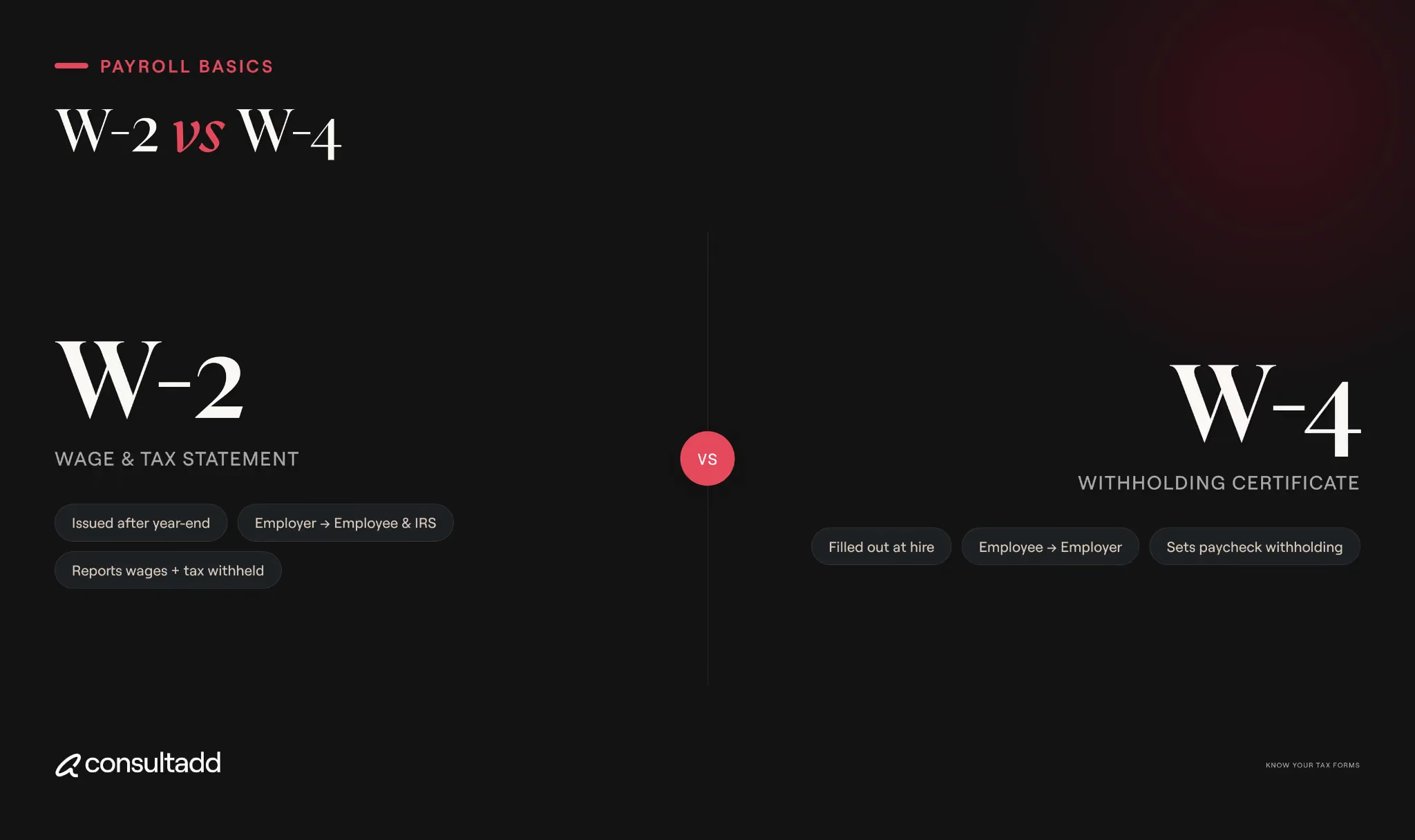
The IRS is direct about the W-4's purpose: it's completed by employees and given to the employer so the employer can withhold the correct federal income tax from pay.
The W-2 works in the other direction: employers file it to report wages, tips, and other compensation paid to employees, along with the taxes that were withheld.
Put simply, the W-4 is a forecast. The W-2 is the actuals.
Why the confusion happens in the first place
If you've spent any time around contract or staffing job postings, you've seen "W2" used as shorthand for an employment classification, meaning you're a direct employee with taxes withheld, as opposed to 1099 (independent contractor) or C2C (corp-to-corp).
That's a completely different use of the term from the W-2 form itself.
Here's where it gets genuinely confusing: to become a "W2 employee" in that staffing sense, the very first thing you do is fill out a W-4, not a W-2. The W-2 doesn't show up until the following tax season.
So a new contractor who was told "this is a W2 role" and then hands in a W-4 form on day one isn't seeing a mismatch. That's exactly how it's supposed to work.
Getting the W-4 wrong doesn't change your classification, but it does cost you
One clarification worth making directly: submitting a W-4 doesn't determine whether you're an employee or a contractor.
Worker classification is decided by the nature of the working relationship, not by which tax forms get filled out. What the W-4 actually controls is how much comes out of each paycheck.
If you claim too few dependents or skip updating it after a life change, like a second job, a new dependent, or a spouse who started working, you can end up with too much or too little withheld all year.
- Too much means you gave the IRS an interest-free loan until you filed your return.
- Too little means a tax bill you weren't expecting.
Neither one is a crisis, but both are avoidable with five minutes of attention when you start a role or when your situation shifts.
Where this gets more complicated: staffing and contract-to-hire placements
If you're moving between contract assignments, or converting from contract to a permanent W2 role, you'll likely fill out a new W-4 for each new employer of record, even if you're doing the exact same work for the same end client. That's normal.
Every employer needs its own W-4 on file, and you'll get a separate W-2 from each one at year's end if you worked for more than one employer during the year.
This is also where it's worth understanding the bigger picture of how W2 employment compares to other contract structures you might be offered.
If you're weighing a W2 offer against a 1099 or C2C arrangement for the same role, our comparison of W2 versus C2C covers the tax and benefits trade-offs beyond just the withholding forms.
And if you're specifically deciding between contract-to-hire and a direct offer, this breakdown of how contract-to-hire actually works is a useful next read.
Quick answers if you're filling one out right now
Q) Starting a new job this week?
You need a W-4, not a W-2. The W-2 doesn't exist yet; it gets generated from the withholding your W-4 sets up.
Q) Filing your taxes?
You need your W-2 (or W-2s, if you had more than one employer), not a new W-4, unless your withholding also needs adjusting for next year.
Q) Not sure if your situation changed enough to update your W-4?
Marriage, divorce, a new dependent, or picking up a second job are the common triggers worth a quick review.
Start Strong With Consultadd
With 15 years in business and 5,000+ successful staffing engagements, we don't just fill roles, we build reliability into your process. We've supported 65 staffing companies in the past year alone and maintain MSAs with industry leaders like Robert Half and TEKsystems.
Here's what working with Consultadd looks like:
- Talent sourced in under 24 hours
- Ready-to-deploy candidates, vetted for experience and compliance
- Lower turnover risk: we match long-term goals, not just short-term needs
- Seamless compliance: visa, documentation, onboarding? Handled.
- Dedicated 1:1 account managers for responsive, personalized support
- Top 100 candidate matches delivered in the past year
- Strong partnerships with universities to tap into fresh, committed talent
- Post-placement support so your investment grows beyond day one
For candidates, your next opportunity is more than just a job title, it's a chance to build skills, gain experience, and move your career forward. At Consultadd, we connect technology professionals with projects and employers that align with their goals, whether they're looking for contract, contract-to-hire, or long-term opportunities.
The tech job market moves fast, but the right guidance can make all the difference. Ready to take the next step in your career journey? Explore Opportunities >>
Key takeaways
- W-4 sets up tax withholding before you're paid; W-2 reports what actually happened after the year ends. They're opposite ends of the same process, not competing forms.
- You complete the W-4 yourself on day one; your employer prepares the W-2 and sends it to you and the government.
- "W2 employee" as a job classification and the W-2 form share a name but describe different things, which is the main source of confusion.
- An incorrect W-4 doesn't reclassify your employment status, but it can lead to an unexpected tax bill or an over-withheld paycheck all year.
- Expect a fresh W-4 for every new employer of record, especially across staffing placements and contract-to-hire conversions.
FAQs
Is W2 the same thing as a W-4?
No. "W2" as an employment term means you're a direct employee with taxes withheld from pay. Form W-4 is the specific document you fill out to set that withholding amount. They're related but not the same thing.
Do I fill out a W-2 or does my employer?
Your employer fills out and files the W-2. You fill out the W-4 yourself, typically when you start a job.
When do I get my W-2?
By January 31 of the year after you worked, so you have time to file your taxes before the mid-April deadline.
How often do I need to update my W-4?
Only when your situation changes, like getting married, having a child, or picking up a second job. Otherwise, it stays on file with your employer indefinitely.
Can my employer see what's on my W-4?
Yes, your employer keeps your W-4 on file and uses it to calculate withholding. It's generally not sent to the IRS unless specifically requested.
If I switch from one staffing agency to another, do I need a new W-4?
Yes. Each employer of record needs its own W-4 on file, even if the work and end client stay the same. You'll also receive a separate W-2 from each employer at year's end.
.png)


.webp)