.avif)

Introduction
Two people can do the exact same job, at the same desk, for the same pay, and end the year in very different financial places. The difference often comes down to a single letter and number on a tax form: 1099 or W-2.
The 1099 vs W2 question boils down to one thing: who sends your taxes to the IRS. A W-2 employee has taxes withheld from every paycheck and the employer covers half of Social Security and Medicare. A 1099 contractor is self-employed, gets paid in full with nothing withheld, and owes all of those taxes themselves.
That one distinction ripples into your paycheck, your benefits, your legal protections, and your paperwork. This guide breaks down the real differences in 2026, who pays what, and how to tell which classification actually applies to you, because it's not always a free choice.
TL;DR
- The core 1099 vs W2 difference is who handles taxes: a W-2 employer withholds and pays half of FICA, while a 1099 contractor pays everything themselves.
- 1099 contractors owe the full 15.3% self-employment tax, versus the 7.65% employee share a W-2 worker pays, though contractors get offsetting deductions.
- W-2 employees get benefits and legal protections; 1099 contractors trade those for flexibility, more control, and business deductions.
- Classification is a legal question decided by the working relationship, not a label you or the employer choose. Getting it wrong is expensive.
- This is general information, not tax or legal advice. Rules changed in 2026, so confirm current figures with the IRS or a professional.
1099 vs W2: what's the difference?
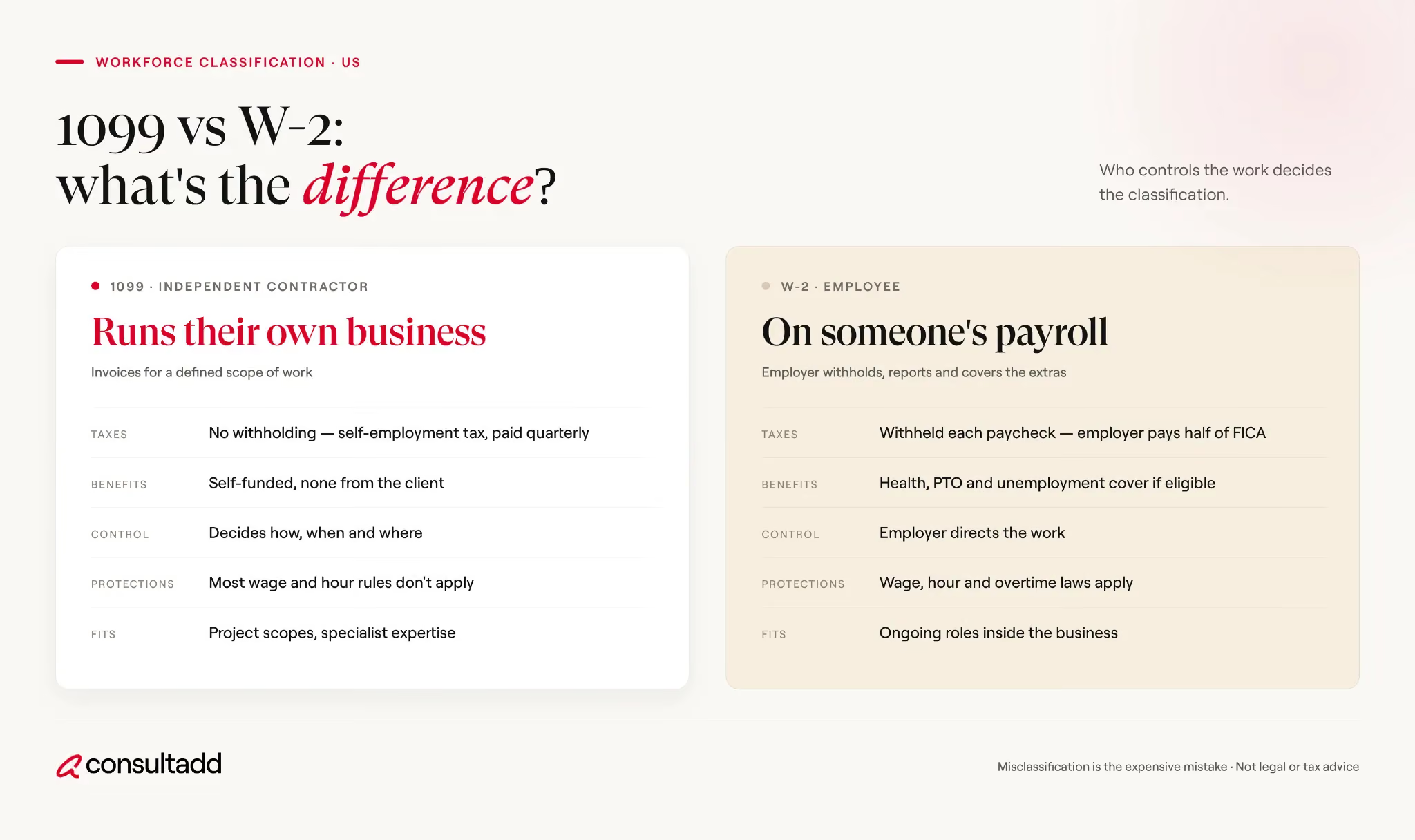
A W-2 employee is on a company's payroll.
- The employer withholds income tax, Social Security, and Medicare from each paycheck, pays the employer share of payroll taxes, and typically provides benefits.
- The employee works under the company's direction and gets legal protections like minimum wage and overtime.
A 1099 contractor is self-employed.
- The company pays them for services rendered, withholds nothing, and the contractor handles their own taxes.
- In exchange for that responsibility, the contractor generally controls how the work gets done and can serve multiple clients.
Here's the master comparison, then we'll dig into the parts that matter most.
The forms behind the labels
The names come straight from IRS forms, and the paperwork differs from day one.
As a W-2 employee, you fill out a Form W-4 when you start, which tells your employer how much tax to withhold. At year end, you receive a W-2 summarizing your wages and the taxes already taken out.
As a 1099 contractor, you fill out a Form W-9 to provide your taxpayer details. After the year ends, the client sends you a Form 1099-NEC reporting what they paid you, with nothing withheld.
One 2026 change worth noting: the 1099-NEC reporting threshold rose from $600 to $2,000 under the One Big Beautiful Bill Act. That changes when a client must issue the form, but it does not change your obligation to report all your income.
Taxes: the biggest difference
If you read one section twice, make it this one. Self-employment tax is the single biggest surprise for anyone moving from W-2 to 1099 income.
When you're a W-2 employee, the 15.3% Social Security and Medicare tax is split down the middle. You pay 7.65%, and your employer pays the other 7.65%.
As a 1099 contractor, you're legally both the employer and the employee, so you pay the full 15.3% yourself. That's 12.4% for Social Security and 2.9% for Medicare, calculated on about 92.35% of your net earnings, per IRS self-employment tax rules.
For 2026, the Social Security portion applies to the first $184,500 of earnings, with an added 0.9% Medicare tax on income above $200,000. On $100,000 of income, a 1099 contractor pays roughly $7,000 more in employment taxes than a W-2 employee earning the same amount.
That said, the gap is more nuanced than a flat penalty.
Contractors get deductions employees don't: you can deduct half of your self-employment tax, take the 20% qualified business income deduction (made permanent under recent law), and write off legitimate business expenses.
There's also a timing catch. Nobody withholds for you, so if you expect to owe $1,000 or more, you generally make quarterly estimated payments. Miss those deadlines and you face underpayment penalties, even if you pay the full amount by April.
Benefits and protections
Taxes are only half the story. The benefits gap is just as real, and it's easy to overlook when you compare two numbers that look the same on paper.
A W-2 job usually bundles in value that never shows on your salary line. A 1099 contractor has to buy or forgo all of it.
The dollars add up. A $100,000 W-2 position often carries an extra $20,000 to $40,000 in benefits value compared with $100,000 of 1099 income.
This is why a common rule of thumb says a 1099 rate should run 30% to 50% higher than the equivalent W-2 wage just to break even. If a W-2 job pays $50 an hour, a contractor usually needs to target $65 to $75 an hour to match the real take-home.
Pros and cons for workers
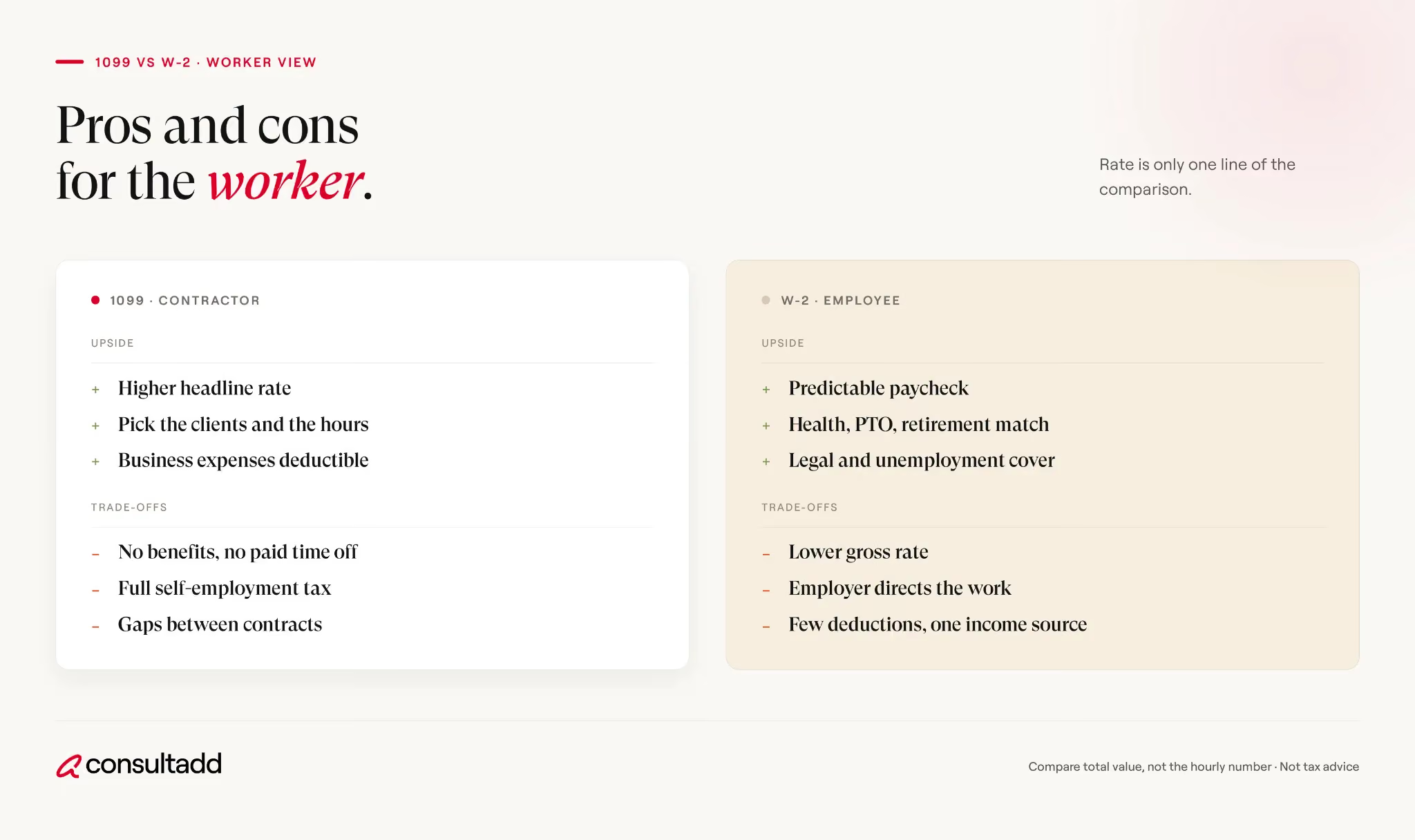
Neither option is universally better. It depends on what you value and where you are in your career.
Being a 1099 contractor offers real upside: higher gross pay, flexibility over your schedule and clients, the ability to deduct business expenses, and access to self-employed retirement plans with high contribution limits.
The trade-offs are the tax burden, the missing benefits, unpredictable income, and the admin of running your own taxes.
Being a W-2 employee offers stability: steady pay, benefits, legal protections, and taxes handled on autopilot. The trade-off is less flexibility and often a lower headline rate.
If you value predictability, W-2 tends to win. If you value autonomy and can manage the tax discipline, 1099 can pay off.
Classification is the law, not a choice
This is the part that surprises employers and workers alike. Whether a role is 1099 or W-2 is not a preference. It's a legal classification based on the actual working relationship, and you can't fix it with a label in a contract.
The IRS uses a three-factor test to decide, and the Department of Labor applies its own economic-reality test. Several states add their own standards on top.
Getting this wrong is costly. If the IRS or DOL reclassifies contractors as employees, a business can owe back payroll taxes, penalties, interest, unpaid overtime, and more, with intentional misclassification adding penalties up to $1,000 per worker and even personal liability for company officers.
The rules are also in motion: federal classification guidance shifted in 2025 and 2026, so anyone making these decisions should confirm the current standard rather than relying on old assumptions.
Beyond 1099 and W2: the C2C option
In tech and staffing, there's a third arrangement worth knowing, because 1099 and W-2 aren't the only ways to engage talent.
Corp-to-corp, or C2C, means you work through your own registered business, and the client contracts with that company rather than with you personally. It's a business-to-business relationship, common among IT professionals, with its own tax and compliance implications.
Consultadd's breakdown of W2 versus C2C explains how it compares, and its guide to corp-to-corp arrangements covers the mechanics.
There's also contract-to-hire, where you start on a contract, often as a W-2 employee of a staffing agency, and convert to a permanent role later.
Consultadd's look at the contract-to-hire model shows how that path works.
One practical note for workers who don't want the 1099 tax burden: when you work through a staffing agency as a W-2 contractor, the agency handles withholding and compliance as your employer of record. You get contract flexibility without carrying the full self-employment load yourself.
A closing reminder, because taxes and classification carry real consequences. The figures here reflect 2026 rules that can change, and your situation may differ.
Treat this as general information, not tax or legal advice, and check the current numbers with the IRS or a qualified professional before you decide.
Start Strong With Consultadd
With 15 years in business and 5,000+ successful staffing engagements, we don't just fill roles, we build reliability into your process. We've supported 65 staffing companies in the past year alone and maintain MSAs with industry leaders like Robert Half and TEKsystems.
Here's what working with Consultadd looks like:
- Talent sourced in under 24 hours
- Ready-to-deploy candidates, vetted for experience and compliance
- Lower turnover risk: we match long-term goals, not just short-term needs
- Seamless compliance: visa, documentation, onboarding? Handled.
- Dedicated 1:1 account managers for responsive, personalized support
- Top 100 candidate matches delivered in the past year
- Strong partnerships with universities to tap into fresh, committed talent
- Post-placement support so your investment grows beyond day one
For candidates, your next opportunity is more than just a job title, it's a chance to build skills, gain experience, and move your career forward. At Consultadd, we connect technology professionals with projects and employers that align with their goals, whether they're looking for contract, contract-to-hire, or long-term opportunities.
The tech job market moves fast, but the right guidance can make all the difference. Ready to take the next step in your career journey? Explore Opportunities >>
Key takeaways
- The core 1099 vs W2 difference is who handles taxes: a W-2 employer withholds and pays half of FICA, while a 1099 contractor pays it all.
- Contractors owe the full 15.3% self-employment tax versus a W-2 employee's 7.65% share, but they get offsetting deductions.
- W-2 roles include benefits and legal protections worth tens of thousands, which is why 1099 rates should run meaningfully higher to compare fairly.
- Classification is decided by the working relationship under IRS and DOL tests, not by a label, and misclassification carries serious penalties.
- In tech, corp-to-corp and W-2 contracting through an agency are common alternatives to going 1099.
FAQs
What is the main difference between 1099 and W2?
The main difference is who handles taxes and employment. A W-2 employee has taxes withheld by an employer who pays half of Social Security and Medicare and often provides benefits. A 1099 contractor is self-employed, receives pay with nothing withheld, and manages their own taxes and benefits.
Do 1099 contractors pay more taxes than W2 employees?
On employment taxes, yes. A 1099 contractor pays the full 15.3% self-employment tax, while a W-2 employee pays only the 7.65% employee share and the employer covers the rest. However, contractors can offset some of that with deductions, including half of the self-employment tax, the qualified business income deduction, and business expenses.
Is it better to be a 1099 or W2 employee?
It depends on your priorities. W-2 offers stability, benefits, and taxes handled for you, which suits people who value predictability. 1099 offers higher gross pay, flexibility, and deductions, which suits people who value autonomy and can manage their own taxes. Run the numbers on your specific situation, including benefits value.
Can an employer choose whether a worker is 1099 or W2?
No. Classification is determined by the nature of the working relationship, not by preference or a contract label. The IRS and Department of Labor use multi-factor tests looking at control and independence. Misclassifying an employee as a contractor can trigger back taxes, penalties, and legal liability.
What is the difference between a W-9 and a W-4?
A W-4 is what a W-2 employee fills out so their employer knows how much tax to withhold from each paycheck. A W-9 is what a 1099 contractor fills out to provide their taxpayer information to a client. The W-4 supports withholding, while the W-9 supports year-end 1099 reporting with no withholding.
What happens if a worker is misclassified as 1099?
Misclassification can be expensive for the business. Consequences include back payroll taxes, penalties and interest, liability for unpaid overtime, workers' compensation exposure, and unemployment claims. Intentional misclassification can add penalties per worker and even personal liability for company officers, so classification should be handled carefully.



.webp)