
.avif)

Introduction
Almost every guide to picking an IT staff augmentation firm tells you to check technical expertise, ask for references, and confirm cultural fit. Reasonable advice.
It also skips the two things that actually determine whether the engagement works: what the bill rate is paying for, and which contract terms you negotiated before you signed.
Those are the parts nobody explains, usually because the firm quoting you has no incentive to.
This guide covers the commercial side. What you are buying, how the rate gets built, the clauses worth fighting over, and the first month that decides whether you got value or just a higher invoice.
TL;DR
- An IT staff augmentation firm supplies people who work under your direction. You keep management control, they keep employer obligations.
- Markups in IT staffing typically run 25% to 75% on the bill rate, and most of that gap is cost, not profit.
- The terms that matter most are the conversion fee, the replacement guarantee, the notice period, and who owns the work product.
- Provisioning delay is the most common way companies destroy the speed advantage they paid a premium for.
- The model fits capacity and specialist gaps. It is the wrong tool for work you cannot define or supervise.
What you are actually buying
Staff augmentation means external professionals work inside your team, follow your process, and report to your managers. You direct the work. You own the outcome.
That last sentence is the whole model, and it is what separates augmentation from everything adjacent to it.
If you find yourself wanting the vendor to be accountable for whether the feature ships, you do not want augmentation. You want an SOW.
Our breakdown of IT staffing models and how each one works covers where each sits.
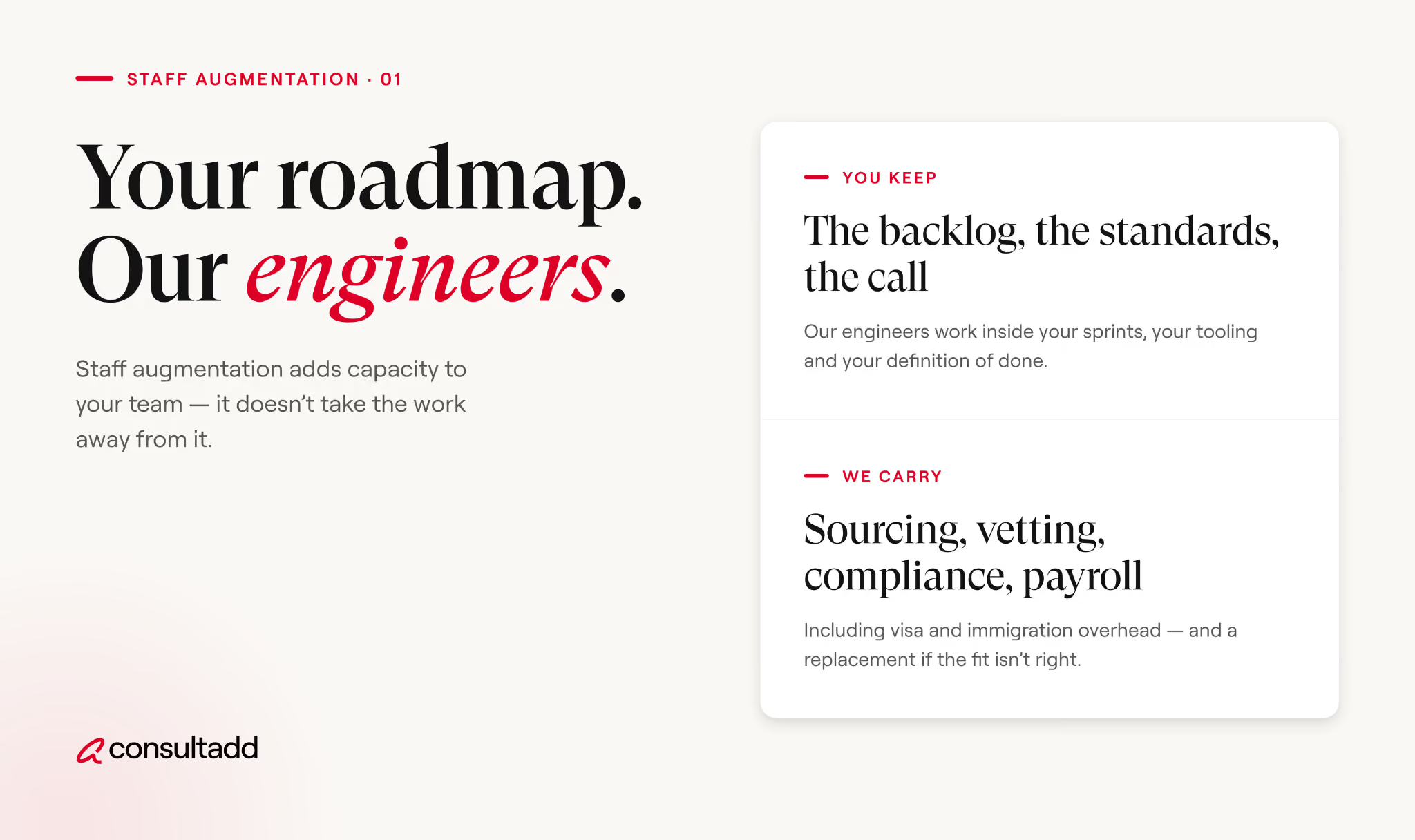
The augmentation firm's actual product is threefold: a sourcing and vetting function you do not have to build, employer-of-record infrastructure, and the ability to scale up and down without a hiring or severance cycle.
How the bill rate is built
You get quoted $128 an hour for a senior Java developer. You know that person could be hired at roughly $115,000 a year. The arithmetic feels wrong.
Here is the actual breakdown:
IT staffing markups generally run about 25% to 75% on contract bill rates, with direct-hire placement fees sitting at 15% to 30% of first-year salary.
A senior software developer paid $80 an hour typically bills somewhere around $112 to $132. A cybersecurity architect paid $100 an hour bills closer to $150 to $175, because scarcity raises both the pay and the recruiting cost.
Markup is not margin
This is the single most misunderstood number in the industry, and the confusion works against you in negotiation.
A 50% markup does not mean the firm keeps 50%. Once payroll taxes, insurance, and benefits come out, a 50% markup often leaves a gross margin in the high teens or low twenties, before the firm has paid a recruiter or a back office.
Two practical consequences. First, a firm quoting a 20% markup on a hard-to-fill role is either losing money, cutting benefits, or has a hidden fee elsewhere. Second, the number to negotiate is rarely the markup percentage. It is the pay rate, the conversion fee, and the volume tier.
Ask for the bill rate and the pay rate separately. A firm that will not show you the split is telling you something.
The market context behind current rates
Rates are not rising the way they were three years ago, and that changes your leverage.
Staffing Industry Analysts forecasts the US staffing market will grow 1% in 2026 to $180.2 billion, with roughly 2% growth in 2027.
That keeps the industry below its pre-pandemic size of $185.5 billion and well under the 2022 peak of $243.9 billion. The IT segment specifically is inching up around 1%.
Demand for labor overall has cooled but not collapsed. The U.S. Bureau of Labor Statistics reported 7.4 million job openings and 5.3 million hires in June 2026.
What that combination means for a buyer: generalist IT contract roles have softened, so you have room to negotiate.
Specialist skills, particularly cloud security, data engineering, and anything AI-adjacent, have not softened at all. Expect firm pricing there and do not waste a negotiation cycle on it.
Contract terms that decide the outcome
The MSA gets signed by procurement and then nobody reads it until something goes wrong. These are the clauses that matter.
The conversion fee is the one that catches most buyers. Staff augmentation frequently turns into contract-to-hire in practice, because a consultant who performs well for six months is exactly who you want to keep.
Negotiate the declining schedule at contract signature, when you have leverage, rather than at the moment you want to make an offer.
On work product, do not rely on a work-for-hire label alone. For software created by contractors, that designation often has no legal effect, and you need an express present assignment instead.
Co-employment and where the risk actually sits
In a proper staff augmentation arrangement, the firm is the employer of record. They run payroll, withhold taxes, carry workers' compensation, and handle unemployment insurance. That is a meaningful part of what your markup buys.
Your exposure is different. It is joint employment, sometimes called co-employment, where your conduct makes you look like an employer of the consultant alongside the firm.
The behaviors that create it are mundane: including contractors in performance review cycles, giving them internal titles and business cards, letting them approve other workers' time, or keeping an engagement running for years with no defined end.
Two practical guardrails:
- Route anything that looks like an employment decision through the firm's account manager, including discipline and termination.
- Keep the engagement's scope and end date documented, even when you expect to extend.
The exposure gets sharper in multi-tier chains, where a prime supplier subcontracts to another vendor who engages a consultant through their own entity.
Classification analysis under the Fair Labor Standards Act turns on economic reality rather than paperwork, and the Department of Labor is explicit that signing an independent contractor agreement does not by itself make someone a contractor. Ask your firm how many tiers sit between them and the person doing the work.
This is general information, not legal advice. Have counsel review your MSA.
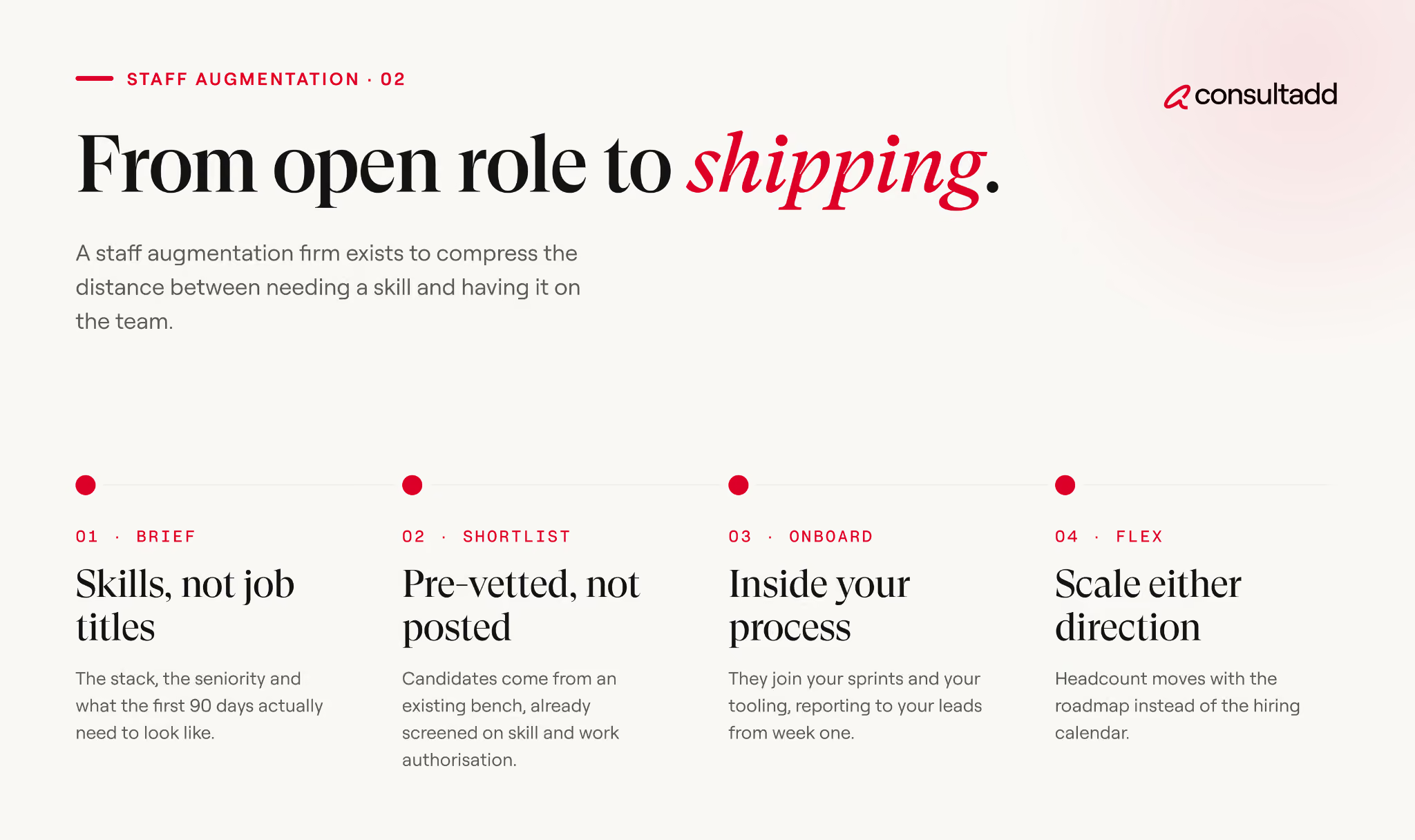
The first 30 days determine your ROI
Here is the sequence that quietly wastes the most money in this model.
The firm sources fast. You pick someone. The start date arrives. Then the consultant spends nine business days waiting on a laptop, a VPN certificate, an SSO group, and read access to one database controlled by a single overloaded platform engineer.
You are paying the bill rate that entire time.
Speed is the primary reason to use an IT staff augmentation firm rather than hire. Burning two weeks of it on provisioning gives back the advantage and leaves you with the premium.
If time to hire is the metric you are trying to move, our guide to time to hire benchmarks and what actually fixes them covers the upstream half of the problem.
When an IT staff augmentation firm is the wrong answer
Honest version, since this cuts against the pitch.
Augmentation struggles when the work cannot be defined well enough to hand over. If your own team cannot articulate what done looks like, adding a contractor adds supervision load, not capacity.
It struggles when you have no one to supervise. The model assumes your managers direct the work. Teams already at capacity often discover that onboarding and reviewing an augmented engineer costs more management hours than the engineer saves.
It struggles for genuinely core, long-horizon roles. If you will still need this function in three years, the cumulative bill rate exceeds the cost of hiring, and you have built institutional knowledge that walks out at the end of the engagement.
And it struggles when what you actually want is accountability for a delivered outcome. That is an SOW with a vendor who owns the result, priced and managed differently.
If you are still deciding between partners and models, our buyer's guide to IT staffing firms works through that comparison.
Start Strong With Consultadd
With 15 years in business and 5,000+ successful staffing engagements, we don't just fill roles, we build reliability into your process. We've supported 65 staffing companies in the past year alone and maintain MSAs with industry leaders like Robert Half and TEKsystems.
Here's what working with Consultadd looks like:
- Talent sourced in under 24 hours
- Ready-to-deploy candidates, vetted for experience and compliance
- Lower turnover risk: we match long-term goals, not just short-term needs
- Seamless compliance: visa, documentation, onboarding? Handled.
- Dedicated 1:1 account managers for responsive, personalized support
- Top 100 candidate matches delivered in the past year
- Strong partnerships with universities to tap into fresh, committed talent
- Post-placement support so your investment grows beyond day one
For candidates, your next opportunity is more than just a job title, it's a chance to build skills, gain experience, and move your career forward. At Consultadd, we connect technology professionals with projects and employers that align with their goals, whether they're looking for contract, contract-to-hire, or long-term opportunities.
The tech job market moves fast, but the right guidance can make all the difference. Ready to take the next step in your career journey? Explore Opportunities >>
Key takeaways
- Staff augmentation means you direct the work and own the outcome. If you want the vendor accountable for delivery, you need an SOW instead.
- Markup is not margin. Ask for the bill rate and pay rate separately, and negotiate the pay rate and conversion fee rather than the markup percentage.
- Settle the conversion fee schedule at signature, because augmentation often becomes contract-to-hire in practice.
- Work-for-hire language alone will not transfer ownership of software. Require present assignment language.
- Start provisioning the day you sign. Onboarding delay is the most common way buyers lose the speed they paid for.
FAQs
What does an IT staff augmentation firm actually do?
It sources and vets technical professionals, employs them as the employer of record, and places them into your team to work under your direction. The firm handles payroll, taxes, workers' compensation, and compliance. You manage the day-to-day work and own the deliverables.
How much does IT staff augmentation cost?
Pricing is usually an hourly bill rate carrying a markup of roughly 25% to 75% over the consultant's pay rate, depending on skill scarcity and volume. Most of that markup covers payroll taxes, insurance, benefits, and recruiting rather than profit. Specialist roles like cloud security and data engineering sit at the top of the range.
What is the difference between staff augmentation and outsourcing?
With augmentation, external staff work under your management and you own the outcome. With outsourcing or managed services, the vendor takes responsibility for a defined deliverable or service level and manages its own people. The choice comes down to whether you want control or accountability.
Can I hire an augmented contractor as a full-time employee?
Usually yes, subject to a conversion fee in your agreement. Negotiate a declining fee schedule upfront, ideally reaching zero after six to twelve months of engagement. Without that term, converting a strong performer can cost as much as a direct placement fee.
Who owns the code an augmented developer writes?
Whoever your contract says, assuming the language is drafted correctly. Work-for-hire designation alone generally does not transfer copyright in software, so the agreement needs an express present assignment. Confirm the assignment holds at every tier if subcontractors are involved.
Is staff augmentation risky from a compliance standpoint?
The firm carries employer obligations, which removes most direct exposure. Your residual risk is joint employment, created by treating contractors like staff in reviews, titles, or discipline. Route employment-type decisions through the firm and keep engagement scope and end dates documented.


.webp)

.png)
