

Introduction
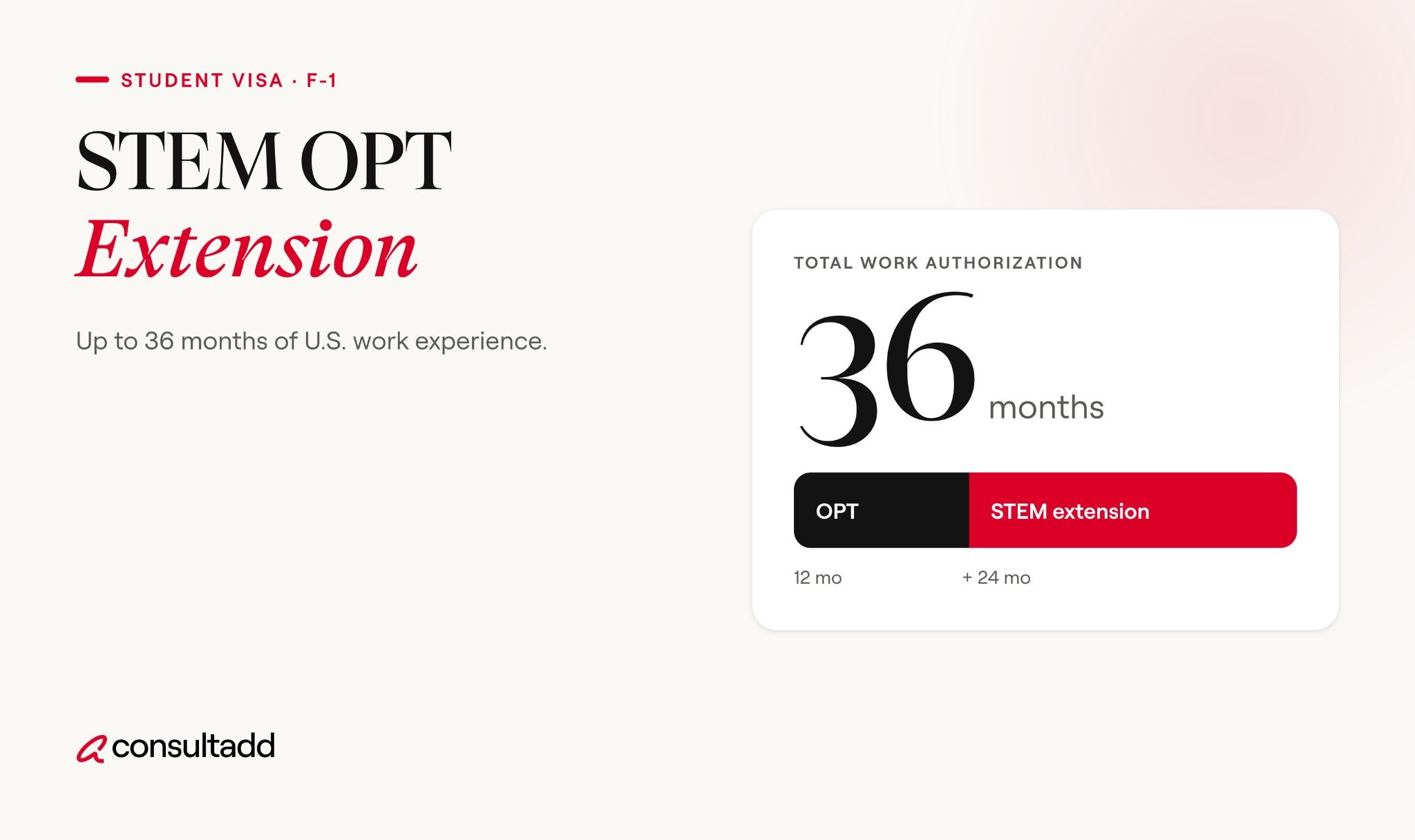
Your 12 months of OPT go by faster than you expect. You start a job, get through onboarding, and the EAD end date is suddenly a few months away. If your degree is in a qualifying STEM field, an OPT extension can add 24 more months of work authorization, for 36 months in total.
The STEM OPT extension isn't automatic, though. You need the right degree, an employer enrolled in E-Verify, a signed training plan, and an application that reaches USCIS before your current EAD expires. Miss one of those and the extension can fall apart.
This guide covers who qualifies, when to file, what to submit, and what changed in 2026.
TL;DR
- The STEM OPT extension adds 24 months to post-completion OPT, for up to 36 months of work authorization on one degree.
- You need a degree on the DHS STEM list, an E-Verify employer, and a Form I-983 training plan signed by you and your employer.
- File Form I-765 within 90 days before your OPT EAD expires, and within 60 days of your DSO's recommendation.
- If you file on time, you can keep working for up to 180 days while the application is pending.
- The 2026 duration of status rule was struck down in court, and the proposed $30,000 STEM OPT fee is not in effect.
What is an OPT extension?
When people say "OPT extension," they almost always mean the 24-month STEM OPT extension. It's the only way to stretch post-completion OPT beyond 12 months on the same degree.
Regular OPT gives F-1 graduates 12 months to work in a job related to their major. If you want a refresher on how that first year works, our guide to how OPT work authorization works covers the basics.
The STEM extension builds on that first year. It doesn't replace it. You have to be in a valid period of post-completion OPT to apply, and you can't apply for a STEM extension while on pre-completion OPT.
This matters for a lot of people. About 294,000 international students participated in OPT in the 2024-25 academic year, more than double the number from a decade earlier, according to Institute of International Education data reported by Higher Ed Dive.
Who qualifies for the STEM OPT extension
STEM OPT eligibility depends on three things: your degree, your employer, and your job.
Degree requirements
Your degree must appear on the DHS STEM Designated Degree Program List. The list goes by CIP code, so check the code on your I-20 rather than your major's name. "Data Analytics" at one school might qualify while a similar program somewhere else does not.
Some other rules:
- The degree must come from an accredited, SEVP-certified U.S. school.
- You can use a previous STEM degree if it was earned at the bachelor's level or higher within the 10 years before you apply.
- You can get a STEM extension up to two times in your life, once per higher degree level.
Employer requirements
The employer side trips people up more than the degree side.
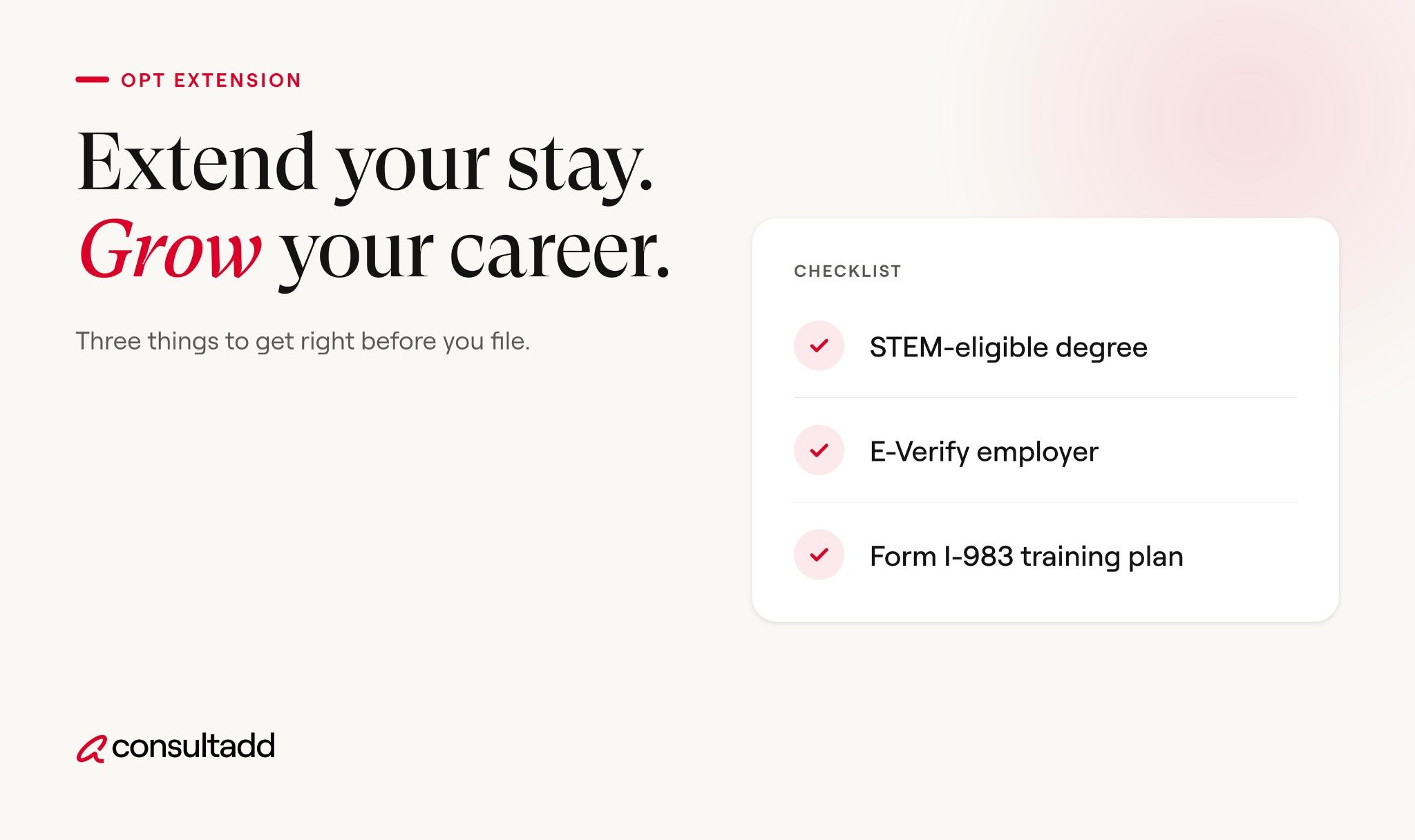
Your employer must be enrolled in E-Verify, and you and your employer must complete Form I-983, the training plan for STEM OPT students. The job must relate directly to your STEM degree, be paid, and be at least 20 hours a week. Your pay also has to match what the employer pays similarly situated U.S. workers.
You also need a bona fide employer-employee relationship. Self-employment doesn't count. Staffing arrangements are allowed, but the employer that signs the I-983 must be the same entity that provides the practical training experience. If an agency only places you and someone else trains and supervises you, that setup usually won't qualify.
Here's how that plays out in practice. A recruiter might find a great data engineering role at a client company, but if the staffing firm can't supervise the training plan itself, the candidate can't use that role for STEM OPT. Good staffing partners check this before the offer, not after.
OPT extension timeline: when to apply
Timing is where most OPT extension problems start. The filing window is short, and USCIS doesn't give you room to be late.
The 60-day rule gets overlooked. After the DSO issues your STEM OPT I-20, you must file Form I-765 and supporting documents within 60 days of the I-20 issue date. If your I-983 takes weeks to finalize, that can squeeze your window.
Plan to start the I-983 conversation with your employer about four months before your EAD expires. That gives HR, your manager, and your DSO time to get it right.
How to apply for a STEM OPT extension
Here's the process from start to finish. Your school's portal may look different, but the order is the same everywhere.
- Confirm your degree is on the STEM list. Match your I-20's CIP code against the list on the Study in the States STEM OPT Hub.
- Confirm your employer uses E-Verify. Ask HR for the company's E-Verify number. You'll need it on the I-983 and the I-765.
- Complete Form I-983 with your employer. Spell out your training goals, how you'll be supervised, and how you'll be evaluated. Generic answers lead to delays.
- Request a STEM OPT I-20 from your DSO. Submit the signed I-983 through your school's process. Many schools charge an admin fee.
- File Form I-765 with USCIS. Use eligibility category (c)(3)(C). Filing online through a myUSCIS account is usually faster and easier to track.
- Pay the filing fee. According to the USCIS fee schedule, filing Form I-765 online costs $470. Paper filing costs more. Confirm the current amount on the USCIS Form I-765 page before you pay.
- Send your receipt notice to your DSO. Keep a copy handy for your employer's HR team.
Documents you'll need
- STEM OPT I-20 signed by your DSO and signed by you
- Copy of your current OPT EAD (front and back)
- Copy of your STEM degree or transcript showing the degree field
- Passport, F-1 visa, and most recent I-94
- Passport-style photos if required for your filing method
- Your employer's name and E-Verify number
You don't send the I-983 to USCIS. It goes to your DSO, who keeps it on file. USCIS can ask for it later, so keep your own copy.
Premium processing is available for STEM OPT applications through Form I-907 for an extra fee. It's worth considering if you need the new EAD quickly for travel or a job change.
Working while your OPT extension is pending
This is the part that stresses people out the most, and it's simpler than it seems.
If USCIS receives your STEM OPT application before your current EAD expires, you can keep working for up to 180 days after the EAD end date while the case is pending. Your receipt notice and old EAD work as proof for your employer.
If the 180 days run out before you get a decision, you have to stop working. You can stay in the U.S., but you can't keep working until approval. Some universities tell students to expect three to four months of processing, but times change.
Check current USCIS processing times for Form I-765.
One more limit: you can't apply for a STEM extension once your OPT has ended. USCIS says you also can't apply after a cap-gap extension ends and you've entered the 60-day grace period.
Rules to follow once your STEM OPT is approved
Approval isn't the finish line. STEM OPT comes with more reporting than regular OPT, and missed reports can create status problems.
Our checklist on the first 30 days after your EAD arrives walks through setting up your SEVP Portal reporting.
The unemployment limit
Regular OPT allows 90 days of unemployment. The STEM extension adds 60 more, for 150 days total across the full 36 months. Days you used during your first year count toward that 150.
Unemployment days keep counting if you leave the country while unemployed. Track them yourself instead of relying on memory.
Changing employers on STEM OPT
You can change jobs on STEM OPT, but the new employer must also use E-Verify, and you need a new I-983 with them. Submit it to your DSO within 10 days of starting.
Before you accept an offer, ask HR whether they've hired STEM OPT employees before. If they don't know what an I-983 is, build in extra time.
If you're still looking, our guide to finding OPT-friendly employers covers which search terms bring up the right roles.
OPT vs STEM OPT extension at a glance
If you're still in school and deciding how to use your work authorization, OPT vs CPT explains why using 12 months of full-time CPT can cost you both OPT and the STEM extension.
What changed for OPT extensions in 2026
2026 brought two big proposals that affect F-1 students. As of late November 2026, neither changes how you apply for an OPT extension today.
The duration of status rule was struck down
DHS published a final rule in July 2026 to replace "duration of status" with fixed admission periods. It would have added more paperwork, including a possible Form I-539 filing alongside some OPT applications.
A federal judge in Massachusetts blocked the rule before it took effect in September. Then, on November 16, 2026, the court vacated the rule, so it isn't in effect. Current OPT and STEM OPT rules remain in place, though DHS may appeal.
The proposed OPT fees
In October 2026, DHS proposed a rule that would require a $70,000 fee for a student's first OPT period and $30,000 for later periods, including STEM OPT extensions. Schools would pay it before recommending a student, though they could pass the cost on.
The comment period ended November 9, 2026, and the proposed fees don't apply right now. You can read the proposal on Regulations.gov.
Nobody knows yet whether the fee will be finalized or in what form. If your STEM OPT window opens in 2027, it makes sense to file as early as your window allows and stay in close contact with your DSO.
The STEM OPT extension and H-1B cap-gap
For many people, the real value of the STEM extension is time. Three years of OPT usually means up to three H-1B lottery attempts instead of one.
If your employer files a timely cap-subject H-1B petition requesting a change of status while you're on STEM OPT, cap-gap can bridge the gap. Your STEM OPT period may be automatically extended to cover the gap between the end of your STEM OPT and the H-1B start, up until April 1 of the fiscal year.
Cap-gap only applies to change-of-status petitions. If the petition uses consular processing, or you travel abroad while it's pending, the bridge may not hold.
Our H-1B sponsorship guide covers how to line up sponsorship before your STEM OPT runs out.
Common OPT extension mistakes recruiters see
Most denials and delays come from a short list of avoidable problems.
One pattern recruiters see often is candidates assuming HR will handle the whole process. HR handles its part, but the deadlines are yours. The candidates who move smoothly are the ones who come to the offer conversation with their EAD end date and their STEM eligibility already confirmed.
For official guidance, the USCIS STEM OPT page is the most reliable reference, and your DSO is the person to ask about your specific case.
Final thoughts on your OPT extension
The OPT extension gives STEM graduates two more years to build experience and take more shots at H-1B. Most of the work happens before you file: confirming your CIP code, checking that your employer uses E-Verify, and getting a solid I-983 signed with time to spare.
After approval, the job is steady compliance. Report changes, submit validations on time, and track your unemployment days. Policy is unsettled right now, so check with your DSO before every major step, especially if your filing window opens in 2027.
For context on our experience, Consultadd appeared on ICE's 2018 list of top 200 employers for OPT and STEM OPT students.
Start Strong With Consultadd
With 15 years in business and 5,000+ successful staffing engagements, we don't just fill roles, we build reliability into your process. We've supported 65 staffing companies in the past year alone and maintain MSAs with industry leaders like Robert Half and TEKsystems.
Here's what working with Consultadd looks like:
- Talent sourced in under 24 hours
- Ready-to-deploy candidates, vetted for experience and compliance
- Lower turnover risk: we match long-term goals, not just short-term needs
- Seamless compliance: visa, documentation, onboarding? Handled.
- Dedicated 1:1 account managers for responsive, personalized support
- Top 100 candidate matches delivered in the past year
- Strong partnerships with universities to tap into fresh, committed talent
- Post-placement support so your investment grows beyond day one
For candidates, your next opportunity is more than just a job title, it's a chance to build skills, gain experience, and move your career forward. At Consultadd, we connect technology professionals with projects and employers that align with their goals, whether they're looking for contract, contract-to-hire, or long-term opportunities.
The tech job market moves fast, but the right guidance can make all the difference. Ready to take the next step in your career journey? Explore Opportunities >>
Key takeaways
- An OPT extension through STEM OPT adds 24 months, but only for degrees on the DHS STEM list.
- Your employer must use E-Verify and sign a Form I-983 training plan, and it must be the entity that actually trains you.
- USCIS must receive your I-765 before your EAD expires and within 60 days of your DSO's recommendation.
- A timely filing lets you keep working for up to 180 days while the case is pending.
- As of November 2026, the duration of status rule is vacated and the proposed $30,000 STEM OPT fee isn't in effect.
FAQs
1. How long is the OPT extension for STEM students?
The STEM OPT extension lasts 24 months. Combined with the first 12 months of post-completion OPT, that's up to 36 months of work authorization on one degree.
2. When should I apply for my STEM OPT extension?
You can file up to 90 days before your current OPT EAD expires. USCIS must receive the application before the expiration date. Start the I-983 with your employer about four months ahead so you aren't rushed.
3. Can I work while my OPT extension is pending?
Yes, if USCIS received your application before your OPT EAD expired. You can keep working for up to 180 days past the expiration date while the case is pending. If the 180 days run out, you must stop working until approval.
4. What happens if my employer isn't enrolled in E-Verify?
You can't use that job for a STEM OPT extension. Your employer would need to enroll before you apply, or you'd need a new job with an E-Verify employer. Confirm this before you accept an offer.
5. Can I change jobs during my STEM OPT extension?
Yes. The new employer must use E-Verify, and you must complete a new I-983 with them. Submit it to your DSO within 10 days of starting the new job.
6. How much does the STEM OPT extension cost in 2026?
The current USCIS fee for Form I-765 is $470 when filed online, with a higher fee for paper filing. Many schools also charge their own processing fee. DHS proposed a $30,000 fee for STEM OPT extensions in October 2026, but it isn't in effect.