
.avif)

Introduction
If you hold a green card and your spouse or young child is still overseas, your case almost certainly sits in F2A. So what is F2A visa category in plain terms?
It is the "A" half of the family second preference, set aside for the spouses and unmarried children under 21 of lawful permanent residents. The catch is that F2A applicants draw from a capped pool of visas each year, which is why a priority date and the monthly Visa Bulletin end up controlling your timeline more than anything you file.
This guide covers who qualifies, how the process runs, what the numbers look like right now, and the mistakes that quietly cost families a year or more.
TL;DR
- F2A covers spouses and unmarried children under 21 of green card holders. Spouses and children of U.S. citizens are immediate relatives instead, with no annual cap.
- Family second preference gets 114,200 visas a year, and F2A takes 77% of that. Three quarters of F2A numbers are exempt from per-country limits, which is why F2A moves faster than F2B or F4 for India and Mexico.
- Your priority date is the day USCIS receives the Form I-130. Nothing moves until that date clears the Visa Bulletin cutoff for your country.
- On the September 2026 bulletin, F2A is currently on the Dates for Filing chart for every country, while the Final Action Date sits at August 22, 2026 for most countries and August 22, 2025 for Mexico.
- Children close to 21 need the Child Status Protection Act math run early, and they must seek permanent residence within one year of a visa becoming available or the protection drops.
What the F2A category actually is
F2A is a slice of the family-sponsored preference system created by section 203(a) of the Immigration and Nationality Act. The second preference as a whole gets 114,200 visas per year, plus any numbers the first preference does not use.
Inside that, F2A takes 77% of the total, and 75% of those F2A numbers are exempt from the per-country limit. F2B, unmarried sons and daughters aged 21 or older, gets the remaining 23%.
That per-country exemption is the single most useful thing to understand about F2A. Most family categories are throttled hard for high-demand countries, because no country can take more than 7% of the combined family and employment totals.
For fiscal year 2026, the worldwide family preference limit is 226,000 and the per-country limit is 28,862. Because three quarters of F2A numbers sit outside that cap, F2A cutoff dates for India, Mexico, China and the Philippines usually track close to the worldwide date instead of falling years behind.
The practical result: an Indian national in F2A waits a fraction of what an Indian national in F4 waits. Same statute, very different math.
Who qualifies for F2A
Two groups, and no others.
Spouses of green card holders
- The marriage has to be legally valid where it took place and it has to be real, not arranged for immigration purposes.
- Same-sex marriages qualify as long as the marriage is legally recognized in the place it was registered.
- The petitioner has to be a lawful permanent resident at the time of filing, not a U.S. citizen, and not someone with a pending green card application.
Unmarried children under 21
- Biological children, stepchildren and adopted children can all qualify.
- Stepchildren only count if the marriage between the child's biological parent and the permanent resident happened before the child turned 18.
- Adopted children qualify only when the legal relationship was created before specific age cutoffs, so adoption cases are worth running past an attorney rather than assuming.
Who does not qualify
- A green card holder cannot sponsor a parent or a sibling at all. Those categories exist only for U.S. citizens.
- Children who marry drop out of F2A immediately.
- A married son or daughter of a green card holder has no preference category whatsoever until the parent naturalizes, at which point the case becomes F3.
- Children who turn 21 move to F2B, which is a much slower line.
F2A compared with the other family categories
Where F2A sits relative to everything else, using the September 2026 Final Action Dates:
How the F2A process works
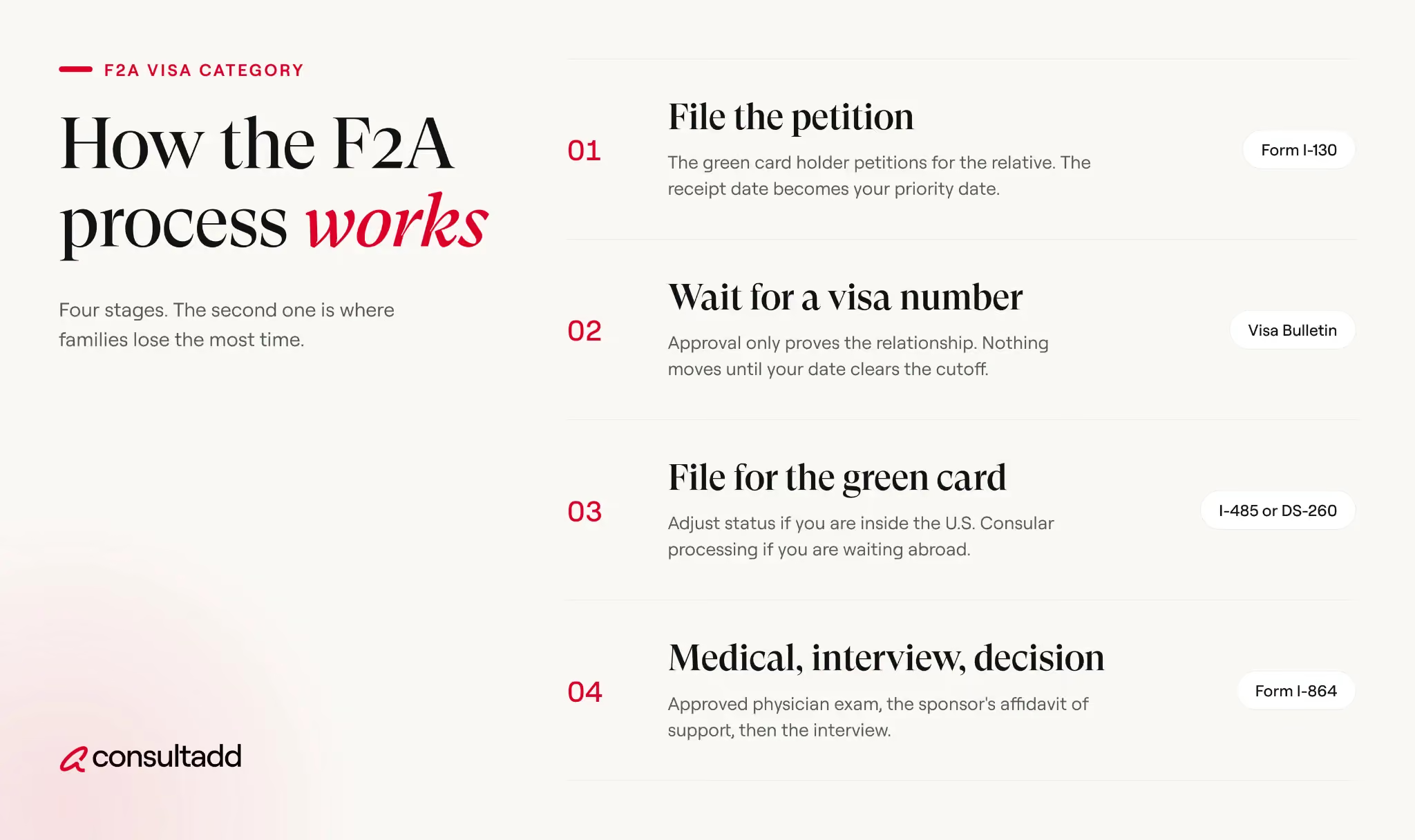
Four stages, and the second one is where families lose time.
Step 1: file Form I-130
The green card holder files Form I-130, Petition for Alien Relative, with USCIS. Filing fees are $625 online through a myUSCIS account or $675 by mail, unchanged since the April 2024 fee rule. A spouse petition also needs Form I-130A, which carries no separate fee. One petition and one fee per relative, so a spouse and two stepchildren means three filings.
The date USCIS receives the petition becomes the priority date. That date is your place in line and it does not change, even if the petition later gets an RFE or sits for years.
Step 2: wait for a visa number
An approved I-130 does not grant status, work permission, travel permission, or admission to the United States. It only establishes the relationship.
Everything after that waits on the Visa Bulletin. If you are unclear on how sponsorship-based petitions differ from work-based ones, our breakdown of how visa sponsorship works in the U.S. covers the distinction.
Step 3: adjustment of status or consular processing
If the beneficiary is already inside the United States in valid status, they file Form I-485 to adjust status. If they are abroad, the case goes to the National Visa Center, then to a consulate for an interview.
Which chart you use depends on where you are. Applicants outside the U.S. use the Final Action Dates chart. Applicants filing I-485 inside the U.S. use whichever chart USCIS designates that month, published at uscis.gov/visabulletininfo.
USCIS has been designating the Dates for Filing chart for family categories through mid-2026, but it makes that call fresh every month.
Step 4: medical exam, interview, decision
The medical exam has to be done by a USCIS-designated civil surgeon for adjustment cases, or a panel physician abroad.
The sponsor also files Form I-864, Affidavit of Support, promising the government the relative will not become a public charge. Then comes the interview and the decision.
Reading the Visa Bulletin for F2A
Here is where F2A stood in September 2026:
First, F2A numbers exempt from the per-country limit went to applicants from all countries with priority dates before August 22, 2025. Numbers subject to the per-country limit went to every country except Mexico for dates from August 22, 2025 up to August 22, 2026, and all Mexican F2A numbers are exempt from the cap.
Second, the State Department attached a warning to the whole bulletin: dates were pushed forward across categories partly because immigrant visa issuance dropped for nationals of certain countries under recent administration actions, and retrogression may be necessary if demand materializes.
Read that as a reason to file when your date is current rather than waiting for a better month. A filing already submitted while the date was current is not undone by a later pullback.
Also note that a fiscal year rollover on October 1 resets the annual numbers, and dates can shift in either direction. Always check the current Visa Bulletin on travel.state.gov rather than a summary.
F2A wait times and costs in 2026
The honest answer on timing is that the petition stage, not the visa line, is the bottleneck right now. Boundless, reading USCIS data, puts the F2A I-130 at roughly 45.5 months for fiscal year 2026, against about 12.9 months for a citizen's spouse filing from abroad.
Other trackers' reports range from the mid-30s to over 100 months depending on service center and how the percentile is calculated. Check the USCIS processing times tool with your own receipt number instead of trusting any single figure, including this one.
Rough government costs, excluding the medical exam and any attorney fees:
Fees change, so confirm against the current USCIS G-1055 fee schedule before you pay. A wrong payment amount gets the whole package rejected, and you refile from scratch.
Aging out and the Child Status Protection Act
This is the part of F2A that catches families off guard.
A child who turns 21 while waiting normally falls out of F2A. The Child Status Protection Act softens that by subtracting the time the I-130 was pending from the child's actual age. If the resulting CSPA age is under 21, the child stays eligible.
There is a second requirement that trips people up. The child must seek to acquire permanent residence within one year of a visa becoming available, by filing the I-485, paying the immigrant visa fee, paying the I-864 review fee, or having an I-824 filed on their behalf.
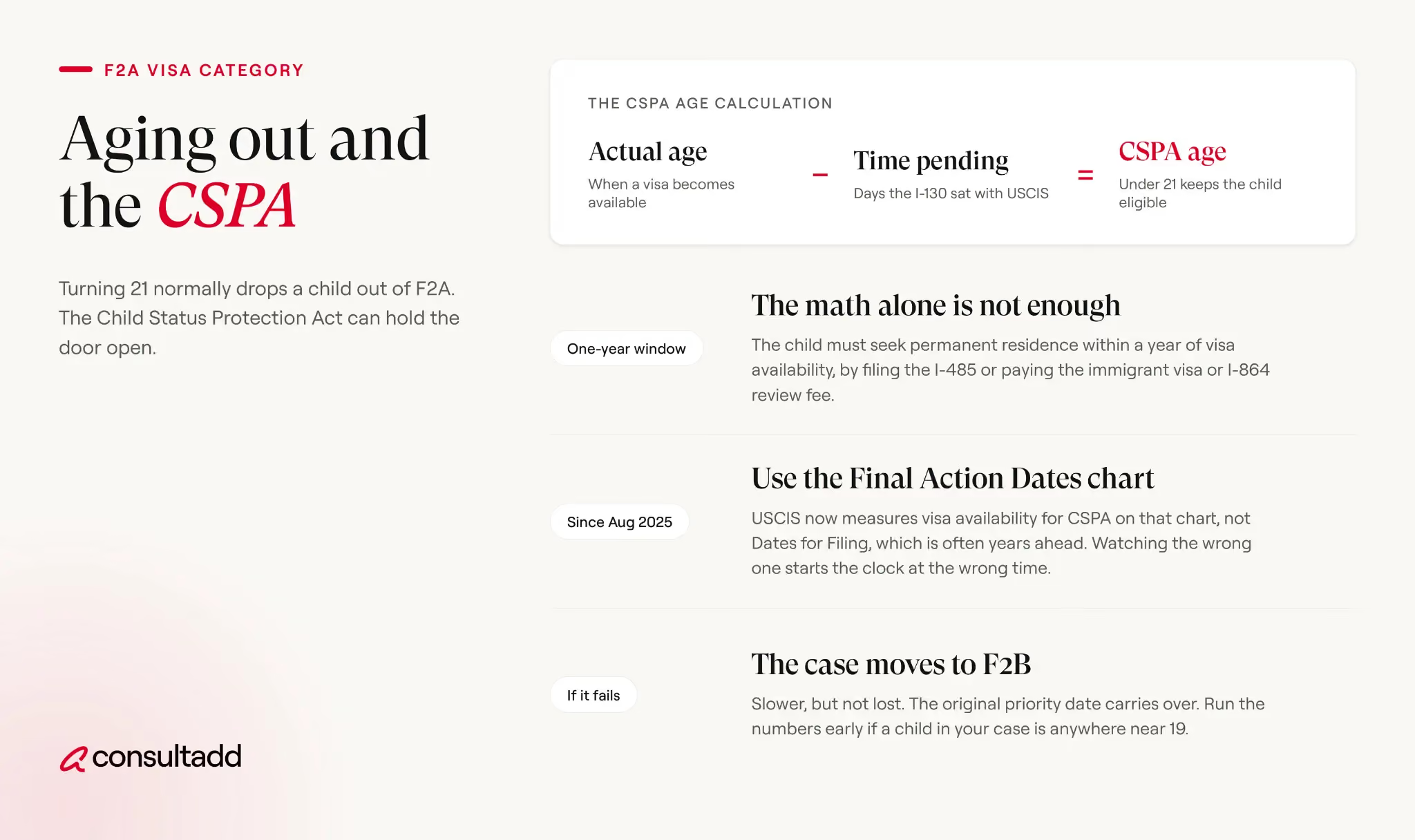
Miss that window and the protection is gone, even if the CSPA math worked out. USCIS can excuse a missed deadline for extraordinary circumstances, but that is discretionary, not a plan.
Since August 15, 2025, USCIS measures visa availability for CSPA purposes using the Final Action Dates chart, matching what the State Department already did for consular cases. That change matters because the Dates for Filing chart is often years ahead. A family watching the wrong chart can start the one-year clock in their head at the wrong time.
If a child does age out despite CSPA, the case converts to F2B and keeps the original priority date. Slower, but not lost. The USCIS guidance on CSPA and the detailed rules in Volume 7, Part A, Chapter 7 of the Policy Manual are worth reading directly if a child in your case is anywhere near 19.
What changes if the sponsor naturalizes
If the petitioning green card holder becomes a U.S. citizen before the beneficiary gets their green card, the category converts automatically.
A spouse becomes an immediate relative with no annual cap and no visa line. A child under 21 also becomes an immediate relative. A son or daughter over 21 converts to F1, and a married one to F3.
For a family sitting in a long F2A petition queue, naturalizing is often the fastest available move, and it removes the aging-out risk for children entirely, because immediate relatives lock their age at the filing date rather than running through the CSPA formula.
If the sponsor naturalizes mid-case, notify USCIS or the National Visa Center with proof of citizenship so the file gets reclassified.
Mistakes that delay F2A cases
From what we see across compliance and documentation work with candidates and their families, the same handful of problems keep recurring.
1. Watching the wrong chart.
Dates for Filing and Final Action Dates are different numbers with different uses. Filing off the wrong one either wastes a fee or wastes a year.
2. Waiting for a better month.
Families sometimes hold off when a date turns current, hoping for cleaner timing. Meanwhile the CSPA clock runs and the bulletin can retrogress.
3. Thin marriage evidence.
A certificate alone rarely satisfies a bona fide marriage review. Joint leases, shared accounts, insurance, photos across time, and travel records do more work than a stack of affidavits.
4. Assuming an approved I-130 means something it does not.
It confers no status and no right to work. If work authorization is the actual concern, our guide to work authorization types and EAD basics sets out what does and does not grant it.
5. Missing an RFE or a document deadline.
USCIS and the NVC set firm response windows. A late reply can stall a case or close it.
6. Confusing document numbers.
The number on a visa foil is not a case number, a priority date, or a visa slot.
We explain what the visa number on a U.S. visa actually means because the mix-up shows up constantly in intake calls.
One more thing worth saying plainly: this is general information, not legal advice. Adoption, prior marriages, unlawful presence, and criminal history all change the analysis, and those cases need a licensed immigration attorney. For an official starting point on eligibility, USAGov's family sponsorship page is a good neutral reference.
Start Strong With Consultadd
With 15 years in business and 5,000+ successful staffing engagements, we don't just fill roles, we build reliability into your process. We've supported 65 staffing companies in the past year alone and maintain MSAs with industry leaders like Robert Half and TEKsystems.
Here's what working with Consultadd looks like:
- Talent sourced in under 24 hours
- Ready-to-deploy candidates, vetted for experience and compliance
- Lower turnover risk: we match long-term goals, not just short-term needs
- Seamless compliance: visa, documentation, onboarding? Handled.
- Dedicated 1:1 account managers for responsive, personalized support
- Top 100 candidate matches delivered in the past year
- Strong partnerships with universities to tap into fresh, committed talent
- Post-placement support so your investment grows beyond day one
For candidates, your next opportunity is more than just a job title, it's a chance to build skills, gain experience, and move your career forward. At Consultadd, we connect technology professionals with projects and employers that align with their goals, whether they're looking for contract, contract-to-hire, or long-term opportunities.
The tech job market moves fast, but the right guidance can make all the difference. Ready to take the next step in your career journey? Explore Opportunities >>
Key takeaways
- The F2A visa category is for spouses and unmarried children under 21 of lawful permanent residents, and it is capped, unlike the immediate relative route open to U.S. citizens.
- F2A gets 77% of the 114,200 second preference visas, and 75% of those numbers ignore per-country limits, which keeps F2A far ahead of F2B, F3 and F4 for high-demand countries.
- Your priority date is the day USCIS receives the I-130, and it survives every later delay in the case.
- As of September 2026, F2A is current on the Dates for Filing chart for all countries, with Final Action Dates at August 22, 2026 for most countries and August 22, 2025 for Mexico.
- Children approaching 21 need the CSPA calculation done early, and they must seek permanent residence within one year of visa availability measured on the Final Action Dates chart.
FAQs
Is the F2A visa the same as a green card?
No. F2A is a preference category that determines when an immigrant visa number becomes available to you. The green card comes at the end, either through adjustment of status inside the United States or an immigrant visa at a consulate abroad. Being in F2A means you are in line, not that you have been approved.
How long does the F2A process take in 2026?
Most of the wait is now in the petition stage rather than the visa line. Boundless puts the F2A I-130 at around 45.5 months for fiscal year 2026, and other trackers report wider ranges depending on service center. Because F2A is current on the Dates for Filing chart, many beneficiaries can move to the green card stage as soon as the petition is approved.
Can my spouse work or travel while the F2A case is pending?
Not on the strength of the I-130 alone. If your spouse is inside the United States and files Form I-485, they can file Form I-765 for a work permit and Form I-131 for travel permission at the same time. A spouse waiting abroad has no U.S. work authorization until they are admitted as a permanent resident.
Is the F2A category current right now?
On the September 2026 Visa Bulletin, F2A was listed as current on the Dates for Filing chart for every country, while the Final Action Dates chart still showed cutoffs. Those are two separate charts with two separate uses, so check which one applies to your situation. The State Department has also warned that retrogression may be necessary in coming months.
What happens to an F2A petition if the sponsor becomes a U.S. citizen?
The category converts automatically. A spouse and any child under 21 become immediate relatives, which removes the annual cap and the visa line entirely. A son or daughter over 21 converts to F1, or F3 if married. Notify USCIS or the National Visa Center with proof of naturalization so your file gets reclassified.
Can my spouse bring our children on the same F2A case?
Often yes. Under section 203(d) of the INA, spouses and children of preference immigrants get the same status and the same order of consideration when accompanying or following to join the principal applicant. Whether a separate I-130 is also advisable depends on the children's relationship to the sponsor and their ages, so this is worth confirming case by case..
.webp)




.webp)