

Introduction
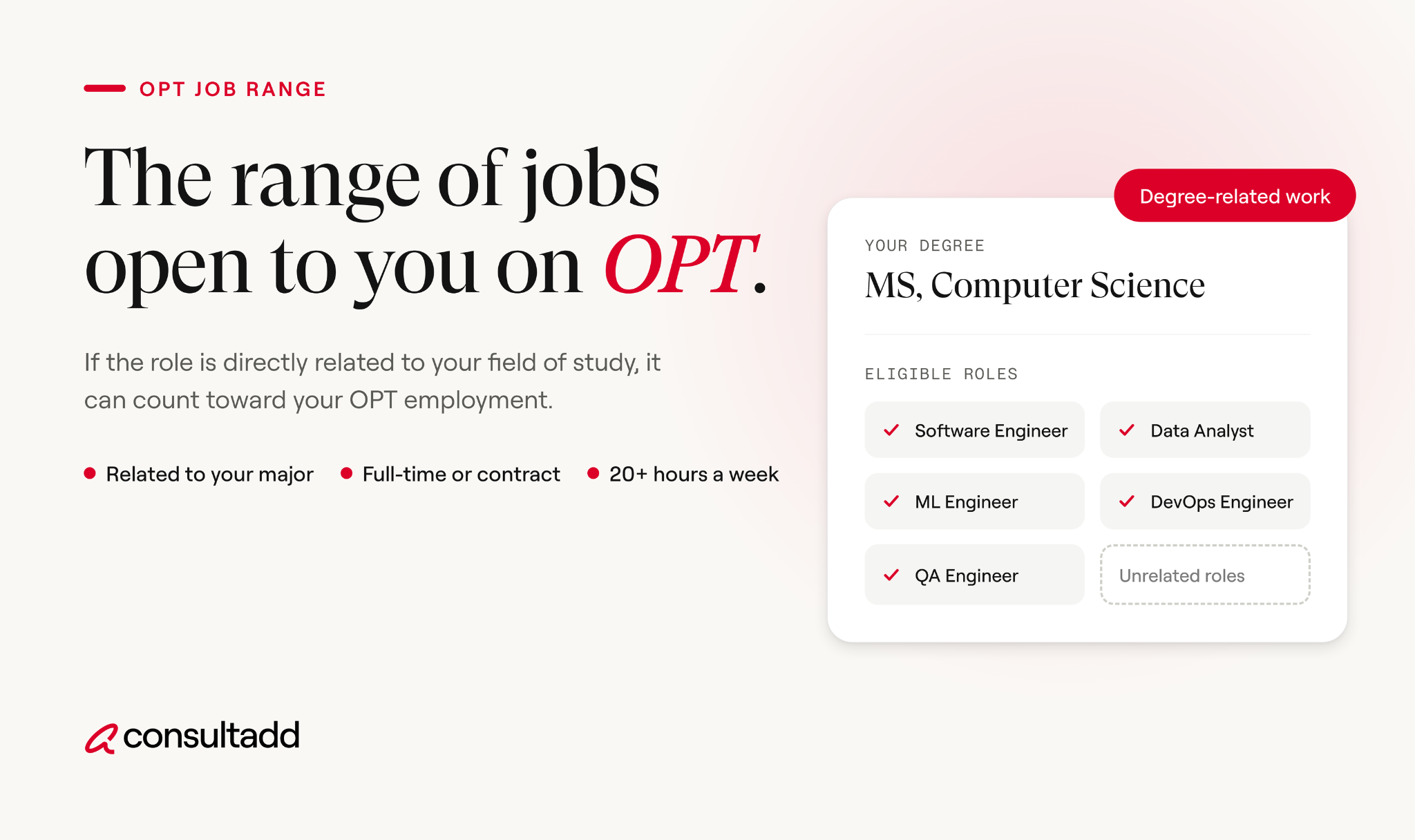
A lot of F-1 graduates think OPT means one full-time salaried job or nothing. The actual OPT job range is much wider.
You can combine part-time roles, work through an agency, take contract assignments, volunteer, or even run your own business, as long as the work is related to your degree.
This guide covers every type of employment OPT allows, how STEM OPT narrows those options, the rules on hours and unemployment days, and what OPT jobs typically pay.
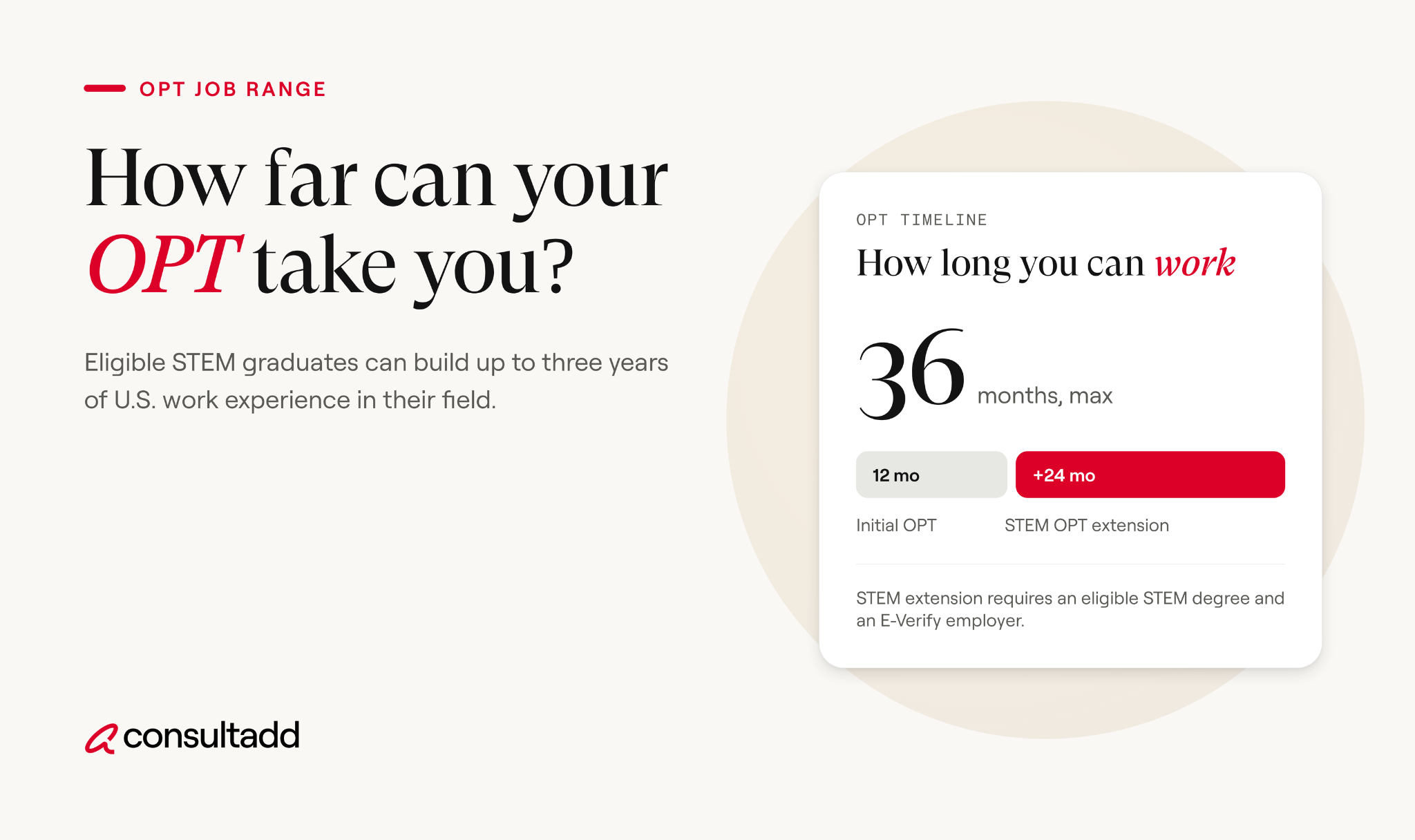
If you need the basics first, including eligibility and the 12-month and 36-month limits, start with our guide to what OPT and CPT are.
TL;DR
- Standard OPT allows paid, part-time, multiple-employer, agency, self-employed, and unpaid work, as long as it relates to your major.
- STEM OPT is stricter: the job must be paid, at least 20 hours a week, and with an E-Verify employer.
- Standard post-completion OPT allows 90 unemployment days, and STEM OPT raises the combined limit to 150.
- You're responsible for being able to explain how each job relates to your degree.
- Pay depends on your field, location, and role. Being on OPT doesn't set your salary.
What the OPT job range covers
"OPT job range" usually means one of two things:
- Job types: which kinds of employment keep you in status.
- Pay: what those jobs typically pay.
Both depend on the same rule. OPT work has to give you practical training related to what you studied. Under that rule, the student is ultimately responsible for explaining how a job relates to their major.
That flexibility helps you. Your job title doesn't have to match your degree name. What matters is that the work you do day to day connects clearly to your field.
Types of OPT employment allowed
Universities describe the allowed types consistently. They include paid employment, working for multiple employers, short-term gigs with multiple employers, being a self-employed business owner, working through an agency, and unpaid work such as volunteering or an unpaid internship.
The table shows how each type works under standard OPT and under the STEM extension.
Unpaid work must be related to your degree and at least 20 hours a week.
Part-time work: On standard OPT, a job of 20 or more hours a week in your field counts as employment, and you can combine several part-time jobs to reach that total.
STEM OPT requirements: To qualify for the extension, you must work in a job directly related to your STEM degree, for an employer enrolled in E-Verify and in good standing. The job must also be paid.
Standard OPT permits properly documented self-employment. STEM OPT does not work that way, because its E-Verify and training plan requirements rule out working through your own single-member company for most students.
The official STEM OPT Hub from the Student and Exchange Visitor Program covers the training plan (Form I-983) and employer duties.
If a recruiter asks whether you're open to C2C, our explainer on C2C vs W-2 vs 1099 explains what that means for students on OPT.
Hours and OPT unemployment days
Two rules apply to every job type in the OPT range: a minimum number of hours and a cap on unemployment days.
Minimum hours: To avoid accruing unemployment days on post-completion OPT, you must work at least 20 hours a week in a job related to your major.
Unemployment limits: On standard OPT, you can have up to 90 days of unemployment in total. Once you move to the STEM extension, the limit becomes 150 days across the full period, combining the original 12 months and the 24-month extension.
Reporting: Once your OPT start date begins, report your employment in the SEVP Portal within 10 days. If you don't report it, those days count as unemployment.
The days you don't expect can use up your limit too. Days between a job offer and your start date count, as do gaps between jobs.
For example, if your EAD becomes valid on August 1 and your job starts August 20, you've already used 19 unemployment days.
Rules on how long F-1 students can stay are also changing. Starting September 15, 2026, open-ended "duration of status" admissions are being replaced with a fixed end date capped at four years.
Our guide to the F-1 duration of status change explains how this affects OPT and STEM OPT timelines.
How to show a job is directly related to your degree
The "directly related" requirement is where most OPT problems start. Your DSO won't approve each job in advance, so keep records you can show later.
Harvard's International Office recommends documenting each role with:
- Employment letters that show your job title, duties, work location, pay rate, and hours per week.
- Proof that the job duties relate to your degree program.
Some habits that help:
- Write a two-line connection between each job and two or three specific courses or skills from your degree. Keep it with your records.
- Ask for a detailed offer letter. A letter that just says "Associate" doesn't help. "Associate, building Python data pipelines for claims analytics" does.
- Be careful with roles outside your field. A computer science graduate working as a restaurant manager is out of range, no matter how many hours they work.
These records also matter later. They help with future H-1B or green card applications, when your employment history may be reviewed closely.
Our guide to H-1B sponsorship for tech professionals explains why.
OPT pay range: what OPT jobs pay
Being on OPT doesn't set your salary. Your field, location, and role do. For that reason, published "OPT salary" figures vary widely, and none of them is a benchmark. Here are two examples.
Low end: ZipRecruiter lists the average salary for the job title "OPT Student" at about $34,464 a year. Most salaries fall between roughly $30,500 and $38,500.
This data is based on postings that use "OPT Student" as the title, which are mostly entry-level and part-time roles.
Typical range: OPTnation, a job board for OPT candidates, estimates that OPT jobs usually start at $40,000 to $70,000 a year, and STEM roles often run $60,000 to $90,000.
Four factors move your pay within that range:
Pay on STEM OPT: STEM OPT also has a wage rule. Your employer must pay you at the same level as similarly situated U.S. workers, and it confirms this on your Form I-983. An unpaid or unusually low-paid STEM role is a compliance problem, not just a weak offer.
Where to find jobs across the OPT range
International graduates usually find OPT roles through three main channels:
- University career services and job platforms: Tools like Handshake often let you filter for employers open to OPT and CPT candidates.
- Direct applications to employers: This works best at companies that have hired international graduates before.
- Tech staffing and consulting firms: Many place OPT graduates in contract or full-time roles and handle the E-Verify and training plan paperwork STEM OPT requires.
When a job application asks about work authorization and future sponsorship, answer truthfully.
Our guide on whether you're legally authorized to work in the U.S. explains how to word those answers.
One warning: never pay an employer to give you a job or to "report" employment you aren't actually doing. Fake employment arrangements can end your status and create problems for any future visa application.
Final thoughts on the OPT job range
The OPT job range is wider than most graduates realize, especially during the first 12 months. On standard OPT, part-time, agency, contract, and even unpaid work can all keep you in status while you look for a long-term role.
STEM OPT narrows those options to paid work with E-Verify employers, so plan ahead before you reach the extension. Keep track of your unemployment days, document how each job relates to your degree, and base salary decisions on your field and location rather than on your visa type.
Start Strong With Consultadd
With 15 years in business and 5,000+ successful staffing engagements, we don't just fill roles, we build reliability into your process. We've supported 65 staffing companies in the past year alone and maintain MSAs with industry leaders like Robert Half and TEKsystems.
Here's what working with Consultadd looks like:
- Talent sourced in under 24 hours
- Ready-to-deploy candidates, vetted for experience and compliance
- Lower turnover risk: we match long-term goals, not just short-term needs
- Seamless compliance: visa, documentation, onboarding? Handled.
- Dedicated 1:1 account managers for responsive, personalized support
- Top 100 candidate matches delivered in the past year
- Strong partnerships with universities to tap into fresh, committed talent
- Post-placement support so your investment grows beyond day one
For candidates, your next opportunity is more than just a job title, it's a chance to build skills, gain experience, and move your career forward. At Consultadd, we connect technology professionals with projects and employers that align with their goals, whether they're looking for contract, contract-to-hire, or long-term opportunities.
The tech job market moves fast, but the right guidance can make all the difference. Ready to take the next step in your career journey? Explore Opportunities >>
Key takeaways
- Standard OPT allows paid, part-time, multiple-employer, agency, self-employed, and unpaid work related to your major.
- STEM OPT requires paid work of at least 20 hours a week with an E-Verify employer, which rules out unpaid work and single-owner businesses.
- You get 90 unemployment days on standard OPT and 150 in total with the STEM extension. Unreported days count against you.
- Document every job's title, duties, hours, and pay, along with how it relates to your degree.
- Your field and location drive OPT pay, and STEM OPT employers must pay a comparable wage.
FAQs
What jobs can I do on OPT?
Any job that gives you practical training related to your degree. That includes full-time, part-time, contract, agency, gig, self-employed, and unpaid roles on standard OPT. STEM OPT limits this to paid roles with E-Verify employers.
Can I work part-time on OPT?
Yes. On post-completion OPT, a job of at least 20 hours a week in your field counts as employment. You can combine several part-time jobs to reach 20 hours, as long as each one relates to your degree.
Can I do unpaid work or volunteer on OPT?
On standard OPT, yes, as long as the work relates to your field and is at least 20 hours a week. Unpaid work doesn't qualify during the STEM OPT extension, which requires paid employment.
How many unemployment days are allowed on OPT?
You can have up to 90 days of unemployment during standard post-completion OPT. With the STEM extension, the combined limit is 150 days. Days between jobs, and between an offer and your start date, count toward the total.
Can I work for a staffing company on OPT?
Yes. Working through an agency is allowed on standard OPT. On STEM OPT, the employer must be enrolled in E-Verify, sign your Form I-983 training plan, and remain responsible for your training. Confirm the arrangement with your DSO before you start.
What is the average salary for OPT jobs?
There isn't one meaningful average, because pay depends on your field, role, and location. Published estimates run from the mid-$30,000s for entry-level roles to $60,000 to $90,000 or more for STEM positions. STEM OPT employers must pay you at the same level as similarly situated U.S. workers.


.webp)