

Introduction
Most people know about the H-1B. Far fewer know there are more than a dozen other types of US work visas, and that the H-1B often isn't the best fit for a given candidate.
The right visa depends on where someone is from, what they do, who's hiring them, and whether they plan to stay for good.
This guide covers the main US work visa categories, who qualifies for each, how long each one lasts, and which ones lead to a green card. It's written for hiring teams and for candidates trying to figure out their options.
TL;DR
- US work visas split into two groups: temporary (nonimmigrant) visas for a set period and immigrant visas that lead to a green card.
- The H-1B is the most common professional work visa, but it's capped at 85,000 new visas a year and decided by a wage-weighted lottery.
- Several H-1B alternatives skip the lottery entirely, including the L-1, O-1, TN, E-3 and H-1B1.
- Students on F-1 status can work through OPT for up to 12 months, or 36 months total with a STEM extension.
- Employment-based green cards fall into five categories (EB-1 to EB-5), with a combined annual limit of about 140,000.
Temporary vs permanent work visas
Every US work visa falls into one of two buckets:
- Nonimmigrant visas let someone work in the US for a limited time, usually for a specific employer.
- Immigrant visas give permanent residence, which means a green card and the freedom to work for almost anyone.
The distinction matters early in hiring. A temporary visa can often be in place within months. A green card can take years, sometimes a decade or more, depending on the category and the person's country of birth.
Most employer-sponsored temporary visas start with a Form I-129 petition filed with USCIS.
If you're new to the employer's side of this, our guide to what visa sponsorship involves and what it costs walks through the process.
One more point people mix up: a visa and work authorization aren't the same thing. A visa gets you through the border. Your status and documents determine whether you can work.
Consultadd's explainer on work authorization and EAD basics covers that difference in detail.
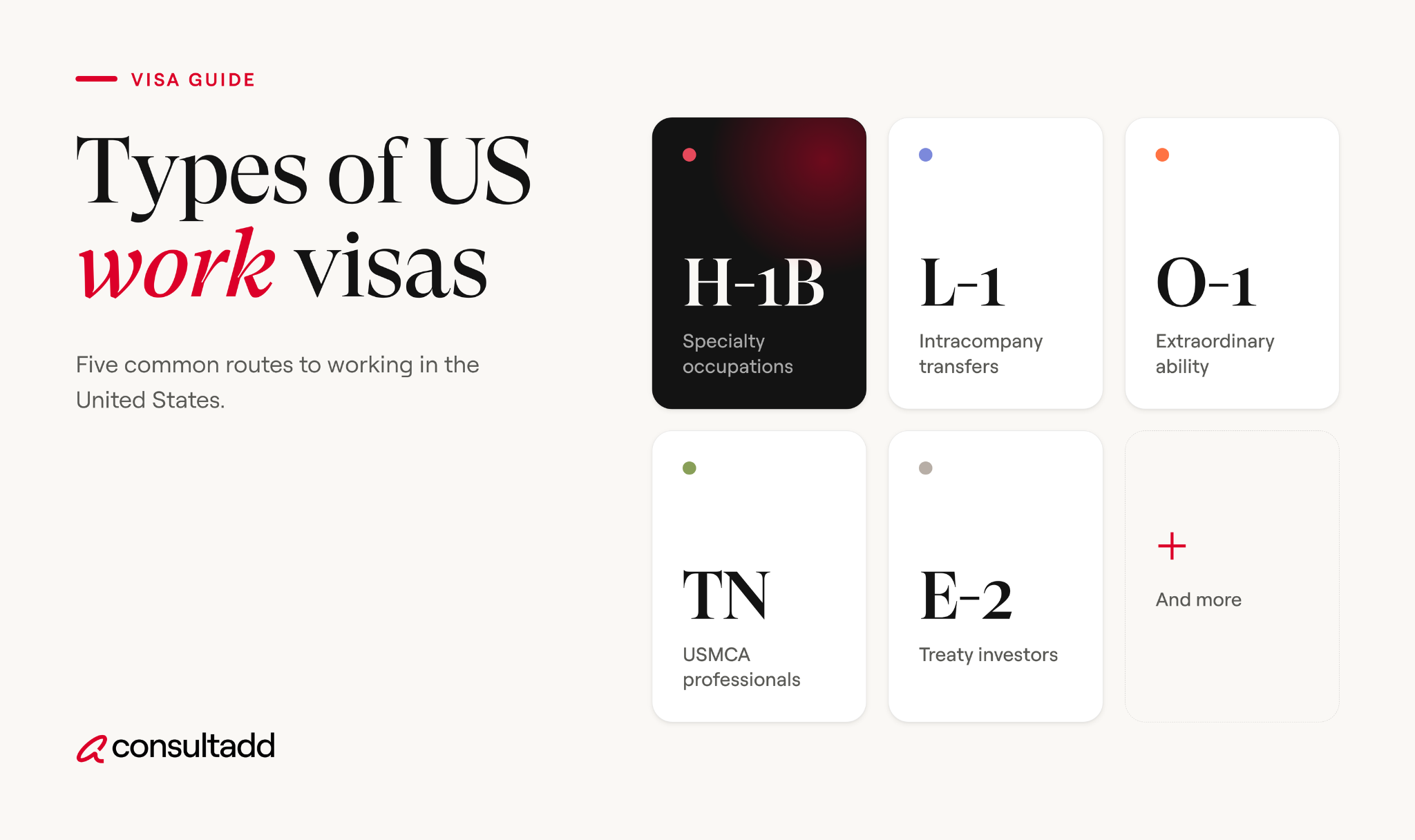
The H visa family
The H category covers the visas most people picture when they think about US work visas. It includes professional, seasonal and trainee roles.
H-1B: the specialty occupation visa
The H-1B is for jobs that require at least a bachelor's degree in a related field. Software developers, data analysts, engineers and accountants make up a large share of H-1B workers.
The annual cap is 85,000 new visas: 65,000 under the regular cap and 20,000 reserved for workers with a U.S. advanced degree. Status starts with a three-year term and can generally run up to six years.
Because H-1B is a dual intent visa, holders can pursue a green card without putting their status at risk.
Demand far exceeds supply. In the FY 2024 lottery, USCIS received 758,994 eligible registrations and selected 110,791.
Starting February 27, 2026, USCIS moved to a selection system that favors higher-paid workers, and a Level IV wage offer now gets four lottery entries compared with one entry at Level I.
Costs are also in flux. A September 2025 proclamation required an extra $100,000 payment for certain new H-1B petitions, but a federal court in Massachusetts vacated the policy implementing that fee on June 8, 2026, and the First Circuit refused to pause that ruling on July 24, 2026.
A new proclamation signed September 18, 2026 extends the fee through September 21, 2027, so employers should check the USCIS H-1B specialty occupations page before filing.
For eligibility details, see H1B visa prerequisites and who qualifies. For a plain-English overview of how the visa works day to day, read what an H1 visa is.
H-1B1: for Chile and Singapore
The H-1B1 works much like the H-1B but only for citizens of Chile and Singapore under free trade agreements.
It has its own allocation (1,400 for Chile and 5,400 for Singapore), so these candidates don't compete in the main lottery. It's renewable in one-year increments and isn't a dual intent visa.
H-2A and H-2B: seasonal and temporary labor
These cover temporary jobs that don't need a degree. The H-2A is for agricultural work and has no annual cap.
The H-2B is for non-agricultural seasonal or peak-load work, such as landscaping, hospitality and construction, and is capped at 66,000 a year.
Both require the employer to get a temporary labor certification first. The Department of Labor's H-2A program page explains that step.
H-3: trainees
The H-3 is for people coming to receive training that isn't available in their home country. It's not meant for productive employment, so it rarely comes up in IT staffing.
Nonimmigrant work visas beyond the H-1B
This is where H-1B alternatives come in. None of the visas below goes through the H-1B lottery, which is why recruiters look at them first when a candidate qualifies.
L-1: intracompany transferees
The L-1 lets a multinational company move an employee from a foreign office to a US office. The employee generally needs at least one continuous year with the company abroad in the past three years.
- L-1A covers managers and executives and can last up to seven years.
- L-1B covers employees with specialized knowledge of the company's products or processes and can last up to five years.
There's no annual cap, and the L-1 is dual intent. Spouses come in on L-2 status.
O-1: extraordinary ability
The O-1 is for people at the top of their field in science, business, education, athletics or the arts. Applicants usually need to meet at least three of eight evidence criteria, such as major awards, published work about them, judging others' work, or a high salary.
The O-1 is granted for up to three years at first and can be extended in one-year increments with no set limit, as long as the person stays eligible. In tech, it's increasingly used by senior engineers, researchers and founders who missed the H-1B lottery.
TN: Canadian and Mexican professionals
The TN visa comes from the USMCA trade agreement. Only citizens of Canada and Mexico qualify, and the job has to appear on the USMCA list of professions, which includes engineers, computer systems analysts and scientists.
There's no annual cap, and status runs in three-year periods that can be renewed. The catch: TN isn't dual intent, so showing an intention to immigrate while applying for or entering on a TN can lead to a denial.
E-3: Australian professionals
The E-3 is a specialty occupation visa for Australian citizens. It has a separate allocation of 10,500 visas a year, renews in two-year increments, and avoids the H-1B lottery.
Spouses of E-3 workers can work in the US.
E-1 and E-2: treaty traders and investors
These are for citizens of countries with qualifying treaties with the US. The E-1 covers substantial trade between the two countries.
The E-2 covers people who invest a substantial amount in a US business and come to run it. Both renew indefinitely as long as the business qualifies.
P, R and other categories
A handful of visas serve narrow groups. P visas cover athletes, entertainers and their support staff. The R-1 covers religious workers.
You'll rarely see these in corporate hiring, but they're part of the full set of US work visa categories.
Student and exchange work options
Students aren't on a work visa, but they're one of the biggest sources of early-career tech talent, so they belong in this conversation.
F-1 OPT and STEM OPT
OPT lets an F-1 student work in a job directly related to their major for up to 12 months, and students with qualifying STEM degrees can get a 24-month extension, for 36 months in total.
Initial OPT doesn't require a job offer. The STEM extension does, and the employer must be enrolled in E-Verify.
Staffing firms need to watch one rule closely. Under USCIS STEM OPT rules, the employer that signs Form I-983 can't hand its training responsibilities to a client, the client's employees, or the client's contractors.
That shapes how STEM OPT candidates can be placed on client projects.
For a side-by-side look at the two most common early-career routes, see the differences between H-1B and OPT.
J-1 exchange visitors
The J-1 covers researchers, scholars, interns and trainees in approved exchange programs. Some J-1 holders must spend two years in their home country before switching to an H-1B or green card, so check that requirement before making an offer.
Employment-based green card categories
Temporary visas solve the immediate hiring need. The employment-based green card is the long-term answer for workers who want to stay.
Congress set the annual limit of 140,000 employment-based green cards in 1990, and that number includes dependent family members.
A per-country limit means people born in India and China often wait much longer than everyone else.
Most employers file under EB-2 or EB-3, which means going through PERM labor certification with the Department of Labor first. EB-1A applicants with extraordinary ability don't need a job offer and can file the petition themselves.
Comparing the main types of US work visas
Here's how the most common professional visas stack up. Caps and durations reflect current rules, but fees and processing times change often.
USCIS keeps an official summary of work pathways for STEM professionals that's worth bookmarking if you hire in tech.
How recruiters match candidates to visa types
In staffing, visa questions come up on almost every international candidate. Experienced recruiters don't start with "do you need an H-1B?"
They start with nationality, current status and how long the candidate has before their work authorization ends.
A few scenarios show how this plays out:
- A Canadian data engineer with a computer science degree usually fits the TN. There's no lottery, approval can happen at the border, and the employer avoids most H-1B costs.
- A developer on STEM OPT with 18 months left gives the employer two H-1B lottery attempts before OPT runs out. Missing both means the team needs a backup plan, often an O-1 or a cap-exempt role.
- An engineer at a multinational's India office may qualify for an L-1B after a year with the company abroad, skipping the lottery entirely.
- A senior ML researcher with publications and conference talks may be a strong O-1 candidate, even if they've lost the H-1B lottery twice.
One practical tip: confirm status documents early. Candidates sometimes describe their status loosely, and a "work permit" can mean OPT, an H-4 EAD or a pending green card EAD. Each has different limits.
If a candidate isn't sure where they stand, our guide on whether you're legally authorized to work in the US is a good place to start.
Choosing among the types of US work visas
The types of US work visas aren't interchangeable. Nationality alone opens or closes the TN, E-3 and H-1B1. Employment history decides the L-1.
A strong record of achievement opens the O-1. Everyone else usually ends up in the H-1B lottery, with all the uncertainty that comes with it.
If you're hiring, map each candidate's options before the offer goes out, not after. If you're a candidate, know your timeline: when your current status ends, how many lottery attempts you have left, and whether a green card is part of the plan.
Rules on H-1B fees and selection have changed several times since 2025, so verify current requirements with USCIS or an immigration attorney before filing anything.
Start Strong With Consultadd
With 15 years in business and 5,000+ successful staffing engagements, we don't just fill roles, we build reliability into your process. We've supported 65 staffing companies in the past year alone and maintain MSAs with industry leaders like Robert Half and TEKsystems.
Here's what working with Consultadd looks like:
- Talent sourced in under 24 hours
- Ready-to-deploy candidates, vetted for experience and compliance
- Lower turnover risk: we match long-term goals, not just short-term needs
- Seamless compliance: visa, documentation, onboarding? Handled.
- Dedicated 1:1 account managers for responsive, personalized support
- Top 100 candidate matches delivered in the past year
- Strong partnerships with universities to tap into fresh, committed talent
- Post-placement support so your investment grows beyond day one
For candidates, your next opportunity is more than just a job title, it's a chance to build skills, gain experience, and move your career forward. At Consultadd, we connect technology professionals with projects and employers that align with their goals, whether they're looking for contract, contract-to-hire, or long-term opportunities.
The tech job market moves fast, but the right guidance can make all the difference. Ready to take the next step in your career journey? Explore Opportunities >>
Key takeaways
- US work visa categories split into temporary nonimmigrant visas and permanent employment-based green cards, and each serves a different hiring need.
- The H-1B is capped and lottery-based, and its fees and selection rules have changed repeatedly since 2025, so check USCIS before filing.
- TN, E-3, H-1B1, L-1 and O-1 visas avoid the H-1B lottery for candidates who qualify by nationality, employer history or achievement.
- STEM OPT gives graduates up to three years of work, but staffing firms must follow the rules on who provides training.
- Employment-based green cards are limited to about 140,000 a year, and most require PERM labor certification first.
FAQs
What are the main types of US work visas?
The main types are temporary work visas such as the H-1B, L-1, O-1, TN, E-3, H-2A and H-2B, and permanent employment-based green cards in the EB-1 through EB-5 categories. Students can also work through F-1 OPT. The right option depends on the person's job, nationality, qualifications and long-term plans.
Which US work visa is easiest to get?
For citizens of Canada and Mexico, the TN is usually the simplest because there's no cap or lottery and Canadians can apply at the border. Australians have a similar route through the E-3. For most other nationalities there's no truly easy option, and the H-1B depends on lottery selection.
Can I get a US work visa without a job offer?
Most US work visas require a sponsoring employer. The main exceptions are the EB-1A green card and the EB-2 National Interest Waiver, which allow self-petitioning. The O-1 can be filed through an agent, and the E-2 lets investors work in their own business.
How long can you stay in the US on a work visa?
It depends on the visa. The H-1B allows up to six years, the L-1A up to seven, and the L-1B up to five. The TN, E-3 and O-1 can be renewed repeatedly as long as the person stays eligible.
Can a work visa lead to a green card?
Yes, especially dual intent visas like the H-1B and L-1, which let holders apply for permanent residence without hurting their current status. The TN, E-3 and H-1B1 don't allow immigrant intent, so candidates on those visas often switch to an H-1B before starting a green card. Wait times depend heavily on the category and country of birth.
Can I change employers on a US work visa?
On an H-1B, you can usually move to a new employer once that employer files a new petition, a process often called an H-1B transfer. Other visas like the TN and O-1 also require the new employer to file. L-1 status is tied to one company group, so changing employers generally means switching to a different visa.